Battle for Jerusalem 70 AD

  • Welcome to Christian Forums, a Christian Forum that recognizes that all Christians are a work in progress.

    You will need to register to be able to join in fellowship with Christians all over the world.

    We hope to see you as a part of our community soon and God Bless!

dmdar

Well-Known Member
Sep 29, 2025
368
436
63
42
Middletown
Faith
Christian
Country
United States
I just found something fascinating on YouTube, it is a documentary on the battle for Jerusalem and the destruction of the 2nd temple, Jesus spoke of this and prophesied during his ministry on the earth-

“And Jesus went out from the temple, and was going on his way; and his disciples came to him to show him the buildings of the temple. But he answered and said unto them, ‘You see all of these things, do you not? Truly I say unto you, there shall not be left here one stone upon another, that shall not be thrown down’” (Matthew 24:1-2)

In this video the Roman general Titus and 60 thousand Roman troops lays siege to Jerusalem in the year 70 AD and eventually sacked the city and burns down the 2nd temple, thus fulfilling the words spoken by Jesus! This is an awesome history lesson and you can see the words of Christ come to pass, you might want to take a look at it, only 15 minutes! I would highly recommend watching the video below!

 
  • Like
Reactions: NotTheRock

Chrysostomos

Well-Known Member
Apr 5, 2025
864
309
63
Kiev
Faith
Christian
Country
Ukraine
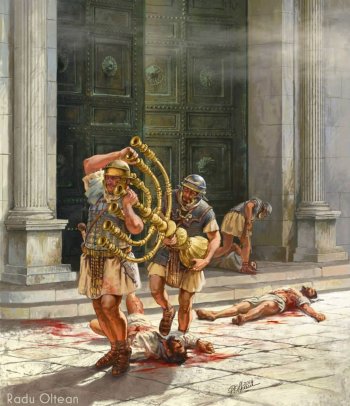
The Romans did a righteous deed when they looted, burned, and demolished the Second Jerusalem Temple.
In doing so, they fulfilled the prophecies of Jesus Christ.

43871_original.jpg
Christ foresaw that in 66 CE, the Jews would rise up against the Roman Empire. Their slogans, as always, were about the people’s happiness, but in reality, as is typical, it was so their leaders could fish in troubled waters across the Mediterranean. Christ also knew that, as a consequence of the rebellion, a Roman legion would be sent to Judea. According to the prophecy recorded in the Gospel, Christ envisioned that in the besieged Jerusalem, infighting would erupt. The Jews would partly slaughter each other and partly starve one another to death (since, during their mutual butchery, they’d also burn their food stores). It was horrific: Jewish women ate not only their neighbors’ children but even their own, as Josephus Flavius reports.

Then the Jews began secretly surrendering to the Romans, abandoning their posts at night. Hope for mercy has always been earned through one thing alone—betrayal. Judas Iscariot wasn’t the only one who knew this; so did every one of the thousands of Jews who fled Jerusalem in secret.

But mercy was nowhere to be found, which isn’t surprising: the Jewish diaspora had already shown its true colors across the Roman Empire. The Romans executed Jews using the same method their fathers and grandfathers had demanded for Christ’s death. On the rampart surrounding Jerusalem, reusable crosses were set up. Every day, about five hundred ‘corpses’ were taken down, only to be replaced by just as many groveling, smiling deserters.

It’s likely that some only realized, as they hung on the cross, that they were exact replicas of their grandfathers, effectively sentencing themselves to a tortured death. Everything comes at a price—and their grandfathers had chanted in the square before the praetorium: “Crucify Him! Crucify Him!”

Eventually, the Roman officers grew tired of this grim conveyor belt and took Jerusalem by storm, suffering almost no losses. They say blood flowed in rivers through the streets of that city, exhausted by its own abominations.

Some Jews survived the city’s fall—only to die in agony later. The men who surrendered during the assault were sent to the mines in Egypt, where they soon perished from exhaustion and beatings. After all, weren’t the Jews dragging Christ to the praetorium for a beating?

Others ended up on the sands of gladiator arenas, where, amid the crowd’s frenzied cheers, they felt the fleeting moment when a sword sliced their flesh or their own brother sank teeth into their neck, hoping to tear through the carotid artery.

As for the Jewish women who surrendered and were still bearable to look at, the Romans sent them to low-class brothels as slaves, where they quickly wore out and died—perhaps, in their final moments, recalling how their grandmothers had strutted with pride on the day of Christ’s crucifixion.
 

Chrysostomos

Well-Known Member
Apr 5, 2025
864
309
63
Kiev
Faith
Christian
Country
Ukraine
But there were some in Jerusalem who, during the siege and fall of the city, not only survived but didn’t even end up enslaved.
These few we’ve been taught to call the early Christians.
They survived because they remembered Christ’s prophecy about the signs of the city’s doom—and when they saw those signs come to pass, they bolted in time.
This prophecy is written in the Gospel.
(Luke 21:20–24)
(Matthew 24:15–21)
The “early Christians” knew this text and obeyed it—that’s why they lived, fleeing Judea, as they were told, into the mountains of neighboring Idumea.
 

Chrysostomos

Well-Known Member
Apr 5, 2025
864
309
63
Kiev
Faith
Christian
Country
Ukraine
Yes, their intentions were loving, pure, altruistic, and holy.
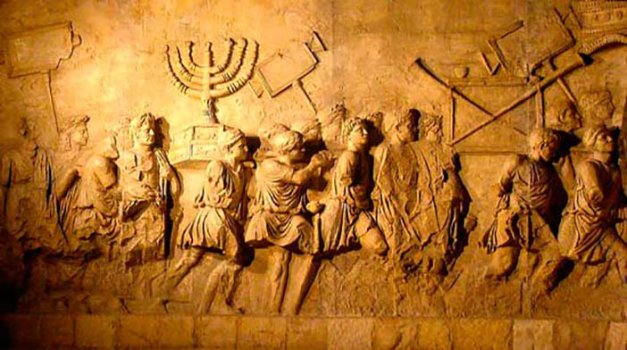
The Temple was set ablaze, despite Titus’s order to preserve it (according to Josephus Flavius, The Jewish War, Book 6). The Temple was looted, and its treasures, including the menorah, were carted off to Rome (as shown on the Arch of Titus).
53466_original.jpg
So, yeah. The soldiers carried out the will of God, even against Titus’s command.
They were doing God’s work.
 
  • Haha
Reactions: NotTheRock

Chrysostomos

Well-Known Member
Apr 5, 2025
864
309
63
Kiev
Faith
Christian
Country
Ukraine
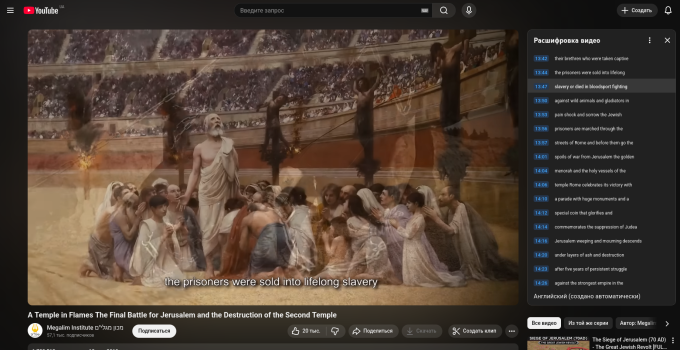
I watched the YouTube video "A Temple in Flames: The Final Battle for Jerusalem and the Destruction of the Second Temple" by Megalim Institute. At the 13:47 mark, where the narration describes Jewish prisoners being "sold into lifelong slavery or died in bloodsport fighting against wild animals and gladiators," the video shows Jean-Léon Gérôme’s painting The Christian Martyrs' Last Prayer (1863–1883).
Снимок экрана от 2025-11-11 18-51-48.png
I find this choice problematic. The painting depicts Christian martyrs facing death in a Roman arena, set in the 2nd or 3rd century CE, which is unrelated to the Jewish revolt of 70 CE described in the video. Using a Christian-themed image to illustrate the fate of Jewish captives creates a misleading conflation of two distinct historical and religious contexts. The Jewish prisoners weren’t persecuted for Christian beliefs but for rebelling against Rome.

It feels like this might have been a deliberate choice to evoke sympathy from American Christian viewers, given the video’s English narration and likely Western audience. The imagery could make Christians connect the Jewish suffering to their own martyrdom narratives, but it sacrifices historical accuracy and risks misrepresenting the events.

It’s worth asking: do you think the creators of this video were so incompetent and uneducated that they made this conflation by accident, purely out of ignorance? That seems unlikely, given that the video is produced by Megalim Institute, an organization focused on historical content, and is clearly aimed at an English-speaking audience, including American Christians. The choice of Gérôme’s painting depicting Christian martyrs is too specific to be a mere oversight. It’s more plausible that this was a deliberate decision to heighten emotional resonance for viewers familiar with Christian martyrdom imagery, even if it’s historically inaccurate.
 

Chrysostomos

Well-Known Member
Apr 5, 2025
864
309
63
Kiev
Faith
Christian
Country
Ukraine
The video states at 9–11 minutes that Titus ordered the Temple to be set on fire, but Josephus (Jewish War 6.4.3–8) says he wanted to save it, and a soldier’s stray torch caused the blaze. No solid evidence contradicts this—claims of Titus’ intent are speculative. The looting of Temple treasures (seen in the Arch of Titus) suggests he valued it intact. The video notes Josephus’ account (11:01–11:13), and as a dramatized doc, it leans on drama over nuance.
 

Chrysostomos

Well-Known Member
Apr 5, 2025
864
309
63
Kiev
Faith
Christian
Country
Ukraine
The video states at 6:39–6:44 that Titus built a "giant siege wall… seven kilometers long" in a "record time of only three days." This is a clear exaggeration.

According to Josephus (Jewish War 5.2.1–3), the circumvallation took about 20–30 days to complete, from May to June 70 CE, with 80,000 soldiers working on a 7-km wall with 13 forts.
Archaeological evidence confirms the wall’s scale but not the absurd speed.
 

Chrysostomos

Well-Known Member
Apr 5, 2025
864
309
63
Kiev
Faith
Christian
Country
Ukraine
One more inaccuracy that stood out to me: at the very end (14:23–14:31) the narrator dramatically says:

after five years of persistent struggle against the strongest empire in the world the Second Temple is destroyed.”

This is misleading. The First Jewish-Roman War did indeed last roughly from 66 to 73/74 CE (7–8 years total), but the actual siege and fall of Jerusalem — the events the whole video is about — lasted only about five months, from 14 April to 8 September 70 CE. The Temple itself was destroyed on 9–10 Av (late August 70 CE).

By saying “after five years… the Second Temple is destroyed” right after showing the siege and the burning of the Temple, the video strongly implies that the siege itself lasted five years, which is simply not true. It’s a classic case of compressing the entire war into the final dramatic act for emotional impact. I get that it sounds more epic, but for anyone who isn’t already familiar with the timeline it creates a completely wrong picture.