

Understanding Genesis 18:1-22:24

  • Welcome to Christian Forums, a Christian Forum that recognizes that all Christians are a work in progress.

    You will need to register to be able to join in fellowship with Christians all over the world.

    We hope to see you as a part of our community soon and God Bless!

Ben Abraham

Well-Known Member
Dec 13, 2020
742
293
63
72
Houston
Faith
Christian
Country
United States
Gender
Male
“VaYERA” (and he appeared) GENESIS 18:1-22:24


YHVH appears to Abraham at his tent, yet it also says that “three” men appeared to him. He addresses them as LORD (YHVH), how is that? One can only wonder. Could one of them be YHVH incarnate and the other two ministering angels? We might see a representation of ELOHIM “Av” (father), “Ben” (son), and “Ruach HaKodesh” (Holy Spirit)? This could lead to a lengthy discussion. All we know is that Abraham receives them with great hospitality. They eat and then they bless. This is pretty much how it works even today. We receive blessings from HaShem, but many times, we bless others, help others, and blessings follow.

Abram addresses the "men” (Shelosh anashim) as “Adonai”. In one Hebrew-English translation, the word “lords’ is used, yet in another, the word “Lord” is used. But in both translations, the word “Adonai” is used, which is “Master,” and it is one of the names of G-d. The “men” are indeed God, walking and talking with Abram.

Abraham shows hospitality to these “men” in that he prepares for them 4 items of food: water, bread, milk, and meat.” It is a great mitzvah to show love and hospitality to others who are outside of your family. Blessed are the foster parents and those parents who adopt unwanted children from other homes and bring them into their own homes as their “adopted children,” just as Adonai has adopted “all believers” into HIS family through our faith in Yeshua. In that way, ALL believers are “B’nei Elohim” (sons of God)

Adonai repays Abraham’s kindness to those “three men”. Not only does He grant Abraham and Sarah a son, “Yitzchak,” but generations down the line, He provides “water” in the desert through the “ROCK” that was split, He provides “Bread” (manna) in the desert, and of course, the cattle of the Israelites produced “milk and meat”. On another level, we see “Yeshua” in all of these. Yeshua is the “Living Water,” the “Bread of Life,” and the Torah is our “Milk and meat”. I guess we can say that all believers start by digesting the “milk’ of the Word, the easy stuff to understand, and when we mature, we can digest the “meat,” the more difficult stuff to understand.

Can we bless “Adonai?” We know that He blesses us in many ways and forms, but how do we “Bless” YHVH? “Baruch” (bless) comes from the word “Berek”, which means “knee”. When we “bow” the knee in praise and worship, we are, in fact, “blessing” Adonai. We come to pray, asking for “this and that,” but do we just come and thank HIM for just who He is?

He announces the birth of “Yitzchak,” yet Sarah laughs in disbelief, “within herself” not even out loud, or, just barely audible, yet YHVH hears her and asks, “Why did Sarah laugh? Yeah, but thou didst laugh.” Can anything be hidden from the LORD? Even inside us, HE KNOWS what is going on inside us, within the heart, within our minds, HE KNOWS ALL THINGS, even the “not so kosher” things. Something to think about the next time we think we are alone. We really are NOT alone.

Abraham intercedes for Sodom and Gomorrah, yet there were not even ten righteous residents of Sodom. Had Abraham asked, “Will you not spare Sodom for only ONE righteous person?” what do you think that the LORD would have answered? Maybe YES? If that had been so, then perhaps Lot and his family might have never left the city! Lot was still considered a “Tzadik,” a righteous person, yet he was living in a sinful and totally corrupt city. That is a dangerous position to be in, to be comfortable in a place where you have no business to be in! or participate in activities that the Lost World does. “By the skin of their teeth,” one might say, the angel drags Lot, his wife, and two daughters out of there before the judgment of destruction begins.

However, we can think back to when the scripture says that “Lot pitched his tent toward Sodom”. He wasn’t there yet; he was close, but then, he was INSIDE Sodom. He even bought a house, perhaps even started a business. We read that he was “at the gates of Sodom” when he invited the angels to come spend the night with him and his family. Those who were at the “gates” of the city were “greeters’ sort of saying, perhaps, “city officials and judges.” Maybe Lot was involved with politics. We can only guess; The Torah doesn’t go into detail about Lot’s life inside Sodom.

We know that before, he had many cattle. What happened to his cattle? Did he sell the cattle to buy the house? What happened to his tents? Traded it all for a life of “excitement?” inside the city? We must say that when families move to places or into corrupt neighborhoods, one might expect that the families also can suffer under corruption.

It isn’t easy to maintain one’s testimony in a pagan society or workplace, but it isn’t impossible. Lot was considered “righteous” in the New Covenant, yet his family suffered. When the angels led Lot and his family (wife and two daughters) out of the city, they were told not to “look back,” yet we remember that Lot’s wife DID look, and behold, she became a pillar of salt. She longed for her lifestyle in corrupt Sodom.

On the other hand, Lot’s daughters had sex with him and produced two sons: Moab and Ammon. The capital city, Amman, in Jordan, is named after “Ammon,” and the Moabites were also a corrupt, idol-worshiping people. But God has his hand in ALL situations. Remember that “Ruth” was a Moabitess, yet she became a “Y’hudit” and became part of God’s people, and Ruth is in the genealogy of Messiah Yeshua. Adonai can make a negative situation or decision and do something with it, something wonderful.
 

Ben Abraham

Well-Known Member
Dec 13, 2020
742
293
63
72
Houston
Faith
Christian
Country
United States
Gender
Male
One thing we remember from Parashah “Noach”, the Torah says that “Noah was righteous in HIS generation.” Does that mean that if he were living in the time of Abraham, he might not have been considered so righteous? If yes, why? Did Noah plead for the lost world before the flood? Did he ask YHVH to save the world IF there could be found a handful of righteous people? We know what transpired during the years that it took Noach to build the ark. He was a preacher and warned the people of judgment. No one responded

In the book of Enoch, we know that Enoch warned the giants of impending judgment. In Noah’s case, the Torah is silent. We do see that Abraham pleads for the innocent people in Sodom. We know that there were probably infants and very young kids who were innocent. Sad to say that they, too, were destroyed; however, they are in heaven today because they died as innocent creations.

The command of the angel to Lot and his family was “don’t look back,” yet Lot’s wife DID look back and was turned into a pillar of salt. Does it really matter what YHVH turned her into? Might as well have been a loaf of bread, a donut, a fudge brownie, a…that fact of the matter is that she DID turn and look back. This is meaningful, indicating that she “longed” for that life of Sodom. She might have thought, “I’ll take one last look and…ZAP…instant saltine cracker. Perhaps she gazed on the very “essence” of YHVH in destruction mode.

We also read about the birth of “Yitzchak” and later the separation of “Ishmael” and “Yitzchak”. We see a separation between the “chosen” and the “world”, but also, we see today the “wheat” and the “tares” growing together, not to say that all the Arabs are evil, there are many born-again Arabs who are the descendants of Ishmael, those who love the LORD. But for the most part, the Arab world and Israel are enemies.

We come to the last part, the final test, “Take your son, your ONLY son who you love, and offer him as a sacrifice” Now God didn’t say “Sacrifice him” only “offer him as a sacrifice” Today, we offer ourselves as “living sacrifices” before YHVH to do his perfect will, and to serve him. Abraham was willing to bring the knife down on his only son Isaac, yet the LORD did not allow him to do so, as it was a test to see his obedience, and to see if he was willing to follow through with “sacrificing and spilling Isaac’s blood”.

When we read this account, we see symbolism. The “donkey” that took Father and Son to Mt Moriah, the donkey that took Yeshua to Jerusalem, later to be led to Mt. Calvary. The wood that was laid on Isaac’s back, compared to the cross beam that was laid on Yeshua’s back, or Yeshua’s back that was laid on that cross beam. The altar of stone, which Abraham built, compared to Calvary’s hill, which is pretty much made of stone, made by our heavenly Father. The fire that was in Abraham’s hands could symbolize the fiery judgment that Yeshua took on our behalf.

Isaac symbolizes ALL of us. Yet when Abraham was ordered to take him off the altar, so we were “replaced” by Yeshua. Isaac was replaced by the ram, which was caught in the thicket. The “ram” is “Yeshua”; the ram’s horns were caught in the thicket, and around the head of our Mashiach was a crown of thorns.

Isaac could not be the sacrifice for sin because he, like all of us, was born in sin. The ram took Isaac’s place as Yeshua took our place. In some translations, there are some interesting words spoken by Abraham. “God will provide himself as a lamb,” other translations read; “God will provide for himself a lamb.” I like the first one since it explains what God did: He came down and became the sacrifice lamb, in our place. What Abraham said was prophetic

God was not willing that anyone should perish, but for ALL to have eternal life. He was not willing that Abraham should give up his only son, but God was willing to give HIS unique SON, Yeshua, for the payment of our sin, once and forever. Yeshua is both “echad” (unity of ONE) and “Yachid” (unique, only, one of a kind)

Yeshua was willing and did undergo suffering for our sins, up there on that cross for a few hours, and thus made the “new covenant” that through his death and sacrifice, we might be saved. That is why the "New Covenant" based on the blood of Yeshua is better than the old, based on the blood of kosher animals. HIS sacrifice was made ONCE only, for all time. Receive HIM as LORD and Savior (if you haven't already), don't die in your sins.


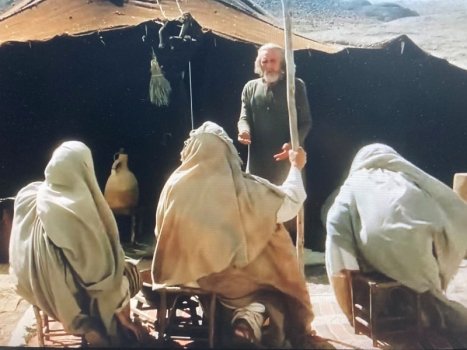
Abram receives his heavenly visitors

Abraham.jpg
 

Davy

Well-Known Member
Feb 11, 2018
15,973
3,379
113
Southeastern U.S.
Faith
Christian
Country
United States
Gender
Male
Yep. I definitely believe one of the "three men" was Lord Jesus Christ back in The Old Testament time. At the end of John 8 Jesus mentioned that Abraham saw His day and was glad. So I interpret that to mean that Abraham met Christ back in that time.
 
  • Like
Reactions: GodsGrace

GodsGrace

Well-Known Member
Aug 29, 2017
17,514
8,609
113
Tuscany
Faith
Christian
Country
Italy
Gender
Female
“VaYERA” (and he appeared) GENESIS 18:1-22:24


YHVH appears to Abraham at his tent, yet it also says that “three” men appeared to him. He addresses them as LORD (YHVH), how is that? One can only wonder. Could one of them be YHVH incarnate and the other two ministering angels? We might see a representation of ELOHIM “Av” (father), “Ben” (son), and “Ruach HaKodesh” (Holy Spirit)? This could lead to a lengthy discussion. All we know is that Abraham receives them with great hospitality. They eat and then they bless. This is pretty much how it works even today. We receive blessings from HaShem, but many times, we bless others, help others, and blessings follow.

Abram addresses the "men” (Shelosh anashim) as “Adonai”. In one Hebrew-English translation, the word “lords’ is used, yet in another, the word “Lord” is used. But in both translations, the word “Adonai” is used, which is “Master,” and it is one of the names of G-d. The “men” are indeed God, walking and talking with Abram.
You sure do write a lot Ben Abraham!
I just would like to mention that no one has ever seen God...I understand this to mean God Father.
I'd say that it was Jesus that appeared in the OT.

What do you think of :

Hebrews 11:25-26
25 choosing rather to endure ill-treatment with the people of God than to enjoy the passing pleasures of sin,
26 considering the reproach of Christ greater riches than the treasures of Egypt; for he was looking to the reward.


It seems as though the writer of Hebrews is stating that Moses thought of Christ in some way.
(which would put Jesus at the scene, per the writer of Hebrews).
Abraham shows hospitality to these “men” in that he prepares for them 4 items of food: water, bread, milk, and meat.” It is a great mitzvah to show love and hospitality to others who are outside of your family. Blessed are the foster parents and those parents who adopt unwanted children from other homes and bring them into their own homes as their “adopted children,” just as Adonai has adopted “all believers” into HIS family through our faith in Yeshua. In that way, ALL believers are “B’nei Elohim” (sons of God)

Adonai repays Abraham’s kindness to those “three men”. Not only does He grant Abraham and Sarah a son, “Yitzchak,” but generations down the line, He provides “water” in the desert through the “ROCK” that was split, He provides “Bread” (manna) in the desert, and of course, the cattle of the Israelites produced “milk and meat”. On another level, we see “Yeshua” in all of these. Yeshua is the “Living Water,” the “Bread of Life,” and the Torah is our “Milk and meat”. I guess we can say that all believers start by digesting the “milk’ of the Word, the easy stuff to understand, and when we mature, we can digest the “meat,” the more difficult stuff to understand.

Can we bless “Adonai?” We know that He blesses us in many ways and forms, but how do we “Bless” YHVH? “Baruch” (bless) comes from the word “Berek”, which means “knee”. When we “bow” the knee in praise and worship, we are, in fact, “blessing” Adonai. We come to pray, asking for “this and that,” but do we just come and thank HIM for just who He is?

He announces the birth of “Yitzchak,” yet Sarah laughs in disbelief, “within herself” not even out loud, or, just barely audible, yet YHVH hears her and asks, “Why did Sarah laugh? Yeah, but thou didst laugh.” Can anything be hidden from the LORD? Even inside us, HE KNOWS what is going on inside us, within the heart, within our minds, HE KNOWS ALL THINGS, even the “not so kosher” things. Something to think about the next time we think we are alone. We really are NOT alone.

Abraham intercedes for Sodom and Gomorrah, yet there were not even ten righteous residents of Sodom. Had Abraham asked, “Will you not spare Sodom for only ONE righteous person?” what do you think that the LORD would have answered? Maybe YES? If that had been so, then perhaps Lot and his family might have never left the city! Lot was still considered a “Tzadik,” a righteous person, yet he was living in a sinful and totally corrupt city. That is a dangerous position to be in, to be comfortable in a place where you have no business to be in! or participate in activities that the Lost World does. “By the skin of their teeth,” one might say, the angel drags Lot, his wife, and two daughters out of there before the judgment of destruction begins.

However, we can think back to when the scripture says that “Lot pitched his tent toward Sodom”. He wasn’t there yet; he was close, but then, he was INSIDE Sodom. He even bought a house, perhaps even started a business. We read that he was “at the gates of Sodom” when he invited the angels to come spend the night with him and his family. Those who were at the “gates” of the city were “greeters’ sort of saying, perhaps, “city officials and judges.” Maybe Lot was involved with politics. We can only guess; The Torah doesn’t go into detail about Lot’s life inside Sodom.

We know that before, he had many cattle. What happened to his cattle? Did he sell the cattle to buy the house? What happened to his tents? Traded it all for a life of “excitement?” inside the city? We must say that when families move to places or into corrupt neighborhoods, one might expect that the families also can suffer under corruption.

It isn’t easy to maintain one’s testimony in a pagan society or workplace, but it isn’t impossible. Lot was considered “righteous” in the New Covenant, yet his family suffered. When the angels led Lot and his family (wife and two daughters) out of the city, they were told not to “look back,” yet we remember that Lot’s wife DID look, and behold, she became a pillar of salt. She longed for her lifestyle in corrupt Sodom.

On the other hand, Lot’s daughters had sex with him and produced two sons: Moab and Ammon. The capital city, Amman, in Jordan, is named after “Ammon,” and the Moabites were also a corrupt, idol-worshiping people. But God has his hand in ALL situations. Remember that “Ruth” was a Moabitess, yet she became a “Y’hudit” and became part of God’s people, and Ruth is in the genealogy of Messiah Yeshua. Adonai can make a negative situation or decision and do something with it, something wonderful.
 

Ben Abraham

Well-Known Member
Dec 13, 2020
742
293
63
72
Houston
Faith
Christian
Country
United States
Gender
Male
Thank you for your comments and reading support. Messiah Yeshua in the Old Testament, Yes, a possibility
 

CTK

Well-Known Member
Aug 13, 2024
1,515
315
83
72
Albuquerque
Faith
Christian
Country
United States
For what it is worth... here is a partial cut / paste from my commentary on Daniel ..

Talking about the Trinity has always been difficult. For two thousand years Christians have tried to speak faithfully about the one God who has made Himself known as Father, Son, and Holy Spirit (ruach). Israel was right to guard against any thought of multiple gods, for there is only one true God—the God of Abraham, Isaac, and Jacob. Yet from the very beginning, that one God has chosen to reveal Himself in three distinct ways. This is not a Christian invention. It is the story Scripture itself tells: before Sinai, at Sinai, and after Sinai with the coming of the Messiah.

Before Sinai: Three Revelations Already Given

Long before Moses stood on the mountain, God was already making Himself known in three inseparable ways.

The Father, unseen.

The God of Abraham called His people out of idolatry, demanding their undivided allegiance (Gen 12:1–3; Exod 12:12). He revealed Himself as El Shaddai—God Almighty (Gen 17:1). Yet He warned, “You cannot see My face, for man shall not see Me and live” (Exod 33:20). The Father is the unseen source of all, the one true God who alone is worthy of worship.​


The Spirit (ruach), drawing near.

From the beginning, God’s Spirit (ruach) was active: hovering over the waters at creation (Gen 1:2), breathing life into Adam (Gen 2:7), filling Joseph with wisdom (Gen 41:38), leading Israel as a pillar of cloud and fire (Exod 13:21–22). Moses’ first encounter at the burning bush was a voice from fire, not an image (Exod 3:2–6). Israel later heard, “You heard a voice but saw no form” (Deut 4:12). The Spirit (ruach)was God’s chosen way of being present with His people, without image or idol.​


The Son, foreshadowed in visible form.

Even before the incarnation, God sometimes appeared in human likeness, pointing ahead to Christ, the true Image of God. The Angel of the LORD spoke with God’s own authority, and Hagar declared, “You are the God who sees me” (Gen 16:13; cf. Exod 3:2–6).​
“The LORD appeared to him by the oaks of Mamre… He lifted up his eyes and looked, and behold, three men stood over against him.” The narrative keeps calling one of these visitors “the LORD” (vv.13, 17), and when the other two leave for Sodom (later called angels in Gen 19:1), Abraham still stands before the LORD (v.22). God appearing in human form.​
Jacob wrestled with a “man” and said, “I have seen God face to face” (Gen 32:30).​
Joshua met the Commander of the LORD’s army and bowed on holy ground (Josh 5:13–15).​
Nebuchadnezzar saw a fourth man in the furnace “like a son of the gods” (Dan 3:25).​
These were not idols fashioned by human hands, but living revelations given by God Himself—anticipations of the day when His Son would come as the perfect Image, showing the Father fully (John 14:9).​


At Sinai: The Pattern Inscribed in the Commandments

When God gave His commandments, He could have given Moses one long sentence: “Worship Me alone, make no images, do not take My Name in vain.” Instead, He divided them into three separate words (Exod 20:3–7). Why? Because He was revealing the same three ways He had already drawn near, and would draw near again.

First Word — Who we worship (the Father).

“You shall have no other gods before Me” (Exod 20:3). The Father claims undivided loyalty: “Hear, O Israel, the LORD is one” (Deut 6:4–5). He is the God and Father of His people (Deut 32:6; Isa 63:16).​

Second Word — How we approach (the Spirit / ruach).

“You shall not make for yourself a carved image” (Exod 20:4). Israel heard a voice but saw no form (Deut 4:12). God comes near on His own terms—by His Spirit (ruach) who fills, guides, convicts, and indwells. The command protects His chosen way of presence (kavod/shekinah) from our attempts to control Him with man-made substitutes.​

Third Word — How we bear His Name (the Son).

“You shall not take the Name of the LORD your God in vain” (Exod 20:7). God was preparing His people for the true Image who would come bearing His Name. He spoke of His Messenger with “My Name in him” (Exod 23:20–21), promised a child called Mighty God (Isa 9:6), and revealed the Son of Man who would receive everlasting dominion (Dan 7:13–14). The command teaches His people to carry His Name truthfully, not emptily—fulfilled perfectly in the Son, who shows the Father and transforms us into His image.​


After Sinai: The Messiah and the Full Revelation

In the fullness of time, the same three ways became complete in Christ and His sending of the Spirit (ruach).

The Father sent His Son, and Jesus taught us to pray, “Our Father in heaven” (Matt 6:9). The one true God was revealed as Father of all who believe.​
The Son came as the perfect Image: “Whoever has seen Me has seen the Father” (John 14:9). In Him the invisible God became visible without destroying us, because He came in human flesh to redeem.​
The Spirit (ruach) was poured out to indwell believers (Acts 2:1–4), convict of sin, guide into truth, and seal God’s people as His own (John 16:13–14; Eph 1:13–14).​

Thus the pattern was not broken but fulfilled: the same God who revealed Himself before Sinai, and inscribed His revelation at Sinai, now reveals Himself fully in Christ and the Spirit (ruach) poured out.


The Wisdom of Order

The sequence of the first three commandments is deliberate.

At Sinai (before the Messiah):

Allegiance to the Father (first).​
Nearness by the Spirit (ruach), not images (second).​
Bearing the Name, foreshadowing the Son (third).​

Here the Spirit’s (ruach) place before the visible Image guarded Israel against filling the gap with idols. God withheld the true Image until the appointed time.


In the Messiah (after the cross):

The Father still claims allegiance.​
The Son now comes first in visible glory, showing us the Father perfectly.​
Only then does the Spirit (ruach) indwell believers, empowering them to bear the Name.​

The shift is purposeful: once Christ came, the danger of counterfeit images was ended, because the true Image was now revealed. Idolatry is silenced by fulfillment, not just prohibition.


One God, Not Three

This is not a new invention, nor a plurality of gods. From Eden onward, the one true God has revealed Himself in three personal ways:

The Father, who cannot be seen directly.​
The Spirit (ruach) who draws near without form.​
The Son, who shows us the Father perfectly.​

The first three commandments were never meant to be just the first three “thou shalt nots.” They are God’s own explanation of how He would draw near to us, reveal His true Image, and make us bearers of His Name.

And so, whether Jew or Gentile, we are not asked to invent clever illustrations of the Trinity or to reduce the mystery of God into a triangle, a chord, or three candles burning as one. Nor are we asked to solve the puzzle of “three Gods in one.” God Himself has already given us His definition—clear, sufficient, and living—in His first three commandments.

They are not arbitrary prohibitions, but revelations of how the one true God draws near: the Father who claims us, the Spirit (ruach) who indwells us, and the Son who shows us the Father perfectly. Look no further. In these three words, God has already told us who He is and how He will be known.