

THE FAKE KJV ONLY ARGUMENT
- Thread starter Davy
- Start date
-
Welcome to Christian Forums, a Christian Forum that recognizes that all Christians are a work in progress.
You will need to register to be able to join in fellowship with Christians all over the world.
We hope to see you as a part of our community soon and God Bless!
You are using an out of date browser. It may not display this or other websites correctly.
You should upgrade or use an alternative browser.
You should upgrade or use an alternative browser.

You seem to have a particular focus on "trashing" the KJV. What would you call it? Is there any other translation that you hate as much?Yea, how many other threads are there pushing any other translation? When you look at it objectively, you realize the KJVO crowd deserve their condemnations.
Let me put it this way. IF KJV were merely preference for you, you would not retort than other have this made up derangement syndrome. Do you do that with all things in life or only your fanatical devotion to translation IDOLATRY?
Much love!

Wrangler
Well-Known Member
- Feb 14, 2021
- 22,011
- 9,650
- 113
- 58
- Faith
- Christian
- Country
- United States
- Gender
- Male
It's non-sequitor if you are assuming something that is patently false, that the "older are better".
LOL. The science of document integrity and authority is well established. Only KJV IDOLATORS suppose writing closer to an even is likely to be less accurate, 2nd hand witnesses (here say)more reliable than 1st hand witnesses.
No reason to suppose motive.Do you suppose God was hiding His real Word all that time?

- Dec 31, 2010
- 6,707
- 3,552
- 113
- Faith
- Christian
- Country
- United States
- Gender
- Male
All I have read is the KJV. No regrets! I must admit, though, that the Strongs Hebrew and Greek are handy additions.


Grailhunter
Well-Known Member
BRETHREN IN CHRIST:
This matter is very simple. It is about a false attack upon the 1611 King James Bible, and in particular against the Greek Textus Receptus (Received Text) that was used for the New Testament, and came from the Traditional Greek texts, or Majority texts, which make up the majority of Greek New Testament manuscripts. A lot of these manuscripts are from Antioch, where those in Christ were first called Christians (Acts 11:26).
The New King James Version Bible is still 'different'... than the original 1611 KJV in the New Testament. Influence of the scholars of Textual Criticism just couldn't stand leaving it alone, as the Preface of the NKJV reveals it contains additional... readings from 'different'... Greek texts which the 1611 KJV translators did not use.
The following is from the Preface of the New King James Version Bible, as presented at blueletterbible.org.
The King James New Testament was based on the traditional text of the Greek-speaking churches, first published in 1516, and later called the Textus Receptus or Received Text. Although based on the relatively few available manuscripts, these were representative of many more which existed at the time but only became known later. In the late nineteenth century, B. Westcott and F. Hort taught that this text had been officially edited by the fourth-century church, but a total lack of historical evidence for this event has forced a revision of the theory. It is now widely held that the Byzantine Text that largely supports the Textus Receptus has as much right as the Alexandrian or any other tradition to be weighed in determining the text of the New Testament.Since the 1880s most contemporary translations of the New Testament have relied upon a relatively few manuscripts discovered chiefly in the late nineteenth and early twentieth centuries. Such translations depend primarily on two manuscripts, Codex Vaticanus and Codex Sinaiticus, because of their greater age. The Greek text obtained by using these sources and the related papyri (our most ancient manuscripts) is known as the Alexandrian Text. However, some scholars have grounds for doubting the faithfulness of Vaticanus and Sinaiticus, since they often disagree with one another, and Sinaiticus exhibits excessive omission.
Wescott and Hort in 1881 released their Greek New Testament revision for the revision committee of English scholars, handing each scholar in secret a copy of their personal Greek revision. 19th century British Bible scholar Dean John W. Burgon studied Wescott and Hort's revision and balked at their revised text, claiming they had actually created a 'new'... Greek NT text.
This revision committee came about as a result of the discovery of the Codex Sinaiticus in 1859 by Tischendorf. In that same era the Vatican's Greek Bible based on Codex Vaticanus, was published.
The NKJV Preface goes on to explain about new Footnotes it contains, revealing the Greek texts used in the translation for the NKJV New Testament...
"Where significant variations occur in the New Testament Greek manuscripts, textual notes are classified as follows:
- NU-Text — There variations from the traditional text generally represent the Alexandrian or Egyptian type of text described previously in "The New Testament Text." They are found in the Critical Text published in the twenty-sixth edition of the Nestle-Aland Greek New Testament (N) and in the United Bible Societies’ third edition (U), hence the acronym, "NU-Text."
- M-Text — This symbol indicates points of variation in the Majority Text from the traditional text, as also previously discussed in "The New Testament Text." It should be noted that M stands for whatever reading is printed in the published Greek New Testament According to the Majority Text, whether supported by overwhelming, strong, or only a divided majority textual tradition."
Do you see that NU-Text symbol above? That is the Critical Text by Nestle-Aland from the United Bible Societies. It is a Greek text taken from Codex Vaticanus and Codex Sinaticus, and Codex Alexandrinus. These were the very same Greek NT texts which Wescott and Hort used for their Greek NT revision of 1881. So basically, the NKJV Bible is NOW using those later discovered corrupt... Greek texts which many Bible scholars have shown doubt about. The New King James Version Bible was released in 1982.
What caused me to look into this matter many years ago was when I was invited to do a Bible study at some friend's house, and they were using the NKJV Bible while I was using and reading the 1611 KJV Bible. When I was baptized in the early 1990's, I was handed a NKJV Bible by my pastor, but I never bothered to check it out, as I stayed in the 1611 KJV. During the Bible study, when I would read a passage from the KJV New Testament, my friend using a NKJV would make sounds of disgust, and I asked him what the matter was. He said his NKJV Bible does not read anything like what I was reading from the 1611 KJV.
That is when I began to look into the NKJV Bible more, and discovered ADDITIONAL READINGS had been ADDED to the KJV in that NKJV. I see their putting Footnotes in the NKJV to account for their ADDITIONS as their attempt to belay assigning guilt for their having revised... the 1611 KJV which did NOT come from the Codex Vaticanus, nor Codex Sinaiticus, nor Codex Alexandrinus. The 1611 KJV New Testament Greek text was translated from the Textus Receptus taken from the Majority Texts, or Traditional Texts, even as the Preface above states.
What that toying with the 1611 KJV by those of Textual Criticism suggests is that their later modern Bible translations, or revisions, just weren't working well enough, as too many Christians were still using the 1611 KJV Bible instead. So they decided to use a direct attack upon the 1611 KJV with a 'modified' New King James Version that contains readings like their later modern New Testament translations, thus adding corruption to the original KJV New Testament.
The KJV is not only inaccurate it has modified the scriptures through the translational process to produce an alternative Christianity. Nearly all the modern false beliefs originate from the KJV.
Wrangler
Well-Known Member
- Feb 14, 2021
- 22,011
- 9,650
- 113
- 58
- Faith
- Christian
- Country
- United States
- Gender
- Male
Advocates remind me of this guy.The KJV is not only inaccurate it has modified the scriptures through the translational process to produce an alternative Christianity. Nearly all the modern false beliefs originate from the KJV.
Timing has nothing to do with it, other than the fact that as I said, they were not available for over 1000 years.LOL. The science of document integrity and authority is well established. Only KJV IDOLATORS suppose writing closer to an even is likely to be less accurate, 2nd hand witnesses (here say)more reliable than 1st hand witnesses.
No reason to suppose motive.
God promised to preserve His word for all generations, and I believe that.
The real issue is their blatant disagreement with each other.
If you want to reply with ad hominem to me, I can only say, I'm not surprised.
When you have 25000 witnesses that say the man's shirt was blue, and you have one that says it was green, and two that say it was red . . . what color do you suppose the man's shirt was?
Idolator. Right. What a crock!
Why is it that this topic causes some to become so insulting? Better question . . . why do some feel the need to be insulting, regardless of the "provocation"?
Wrangler
Well-Known Member
- Feb 14, 2021
- 22,011
- 9,650
- 113
- 58
- Faith
- Christian
- Country
- United States
- Gender
- Male
That’s what literary experts say. KJVism goes against science.Timing has nothing to do with it
No, the fact that some are older isn't my deciding factor, how ever much you desire to impugn my POV.That’s what literary experts say. KJVism goes against science.
Well, the age of the mss and the fact that they were buried in the sands of time . . . forget about your science so called, prioritizing those mss makes God false, because they were not available, while God, again, promised to preserve His Word to all generations. He didn't leave the world without a correct Bible for all those centuries.
Having studied manuscripts and translations for many years, I myself prefer the KJV. You don't have to. But apparently you do have to go after those who prefer the King James. That's you.
No surprises on this thread!
I'll leave you to it.
Wrangler
Well-Known Member
- Feb 14, 2021
- 22,011
- 9,650
- 113
- 58
- Faith
- Christian
- Country
- United States
- Gender
- Male
Appeal to Subjectivism. The term I was looking for is Textual criticism - what is it? | GotQuestions.orgNo, the fact that some are older isn't my deciding factor, how ever much you desire to impugn my POV.
Wrangler
Well-Known Member
- Feb 14, 2021
- 22,011
- 9,650
- 113
- 58
- Faith
- Christian
- Country
- United States
- Gender
- Male
apparently you do have to go after those who prefer the King James.
You’re a little late to the party as this Strawman has already been addressed.
Because IDOLATRY is not merely a preference - putting aside your false claims of it being better! You are not being honest with yourself about the passionate fanaticism KJV-ism has:
- Not merely a preference
- Not merely claiming it is the best translation.
- Saying one is under satanic influence if they read other translations and can't be saved.

Behold
Well-Known Member
All I have read is the KJV. No regrets! I must admit, though, that the Strongs Hebrew and Greek are handy additions.
You can "check" other "new" versions or any version for scriptural accuracy using a KJV.
The KJV will detect a junk NT, in about 20 seconds if you know how to use it properly.
And for those who might want to know........ the KJV will prove to you that one of the newer and most popular versions is total junk.
And what version is that?
Its the NIV, which is one of the worst bible versions ever created.
The NIV will ruin your understanding of many important doctrines, or prevent you from learning them, because it hides many of them by changing important words on purpose.....or omits them altogether.... and it will cause you to become confused about your own Salvation.
When i meet someone who is upset about "losing salvation" i will try to find out when that began in their mind., and often, they will be the victim of a NIV.
Avoid it.
Wrangler
Well-Known Member
- Feb 14, 2021
- 22,011
- 9,650
- 113
- 58
- Faith
- Christian
- Country
- United States
- Gender
- Male
@Behold, I know OSAS is important to you and I think you’ll agree the point you make is about one being confused about OSAS (or other doctrines) whether one reads KJV or another translation - and not that ones salvation depends on one’s understanding. That is, the translation does not save anyone. Agreed?it will cause you to become confused about your own Salvation.

Michiah-Imla
Well-Known Member

100% AGREEDYou can "check" other "new" versions or any version for scriptural accuracy using a KJV.
The KJV will detect a junk NT, in about 20 seconds if you know how to use it properly.
And for those who might want to know........ the KJV will prove to you that one of the newer and most popular versions is total junk.
And what version is that?
Its the NIV, which is one of the worst bible versions ever created.
The NIV will ruin your understanding of many important doctrines, or prevent you from learning them, because it hides many of them by changing important words on purpose.....or omits them altogether.... and it will cause you to become confused about your own Salvation.
When i meet someone who is upset about "losing salvation" i will try to find out when that began in their mind., and often, they will be the victim of a NIV.
Avoid it.
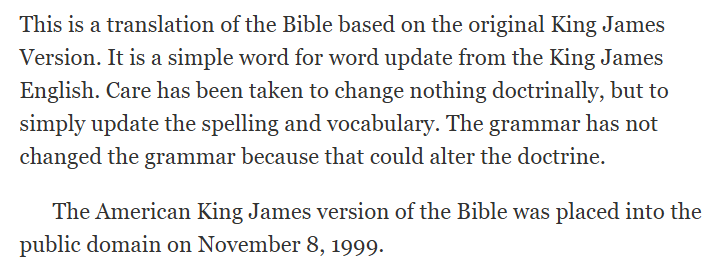
ps Some may find the KJV to understand so maybe try :-
I've seen it myself. You clearly have a deep seated agenda.You’re a little late to the party as this Strawman has already been addressed.
Behold
Well-Known Member
@Behold, I know OSAS is important to you
OSAS is not "important" to anyone, except to deceived people who need to post about it on forums.
And these dont even know what it means, or where it began.
According to Jude and Paul.....This idea of "license to sin".......comes from Jews in Paul's Day, who accused Him of preaching what you mistakenly refer to as "OSAS".
So what is that?
That is a Satanic Theology stragegy concept that is designed to build a stronghold in your mind..., that blinds you from understanding the Eternal EFFECT of "imputed righteousness"......which then causes you to falsely believe that God's Grace, when taught as eternal forgiveness, is "teaching license to sin".
So, this deceived believer, ends up stranded in a religious carnal mind, never knowing or understanding God's Mercy as God's Grace, as they could have, but never will now, because this stronghold has them trying to stay saved instead of trusting in Christ to keep them saved.
This Satanic Strategy, is designed to cause you to never be able to understand God's "imputed righteousness" as ETERNAL., and instead creates you to be a deceived legalist who is trying not to lose your salvation.
That is, the translation does not save anyone. Agreed?
If you like, we can agree that the words in a real bible are Holy and Spirituial, and the Gospel is found there, and if you believe it, then by believing in the words of righteousness, as found in a real bible as : THE GOSPEL< then you can be saved.
So, yes, the words found in a real bible that Paul defines as "we preach Christ crucified" have the power to save you, if you believe them because "they are the power of God unto Salvation for everyone who BELIEVES"...= the words found in the NT known as "The Gospel of the Grace of God", that Paul gave us.
Last edited:
When it's to discount the MMS, forget it. If you want the authentic Bible, that's where it's found.Appeal to Subjectivism. The term I was looking for is Textual criticism - what is it? | GotQuestions.org
Much love!
- Dec 31, 2010
- 6,707
- 3,552
- 113
- Faith
- Christian
- Country
- United States
- Gender
- Male
Lao-Tzu said... "Sages have no strange clothes or weird behavioral patterns."
In Christianity I have run into, "weird behavioral patterns" my share of times. It does not seem to come from doctrine, bible versions, or teaching. It seems like people were just born that way, or brought up under a terrible set of circumstances. A true sage, or man of true wisdom, in my mind, is someone who truly has been saved, sanctified, and filled with the Holy Spirit.
It has been unfortunate in my travels to have run into terrible people. I wish I could say something like, "read this version of the Bible and you will attain perfection." But that has never been the case.
In Christianity I have run into, "weird behavioral patterns" my share of times. It does not seem to come from doctrine, bible versions, or teaching. It seems like people were just born that way, or brought up under a terrible set of circumstances. A true sage, or man of true wisdom, in my mind, is someone who truly has been saved, sanctified, and filled with the Holy Spirit.
It has been unfortunate in my travels to have run into terrible people. I wish I could say something like, "read this version of the Bible and you will attain perfection." But that has never been the case.
Similar threads

- Replies
- 0
- Views
- 85
- Replies
- 54
- Views
- 2K

- Replies
- 3
- Views
- 256

- Replies
- 0
- Views
- 321

