Explain Rom 13:1-4
1Let every soul be subject unto the higher powers. For there is no power but of God: the powers that be are ordained of God.
2Whosoever therefore resisteth the power, resisteth the ordinance of God: and they that resist shall receive to themselves damnation.
3For rulers are not a terror to good works, but to the evil. Wilt thou then not be afraid of the power? do that which is good, and thou shalt have praise of the same:
4For he is the minister of God to thee for good. But if thou do that which is evil, be afraid; for he beareth not the sword in vain: for he is the minister of God, a revenger to execute wrath upon him that doeth evil.
Below is the explanation of Romans 12 and 13.
Part 1
The Sacrifices were the basis and the forms of ancient religion. Everything was obtained and everything was expiated by means of sacrifices. Through the sacrifice, one intended to honour God and appease Him, thanking Him for a victory or for a healing. It was the era of the material sacrifice. And it was logical that it was such, given that there was no other rite, nor any other obvious way of honouring the Eternal and invoking His help.
Man, who had still not been taught by the Incarnate Word and who was lacking a holy Victim for a perpetual and perfect Sacrifice, nevertheless felt, through even a natural law, that the Creator, the true God or the god worshipped in individual religions, was to be offered the same gifts that He had given to man, and thus [man] used animals and fruits of the earth in a burnt offering so that they could be truly sacrificed.
However, were they "a living sacrifice"? No. They were the sacrifices of animals or of plant products, the first being already dead and the second already up-rooted from the nourished earth. There was no living victim placed to consume his sacrifice in order to honour God. And the sacrifice was always relative, even if it was of large animals of great material value.
Never, prior to the Christ-Lamb being immolated in order to appease and expiate divine wrath and human sins, never had a man been sacrificed except in idolatrous religions, or had sacrificed himself in order to give perfect honour and atonement to God. And therefore, the sacrifice was always relative and imperfect since, on account of the sins of men, animals which were less guilty than men, were immolated, substituting upon the altar the one who was truly guilty. And all sins, through God's kindness and who had Himself indicated these sacrifices in expectation of the perfect sacrifice, were expiated thus.
All except one: Original Sin. For that one, mountains of victims would not have been sufficient. Even if in one go, all the bulls, calves, lambs and goats were to have been immolated, which for centuries had transformed the Temple into a perpetual slaughter-house, especially during ritual feasts, flowing with rivers of blood and smoking with the fires of the victims, the sacrifice would not have been sufficient to wash out Original Sin.
So that the spirit of man could be restored to Grace and man restored to his dignity as a child of God, co-heir of Heaven and so that Justice could be appeased and Evil conquered, a perfect Victim was needed, a unique Victim who, being God as the offended God, would pay as God to God, the redemption of man, and as the most Holy Man, He would expiate for the sinful man.
Only the Man-God, Jesus, could have appeased God and redeemed man, being true God and true Man.
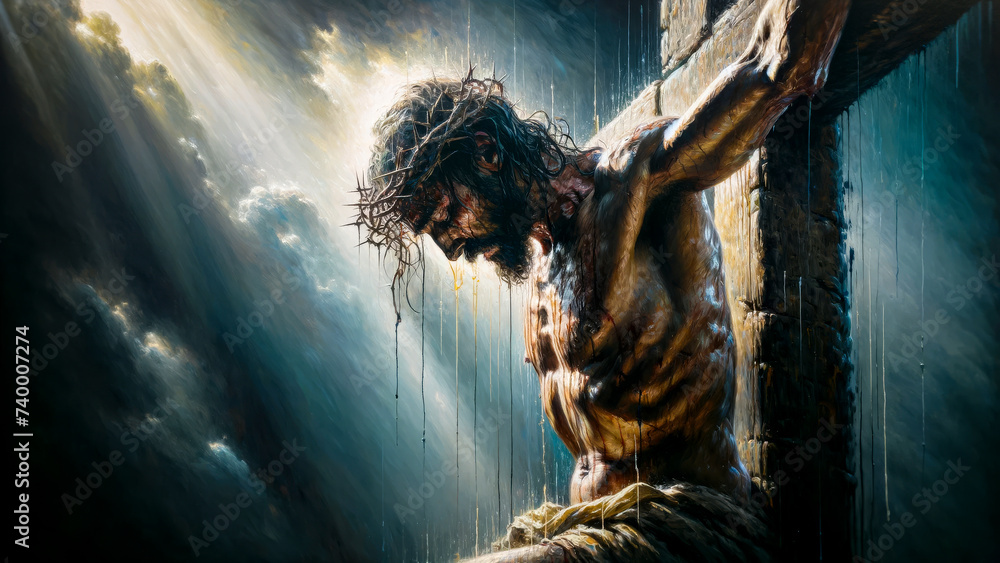
And Jesus was immolated. However, His Sacrifice was not consumed on dead flesh, but on a living Body onto which all the torments were hurled in order to expiate all the sins of which the Innocent One had burdened Himself so as to consume them all.
Total sacrifice: of the spirit of Christ tested by the abandonment of the Father in order to make amends for the sin of the spirit of Adam, guilty for having abandoned God and His Law; of the perfect intellect of the Son of Man in order to make amends for the pride of Adam; of the innocent flesh of the Lamb of God in order to make amends for Adam's lust. And so that the world, forever a sinner, could always have a perfect victim in the presence of the immolation, the eternal Christ and Pontiff constitutes the perpetual sacrifice: that of the Eucharist in which it is still and always Christ in Body, Blood, Soul and Divinity who is offered and consumed upon the altars.
Perpetual sacrifice and living sacrifice. The new sacrifice of the perfect Religion. "This is My Body, this is My Blood which are given up for you. Do this in memory of Me." He uses the present [tense]. Because in fact, until the end of time, the Sacrifice will always be new and always the same as the one consumed by Christ, equally valid before God and in favour of men.
However, to the living Sacrifice which is consumed upon the altars, man must join to it his own individual sacrifice, the one of all hours to be carried out in all his occupations, duties, and above all, in the will of God, even if it is a will of sorrow. A sacrifice that can be either of the flesh, in the form of diseases, poverty and exhausting work; moral, in the form of injustices, calumnies and incomprehension; or spiritual, in the form of persecutions on the part of men or abandonments of God in order to test the faith of His servant. And more: faithfulness to the Law by preserving bodies, thoughts, sentiments and spirits in a chaste, just and loving manner.
Because this, more than the outward rites, constitutes the reasonable service of which Paul speaks. Not only the form, but the substance of the service to God. And the substance is given by renewing oneself, by a continual renewal of the individual I, as the renewal of the whole of creation in its animals, plants and in its seasons is continual, a continual spiritual and moral renewal in order to make oneself into a new humanity, transforming oneself ever more in Christ. The essence of the devotion to God is given by a continual, arduous and sometimes even sorrowful ascending towards the perfection in order to do the will of God, the first and common divine will for all creatures with divine likeness and predestination to glory: that they make themselves holy in order to rise to the dwelling place of the Father forever.
This renewal, this transformation, this ascent towards perfection, this human will which is precisely of the man in whom there is a more living likeness with the Father, union with the Son, and a docility towards all the inspirations of the Holy Spirit, - so that his gifts do not remain inert as a seed which has fallen onto a stone, but active as a seed which has fallen into very fertile soil and that as a great plant is able to nourish with holy fruits not only the one who possesses it, but many others, more unhappy than guilty, poorer in God because they do not know Him and because there is no one who instructs them because they are indifferent to God - one obtains by doing, in everything and for everything, that which God proposes one to do, in the way in which God proposes it and in the measure which God marks out.
Contributing much to the good of the whole mystical Body is one who crosses the continents and who labours tirelessly in apostolic work in order to bring new Christians to the militant Church, as someone who, unknown and hidden, suffers, and owing to his grief, he requests the help of missionaries; nor is his little Mass (the victims are hosts and their bed is Golgotha on which they consume the sacrifice for the good of many) less pleasing to the Lord. Contributing to the good of his brothers is he who writes the revelations of God because God made of him a revealer, like one who writes works of a genius in order to render the obscure points of the Scriptures or of truths of faith more comprehensible and more lovable because Jesus' and Mary become better known. It is sufficient that every action or ministry be moved and upheld by love. True love.
True love which makes one hate the evil in himself not because it is the cause of superterrestrial punishment, but because it is a sorrow given to God. True love that, as it brings us to not want to do evil, so it pushes us to tear away our sinful brothers from evil, and inspires us to reproach them in a manner that, having to be rightly severe however, they are not lacking in mercy to the point of embittering or disheartening instead of comforting those who have fallen. True fraternal love that makes men into brothers who reciprocally tolerate each other even if they are very imperfect, and who always help each other and love each other in the Lord. True love that makes them diligent in the zeal and for the zeal towards God, fervent in spirit, serene during trials, patient in tribulations, unwearied in prayer, even if it seems that Heaven does not answer, merciful, and therefore, practicing all the corporal and spiritual works of mercy without rancour, hate or desire of revenge, full of understanding for their neighbour, without envying him if he is joyful, without indifference or delighting wickedly if he suffers, and not avid of rising to positions of honour by de-throning others, even by means of calumny, always happy of their very own condition and who are never revengeful, even towards those who have harmed them.
This is love. True love that gives glory to God and good to ones' brothers. And God, if not our brothers, will make up for it by re-establishing justice, by showing the truth of facts, and by punishing and rewarding just as each has merited.