Thayer’s
to be no longer dead, to recover life, be restored to life: ....
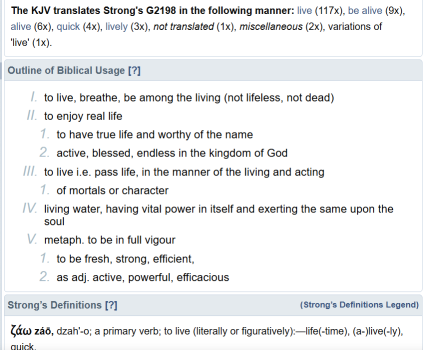
Where are you seeing that? This is what I see for Thayer's Greek Lexicon on blueletterbible.org.
Thayer's Greek Lexicon [?]
STRONGS G2198:
ζάω, ζῶ, ζῇς, ζῇ, infinitive ζῆν (so L T, but R G WH -η-, Tr also (except
1 Corinthians 9:14;
2 Corinthians 1:8); cf. Winers Grammar, § 5, 4 c.; WH. Introductory § 410; Lipsius Gram. Unters., p. 5f), participle ζῶν; imperfect ἔζων (
Romans 7:9, where Vat. has the inferior form ἔζην (found again
Colossians 3:7 ἐζῆτε); cf. Fritzsche on Romans, ii., p. 38; (WHs Appendix, p. 169; Veitch, under the word)); future in the earlier form ζήσω (
Romans 6:2 (not L marginal reading);
Hebrews 12:9; L T Tr WH also in John (
John 5:25);
John 6:57,
58 (
John 6:51 T WH), (not L;
John 14:19 T Tr WH);
2 Corinthians 13:4;
James 4:15), and much oftener ((?) five times, quotations excepted, viz.
Matthew 9:18;
Luke 10:28;
John 11:25;
Romans 8:13;
Romans 10:5; cf. Moulton's Winer, p. 105) the later form, first used by (Hippocrates 7, 536 (see Veitch, under the word)) Demosthenes, ζήσομαι; 1 aorist (unused in Attic (Hipp., Anth. Pal., Plutarch, others (see Veitch))) ἔζησα (
Acts 26:5, etc.); cf. Alexander Buttmann (1873) Ausf. Sprachl. ii. 191f; Buttmann, 58 (51); Krüger, i., p. 172; Kühner, i. 829; Winers Grammar, 86 (83); (Veitch, under the word); Hebrew חָיָה; (from (Homer) Theognis, Aeschylus down); to live;
I. properly,
1. to live, be among the living, be alive (not lifeless, not dead):
Acts 20:12;
Romans 7:1-3;
1 Corinthians 7:39;
2 Corinthians 1:8;
2 Corinthians 4:11;
1 Thessalonians 4:15,
17;
Revelation 19:20, etc.; ψυχή ζῶσα,
1 Corinthians 15:45 and R Tr marginal reading
Revelation 16:3; διά παντός τοῦ ζῆν, during all their life (on earth),
Hebrews 2:15 (διατελεῖν πάντα τόν τοῦ ζῆν χρόνον, Diodorus 1, 74 (cf. Buttmann, 262 (225))); ἔτι ζῶν (participle imperfect (cf. Winer's Grammar, 341 (320))), while he was yet alive, before his death,
Matthew 27:63; with ἐν σαρκί added, of the earthly life,
Philippians 1:22; ὁ δέ νῦν ζῶ ἐν σαρκί, that life which I live in an earthly body,
Galatians 2:20 (Buttmann, 149 (130); Winer's Grammar, 227 (213)); ἐν αὐτῷ ζῶμεν, in God is the cause why we live,
Acts 17:28; ζῶσα τέθνηκε,
1 Timothy 5:6; ἐμοί τό ζῆν Χριστός, my life is devoted to Christ, Christ is the aim, the goal, of my life,
2. emphatically, and in the Messianic sense, to enjoy real life, i. e. to have true life and worthy of the name — active, blessed, endless in the kingdom of God (or ζωή αἰώνιος; see ζωή, 2b.):
Luke 10:28;
John 5:25;
John 11:25;
Romans 1:17;
Romans 8:13;
Romans 14:9 ((?) see above);
Galatians 3:12;
Hebrews 12:9; with the addition of ἐκ πίστεως,
Hebrews 10:38; of εἰς τόν αἰῶνα,
John 6:51,
58; σύν Χριστῷ, in Christ's society,
1 Thessalonians 5:10; this life in its absolute fullness Christ enjoys, who owes it to God; hence, he says ζῶ διά τόν πατέρα,
John 6:57;
3. to live i. e. pass life, of the manner of living and acting;
II. Metaphorically, of inanimate things;
Had to remove some of it to get this down under 10,000 characters. Nowhere is the word used to describe a resurrection from the dead.
You can view the full text here:
G2198 - zaō - Strong's Greek Lexicon (KJV)