Daniel 7 can't support Amil's Timeline Pertaining to Rev 6:9-11, Rev 20:4

  • Welcome to Christian Forums, a Christian Forum that recognizes that all Christians are a work in progress.

    You will need to register to be able to join in fellowship with Christians all over the world.

    We hope to see you as a part of our community soon and God Bless!

Spiritual Israelite

Well-Known Member
Apr 13, 2022
18,651
7,486
113
Midwest
Faith
Christian
Country
United States
Gender
Male
Thanks for the response

I personally don't believe that the non-literal "Thousand Years" actually has a time frame,
It very clearly indicates that it has a beginning and an end. When it ends then Satan will be loosed. The text is very, very clear about this.

Revelation 20:3 And cast him into the bottomless pit, and shut him up, and set a seal upon him, that he should deceive the nations no more, till the thousand years should be fulfilled: and after that he must be loosed a little season.

This explicitly says that once the thousand years are over, then Satan will be loosed for a little season.

And that can be seen in the following verse as well...

Revelation 20:7 And when the thousand years are expired, Satan shall be loosed out of his prison,

So, the non-literal thousand years does represent a time frame with a beginning and end.

I believe it's a large number expressing the Lord's eternal, today the words could be a "Trillion Years" I use 2 Peter 3:8 in explanation where in the Lord's eternal spiritual realm one day is a thousand years showing the eternal realm where literal earthly time doesn't exist

In Revelation 20:7 when it states "The Thousand Years Are Expired" it means nothing more than events move from the Lords eternal spiritual to the earthly realm

Thanks for the time, Jesus Is The Lord
I don't understand what you're trying to say. It can't represent eternity because it has a beginning and an end. This isn't even debatable. But, believe what you want.
 

Spiritual Israelite

Well-Known Member
Apr 13, 2022
18,651
7,486
113
Midwest
Faith
Christian
Country
United States
Gender
Male
If I'm understanding you correctly you are making a completely valid point here, and the reaction to it proves why.

If the Amil millennium began 2,000 years ago and satan's little season still hasn't started, look at the math of what you actually have. you have 1,000 literal years, followed by another 1,000 year time gap tacked onto the end of it before we ever reach satan's little season.
If the thousand years isn't literal, as Amills believe, then there is no time gap in the thousand years. Your statement is based on the assumption that the thousand years is literal, so it's not a valid argument to make against Amill.

Because Amil claims the saints just keep right on reigning continuously through both the thousand years and the little season, nothing visibly changes at the 1,000 year mark.
What changes is that Satan is loosed at that point. That is what Premills believe as well. How is this any kind of argument against Amill?

That means a non-literal 1,000 years produces the exact same historical timeline as a literal 1,000 years with a 1,000 year gap added after it.
LOL. What? Once again you have resorted to misrepresenting Amill in your desperate attempt to refute it. It's all you can do. If you actually addressed what we actually believe, then you can't refute it.

Some Premils point to a Scriptural interval (the times of the Gentiles) between the 69th and 70th weeks of Daniel 9, and Amils mock it as inserting a gap.
Rightfully so. That would be equivalent to someone saying there is a gap somewhere within the thousand years. Nowhere does the Daniel 9 prophecy allow for any gaps within the 70 weeks. It's a determined 70 week (490 year) time period that people like you have stretched out to at least a 2,500 year time period instead.

Yet Amil relies on an extra 1,000 year buffer after the first thousand years to stretch its timeline across 2,000 years of church history, plus satan's little season before the final resurrection ever begins.
Nonsense. Again, you are talking as if the thousand years was literal. Amills do not take it literally, so how can we be adding an extra 1,000 years to a non-literal 1,000 years? That's ridiculous.

You can't condemn one timeline for recognizing a Biblical interval while relying on the exact same gap mechanics to make your own timeline work.
No, we are not using the "exact same gap mechanics" at all. Again, seeing a time gap within the 70 weeks would be like seeing a time gap within the thousand years. It's complete nonsense.
 

Spiritual Israelite

Well-Known Member
Apr 13, 2022
18,651
7,486
113
Midwest
Faith
Christian
Country
United States
Gender
Male
I guess I have to go over this with you again, here’s why trying to over-spiritualize can lead to incorrect interpretations, especially with numbers, like assigning certain meanings to numbers then applying that to scripture.

Let’s take for example the number 144,000.
Let’s say 144,000 means all the saved people.
The number 4 means universality, like the 4 winds
The number 2 is the number of witness and confirmation
The number 1,000 is the fullness of what’s in view

Since multiples of 10 always give the same outcome of “the fullness of what’s in view”, let’s do the math.


In Revelation 7:1 the 4 angels are standing on the 4 corners of the earth holding the 4 winds, so we divide 144,000 by 4 = 36,000. This is the universality of all the saved.

Since these are also the 2 witnesses we divide 36,000 by 2 = 18,000. This number is the universality of all the saved that witness.

And since this all takes place in the millennium we divide 18,000 by 1,000 = 18. This number is fullness of the universality of all the saved witnessing.

However, 1,000 or the millennium is also when Jesus sits on David's throne and in 2 Samuel 23:39 David's mighty warriors were 37 in all, so we multiply 18 by 37 = 666. This is the number of the fullness of all the saved warriors that witnessed during their millennium.

There, I over-spiritualized to the point that I can make the scriptures say whatever I want, I can even make the saved = 666.
Do you have an issue with symbolism or something? The book of Revelation is a highly symbolic book. That's a fact. It was purposely "signified" (Revelation 1:1). Why do you have such a problem with the idea that the 144,000 is not a literal number?
 

claninja

Active Member
Dec 11, 2022
789
158
43
the south
Faith
Christian
Country
United States
Gender
Male
Nonsense. You'd have a point if the same Greek words were used in both verses 4 and 5 to describe those who lived and reigned with Christ in verse 4 and those who live again after the thousand years in verse 5. But, that is not the case. In verse 4, the Greek word "zao" is used to describe those who lived and reigned with Christ. That word is never used to describe someone being resurrected from the dead. The word means to be alive or to live. In verse 5 the Greek word "anazao" is used to describe the rest of the dead living again after the thousand years. That word is used to describe someone being resurrected from the dead. If those who have part in the first resurrection were being described as coming back to life in verse 4 then why wasn't the word "anazao" used there as well like it is in verse 5?

This is just lexically wrong. Where are you getting this information from?

Thayer’s
to be no longer dead, to recover life, be restored to life: Matthew 9:18; Acts 9:41; so of Jesus risen from the dead, Mark 16:11; Luke 24:5, 23; Acts 1:3; Acts 25:19; Romans 6:10; 2 Corinthians 13:4; opposed to νεκρός, Revelation 1:18; Revelation 2:8; ἔζησεν came to life, lived again, Romans 14:9 G LT Tr WH (opposed to ἀπέθανε); Revelation 13:14; Revelation 20:4, 5
 

Spiritual Israelite

Well-Known Member
Apr 13, 2022
18,651
7,486
113
Midwest
Faith
Christian
Country
United States
Gender
Male
Thayer’s
to be no longer dead, to recover life, be restored to life: ....
Where are you seeing that? This is what I see for Thayer's Greek Lexicon on blueletterbible.org.

Thayer's Greek Lexicon [?]
STRONGS G2198:
ζάω, ζῶ, ζῇς, ζῇ, infinitive ζῆν (so L T, but R G WH -η-, Tr also (except 1 Corinthians 9:14; 2 Corinthians 1:8); cf. Winers Grammar, § 5, 4 c.; WH. Introductory § 410; Lipsius Gram. Unters., p. 5f), participle ζῶν; imperfect ἔζων (Romans 7:9, where Vat. has the inferior form ἔζην (found again Colossians 3:7 ἐζῆτε); cf. Fritzsche on Romans, ii., p. 38; (WHs Appendix, p. 169; Veitch, under the word)); future in the earlier form ζήσω (Romans 6:2 (not L marginal reading); Hebrews 12:9; L T Tr WH also in John (John 5:25); John 6:57,58 (John 6:51 T WH), (not L; John 14:19 T Tr WH); 2 Corinthians 13:4; James 4:15), and much oftener ((?) five times, quotations excepted, viz. Matthew 9:18; Luke 10:28; John 11:25; Romans 8:13; Romans 10:5; cf. Moulton's Winer, p. 105) the later form, first used by (Hippocrates 7, 536 (see Veitch, under the word)) Demosthenes, ζήσομαι; 1 aorist (unused in Attic (Hipp., Anth. Pal., Plutarch, others (see Veitch))) ἔζησα (Acts 26:5, etc.); cf. Alexander Buttmann (1873) Ausf. Sprachl. ii. 191f; Buttmann, 58 (51); Krüger, i., p. 172; Kühner, i. 829; Winers Grammar, 86 (83); (Veitch, under the word); Hebrew חָיָה; (from (Homer) Theognis, Aeschylus down); to live;
I. properly,
1. to live, be among the living, be alive (not lifeless, not dead): Acts 20:12; Romans 7:1-3; 1 Corinthians 7:39; 2 Corinthians 1:8; 2 Corinthians 4:11; 1 Thessalonians 4:15, 17; Revelation 19:20, etc.; ψυχή ζῶσα, 1 Corinthians 15:45 and R Tr marginal reading Revelation 16:3; διά παντός τοῦ ζῆν, during all their life (on earth), Hebrews 2:15 (διατελεῖν πάντα τόν τοῦ ζῆν χρόνον, Diodorus 1, 74 (cf. Buttmann, 262 (225))); ἔτι ζῶν (participle imperfect (cf. Winer's Grammar, 341 (320))), while he was yet alive, before his death, Matthew 27:63; with ἐν σαρκί added, of the earthly life, Philippians 1:22; ὁ δέ νῦν ζῶ ἐν σαρκί, that life which I live in an earthly body, Galatians 2:20 (Buttmann, 149 (130); Winer's Grammar, 227 (213)); ἐν αὐτῷ ζῶμεν, in God is the cause why we live, Acts 17:28; ζῶσα τέθνηκε, 1 Timothy 5:6; ἐμοί τό ζῆν Χριστός, my life is devoted to Christ, Christ is the aim, the goal, of my life,
2. emphatically, and in the Messianic sense, to enjoy real life, i. e. to have true life and worthy of the name — active, blessed, endless in the kingdom of God (or ζωή αἰώνιος; see ζωή, 2b.): Luke 10:28; John 5:25; John 11:25; Romans 1:17; Romans 8:13; Romans 14:9 ((?) see above); Galatians 3:12; Hebrews 12:9; with the addition of ἐκ πίστεως, Hebrews 10:38; of εἰς τόν αἰῶνα, John 6:51, 58; σύν Χριστῷ, in Christ's society, 1 Thessalonians 5:10; this life in its absolute fullness Christ enjoys, who owes it to God; hence, he says ζῶ διά τόν πατέρα, John 6:57;
3. to live i. e. pass life, of the manner of living and acting;
II. Metaphorically, of inanimate things;

Had to remove some of it to get this down under 10,000 characters. Nowhere is the word used to describe a resurrection from the dead.

You can view the full text here: G2198 - zaō - Strong's Greek Lexicon (KJV)


 

claninja

Active Member
Dec 11, 2022
789
158
43
the south
Faith
Christian
Country
United States
Gender
Male
No, it isn't.
Yes it is.

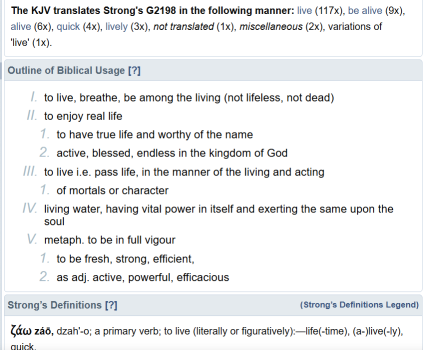
I use the blueletterbible.org site. It shows this for the word "zao":

So did I.

Revelation 20:4 usage is listed under

  1. to live, breathe, be among the living (not lifeless, not dead)

Where are you seeing that? This is what I see for Thayer's Greek Lexicon on blueletterbible.org.

Whatever you copy and pasted is missing usages and meanings, probably what you cut to stay under 10,000 characters.

  1. to live, breathe, be among the living (not lifeless, not dead)

(G2198 - zaō - Strong's Greek Lexicon (KJV))

“to live, be among the living, be alive (not lifeless, not dead): Acts 20:12; Romans 7:1-3; 1 Corinthians 7:39; 2 Corinthians 1:8; 2 Corinthians 4:11; 1 Thessalonians 4:15, 17; Revelation 19:20, etc.; ψυχή ζῶσα, 1 Corinthians 15:45and R Tr marginal reading Revelation 16:3; διά παντός τοῦ ζῆν, during all their life (on earth), Hebrews 2:15 (διατελεῖνπάντα τόν τοῦ ζῆν χρόνον, Diodorus1, 74 (cf. Buttmann, 262 (225))); ἔτι ζῶν(participle imperfect (cf. Winer's Grammar, 341 (320))), while he was yet alive, before his death, Matthew 27:63; with ἐν σαρκίadded, of the earthly life, Philippians 1:22; ὁ δέ νῦν ζῶ ἐν σαρκί, that life which I live in an earthly body, Galatians 2:20(Buttmann, 149 (130); Winer's Grammar, 227 (213)); ἐν αὐτῷ ζῶμεν, in God is the cause why we live, Acts 17:28; ζῶσατέθνηκε, 1 Timothy 5:6; ἐμοί τό ζῆνΧριστός, my life is devoted to Christ, Christ is the aim, the goal, of my life, Philippians 1:21; ζῶντες are opposed to νεκροί, Matthew 22:32; Mark 12:27; Luke 20:38; ζῶντες καί νεκροί, Acts 10:42; Romans 14:9; 2 Timothy 4:1; 1 Peter 4:5; in the sense of living and thriving, 2 Corinthians 6:9; 1 Thessalonians 3:8; ζῇ ἐν ἐμοίΧριστός, Christ is living and operative in me, i. e. the holy mind and energy of Christ pervades and moves me Galatians 2:20; ἐκ δυνάμεως Θεοῦ ζῆν εἰς τινα, through the power of God to live and be strong toward one (namely, in correcting and judging), 2 Corinthians 13:4; in the absolute sense, God is said to be ὁ ζῶν: Matthew 16:16; Matthew 26:63; John 6:57; John 6:69 Rec.; Acts 14:15; Romans 9:26; 2 Corinthians 3:3; 2 Corinthians 6:16; 1 Thessalonians 1:9; 1 Timothy 3:15; 1 Timothy 4:10; 1 Timothy 6:17 R G; Hebrews 3:12; Hebrews 9:14; Hebrews 10:31; Hebrews 12:22; Revelation 7:2 (Joshua 3:10; 2 Kings 19:4, 16; Isaiah 37:4, 17; Hosea 1:10; Daniel 6:20Theod., 26, etc.); with the addition of εἰςτούς αἰῶνας τῶν αἰώνων, Revelation 4:9; Revelation 15:7; ζῶ ἐγώ (אָנִי חַי, Numbers 14:21; Isaiah 49:18, etc.) as I live (by my life), the formula by which God swears by himself, Romans 14:11. equivalent to to continue to live, to be kept alive (ὅστις ζῆν ἐπιθυμεῖ, πειράσθω νικαν, Xenophon, an. 3, 2, 26 (39)): ἐάν ὁ κύριος θελήσῃ καίζήσωμεν (ζήσομεν L T Tr WH), James 4:15 (Buttmann, 210 (181); Winer's Grammar, 286 (268f)); ζῆν ἐπ' ἄρτῳ(Matthew 4:4, etc.) see ἐπί, B. 2 a. α. (Tobit 5:20); ζῆν ἐκ τίνος, to get a living from a thing, 1 Corinthians 9:14; also when used of convalescents, John 4:50f, 53; with ἐκ τῆς ἀρρωστίας added, 2 Kings 1:2; 2 Kings 8:8f, figuratively, to live and be strong: ἐν τούτοις (for Rec. ἐν αὐτοῖς) in these vices, opposed to the ethical death by which Christians are wholly severed from sin (see ἀποθνῄσκω, II. 2 b.), Colossians 3:7; cf. Meyer at the passage equivalent to to be no longer dead, to recover life, be restored to life: Matthew 9:18; Acts 9:41; so of Jesus risen from the dead, Mark 16:11; Luke 24:5, 23; Acts 1:3; Acts 25:19; Romans 6:10; 2 Corinthians 13:4; opposed to νεκρός, Revelation 1:18; Revelation 2:8; ἔζησενcame to life, lived again, Romans 14:9 G LT Tr WH (opposed to ἀπέθανε); Revelation 13:14; Revelation 20:4, 5”
 

Spiritual Israelite

Well-Known Member
Apr 13, 2022
18,651
7,486
113
Midwest
Faith
Christian
Country
United States
Gender
Male
Yes it is.
LOL. It's not. As I showed. But, just believe what you want. You won't consider any evidence presented against what you want to believe. That's clear.

So did I.

Revelation 20:4 usage is listed under

  1. to live, breathe, be among the living (not lifeless, not dead)
How does that describe someone being resurrected? It doesn't. To be alive and not dead is not a specific reference to the act of being resurrected. In Acts 1:18, the word is used to describe Jesus being alive when the book was written after previously being dead. But, it's not a direct reference to the actual act of Him being resurrected. The word "zao" never is used to refer to the act of being resurrected from death to live like the word anazao is in Revelation 20:5.
 

Spiritual Israelite

Well-Known Member
Apr 13, 2022
18,651
7,486
113
Midwest
Faith
Christian
Country
United States
Gender
Male
Whatever you copy and pasted is missing usages and meanings, probably what you cut to stay under 10,000 characters.

  1. to live, breathe, be among the living (not lifeless, not dead)

(G2198 - zaō - Strong's Greek Lexicon (KJV))

“to live, be among the living, be alive (not lifeless, not dead): Acts 20:12; Romans 7:1-3; 1 Corinthians 7:39; 2 Corinthians 1:8; 2 Corinthians 4:11; 1 Thessalonians 4:15, 17; Revelation 19:20, etc.; ψυχή ζῶσα, 1 Corinthians 15:45and R Tr marginal reading Revelation 16:3; διά παντός τοῦ ζῆν, during all their life (on earth), Hebrews 2:15 (διατελεῖνπάντα τόν τοῦ ζῆν χρόνον, Diodorus1, 74 (cf. Buttmann, 262 (225))); ἔτι ζῶν(participle imperfect (cf. Winer's Grammar, 341 (320))), while he was yet alive, before his death, Matthew 27:63; with ἐν σαρκίadded, of the earthly life, Philippians 1:22; ὁ δέ νῦν ζῶ ἐν σαρκί, that life which I live in an earthly body, Galatians 2:20(Buttmann, 149 (130); Winer's Grammar, 227 (213)); ἐν αὐτῷ ζῶμεν, in God is the cause why we live, Acts 17:28; ζῶσατέθνηκε, 1 Timothy 5:6; ἐμοί τό ζῆνΧριστός, my life is devoted to Christ, Christ is the aim, the goal, of my life, Philippians 1:21; ζῶντες are opposed to νεκροί, Matthew 22:32; Mark 12:27; Luke 20:38; ζῶντες καί νεκροί, Acts 10:42; Romans 14:9; 2 Timothy 4:1; 1 Peter 4:5; in the sense of living and thriving, 2 Corinthians 6:9; 1 Thessalonians 3:8; ζῇ ἐν ἐμοίΧριστός, Christ is living and operative in me, i. e. the holy mind and energy of Christ pervades and moves me Galatians 2:20; ἐκ δυνάμεως Θεοῦ ζῆν εἰς τινα, through the power of God to live and be strong toward one (namely, in correcting and judging), 2 Corinthians 13:4; in the absolute sense, God is said to be ὁ ζῶν: Matthew 16:16; Matthew 26:63; John 6:57; John 6:69 Rec.; with the addition of εἰςτούς αἰῶνας τῶν αἰώνων, Revelation 4:9; Revelation 15:7; ζῶ ἐγώ (אָנִי חַי, Numbers 14:21; Isaiah 49:18, etc.) as I live (by my life), the formula by which God swears by himself, Romans 14:11. equivalent to to continue to live, to be kept alive (ὅστις ζῆν ἐπιθυμεῖ, πειράσθω νικαν, Xenophon, an. 3, 2, 26 (39)): ἐάν ὁ κύριος θελήσῃ καίζήσωμεν (ζήσομεν L T Tr WH), James 4:15 (Buttmann, 210 (181); Winer's Grammar, 286 (268f)); ζῆν ἐπ' ἄρτῳ(Matthew 4:4, etc.) see ἐπί, B. 2 a. α. (Tobit 5:20); ζῆν ἐκ τίνος, to get a living from a thing, 1 Corinthians 9:14; also when used of convalescents, John 4:50f, 53; with ἐκ τῆς ἀρρωστίας added, 2 Kings 1:2; 2 Kings 8:8f, figuratively, to live and be strong: ἐν τούτοις (for Rec. ἐν αὐτοῖς) in these vices, opposed to the ethical death by which Christians are wholly severed from sin (see ἀποθνῄσκω, II. 2 b.), Colossians 3:7; cf. Meyer at the passage equivalent to to be no longer dead, to recover life, be restored to life: Matthew 9:18; Acts 9:41; so of Jesus risen from the dead, Mark 16:11; Luke 24:5, 23; Acts 1:3; Acts 25:19; Romans 6:10; 2 Corinthians 13:4; opposed to νεκρός, Revelation 1:18; Revelation 2:8; ἔζησενcame to life, lived again, Romans 14:9 G LT Tr WH (opposed to ἀπέθανε); Revelation 13:14; Revelation 20:4, 5”
None of this supports your claim. None of those verses refer to the act of someone being resurrected from the dead. The word can refer to someone living and being alive after previously being dead, but it never is used to refer to the actual act of someone coming to life and being resurrected from death to life the way the word "anazao" is in Revelation 20:5.

Look at the following passage...

Matthew 27:62 On the next day, which followed the Day of Preparation, the chief priests and Pharisees gathered together to Pilate, 63 saying, “Sir, we remember, while He was still alive (zao), how that deceiver said, ‘After three days I will rise (egeiro).’

In verse 63 the word "zao" is translated as "alive" in reference to Jesus being alive and then when it refers to Him being resurrected the Greek word "egeirō" was used instead. The word "zao" never is used to refer to the act of someone being resurrected. Instead, words like anazao, anastasis and egeiro were used. The word "zao" always refers to someone being alive and living their lives. It can refer to someone who is alive after previously being dead, but never refers to their resurrection itself. That's what you are not understanding. In Revelation 20:4, it's talking about believers who were physically dead, but their souls were living and reigning with Christ in heaven.
 
Last edited:

Davidpt

Well-Known Member
Dec 6, 2023
3,131
972
113
68
East Texas
Faith
Christian
Country
United States
Time gaps to be inserted to what? I'm not inserting any time gaps that scripture itself doesn't indicate. I'm not inserting a time gap between the thousand years and the resurrection and judgment. Scripture itself does that.


Uh huh. Or into the determined 70 week (490 year) time period.


My overall understanding of scripture determines the timing of the thousand years. It talks about Jesus reigning with His followers being priests and the second death having no power over them during the thousand years. Other scripture teaches that He began reigning after His resurrection (Matthew 28:16-18, Ephesians 1:19-23, Rev 1:5) with His followers being made priests back then (1 Peter 2:5-9, Rev 1:5-6), so that tells me the timing of the thousand years. It has obviously been well over a thousand years since then and Jesus has not yet returned and the dead have not yet been resurrected and the judgment has not yet taken place.

Amil's millennial timeline:

33 AD the millennium begins while Christ is still bodily present. Then a gap of thousands of years follow that until a major event begins. In this case meaning satan's little season. And at the end of that Christ bodily returns and destroys the beast.

My Timeline involving the 70 weeks and the 70th week:

In 33 AD Christ bodily fulfilled the middle of the week. But the remainder of the week did not follow that. A gap of thousands of years follow that. Then when the beast ascends out of the pit the final half of the 70th week begins. At the end of that Christ bodily returns and destroys the beast.

Now notice what these 2 timelines have in common. They have Christ initially bodily present(1st advent), followed by Christ no longer being bodily present(His ascension 2K years ago) where a gap of thousand of years follow His ascension until a major event begins. In your case meaning satan's little season. In my case meaning the 42 month reign of the beast.

Then at the end of satan's little season, your view, Christ bodily returns and destroys the beast(2nd advent)

Then at the end of the 42 month reign, my view, Christ bodily returns and destroys the beast(2nd advent)


Our timelines are identical except for what major event we insist begins after this thousands of years gap. But you insist only your timeline is valid but mine isn't. Both of our timelines begin with Christ bodily at the cross. Both of our timelines have a gap of thousands of years until a major event begins. Both of our timelines have Christ bodily returning at the end of the major event that followed this gap of thousands of years, then Christ destroying the beast.

But somehow there can only be a gap of thousands of years after the cross until a major event occurs per your timeline, but my timeline is not allowed this because it is not valid to have a gap of thousands of years after the cross until a major event begins per my timeline. Why not? You insist it's valid per your timeline. So why can't it equally be valid per my timeline? How is that my timeline equals a gap inserted in timeline but yours doesn't? That you argue your timeline has no gap in it anywhere. Except my timeline proves yours does.

Does the 42 month reign of the beast = satan's little season after the millennium? Of course not. Both Revelation 20:4 and the Timeline in Daniel 7 prove they are not the same event. Therefore, it is debunked that the 42 month reign = satan's little season. And that Amil needs it to equal satan's little season in order for Amil to be the correct view.
 
Last edited:

claninja

Active Member
Dec 11, 2022
789
158
43
the south
Faith
Christian
Country
United States
Gender
Male
LOL. It's not. As I showed. But, just believe what you want. You won't consider any evidence presented against what you want to believe. That's clear.
You didn’t present any evidence for your claim. Nothing you presented demonstrated it means spiritual life in the context of revelation 20.

How does that describe someone being resurrected? It doesn't. To be alive and not dead is not a specific reference to the act of being resurrected. In Acts 1:18, the word is used to describe Jesus being alive when the book was written after previously being dead. But, it's not a direct reference to the actual act of Him being resurrected. The word "zao" never is used to refer to the act of being resurrected from death to live like the word anazao is in Revelation 20:5.

Right, zao, means living. Context determines whether this means living as in spiritually alive, or living as in not physically dead, but breathing.

In thayer’s It’s usage is defined as “no longer dead, to be restored to life” in the context revelation 20. Though you conveniently left this part when trimming the lexical entry to fit within the 10,000 character limit.

the saints, who were killed by the beast, live. In other words, They are no longer dead, but restored to life.

Is John seeing living sinners being restored to life or is John seeing believers who have been killed being restored to life?
 

Davidpt

Well-Known Member
Dec 6, 2023
3,131
972
113
68
East Texas
Faith
Christian
Country
United States
Is John seeing living sinners being restored to life or is John seeing believers who have been killed being restored to life?

If it's this, there is no such thing as a dead soul during the waiting state that precedes a bodily resurrection.. Even the lost, their souls are not dead they are alive. They are just not in a happy place after their death and prior to their resurrection. Their soul is not dead in the meantime. Only their body is. Why then would a soul need to be restored to life after the death of the body but prior to a bodily resurrection? Why would anyone be priests to God and Christ while in heaven in a disembodied state? Do angels in heaven need disembodied priests ministering to them? Do other departed believers in heaven need disembodied priests ministering to them? Do those still alive on the earth need disembodied priests ministering to them? There is no logic to this no matter how you look at it.
 

claninja

Active Member
Dec 11, 2022
789
158
43
the south
Faith
Christian
Country
United States
Gender
Male
None of this supports your claim. None of those verses refer to the act of someone being resurrected from the dead. The word can refer to someone living and being alive after previously being dead, but it never is used to refer to the actual act of someone coming to life and being resurrected from death to life the way the word "anazao" is in Revelation 20:5.

Look at the following passage...

Matthew 27:62 On the next day, which followed the Day of Preparation, the chief priests and Pharisees gathered together to Pilate, 63 saying, “Sir, we remember, while He was still alive (zao), how that deceiver said, ‘After three days I will rise (egeiro).’

In verse 63 the word "zao" is translated as "alive" in reference to Jesus being alive and then when it refers to Him being resurrected the Greek word "egeirō" was used instead. The word "zao" never is used to refer to the act of someone being resurrected. Instead, words like anazao, anastasis and egeiro were used. The word "zao" always refers to someone being alive and living their lives. It can refer to someone who is alive after previously being dead, but never refers to their resurrection itself. That's what you are not understanding. In Revelation 20:4, it's talking about believers who were physically dead, but their souls were living and reigning with Christ in heaven.

My intention wasn’t that zao means the physical act of resurrection. My argument was that thayers defines it as being restored to life, no longer dead,

therefore zao can imply physical resurrection when contrasted with being physically dead.
 

claninja

Active Member
Dec 11, 2022
789
158
43
the south
Faith
Christian
Country
United States
Gender
Male
If it's this, there is no such thing as a dead soul during the waiting state that precedes a bodily resurrection.. Even the lost, their souls are not dead they are alive. They are just not in a happy place after their death and prior to their resurrection. Their soul is not dead in the meantime. Only their body is. Why then would a soul need to be restored to life after the death of the body but prior to a bodily resurrection? Why would anyone be priests to God and Christ while in heaven in a disembodied state? Do angels in heaven need disembodied priests ministering to them? Do other departed believers in heaven need disembodied priests ministering to them? Do those still alive on the earth need disembodied priests ministering to them? There is no logic to this no matter how you look at it.

Well, I think that contextually the saints are physically dead and brought to physical life in revelation 20.

This is because the saints are described as “souls of the beheaded” and “those who did not take the mark of beast or worship”, which are labeled as “killed” in revelation 13. Additionally these in vs 4 are contrasted with “rest of the dead lived not again….” In revelation 20.

So just from a narrative/thematic standpoint, John is obviously not seeing sinners becoming born again Christians. Instead it’s pretty clear, he is seeing the saints who were killed by the beast living/being restored to life. He literally calls this the first resurrection.
 

Spiritual Israelite

Well-Known Member
Apr 13, 2022
18,651
7,486
113
Midwest
Faith
Christian
Country
United States
Gender
Male
Amil's millennial timeline:

33 AD the millennium begins while Christ is still bodily present. Then a gap of thousands of years follow that until a major event begins. In this case meaning satan's little season. And at the end of that Christ bodily returns and destroys the beast.

My Timeline involving the 70 weeks and the 70th week:

In 33 AD Christ bodily fulfilled the middle of the week. But the remainder of the week did not follow that. A gap of thousands of years follow that. Then when the beast ascends out of the pit the final half of the 70th week begins. At the end of that Christ bodily returns and destroys the beast.

Now notice what these 2 timelines have in common. They have Christ initially bodily present(1st advent), followed by Christ no longer being bodily present(His ascension 2K years ago) where a gap of thousand of years follow His ascension until a major event begins. In your case meaning satan's little season. In my case meaning the 42 month reign of the beast.

Then at the end of satan's little season, your view, Christ bodily returns and destroys the beast(2nd advent)

Then at the end of the 42 month reign, my view, Christ bodily returns and destroys the beast(2nd advent)


Our timelines are identical except for what major event we insist begins after this thousands of years gap. But you insist only your timeline is valid but mine isn't. Both of our timelines begin with Christ bodily at the cross. Both of our timelines have a gap of thousands of years until a major event begins. Both of our timelines have Christ bodily returning at the end of the major event that followed this gap of thousands of years, then Christ destroying the beast.

But somehow there can only be a gap of thousands of years after the cross until a major event occurs per your timeline, but my timeline is not allowed this because it is not valid to have a gap of thousands of years after the cross until a major event begins per my timeline. Why not? You insist it's valid per your timeline. So why can't it equally be valid per my timeline? How is that my timeline equals a gap inserted in timeline but yours doesn't? That you argue your timeline has no gap in it anywhere. Except my timeline proves yours does.

Does the 42 month reign of the beast = satan's little season after the millennium? Of course not. Both Revelation 20:4 and the Timeline in Daniel 7 prove they are not the same event. Therefore, it is debunked that the 42 month reign = satan's little season. And that Amil needs it to equal satan's little season in order for Amil to be the correct view.
You are not addressing my argument regarding the problem with inserting a time gap within the 70 weeks. As I've said multiple times now, that would be like inserting a time gap within the thousand years. In Daniel 9:24 it says 70 weeks were determined to fulfill six things that are listed in the verse. That means a 70 week (490 year) time period was determined for certain things to be fulfilled including the rebuilding of Jerusalem and the six things listed in Daniel 9:24. The fact that the time period was determined means it was a determine, continuous time period of 70 weeks (490 years). There is no basis for inserting a gap into that time period whatsoever.

In contrast to that, the thousand years clearly has what we call Satan's little season following it which is then followed by the resurrection of the dead and judgment. Those things are all clearly spelled out in that chronological sequence. No time gaps are being inserted by the interpreter there like there is when you insert a gap in the 70 weeks. This is my argument, which you are not addressing at all. Can you try addressing it now?
 

Spiritual Israelite

Well-Known Member
Apr 13, 2022
18,651
7,486
113
Midwest
Faith
Christian
Country
United States
Gender
Male
You didn’t present any evidence for your claim.
LOL! So, Strong's definitions of the word "zao" can't be counted as evidence? You are hilarious.

Nothing you presented demonstrated it means spiritual life in the context of revelation 20.
The words mean to be living and to be alive. The souls John saw are physically dead. So, that implies they are spiritually alive since it says they lived and reigned with Christ a thousand years.

Right, zao, means living.
Uh huh. It doesn't mean resurrection or to come to life. That's what you're not getting.

Context determines whether this means living as in spiritually alive, or living as in not physically dead, but breathing.
Uh huh.

In thayer’s It’s usage is defined as “no longer dead, to be restored to life” in the context revelation 20. Though you conveniently left this part when trimming the lexical entry to fit within the 10,000 character limit.
I didn't purposely trim any certain part of it. I kept trimming until it got down under 10,000 characters. I was looking at the main definitions he gave which were that the word means to be alive or to be among the living or to be living your life, etc.

the saints, who were killed by the beast, live. In other words, They are no longer dead, but restored to life.
Where does it say they are no longer physically dead? Do you not believe that those who are physically dead are spiritually alive?

Is John seeing living sinners being restored to life or is John seeing believers who have been killed being restored to life?
He's seeing the souls of physically dead believers living and reigning with Christ. Maybe part of the problem here is that you believe in soul sleep since you assume that had to be restored to physical life in order to be living?
 

grafted branch

Well-Known Member
Dec 11, 2023
2,154
371
83
49
Arizona
Faith
Christian
Country
United States
Gender
Male
Time gaps to be inserted to what? I'm not inserting any time gaps that scripture itself doesn't indicate. I'm not inserting a time gap between the thousand years and the resurrection and judgment. Scripture itself does that.
SI said “Scripture itself does that.”

Not so, if you interpret “the rest of the dead” as being spiritually dead then you can have them live again after the thousand years and before Satan’s little season. Or you could take a Preterist type of view and claim there was a physical resurrection in 70AD and make that fit prior to Satan being loosed.

You’re just making a claim that the Bible itself inserts a gap, no different than a Premill who might declare the Bible itself inserts a gap in the 70 weeks.

My overall understanding of scripture determines the timing of the thousand years. It talks about Jesus reigning with His followers being priests and the second death having no power over them during the thousand years. Other scripture teaches that He began reigning after His resurrection (Matthew 28:16-18, Ephesians 1:19-23, Rev 1:5) with His followers being made priests back then (1 Peter 2:5-9, Rev 1:5-6), so that tells me the timing of the thousand years. It has obviously been well over a thousand years since then and Jesus has not yet returned and the dead have not yet been resurrected and the judgment has not yet taken place.
Right, but the explanation you gave above doesn’t prove one way or the other if the 1,000 years are a literal time period with a time gap added till Satan is loosed or if the 1,000 years are a non-literal time period till Satan is loosed.

But, it's not literal, so that's not a problem for Amill.
You’re using circular reasoning.

The 1,000 years are non-literal, therefore there is no time gap. There are no time gaps allowed, therefore the 1,000 years are non-literal.

Yeah, so? Most of us believe that the 70 weeks are non-literal as far as not believing they represent 490 days. Most of us believe it represents 490 years instead.
Right, which means a person can use the same circular logic to place the times of the Gentiles into the non-literal 70 weeks when they use the same interpretation methods you use.

The 70 weeks are non-literal therefore the times of the Gentiles happen within them. The times of the Gentiles happen within the 70 weeks therefore they are non-literal.

No, I'm not. You are clueless
Why are you resorting to insults? Personally, every time I see you use insults on this forum I think you’re trying to hide some point that you can’t defend any other way.
 

grafted branch

Well-Known Member
Dec 11, 2023
2,154
371
83
49
Arizona
Faith
Christian
Country
United States
Gender
Male
If the thousand years isn't literal, as Amills believe, then there is no time gap in the thousand years. Your statement is based on the assumption that the thousand years is literal, so it's not a valid argument to make against Amill.
Another example of your circular logic.

The 1,000 years are non-literal, therefore there is no time gap. There are no time gaps allowed, therefore the 1,000 years are non-literal.
 

Spiritual Israelite

Well-Known Member
Apr 13, 2022
18,651
7,486
113
Midwest
Faith
Christian
Country
United States
Gender
Male
Amil's millennial timeline:

33 AD the millennium begins while Christ is still bodily present. Then a gap of thousands of years follow that until a major event begins. In this case meaning satan's little season. And at the end of that Christ bodily returns and destroys the beast.

My Timeline involving the 70 weeks and the 70th week:

In 33 AD Christ bodily fulfilled the middle of the week. But the remainder of the week did not follow that. A gap of thousands of years follow that. Then when the beast ascends out of the pit the final half of the 70th week begins. At the end of that Christ bodily returns and destroys the beast.

Now notice what these 2 timelines have in common. They have Christ initially bodily present(1st advent), followed by Christ no longer being bodily present(His ascension 2K years ago) where a gap of thousand of years follow His ascension until a major event begins. In your case meaning satan's little season. In my case meaning the 42 month reign of the beast.

Then at the end of satan's little season, your view, Christ bodily returns and destroys the beast(2nd advent)

Then at the end of the 42 month reign, my view, Christ bodily returns and destroys the beast(2nd advent)


Our timelines are identical except for what major event we insist begins after this thousands of years gap. But you insist only your timeline is valid but mine isn't. Both of our timelines begin with Christ bodily at the cross. Both of our timelines have a gap of thousands of years until a major event begins. Both of our timelines have Christ bodily returning at the end of the major event that followed this gap of thousands of years, then Christ destroying the beast.

But somehow there can only be a gap of thousands of years after the cross until a major event occurs per your timeline, but my timeline is not allowed this because it is not valid to have a gap of thousands of years after the cross until a major event begins per my timeline. Why not? You insist it's valid per your timeline. So why can't it equally be valid per my timeline? How is that my timeline equals a gap inserted in timeline but yours doesn't? That you argue your timeline has no gap in it anywhere. Except my timeline proves yours does.

Does the 42 month reign of the beast = satan's little season after the millennium? Of course not. Both Revelation 20:4 and the Timeline in Daniel 7 prove they are not the same event. Therefore, it is debunked that the 42 month reign = satan's little season. And that Amil needs it to equal satan's little season in order for Amil to be the correct view.
Amil does not need the 42 month reign of the beast to equal Satan's little season. I am an Amil and do not believe that. You have no understanding of Amil, as you prove over and over again.
 

Spiritual Israelite

Well-Known Member
Apr 13, 2022
18,651
7,486
113
Midwest
Faith
Christian
Country
United States
Gender
Male
SI said “Scripture itself does that.”

Not so, if you interpret “the rest of the dead” as being spiritually dead
I don't interpret them as being spiritually dead.

then you can have them live again after the thousand years and before Satan’s little season.
No idea of what you're talking about.

Or you could take a Preterist type of view and claim there was a physical resurrection in 70AD and make that fit prior to Satan being loosed.
Why would I do that? Preterism is a false doctrinal system.

You’re just making a claim that the Bible itself inserts a gap, no different than a Premill who might declare the Bible itself inserts a gap in the 70 weeks.
You don't get it. The Bible itself indicates that Satan's little season follows the thousand years. I didn't insert that. Contrastly, the Bible never teaches that there are any gaps in the 70 weeks. That's like saying there's a gap in the thousand years. It's nonsense.

Right, but the explanation you gave above doesn’t prove one way or the other if the 1,000 years are a literal time period with a time gap added till Satan is loosed or if the 1,000 years are a non-literal time period till Satan is loosed.
No one can prove from the text itself one way or another if the thousand years is literal or not. That's why other scripture has to be taken into account.

You’re using circular reasoning.
No, I'm not. You have no idea of what you're talking about. You are addressing a strawman instead of me.

The 1,000 years are non-literal, therefore there is no time gap. There are no time gaps allowed, therefore the 1,000 years are non-literal.
Say what? Literal or not, there are no time gaps within the thousand years time period. What is hard to understand about that?

Right, which means a person can use the same circular logic to place the times of the Gentiles into the non-literal 70 weeks when they use the same interpretation methods you use.
No, they can't. You are not understanding my argument at all.

The 70 weeks are non-literal therefore the times of the Gentiles happen within them. The times of the Gentiles happen within the 70 weeks therefore they are non-literal.
Huh? No idea what you're talking about. Nothing you're saying addresses my argument.

Why are you resorting to insults?
Because you are speaking nothing but nonsense and not actually addressing my argument. That gets tiring.

Personally, every time I see you use insults on this forum I think you’re trying to hide some point that you can’t defend any other way.
LOL. You go ahead and believe whatever you want. Doesn't make it true, but I know you will just believe whatever comes to your mind.