Paul's Gospel

  • Welcome to Christian Forums, a Christian Forum that recognizes that all Christians are a work in progress.

    You will need to register to be able to join in fellowship with Christians all over the world.

    We hope to see you as a part of our community soon and God Bless!

Wick Stick

Well-Known Member
Sep 21, 2023
2,424
1,486
113
46
Phoenix
Faith
Christian
Country
United States
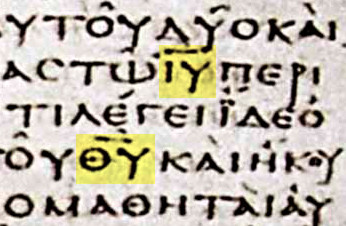
I don't view those as actual nomina sacra. What I mean when using that term is those places in the N/T where we find them in the Greek text, where they are clearly designated to be such because of the over-lines or over-strikes above all of them. Moreover the terms nomen sacrum, (singular), and nomina sacra, (plural), are the Latin terms given to them by scholars meaning "sacred name", (nomen sacrum), or "sacred names", (nomina sacra). There are none in the OG LXX-Septuagint and certainly not in the Hebrew text, so then, without debating, agreeing, or disagreeing with your hypothesis, it simply is not what I was speaking about. Scrolling down the following Wiki page you may find a fairly good list of the nomina sacra in some of the better known codices, manuscripts, etc.

Certainly not Greek, and there's no line of course, but Hebrew does use something similar. YH is clearly short for YHVH. EL is clearly short for ELHM. Not just Hebrew, either. All Semitic languages seem to shorten their gods names. NB for Nabuw is pretty well attested in the Bible, despite being a Babylonian god.
 
Last edited:

Wick Stick

Well-Known Member
Sep 21, 2023
2,424
1,486
113
46
Phoenix
Faith
Christian
Country
United States
Chrestos may also be rendered as gracious...

...Yah Elohim is the Dove brooding over the waters in the very beginning, Ruach Elohim, (Gen 1:2, anarthrous in both the Hebrew and the Greek LXX, Pneuma Theou, Mat 3:16 N/A, W/H, anarthous, from Gen 1:2), and Ruach Elohim is the Testimony-Word-Spirit of the Father, even the Logos in John 1:1. This is one of the major differences between Christian Trinitarianism and Chrestian Adoptionism, (at least in my understanding of Adoptionism by way of the holy scriptures).
Gracious is an odd word to describe... anything of the Old Testament. When the Word of the Lord came to the prophets, they proclaimed impending judgment. Nations were destroyed. More than half of Israel went into perdition, as well as many of the neighboring nations.

Righteous, or Holy seem like more appropriate words to describe what happened. Gracious? not so much
 

Wick Stick

Well-Known Member
Sep 21, 2023
2,424
1,486
113
46
Phoenix
Faith
Christian
Country
United States
A nickname for the name of the Father, eh? Unfortunate assumption.
Nickname seems... disrespectful? The practice is probably rooted in the opposite - a reticence to say or write the full name of a deity out of reverence.
 

Ziggy

Well-Known Member
Oct 19, 2020
10,781
9,710
113
61
Maine, USA
Faith
Christian
Country
United States
Gender
Female
Paul is reminding the Galatians of a literal Gospel account which they had received from him. The Galatians were not at Golgotha to have seen the crucifixion for themselves, with their own eyes: that rather came by the message and the Gospel account which Paul had delivered unto them.
Imagine how challenging it must have been to travel to strange lands to deliver a Gospel they had never heard.
Galatia was situated in the heart of what is Turkey today. It was mostly formed by Celtics of European descent.
According to history they had a few skirmishes with the Romans.

Galatia was named after the Gauls from Thrace (cf. Tylis), who settled here and became a small transient foreign tribe in the 3rd century BC, following the Gallic invasion of the Balkans in 279 BC.

By the 1st century BC, the Celts had become so Hellenized that some Greek writers called them Hellenogalatai (Ἑλληνογαλάται). The Romans called them Gallograeci. Though the Celts had, to a large extent, integrated into Hellenistic Asia Minor, they preserved their linguistic and ethnic identity.

Upon the death of Deiotarus, the Kingdom of Galatia was given to Amyntas, an auxiliary commander in the Roman army of Brutus and Cassius who gained the favor of Mark Antony. After his death in 25 BC, Galatia was incorporated by Augustus into the Roman Empire, becoming a Roman province. Near his capital Ancyra (modern Ankara), Pylamenes, the king's heir, rebuilt a temple of the Phrygian god Men to venerate Augustus (the Monumentum Ancyranum), as a sign of fidelity. It was on the walls of this temple in Galatia that the major source for the Res Gestae of Augustus were preserved for modernity. Few of the provinces proved more enthusiastically loyal to Rome.

Josephus related the Biblical figure Gomer to Galatia (or perhaps to Gaul in general): "For Gomer founded those whom the Greeks now call Galatians, [Galls], but were then called Gomerites. "Others have related Gomer to Cimmerians.

Paul the Apostle visited Galatia in his missionary journeys, and wrote to the Christians there in the Epistle to the Galatians.

Although originally possessing a strong cultural identity, by the 2nd century AD, the Galatians had become assimilated (Hellenization) into the Hellenistic civilization of Anatolia. The Galatians were still speaking the Galatian language in the time of St. Jerome (347–420 AD), who wrote that the Galatians of Ancyra and the Treveri of Trier (in what is now the Rhineland) spoke the same language (Comentarii in Epistolam ad Galatos, 2.3, composed c. 387).

In an administrative reorganisation (c. 386–395), two new provinces succeeded it, Galatia Prima and Galatia Secunda or Salutaris, which included part of Phrygia. The fate of the Galatian people is a subject of some uncertainty, but they seem ultimately to have been absorbed into the Greek-speaking populations of Anatolia.

Gal 1:6
I marvel that ye are so soon removed from him that called you into the grace of Christ unto another gospel:
Gal 1:7
Which is not another; but there be some that trouble you, and would pervert the gospel of Christ.

Gal 3:1
O foolish Galatians, who hath bewitched you, that ye should not obey the truth, before whose eyes Jesus Christ hath been evidently set forth, crucified among you?

Gal 4:8
Howbeit then, when ye knew not God, ye did service unto them which by nature are no gods.
Gal 4:9
But now, after that ye have known God, or rather are known of God, how turn ye again to the weak and beggarly elements, whereunto ye desire again to be in bondage?
Gal 4:10
Ye observe days, and months, and times, and years.
Gal 4:11
I am afraid of you, lest I have bestowed upon you labour in vain.

Near his capital Ancyra (modern Ankara), Pylamenes, the king's heir, rebuilt a temple of the Phrygian god Men to venerate Augustus (the Monumentum Ancyranum), as a sign of fidelity.

Mēn (Greek: Μήν "month; Moon", presumably influenced by Avestan måŋha) was a lunar god worshipped in the western interior parts of Anatolia. He is attested in various localized variants, such as Mēn Askaenos in Antioch in Pisidia, or Mēn Pharnakou at Ameria in Pontus.

Mēn was probably a Phrygian deity, associated with the local descendant of the Hitto-Luwian moon god Arma, and is often found in association with Persianate elements, especially with the goddess Anahita. Lunar symbolism dominates his iconography. The god is usually shown with the horns of a crescent emerging from behind his shoulders, and he is described as the god presiding over the (lunar) months. Strabo describes Mēn as a local god of the Phrygians. Mēn may also be influenced by the Zoroastrian lunar divinity Mah.

Gal 5:7
Ye did run well; who did hinder you that ye should not obey the truth?
Gal 5:8
This persuasion cometh not of him that calleth you.

2Ti 4:10
For Demas hath forsaken me, having loved this present world, and is departed unto Thessalonica; Crescens to Galatia, Titus unto Dalmatia.
2Ti 4:11
Only Luke is with me. Take Mark, and bring him with thee: for he is profitable to me for the ministry.

It must have been very challenging.

Hugs

 
  • Like
Reactions: Brakelite and dak

dak

Well-Known Member
Feb 9, 2013
1,461
188
63
Messianica
sites.google.com
Faith
Other Faith
Country
United States
Gender
Male
Imagine how challenging it must have been to travel to strange lands to deliver a Gospel they had never heard.
Galatia was situated in the heart of what is Turkey today. It was mostly formed by Celtics of European descent.
According to history they had a few skirmishes with the Romans.

Galatia was named after the Gauls from Thrace (cf. Tylis), who settled here and became a small transient foreign tribe in the 3rd century BC, following the Gallic invasion of the Balkans in 279 BC.

By the 1st century BC, the Celts had become so Hellenized that some Greek writers called them Hellenogalatai (Ἑλληνογαλάται). The Romans called them Gallograeci. Though the Celts had, to a large extent, integrated into Hellenistic Asia Minor, they preserved their linguistic and ethnic identity.

Upon the death of Deiotarus, the Kingdom of Galatia was given to Amyntas, an auxiliary commander in the Roman army of Brutus and Cassius who gained the favor of Mark Antony. After his death in 25 BC, Galatia was incorporated by Augustus into the Roman Empire, becoming a Roman province. Near his capital Ancyra (modern Ankara), Pylamenes, the king's heir, rebuilt a temple of the Phrygian god Men to venerate Augustus (the Monumentum Ancyranum), as a sign of fidelity. It was on the walls of this temple in Galatia that the major source for the Res Gestae of Augustus were preserved for modernity. Few of the provinces proved more enthusiastically loyal to Rome.

Josephus related the Biblical figure Gomer to Galatia (or perhaps to Gaul in general): "For Gomer founded those whom the Greeks now call Galatians, [Galls], but were then called Gomerites. "Others have related Gomer to Cimmerians.

Paul the Apostle visited Galatia in his missionary journeys, and wrote to the Christians there in the Epistle to the Galatians.

Although originally possessing a strong cultural identity, by the 2nd century AD, the Galatians had become assimilated (Hellenization) into the Hellenistic civilization of Anatolia. The Galatians were still speaking the Galatian language in the time of St. Jerome (347–420 AD), who wrote that the Galatians of Ancyra and the Treveri of Trier (in what is now the Rhineland) spoke the same language (Comentarii in Epistolam ad Galatos, 2.3, composed c. 387).

In an administrative reorganisation (c. 386–395), two new provinces succeeded it, Galatia Prima and Galatia Secunda or Salutaris, which included part of Phrygia. The fate of the Galatian people is a subject of some uncertainty, but they seem ultimately to have been absorbed into the Greek-speaking populations of Anatolia.

Gal 1:6
I marvel that ye are so soon removed from him that called you into the grace of Christ unto another gospel:
Gal 1:7
Which is not another; but there be some that trouble you, and would pervert the gospel of Christ.

Gal 3:1
O foolish Galatians, who hath bewitched you, that ye should not obey the truth, before whose eyes Jesus Christ hath been evidently set forth, crucified among you?

Gal 4:8
Howbeit then, when ye knew not God, ye did service unto them which by nature are no gods.
Gal 4:9
But now, after that ye have known God, or rather are known of God, how turn ye again to the weak and beggarly elements, whereunto ye desire again to be in bondage?
Gal 4:10
Ye observe days, and months, and times, and years.
Gal 4:11
I am afraid of you, lest I have bestowed upon you labour in vain.

Near his capital Ancyra (modern Ankara), Pylamenes, the king's heir, rebuilt a temple of the Phrygian god Men to venerate Augustus (the Monumentum Ancyranum), as a sign of fidelity.

Mēn (Greek: Μήν "month; Moon", presumably influenced by Avestan måŋha) was a lunar god worshipped in the western interior parts of Anatolia. He is attested in various localized variants, such as Mēn Askaenos in Antioch in Pisidia, or Mēn Pharnakou at Ameria in Pontus.

Mēn was probably a Phrygian deity, associated with the local descendant of the Hitto-Luwian moon god Arma, and is often found in association with Persianate elements, especially with the goddess Anahita. Lunar symbolism dominates his iconography. The god is usually shown with the horns of a crescent emerging from behind his shoulders, and he is described as the god presiding over the (lunar) months. Strabo describes Mēn as a local god of the Phrygians. Mēn may also be influenced by the Zoroastrian lunar divinity Mah.

Gal 5:7
Ye did run well; who did hinder you that ye should not obey the truth?
Gal 5:8
This persuasion cometh not of him that calleth you.

2Ti 4:10
For Demas hath forsaken me, having loved this present world, and is departed unto Thessalonica; Crescens to Galatia, Titus unto Dalmatia.
2Ti 4:11
Only Luke is with me. Take Mark, and bring him with thee: for he is profitable to me for the ministry.

It must have been very challenging.

Hugs

Excellent post, thank you.
 
  • Like
Reactions: Ziggy

Brakelite

Well-Known Member
Feb 6, 2020
10,882
7,264
113
Melbourne
brakelite.wordpress.com
Faith
Christian
Country
Australia
Gender
Male
Imagine how challenging it must have been to travel to strange lands to deliver a Gospel they had never heard.
Galatia was situated in the heart of what is Turkey today. It was mostly formed by Celtics of European descent.
According to history they had a few skirmishes with the Romans.

Galatia was named after the Gauls from Thrace (cf. Tylis), who settled here and became a small transient foreign tribe in the 3rd century BC, following the Gallic invasion of the Balkans in 279 BC.

By the 1st century BC, the Celts had become so Hellenized that some Greek writers called them Hellenogalatai (Ἑλληνογαλάται). The Romans called them Gallograeci. Though the Celts had, to a large extent, integrated into Hellenistic Asia Minor, they preserved their linguistic and ethnic identity.

Upon the death of Deiotarus, the Kingdom of Galatia was given to Amyntas, an auxiliary commander in the Roman army of Brutus and Cassius who gained the favor of Mark Antony. After his death in 25 BC, Galatia was incorporated by Augustus into the Roman Empire, becoming a Roman province. Near his capital Ancyra (modern Ankara), Pylamenes, the king's heir, rebuilt a temple of the Phrygian god Men to venerate Augustus (the Monumentum Ancyranum), as a sign of fidelity. It was on the walls of this temple in Galatia that the major source for the Res Gestae of Augustus were preserved for modernity. Few of the provinces proved more enthusiastically loyal to Rome.

Josephus related the Biblical figure Gomer to Galatia (or perhaps to Gaul in general): "For Gomer founded those whom the Greeks now call Galatians, [Galls], but were then called Gomerites. "Others have related Gomer to Cimmerians.

Paul the Apostle visited Galatia in his missionary journeys, and wrote to the Christians there in the Epistle to the Galatians.

Although originally possessing a strong cultural identity, by the 2nd century AD, the Galatians had become assimilated (Hellenization) into the Hellenistic civilization of Anatolia. The Galatians were still speaking the Galatian language in the time of St. Jerome (347–420 AD), who wrote that the Galatians of Ancyra and the Treveri of Trier (in what is now the Rhineland) spoke the same language (Comentarii in Epistolam ad Galatos, 2.3, composed c. 387).

In an administrative reorganisation (c. 386–395), two new provinces succeeded it, Galatia Prima and Galatia Secunda or Salutaris, which included part of Phrygia. The fate of the Galatian people is a subject of some uncertainty, but they seem ultimately to have been absorbed into the Greek-speaking populations of Anatolia.

Gal 1:6
I marvel that ye are so soon removed from him that called you into the grace of Christ unto another gospel:
Gal 1:7
Which is not another; but there be some that trouble you, and would pervert the gospel of Christ.

Gal 3:1
O foolish Galatians, who hath bewitched you, that ye should not obey the truth, before whose eyes Jesus Christ hath been evidently set forth, crucified among you?

Gal 4:8
Howbeit then, when ye knew not God, ye did service unto them which by nature are no gods.
Gal 4:9
But now, after that ye have known God, or rather are known of God, how turn ye again to the weak and beggarly elements, whereunto ye desire again to be in bondage?
Gal 4:10
Ye observe days, and months, and times, and years.
Gal 4:11
I am afraid of you, lest I have bestowed upon you labour in vain.

Near his capital Ancyra (modern Ankara), Pylamenes, the king's heir, rebuilt a temple of the Phrygian god Men to venerate Augustus (the Monumentum Ancyranum), as a sign of fidelity.

Mēn (Greek: Μήν "month; Moon", presumably influenced by Avestan måŋha) was a lunar god worshipped in the western interior parts of Anatolia. He is attested in various localized variants, such as Mēn Askaenos in Antioch in Pisidia, or Mēn Pharnakou at Ameria in Pontus.

Mēn was probably a Phrygian deity, associated with the local descendant of the Hitto-Luwian moon god Arma, and is often found in association with Persianate elements, especially with the goddess Anahita. Lunar symbolism dominates his iconography. The god is usually shown with the horns of a crescent emerging from behind his shoulders, and he is described as the god presiding over the (lunar) months. Strabo describes Mēn as a local god of the Phrygians. Mēn may also be influenced by the Zoroastrian lunar divinity Mah.

Gal 5:7
Ye did run well; who did hinder you that ye should not obey the truth?
Gal 5:8
This persuasion cometh not of him that calleth you.

2Ti 4:10
For Demas hath forsaken me, having loved this present world, and is departed unto Thessalonica; Crescens to Galatia, Titus unto Dalmatia.
2Ti 4:11
Only Luke is with me. Take Mark, and bring him with thee: for he is profitable to me for the ministry.

It must have been very challenging.

Hugs
Just to follow on a little from your historical view of the Celtic origins of the Galatians, there were other Celtic communities in southern Europe, particularly northern Italy and southern France. These were left behind as others continued further east. But together they formed a trade bloc, all the way back to Britain. Those traders took the gospel with them, and thus developed the Celtic church in Britain from the earliest century of the Christian Era. By the time Rome got round to sending missionaries, they discovered am already thriving church in Britain which shocked them. Augustine demanded that the Celts submit to papal authority, which request was politely refused. Augustine then threatened war. Hence came centuries of conflict and bloodshed between the original church in Britain and the Johnny come lately, Rome.
 
  • Like
Reactions: Ziggy

dak

Well-Known Member
Feb 9, 2013
1,461
188
63
Messianica
sites.google.com
Faith
Other Faith
Country
United States
Gender
Male
Nickname seems... disrespectful? The practice is probably rooted in the opposite - a reticence to say or write the full name of a deity out of reverence.

When I began to backtrack and investigate quotes in the N/T from the Tanakh, (which are primarily from the LXX-Septuagint), I quickly began to learn from my Septuagint fathers how to begin "rightly dividing the Word of Truth", and that statement really has nothing to do with what hyper-dispensationalism has done to the scripture in modern times: it speaks of the proper way to separate the Hebrew text. The Septuagint was the first separation of the Hebrew text in order to render it into Greek. The Pharisee separation of the same text came later, as a response to the Septuagint separation of the text, and the Pharisee version is mostly what has been discovered at Khirbet Qumran, meaning that the Masoretes aren't really to blame on this one: they were following Pharisee tradition from just before the first century, yet indeed, they also ignored the tradition of the Kohanim, (no doubt sons of Tzadok, who at the very least, rendered the Torah in the Septuagint which came first, c. 285 BC), and the Leviim (aka Levites) who came before the Perushim-Pharisees.

You've essentially unknowingly confessed that "Jesus is YHWH".

Romans 14:11 ASV (Isa 45:23-24a~b)
11 For it is written, As I live, saith the Lord, to me every knee shall bow, And every tongue shall confess to God.

Note: the above English translation isn't even fully correct, imo, (I couldn't find one).
 

Wick Stick

Well-Known Member
Sep 21, 2023
2,424
1,486
113
46
Phoenix
Faith
Christian
Country
United States
When I began to backtrack and investigate quotes in the N/T from the Tanakh, (which are primarily from the LXX-Septuagint), I quickly began to learn from my Septuagint fathers how to begin "rightly dividing the Word of Truth", and that statement really has nothing to do with what hyper-dispensationalism has done to the scripture in modern times: it speaks of the proper way to separate the Hebrew text.
Say more. Is the "division" you're talking about have to do with grammar or is it more of a categorization (e.g. law, prophets, writings).
The Septuagint was the first separation of the Hebrew text in order to render it into Greek. The Pharisee separation of the same text came later, as a response to the Septuagint separation of the text, and the Pharisee version is mostly what has been discovered at Khirbet Qumran, meaning that the Masoretes aren't really to blame on this one: they were following Pharisee tradition from just before the first century,
That doesn't track. Qumran was a community of Baptizers ("Essenes"). They weren't Pharisees, nor were they particularly friendly to Pharisees.
yet indeed, they also ignored the tradition of the Kohanim, (no doubt sons of Tzadok, who at the very least, rendered the Torah in the Septuagint which came first, c. 285 BC), and the Leviim (aka Levites) who came before the Perushim-Pharisees.
You're understating it. They regarded them as their enemy - they refer to them as "wicked priests" and prophecy their downfall repeatedly in the writings from Qumran. Their whole sect seems to have been formed in reaction to the corruption in the Zadokite priesthood.
You've essentially unknowingly confessed that "Jesus is YHWH".
Don't think so? Having a theophoric YH in your name doesn't do that. There is a certain sense in which Jesus speaks as the mouthpiece of the Father, sometimes confusingly so.
 

dak

Well-Known Member
Feb 9, 2013
1,461
188
63
Messianica
sites.google.com
Faith
Other Faith
Country
United States
Gender
Male
Say more. Is the "division" you're talking about have to do with grammar or is it more of a categorization (e.g. law, prophets, writings).

It concerns the actual separation of the Hebrew text, which was not separated in the time when the LXX was rendered. The Assyrian (Babylonian) block script from the time of Ezra was in a scritpua continua form much like the early Uncial Greek texts. The waw/vav served as the word separator, thousands of which were unfortunately dropped out of the text when it was separated by the Pharisees, and which is also when, where, and why the five final form letters or sofits became necessary. The blank spaces and final form sofits at Qumran pretty much prove what I said about the Pharisee texts found there, regardless of what the Hessenim-Tzadokim thought about the Pharisees at Qumran, (Damashek).

Qumran was a community of Baptizers ("Essenes"). They weren't Pharisees, nor were they particularly friendly to Pharisees.

True, of course.

You're understating it. They regarded them as their enemy - they refer to them as "wicked priests" and prophecy their downfall repeatedly in the writings from Qumran. Their whole sect seems to have been formed in reaction to the corruption in the Zadokite priesthood.

Yes, those at Qumran-Damashek were diametrically opposed to the Sadducees who ruled the priesthood at Yerushalem: but I would be careful not to assume that the Sadducees were real Tzadokim. The best you will probably come up with in researching their origin is that they were a group with beliefs that came from a previous heretic called Saduc. Other than that nobody really knows where they came from.

Don't think so? Having a theophoric YH in your name doesn't do that. There is a certain sense in which Jesus speaks as the mouthpiece of the Father, sometimes confusingly so.

That's not the issue: the issue is the text which Paul quoted from. It's not an accident that he quotes from the LXX-Septuagint which is clearly separated differently than the modern Masoretic Hebrew text. Just as I said previously about the Psalm: the one who rendered the LXX version of the Isa 45:23-24 passage was NOT reading the Tetragrammaton anywhere therein, not even the verse breaks are the same. In the LXX, Yah is mostly rendered as ho Kurios, with the article, (which is not the Tetragammaton), but sometimes Yah may be also rendered as ho Theos.

There were not two or three competing Hebrew texts in the approximately three hundred years before the first century, (as scholarship has sometimes suggested), there was rather one unseparated text that ended up being separated two or three different ways by two or three separate factions or sects. The Tzadokim at Qumran having Pharisee texts in their library, (which isn't actually proven), doesn't mean they suddenly agreed with Pharisee doctrine. There are even those who propose that the texts found in the caves at Qumran, (or maybe only some of them), may have been hidden there by those at Yerushalem when the Jewish-Roman war began. But apart from scripture texts, in the writings of the Tzadokim at that same location, Qumran, display very clearly what you have also described.
 

Wick Stick

Well-Known Member
Sep 21, 2023
2,424
1,486
113
46
Phoenix
Faith
Christian
Country
United States
It concerns the actual separation of the Hebrew text, which was not separated in the time when the LXX was rendered. The Assyrian (Babylonian) block script from the time of Ezra was in a scritpua continua form much like the early Uncial Greek texts. The waw/vav served as the word separator, thousands of which were unfortunately dropped out of the text when it was separated by the Pharisees, and which is also when, where, and why the five final form letters or sofits became necessary. The blank spaces and final form sofits at Qumran pretty much prove what I said about the Pharisee texts found there, regardless of what the Hessenim-Tzadokim thought about the Pharisees at Qumran, (Damashek).
This is fascinating. I have not heard this before and would like to read more about it. Do you recommend a certain source?
Yes, those at Qumran-Damashek were diametrically opposed to the Sadducees who ruled the priesthood at Yerushalem: but I would be careful not to assume that the Sadducees were real Tzadokim. The best you will probably come up with in researching their origin is that they were a group with beliefs that came from a previous heretic called Saduc. Other than that nobody really knows where they came from.
It would seem that, whatever their origins, they were installed/endorsed by the Seleucids and were pro-Hellenization.

I would like to apply the New Testament rule of figuring paternity based on behavior ("ye do the deeds of your father") and say that makes them illegitimate. Except... ALL the priests in Israel's history acted that way. They always stoned the prophets, founded schools of false prophecy, etc. Perhaps we should do as Jesus did and simply conclude them as "children of the devil" based on their deeds?
That's not the issue: the issue is the text which Paul quoted from. It's not an accident that he quotes from the LXX-Septuagint which is clearly separated differently than the modern Masoretic Hebrew text. Just as I said previously about the Psalm: the one who rendered the LXX version of the Isa 45:23-24 passage was NOT reading the Tetragrammaton anywhere therein, not even the verse breaks are the same. In the LXX, Yah is mostly rendered as ho Kurios, with the article, (which is not the Tetragammaton), but sometimes Yah may be also rendered as ho Theos.
Perhaps I might feel differently after I've read more examples, but... right now this seems like a needless splitting of hairs. Hebrew parallels set ELHM and YHVH to the same meaning, from David onward. It seems to follow that Theos and Kurios are often equivalent, though Kurios has some wiggle room in it (e.g. Psa 110:1).

It seems you are are identifying YH as someone other than YHVH. That seems unlikely to me given the theophoric naming. Who then? Yeshua? He is rightly identified as DBR~YHVH for the most part. Can you show me where DBR~YHVH is set equal to YH in parallelism? I don't see that happening.
There were not two or three competing Hebrew texts in the approximately three hundred years before the first century, (as scholarship has sometimes suggested), there was rather one unseparated text that ended up being separated two or three different ways by two or three separate factions or sects. The Tzadokim at Qumran having Pharisee texts in their library, (which isn't actually proven), doesn't mean they suddenly agreed with Pharisee doctrine. There are even those who propose that the texts found in the caves at Qumran, (or maybe only some of them), may have been hidden there by those at Yerushalem when the Jewish-Roman war began. But apart from scripture texts, in the writings of the Tzadokim at that same location, Qumran, display very clearly what you have also described.
Coming back to the Qumran manuscripts... where the tetragrammaton appears there, it is written in Paleo-Hebrew script. That happens even in their Greek manuscripts (or so I'm told, haven't actually tried reading them). Does that not make it clear who is in sight in any given verse?
 

Eternally Grateful

Well-Known Member
Feb 27, 2020
19,720
10,441
113
60
Columbus, ohio
Faith
Christian
Country
United States
Gender
Male
Of course they are required. We are judged by them. You don't have them, you fail the test, regardless how much you may believe.
But they will not save you. Make you worthy of being saved. or get you one second in heaven.

they are a result of salvation.. not in order to get saved.. Humble yourself to the throne of God. and he will save you..
 

newnature

Active Member
Mar 24, 2011
588
102
43
Titus 2:11-12, Paul explains exactly how grace works, for the grace of God has appeared, that offers salvation to all people, it teaches us to say no to ungodliness and worldly passions and to live self-controlled, upright and Godly lives. Teaches, grace teaches, grace empowers, grace transforms. Grace is not just passive forgiveness, it’s active power that changes you from within. Grace teaches you to renounce ungodliness, it empowers you to say no to worldly desires, it gives you strength to live righteously and Godly, that’s real grace. Grace is not a get out of jail free card, that allows you to keep sinning without guilt, it’s a transforming power that makes you capable of living differently.
 
  • Like
Reactions: Ziggy

Brakelite

Well-Known Member
Feb 6, 2020
10,882
7,264
113
Melbourne
brakelite.wordpress.com
Faith
Christian
Country
Australia
Gender
Male
then you agree. works are not required to be saved.. thank you
I didn't say that. I said we will be judged by our works. Our eternal destiny depends on our works. I didn't say works save us. They don't. But they testify in truth that the faith we claim to have in the blood of Christ and His sacrifice, is real. If our faith is fake, lukewarm, misdirected, or based on emotion and feelings rather than the Word of God, works well expose and reveal that falsehood. So, bottom line. We are judged by our works, not by our profession of faith.
 

Brakelite

Well-Known Member
Feb 6, 2020
10,882
7,264
113
Melbourne
brakelite.wordpress.com
Faith
Christian
Country
Australia
Gender
Male
I didn't say that. I said we will be judged by our works. Our eternal destiny depends on our works. I didn't say works save us. They don't. But they testify in truth that the faith we claim to have in the blood of Christ and His sacrifice, is real. If our faith is fake, lukewarm, misdirected, or based on emotion and feelings rather than the Word of God, works well expose and reveal that falsehood. So, bottom line. We are judged by our works, not by our profession of faith.
That's why James was able to testify, without works faith is dead. Read the parables of Jesus. Several reveal the truth that works are essential, and we are judged by them. Our eternal destiny depends on them.
 

Eternally Grateful

Well-Known Member
Feb 27, 2020
19,720
10,441
113
60
Columbus, ohio
Faith
Christian
Country
United States
Gender
Male
I didn't say that.
oh so as I thought. You believe we must save ourselves by our works. But I alreadyknew that
I said we will be judged by our works.
Yes. our works will be judged and we will recieve reward or watch our works burned.

But our works have zero part in whether we will get to heaven or not.
Our eternal destiny depends on our works.
No it does not. if your tryign to get to God with your works. you will fail.. period..

there is only one way and one work to secure your eternal salvation and that is the cross
I didn't say works save us. They don't. But they testify in truth that the faith we claim to have in the blood of Christ and His sacrifice, is real. If our faith is fake, lukewarm, misdirected, or based on emotion and feelings rather than the Word of God, works well expose and reveal that falsehood. So, bottom line. We are judged by our works, not by our profession of faith.
You just contradicted yourself my friend.. You can not have it both ways. thats why legalism crashes and burns, it can not agree with itself..
 

dak

Well-Known Member
Feb 9, 2013
1,461
188
63
Messianica
sites.google.com
Faith
Other Faith
Country
United States
Gender
Male
This is fascinating. I have not heard this before and would like to read more about it. Do you recommend a certain source?

There are plenty but, even though older sources, the books from most authors are still copyrighted and sold on Amazon, so you probably will not find much online, (hardly anyone is interested in such studies now days anyway).

1) "The Nature of Word Division in Ancient Hebrew Manuscripts
Ancient Hebrew script, as preserved in the earliest stages of its transmission, was written without spaces between words. This scriptio continua, or continuous writing, characterized Hebrew writing until the later stages of the Second Temple period. In the earliest Hebrew inscriptions, such as the Gezer Calendar (ca. 925 B.C.E.) and the Siloam Inscription (ca. 701 B.C.E.), word division was either entirely absent or inconsistently indicated through minimal spacing or the use of small dots. The absence of consistent spacing was not a sign of carelessness but rather reflected the scribal conventions of the time. The reader was expected to recognize word boundaries through contextual familiarity and linguistic intuition."

Note that the above author, by the end of the article, (under the heading "Conclusion"), reveals how terribly the modern text of the Meshiah-rejecting Masoretes has blinded him to the ancient reality he somewhat recognizes in the quote above. He never even mentions the fact that we have a plethora of Tanakh quotes from the Apostolic writers that do not match the Masorete text, (which did not exist until a thousand years later anyway).

2) Harvey Minkoff (Link) asserted that ancient Hebrew manuscripts did not leave spaces between words, (scriptio continua). His books are still available on Amazon and several articles at BAS Library if you join and pay for a membership.

3) B.J. Roberts: "Another source of textual corruption was the absence of word-division in the text in both the Canaanite and the Aramaic script, with a resultant possible divergent division of words and the consequent adoption of erroneous readings." -- The Old Testament Text and Versions (Cardiff, 1951), p. 93. (Book is still available at Amazon).

The following is an opposing viewpoint, which I link to because of the healthy amount of examples and scripts from multiple languages in and around the Middle East in the time periods concerned. However, note that the author mentions basically three types of word separators, mainly, the dot, three vertical dots similar to a vertical stroke, and also the vertical stroke. He fails to realize that the vertical stroke, which is the separator he most often mentions, is nearly identical to the Hebrew waw/vav in the Ashuri square script text where it was indeed originally used as a word separator.


The waw/vav in the original Ashuri script from Babylon played three roles: the formation of words, the particle of continuance, ("and", etc.), and the word separator. And because the text already had the word separators within it, yes in deed, it was surely written in a scriptio continua form.

The following blogster unfortunately appears to be a Kabbalist, (which I am certainly not), and I believe he goes a little overboard in some ways, however, his overall argument is sound, and if true, answers some important questions regarding this topic. For example, if indeed the Torah was written as if to be a single super long thread of letters from the beginning to the end, it would surely explain the reason why practically every verse begins with the waw/vav in its function as the particle of continuance. There are other things also but I'll leave it at that.


I would like to apply the New Testament rule of figuring paternity based on behavior ("ye do the deeds of your father") and say that makes them illegitimate. Except... ALL the priests in Israel's history acted that way. They always stoned the prophets, founded schools of false prophecy, etc. Perhaps we should do as Jesus did and simply conclude them as "children of the devil" based on their deeds?

According to Ezekiel the Prophet the sons of Tzadok remained faithful and they were rewarded for it:

Ezekiel 44:10-16 KJV
10 And the Levites that are gone away far from me, when Israel went astray, which went astray away from me after their idols; they shall even bear their iniquity.
11 Yet they shall be ministers in my sanctuary, having charge at the gates of the house, and ministering to the house: they shall slay the burnt offering and the sacrifice for the people, and they shall stand before them to minister unto them.
12 Because they ministered unto them before their idols, and caused the house of Israel to fall into iniquity; therefore have I lifted up mine hand against them, saith the Lord GOD, and they shall bear their iniquity.
13 And they shall not come near unto me, to do the office of a priest unto me, nor to come near to any of my holy things, in the most holy place: but they shall bear their shame, and their abominations which they have committed.
14 But I will make them keepers of the charge of the house, for all the service thereof, and for all that shall be done therein.
15 But the priests the Levites, the sons of Zadok, that kept the charge of my sanctuary when the children of Israel went astray from me, they shall come near to me to minister unto me, and they shall stand before me to offer unto me the fat and the blood, saith the Lord GOD:
16 They shall enter into my sanctuary, and they shall come near to my table, to minister unto me, and they shall keep my charge.

The sons of Tzadok are those who went to Damashek-Qumran after they were deposed from the priesthood in the time of Antiochus 4, when the Hasmonean-Maccabees usurped the priesthood and introduced the lunisolar Babylonian calendar. The same group, the sons of Tzadok, continued in their faithfulness as exhibited in their writings.

Here is one that may surprise you:

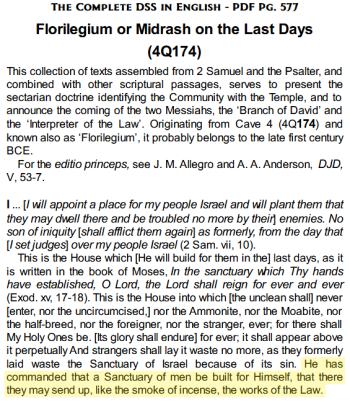
the-complete-dss-in-english-p577.png

As one will hopefully see, the above highlighted text is speaking of prayer offerings ascending like smoke from the sanctuary or sanctuaries of men, (the body-temple analogy, the same as found in the N/T writers and especially in the writings of Paul). Moreover the above text places those prayer offerings in the context of "the works of the law", which Paul so often rightly rails against.

But why does Paul so strongly emphasize his opposition to "the works of the law"? It is because he was formerly a Pharisee the son of a Pharisee, fully brought up and taught in all the mindset and carnal minded ways of the Pharisees: and the mindset of the Sadducees, Chief Priests, and Scribes were the same as the Pharisees, always viewing "the works of the law" in terms of the natural minded physical-literalism of the flesh and the mind of the flesh, (and each sect had their own lists for "the works of the law" which were not even all in agreement).

The Pharisees, Sadducees, Chief Priests, and Scribes held positions and views of "the works of the law" which were the extreme opposite of the spiritual minded man which you see exhibited in the above highlighted quote, which actually confirms Paul's teachings against the physical-minded carnal reasoning of "the works of the law" taught among the Pharisees, Sadducees, Chief Priests, and Scribes in the early first century and during the ministry of the Meshiah in the Gospel accounts.

Perhaps I might feel differently after I've read more examples, but... right now this seems like a needless splitting of hairs. Hebrew parallels set ELHM and YHVH to the same meaning, from David onward. It seems to follow that Theos and Kurios are often equivalent, though Kurios has some wiggle room in it (e.g. Psa 110:1).

It seems you are are identifying YH as someone other than YHVH. That seems unlikely to me given the theophoric naming. Who then? Yeshua? He is rightly identified as DBR~YHVH for the most part. Can you show me where DBR~YHVH is set equal to YH in parallelism? I don't see that happening.

Coming back to the Qumran manuscripts... where the tetragrammaton appears there, it is written in Paleo-Hebrew script. That happens even in their Greek manuscripts (or so I'm told, haven't actually tried reading them). Does that not make it clear who is in sight in any given verse?

I will try to come back to the above comments in another post.
 
Last edited:
  • Like
Reactions: Wick Stick