

She rejects Christ as the final sacrifice sin.Do you not consider that believing that will happen in the future contradicts what is written in other scriptures like John 4:19-24 and Hebrews 8 to 10?
Here is what Jesus said about people having to go to Jerusalem to worship.
John 4:19 The woman said to Him, “Sir, I perceive that You are a prophet. 20 Our fathers worshiped on this mountain, and you Jews say that in Jerusalem is the place where one ought to worship.” 21 Jesus said to her, “Woman, believe Me, the hour is coming when you will neither on this mountain, nor in Jerusalem, worship the Father. 22 You worship what you do not know; we know what we worship, for salvation is of the Jews. 23 But the hour is coming, and now is, when the true worshipers will worship the Father in spirit and truth; for the Father is seeking such to worship Him. 24 God is Spirit, and those who worship Him must worship in spirit and truth.”
Why would God make it so that people would no longer have to go to Jerusalem to worship while indicating that He seeks those who worship Him in spirit and in truth wherever they are located, only to once again make people go to Jerusalem to worship? Do you think God is wishy washy like that where He would make things better and then go back to the former way of doing things again? As if He will one day decide that He no longer seeks people to worship Him in spirit and truth wherever they are?
And, do you know that keeping the feast of tabernacles involves animal sacrifices and offerings? Why would future animal sacrifices and offerings occur when scripture is clear that their purpose was to foreshadow Christ's once for all sacrifice and were made obsolete by His new covenant sacrifice?
Hebrews 10:5 Therefore, when He came into the world, He said: “Sacrifice and offering You did not desire, But a body You have prepared for Me. 6 In burnt offerings and sacrifices for sin You had no pleasure. 7 Then I said, ‘Behold, I have come—In the volume of the book it is written of Me—To do Your will, O God.’ ”8 Previously saying, “Sacrifice and offering, burnt offerings, and offerings for sin You did not desire, nor had pleasure in them” (which are offered according to the law), 9 then He said, “Behold, I have come to do Your will, O God.” He takes away the first that He may establish the second. 10 By that will we have been sanctified through the offering of the body of Jesus Christ once for all.
Update on World System.
- Thread starter Marilyn C
- Start date
-
Welcome to Christian Forums, a Christian Forum that recognizes that all Christians are a work in progress.
You will need to register to be able to join in fellowship with Christians all over the world.
We hope to see you as a part of our community soon and God Bless!
You are using an out of date browser. It may not display this or other websites correctly.
You should upgrade or use an alternative browser.
You should upgrade or use an alternative browser.

The passage above shows that it will be mandatory for representatives of all the nations to attend the Feast of Tabernacles in Jerusalem every year. If a nation doesn't attend, they will suffer drought.Hi Luther,
So what about -
People will have to go up to Jerusalem to worship and celebrate the Feast of Tabernacles. If they don`t then God will not send any rain upon their land. This will cause famine, plagues, disease and death.
`And it shall be that whichever of the families of the earth do not come up to Jerusalem to worship the King, the Lord of hosts, on them there will be no rain.
If the family of Egypt will not come up and enter in, they shall have no rain; they shall receive the plague with which the lord strikes the nations who do not come up to keep the Feast of Tabernacles.` (Zech. 14: 17 & 18)
Jesus nails the Premillennial future application of this. He shows the eternal move away from the old covenant to the new covenant. He shows the movement away from apostate Christ-rejecting Jerusalem to a spiritual people located throughout the world who worship Him in Spirit and in truth.
This whole sea-change can be observed at the time when the woman of Samaria declared unto Jesus, in John 4:19-24, “Sir, I perceive that thou art a prophet. Our fathers worshipped in this mountain; and ye say, that in Jerusalem is the place where men ought to worship.”
Christ revealingly responded, “Woman, believe me, the hour cometh, when ye shall neither in this mountain, nor yet at Jerusalem, worship the Father. Ye worship ye know not what: we know what we worship: for salvation is of the Jews. But the hour cometh, and now is, when the true worshippers shall worship the Father in spirit and in truth.”
Here we see the movement away from a central geographical worship (and location), to the nations of the earth. This change came with the earthly ministry of Christ and the willful rejection of Him by the Jews. The theocratic nation was removed and replaced by a spiritual nation throughout all nations. Today we have no need to look for a brick temple in Jerusalem because we have entered into a spiritual edifice found throughout the world. God’s chosen people are “they that worship him [God] ... in spirit and in truth” (John 4:24). God’s people are a spiritual people who are spiritually circumcised.
The new structure our Lord spoke of here was a spiritual house and relates to Himself and the building of His spiritual body – the Church. Any Jew interpreting these words in a literal sense would have mistakenly assumed that the hope for the nations in the last days would arise in the form of the physical provisional earthly temple in Jerusalem rather than a new spiritual temple throughout the world.
What Christ was teaching here was that a new economy was being introduced through His earthly ministry that would forever replace the old. No longer would the worship of the living God be constrained to a natural land-mass or be centered upon a visible brick building built with hands in earthly Jerusalem, rather, it would now be concentrated in a spiritual temple (the redeemed Church) which is positionally located within the heavenly New Jerusalem. That temple would not be restricted to one ethnic nation but would rather be situated throughout all the nations of the world.
Why would God move from the focus away from the old inferior literal visible physical temporal earthly abode to the new superior spiritual invisible heavenly eternal abode and then move it regressively back to the old covenant setup? Why would we go back to the abandoned and failed Mosaic ceremonial system when Jesus has made a perfect final sacrifice for sin? As Eric asked: Is there a future day coming where Jesus is going to decide that He no longer seeks people to worship Him in spirit and truth throughout the globe? Why would we go back to the former failed way of doing things?

Spiritual Israelite
Well-Known Member
Terrible. Some people here don't even think about the ramifications of their beliefs. Sad to see.She rejects Christ as the final sacrifice sin.

Davy
Well-Known Member
No, Davy, it won't be upon this current earth. Jesus Christ is coming in glory and VICTORY over this sin cursed earth to make it NEW.
That is man's false theory of Amillennialism. One has to omit much Bible Scripture in order to believe in that doctrine. They believe the new heavens, and a new earth time begins on the day of Christ's future return. It does not. Christ Jesus must... reign for a 1,000 years over the unsaved nations, with His elect, which means the wicked and unsaved will still exist all throughout that 1,000 years. This is what Revelation 20 shows, it's what Zechariah 14 shows, it's what Ezekiel 44 and 47 shows, it's what Jesus even showed in John 5:28-29 with the "resurrection of damnation." And in Acts 24:15, Apostle Paul said it was his hope that there will also be a resurrection of the unjust. He didn't hope that just so those could be raised from the dead and then immediately judged and destroyed.
Davy
Well-Known Member
So the `plague` is heavenly language?
One can go too far either way with what no rain will cause in that future time. It's important to remember that after Lord Jesus returns, we all, including the wicked, will be in their spirit bodies. So how would no rain upon the lands of the unsaved nations affect them? They definitely wouldn't have it as good, that's for sure, because that time is prophesied to be a blessed time to enjoy all the rich things of the earth. So that drying up because of no rain definitely would affect those in spirit bodies in that time. It just would not kill them, for the only remaining death after Jesus returns is the "second death", which is the casting into the "lake of fire" after Christ's 1,000 years reign (Rev.20).
Spiritual Israelite
Well-Known Member
Yes, it does. Peter said so.That is man's false theory of Amillennialism. One has to omit much Bible Scripture in order to believe in that doctrine. They believe the new heavens, and a new earth time begins on the day of Christ's future return. It does not.
2 Peter 3:10 But the day of the Lord will come as a thief in the night, in which the heavens will pass away with a great noise, and the elements will melt with fervent heat; both the earth and the works that are in it will be burned up. 11 Therefore, since all these things will be dissolved, what manner of persons ought you to be in holy conduct and godliness, 12 looking for and hastening the coming of the day of God, because of which the heavens will be dissolved, being on fire, and the elements will melt with fervent heat? 13 Nevertheless we, according to His promise, look for new heavens and a new earth in which righteousness dwells.
When Jesus returns He will send fire upon the entire earth. This is very straightforward. Peter is describing here in detail the "sudden destruction" that Paul said will come upon unbelievers from which "they shall not escape" on the day of the Lord's return. Then Peter points out that what we look for in direct fulfillment of the promise of Christ's second coming is "new heavens and a new earth in which righteousness dwells.". You instead are looking for an earthly millennial kingdom in direct fulfillment of the promise of His second coming. Peter was clearly an Amillennialist. Listen to Peter instead of your own imagination.
You are making things up that are not taught in scripture. No one will be resurrected unto mortal life again in the future. There are no second chances at salvation after people die. In Acts 24:15 Paul said there will be a singular resurrection of the dead event and it will involve both the just and unjust. That is what Jesus taught in John 5:28-29 and what is indicated in Daniel 12:2, also. We know that the righteous dead will be resurrected when Jesus returns (1 Cor 15:22-23, 1 Thess 4:14-17), so that is when the unjust will be resurrected, also. And the judgment immediately follows that. Jesus said unbelievers will be resurrected unto damnation. Not unto mortal life again on the earth. Damnation. Forever. Once people die, they then look forward to judgment, not being resurrected unto mortal life again (Hebrews 9:27).Christ Jesus must... reign for a 1,000 years over the unsaved nations, with His elect, which means the wicked and unsaved will still exist all throughout that 1,000 years. This is what Revelation 20 shows, it's what Zechariah 14 shows, it's what Ezekiel 44 and 47 shows, it's what Jesus even showed in John 5:28-29 with the "resurrection of damnation." And in Acts 24:15, Apostle Paul said it was his hope that there will also be a resurrection of the unjust. He didn't hope that just so those could be raised from the dead and then immediately judged and destroyed.
Davy
Well-Known Member
Yes, it does. Peter said so.
....
The word "elements" in the Greek of 2 Peter 3 does not mean material elements like the atomic weight list. In the Greek it means 'a serial', pointing to a world earth age. And there is plenty of Bible Scripture to show that God does not literally destroy the whole earth on that "day of the Lord" when Jesus comes. Instead, God's consuming fire is going to burn MAN'S works off this earth, leaving the earth. This is shown at the end of Hebrews 12, so I'm surprised you've never read it.
Moreover, Zechariah 14 reveals those unsaved who will come upon Jerusalem on the last day of this world will be made to come up to Jerusalem (on earth) from year to year to worship The KING (Jesus), and keep the Feast of Tabernacles. So you want to talk about who is making things up, it's not me, it's that false doctrine from men you like called Amillennialism.
Spiritual Israelite
Well-Known Member
Yes, it absolutely does mean that. You know nothing about seeing the context of scripture. To deny that it's talking about the material elements is like denying that it's talking about the literal heavens and earth. But, you don't do that, do you?The word "elements" in the Greek of 2 Peter 3 does not mean material elements like the atomic weight list.
Nonsense. Nowhere does scripture ever speak of world earth ages. Jesus spoke of this temporal age during which people get married and die and the eternal age to come during which people will no longer get married or die (Luke 20:34-36). If you want to talk about ages, then talk about them the way Jesus did instead of making things up.In the Greek it means 'a serial', pointing to a world earth age.
There is none. You should not make a fool out of Peter like this. He knew what he was talking about. What he wrote lines up with what Paul wrote in 1 Thessalonians 5:2-3 where he said that "sudden destruction" will come upon unbelievers from which "they shall not escape". If the fire Peter wrote about doesn't come down upon the entire earth, then that would contradict what Paul wrote. If you look at what they both wrote about the day of the Lord, it's impossible to conclude that any mortals could possibly survive and escape the destruction that will occur on that day.And there is plenty of Bible Scripture to show that God does not literally destroy the whole earth on that "day of the Lord" when Jesus comes.
I have read the entire Bible, so this has nothing to do with me supposedly not reading something. It has to do with you not understanding what you read. Peter is talking about literal physical fire coming down upon the earth which he contrasted with the waters of the flood that destroyed the world long ago (2 Peter 3:6-7).Instead, God's consuming fire is going to burn MAN'S works off this earth, leaving the earth. This is shown at the end of Hebrews 12, so I'm surprised you've never read it.
LOL. That interpretation BLATANTLY contradicts these scriptures...Moreover, Zechariah 14 reveals those unsaved who will come upon Jerusalem on the last day of this world will be made to come up to Jerusalem (on earth) from year to year to worship The KING (Jesus), and keep the Feast of Tabernacles.
John 4:19 The woman said to Him, “Sir, I perceive that You are a prophet. 20 Our fathers worshiped on this mountain, and you Jews say that in Jerusalem is the place where one ought to worship.” 21 Jesus said to her, “Woman, believe Me, the hour is coming when you will neither on this mountain, nor in Jerusalem, worship the Father. 22 You worship what you do not know; we know what we worship, for salvation is of the Jews. 23 But the hour is coming, and now is, when the true worshipers will worship the Father in spirit and truth; for the Father is seeking such to worship Him. 24 God is Spirit, and those who worship Him must worship in spirit and truth.”
Why can't you see that your interpretations make a fool out of God? Long ago He made it so that people would no longer need to go to Jerusalem to worship, but instead commanded that people worship Him in spirit and truth wherever they are. Why in the world would God make things better like that only to regress to the old ways again in the future? That's utter nonsense.
Keeping the feast of tabernacles requires animal sacrifices and offerings. That will NOT happen in the future! Jesus made animal sacrifices and offerings obsolete by way of His once for all sacrifice, as it talks about in Hebrews 10.
If Amillennialism is false, then why do you utterly fail to refute it every time you attempt to do do. You arguments are extremely weak.So you want to talk about who is making things up, it's not me, it's that false doctrine from men you like called Amillennialism.
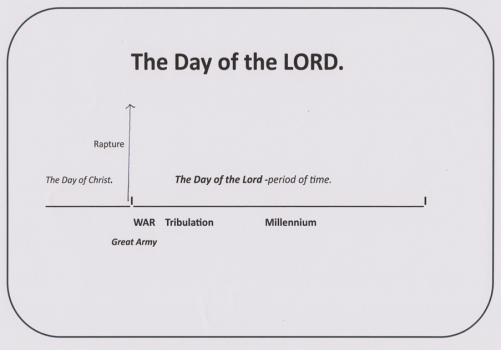
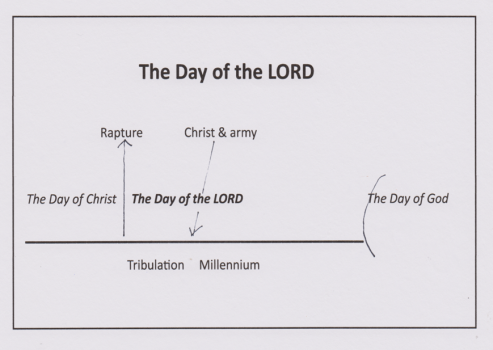

In Hebrew and Greek the word ` Day, ` refers to a period of time and a specific day. Thus context is important to know which.
1. The Day of Christ. (Phil. 1: 6 - 10) 1 Cor. 1: 7 & 8)
This period of time is not only the first in chronological order of fulfilment, but is the greatest in importance in the Divine predestinations. Each reference relates entirely and exclusively to the Church, the Body of Christ, in the specific time-slot identified with the coming of the Lord Jesus Christ. It signifies completion of the highest of God`s purposes, the supreme expression of Divine revelation.
All other expressions of His ordinations are dependent on its completion.
2. The Day of the LORD. (1 Thess. 5: 2 - 9, 2 Peter 3: 10)
This has to do with Israel and the nations and is invariably connected with the wrath of God poured out in judgment on an unbelieving world. It refers to that period of time from the termination of `The Day of Christ,` through the tribulation and millennium and terminating with the creation of the new heavens and earth which precludes `The Day of God. `
3. The Day of God. (2 Peter 3: 11 & 12)
The Day when God will purge and purify the heavens and the earth by fire. Peter is the only one who uses the phrase, `The Day of God.` (It concludes `The Day of the LORD.` )
1. The Day of Christ. (Phil. 1: 6 - 10) 1 Cor. 1: 7 & 8)
This period of time is not only the first in chronological order of fulfilment, but is the greatest in importance in the Divine predestinations. Each reference relates entirely and exclusively to the Church, the Body of Christ, in the specific time-slot identified with the coming of the Lord Jesus Christ. It signifies completion of the highest of God`s purposes, the supreme expression of Divine revelation.
All other expressions of His ordinations are dependent on its completion.
2. The Day of the LORD. (1 Thess. 5: 2 - 9, 2 Peter 3: 10)
This has to do with Israel and the nations and is invariably connected with the wrath of God poured out in judgment on an unbelieving world. It refers to that period of time from the termination of `The Day of Christ,` through the tribulation and millennium and terminating with the creation of the new heavens and earth which precludes `The Day of God. `
3. The Day of God. (2 Peter 3: 11 & 12)
The Day when God will purge and purify the heavens and the earth by fire. Peter is the only one who uses the phrase, `The Day of God.` (It concludes `The Day of the LORD.` )
Spiritual Israelite
Well-Known Member
You are trying to claim that the day of the Lord and the day of God are not referring to the same thing and using 2 Peter 3:10-12 as evidence for that. So, let's examine the text itself to see if that is actually indicated in the text.In Hebrew and Greek the word ` Day, ` refers to a period of time and a specific day. Thus context is important to know which.
1. The Day of Christ. (Phil. 1: 6 - 10) 1 Cor. 1: 7 & 8)
This period of time is not only the first in chronological order of fulfilment, but is the greatest in importance in the Divine predestinations. Each reference relates entirely and exclusively to the Church, the Body of Christ, in the specific time-slot identified with the coming of the Lord Jesus Christ. It signifies completion of the highest of God`s purposes, the supreme expression of Divine revelation.
All other expressions of His ordinations are dependent on its completion.
2. The Day of the LORD. (1 Thess. 5: 2 - 9, 2 Peter 3: 10)
This has to do with Israel and the nations and is invariably connected with the wrath of God poured out in judgment on an unbelieving world. It refers to that period of time from the termination of `The Day of Christ,` through the tribulation and millennium and terminating with the creation of the new heavens and earth which precludes `The Day of God. `
3. The Day of God. (2 Peter 3: 11 & 12)
The Day when God will purge and purify the heavens and the earth by fire. Peter is the only one who uses the phrase, `The Day of God.` (It concludes `The Day of the LORD.` )
2 Peter 3:10 But the day of the Lord will come as a thief in the night, in which the heavens will pass away with a great noise, and the elements will melt with fervent heat; both the earth and the works that are in it will be burned up. 11 Therefore, since all these things will be dissolved, what manner of persons ought you to be in holy conduct and godliness, 12 looking for and hastening the coming of the day of God, because of which the heavens will be dissolved, being on fire, and the elements will melt with fervent heat?
2 Peter 3:10 talks about the day of the Lord as being when "the heavens will pass away with a great noise, and the elements will melt with fervent heat" and also when "both the earth and the works that are in it will be burned up". That doesn't match with what you said about it at all. It appears that you are just making things up here. Like 2 Peter 3:10, we can see that 2 Peter 3:11-12 refers to the day of God as being when "the heavens will be dissolved, being on fire, and the elements will melt with fervent heat". So, what basis do you have for trying to claim that the day of the Lord and the day of God are not the same thing when both verses indicate that the day of the Lord/day of God is when the heavens will be dissolved and the elements will melt with fervent heat? Nowhere in 2 Peter 3:10-12 does Peter indicate that he's talking about a period of time there. Not even close. How can a long period of time come unexpectedly as a thief in the night? That makes no sense.
The day of Christ, the day of the Lord and the day of God are three ways of referring to the same day (Christ is the Lord and is God), which is the day when Jesus will come unexpectedly as a thief in the night and then bring down His wrath upon unbelievers with fiery "sudden destruction" from which "they shall not escape" (1 Thess 5:2-3).
They refer to different purposes of God as I previously write -The day of Christ, the day of the Lord and the day of God are three ways of referring to the same day (Christ is the Lord and is God), which is the day when Jesus will come unexpectedly as a thief in the night and then bring down His wrath upon unbelievers with fiery "sudden destruction" from which "they shall not escape" (1 Thess 5:2-3).
The Day of Christ - building up the Body of Christ and coming for them. (1 Cor. 1 : 8)
The Day of the LORD (God Almighty) in judgment upon the rebellious. (Rev. 15: 7)
The Day of God when all things are made new. ( 2 Peter 3: 12)
Spiritual Israelite
Well-Known Member
No, they do not. I showed you that 2 Peter 3:10 refers to the same things as 2 Peter 3:12 does (heavens passing away/dissolving, elements melting with fervent heat), so there is no basis whatsoever for claiming that 2 Peter 3:10 is talking about something different than 2 Peter 3:12. Peter referred to the day of the Lord and the day of God in the exact same context.They refer to different purposes of God as I previously write -
The Day of Christ - building up the Body of Christ and coming for them. (1 Cor. 1 : 8)
The Day of the LORD (God Almighty) in judgment upon the rebellious. (Rev. 15: 7)
The Day of God when all things are made new. ( 2 Peter 3: 12)
So, SI it seems you think God uses those names interchangeably. Let`s have a closer look.No, they do not. I showed you that 2 Peter 3:10 refers to the same things as 2 Peter 3:12 does (heavens passing away/dissolving, elements melting with fervent heat), so there is no basis whatsoever for claiming that 2 Peter 3:10 is talking about something different than 2 Peter 3:12. Peter referred to the day of the Lord and the day of God in the exact same context.
`The LORD said to my Lord, "Sit at my right hand...` (Ps. 110: 1)
So is the LORD talking to Himself? If, as you say the words mean the same. Of course the LORD is not talking to Himself but to His Son, the Lord Jesus Christ.
The LORD (Father) "Sit at my right hand...
The Lord, (Lord Jesus Christ) sitting at the Father`s right hand.
And for God (Father Son and Holy Spirit) who will be over all in the New heavens and New earth. (1 Cor. 15: 28_
PeterAndroz
Active Member
This 'trinity' tag upsets and confuses so many people.So, SI it seems you think God uses those names interchangeably. Let`s have a closer look.
`The LORD said to my Lord, "Sit at my right hand...` (Ps. 110: 1)
So is the LORD talking to Himself? If, as you say the words mean the same. Of course the LORD is not talking to Himself but to His Son, the Lord Jesus Christ.
The LORD (Father) "Sit at my right hand...
The Lord, (Lord Jesus Christ) sitting at the Father`s right hand.
And for God (Father Son and Holy Spirit) who will be over all in the New heavens and New earth. (1 Cor. 15: 28_
A simpler way is just to accept & believe that The Father, The HS, Christ in some intelligent form existed before Gen 1:1, John 1:1 and continue to do so.
Davy
Well-Known Member
Yes, it absolutely does mean that. You know nothing about seeing the context of scripture. To deny that it's talking about the material elements is like denying that it's talking about the literal heavens and earth. But, you don't do that, do you?
Does not.
NT:4747
stoicheion (stoy-khi'-on); neuter of a presumed derivative of the base of NT:4748; something orderly in arrangement, i.e. (by implication) a serial (basal, fundamental, initial) constituent (literally), proposition (figuratively):
KJV - element, principle, rudiment.
(Biblesoft's New Exhaustive Strong's Numbers and Concordance with Expanded Greek-Hebrew Dictionary. Copyright © 1994, 2003, 2006, 2010 Biblesoft, Inc. and International Bible Translators, Inc.)
As Peter was covering about the 3 world earth ages in that 2 Peter 3 Chapter, an orderly arrangement is what he was referring to, and in the case of the 10th verse it is about this present world time.
Did God completely destroy the earth at the flood of Noah's day? No, but only cleansed the earth's surface. Same thing will happen on the "day of the Lord", except using God's consuming fire this next time.
Heb 12:25-29
25 See that ye refuse not Him That speaketh. For if they escaped not who refused Him That spake on earth, much more shall not we escape, if we turn away from Him That speaketh from heaven:
26 Whose voice then shook the earth: but now He hath promised, saying, 'Yet once more I shake not the earth only, but also heaven.'
27 And this word, 'Yet once more', signifieth the removing of those things that are shaken, as of things that are made, that those things which cannot be shaken may remain.
28 Wherefore we receiving a kingdom which cannot be moved, let us have grace, whereby we may serve God acceptably with reverence and godly fear:
29 For our God is a consuming fire.
KJV
Your mocking won't help you understand the above. Nor will it deter others into believing you.
Spiritual Israelite
Well-Known Member
Scripture does. That is very clear. Why will you not address what I said about 2 Peter 3:10 in comparison to 2 Peter 3:12? You try to claim those verses are not speaking about the same thing when they so clearly are. How can a reference to the day when the heavens pass away with the elements melting with fervent heat not by the same day when the heavens dissolve with the elements melting with fervent heat?So, SI it seems you think God uses those names interchangeably.
You are going out of your way to try to deny the obvious. The references to the day of Christ, day of the Lord and day of God always refer to the day that Jesus returns. Jesus is the Lord and He is God, so they all refer to the day He will return and bring "sudden destruction" by fire upon the earth from which unbelievers "shall not escape" (1 Thess 5:2-3, 2 Peter 3:10-12). If the day of the Lord refers to the day of God the Father in contrast to the day of Christ, as you seem to be trying to claim, then who do you think God refers to in "the day of God"?Let`s have a closer look.
`The LORD said to my Lord, "Sit at my right hand...` (Ps. 110: 1)
So is the LORD talking to Himself? If, as you say the words mean the same. Of course the LORD is not talking to Himself but to His Son, the Lord Jesus Christ.
The LORD (Father) "Sit at my right hand...
The Lord, (Lord Jesus Christ) sitting at the Father`s right hand.
And for God (Father Son and Holy Spirit) who will be over all in the New heavens and New earth. (1 Cor. 15: 28_
Spiritual Israelite
Well-Known Member
Showing only one of the definitions of the Greek word "stoicheion" is very misleading and seems to be purposely deceptive on your part.Does not.
NT:4747
stoicheion (stoy-khi'-on); neuter of a presumed derivative of the base of NT:4748; something orderly in arrangement, i.e. (by implication) a serial (basal, fundamental, initial) constituent (literally), proposition (figuratively):
KJV - element, principle, rudiment.
(Biblesoft's New Exhaustive Strong's Numbers and Concordance with Expanded Greek-Hebrew Dictionary. Copyright © 1994, 2003, 2006, 2010 Biblesoft, Inc. and International Bible Translators, Inc.)
From blueletterbible.org....
stoicheion (pronounced stoy-khi'-on)
Outline of Biblical Usage [?]
- any first thing, from which the others belonging to some series or composite whole take their rise, an element, first principal
- the letters of the alphabet as the elements of speech, not however the written characters, but the spoken sounds
- the elements from which all things have come, the material causes of the universe
- the heavenly bodies, either as parts of the heavens or (as others think) because in them the elements of man, life and destiny were supposed to reside
- the elements, rudiments, primary and fundamental principles of any art, science, or discipline
- i.e. of mathematics, Euclid's geometry
Thayer's Greek Lexicon:
STRONGS G4747:
στοιχεῖον, στοιχειου, τό (from στοῖχος a row, rank, series; hence, properly, that which belongs to any στοῖχος, that of which a στοῖχος is composed; hence), "any first thing, from which the others belonging to some series or composite whole take their rise; an element, first principle".
The word denotes specifically:
1. the letters of the alphabet as the elements of speech, not however the written characters (which are called γράμματα), but the spoken sounds: στοιχεῖον φωνῆς φωνή ἀσύνθετος, Plato definition, p. 414 e.; τό ῥω τό στοιχεῖον, id. Crat., p. 426 d.; στοιχεῖον ἐστι φωνή ἀδιαιρετος, οὐ πᾶσα δέ, ἀλλ' ἐξ ἧς πεφυκε συνετή γίγνεσθαι φωνή, Aristotle, poet. 20, p. 1456{b}, 22.
2. the elements from which all things have come, the material causes of the universe (ἐστι δέ στοιχεῖον, ἐξ οὗ πρώτου γίνεται τά γινόμενα καί εἰς ὁ ἔσχατον ἀναλύεται... τό πῦρ, τό ὕδωρ, ὁ ἀήρ, ἡ γῆ, (Diogenes Laërtius Zeno 137); so very often from Plato down, as in Tim., p. 48 b.; in the Scriptures: Wis. 7:17 Wis. 19:17; 2 Peter 3:10, 12.
3. the heavenly bodies (omitting further commentary to save space)
4. the elements, rudiments, primary and fundamental principles (cf. our 'alphabet' or 'a b c') of any art, science, or discipline; e. g. of mathematics, as in the title of Euclid's well-known work (omitting further commentary to save space).
I have talked to you about this before and you obviously have forgotten what I said. I did not say, and have never said, that I believe the earth will be annihilated. I've told you that before multiple times. I believe the entire earth surface will have fire come down upon it and it will be renewed, resulting in the new earth. How can any mortal survive fire coming down upon the entire earth's surface? Not possible. Also, all unbelievers in the world were killed by the flood of Noah's day. Jesus said the same will happen when He comes again (Matthew 24:35-39). And believers will all have immortal bodies at that point. That does not leave any mortals to populate the earth at that point.As Peter was covering about the 3 world earth ages in that 2 Peter 3 Chapter, an orderly arrangement is what he was referring to, and in the case of the 10th verse it is about this present world time.
Did God completely destroy the earth at the flood of Noah's day? No, but only cleansed the earth's surface. Same thing will happen on the "day of the Lord", except using God's consuming fire this next time.
My mocking is of you blatantly twisting scripture the way you do with 2 Peter 3:10-12. My view agrees with what is described in Hebrews 12:25-29, so it's foolish to try to use that passage against me. It just shows that you don't understand what I believe.Heb 12:25-29
25 See that ye refuse not Him That speaketh. For if they escaped not who refused Him That spake on earth, much more shall not we escape, if we turn away from Him That speaketh from heaven:
26 Whose voice then shook the earth: but now He hath promised, saying, 'Yet once more I shake not the earth only, but also heaven.'
27 And this word, 'Yet once more', signifieth the removing of those things that are shaken, as of things that are made, that those things which cannot be shaken may remain.
28 Wherefore we receiving a kingdom which cannot be moved, let us have grace, whereby we may serve God acceptably with reverence and godly fear:
29 For our God is a consuming fire.
KJV
Your mocking won't help you understand the above. Nor will it deter others into believing you.
He is reigning now. Hello! Do you deny that?That is man's false theory of Amillennialism. One has to omit much Bible Scripture in order to believe in that doctrine. They believe the new heavens, and a new earth time begins on the day of Christ's future return. It does not. Christ Jesus must... reign for a 1,000 years over the unsaved nations, with His elect, which means the wicked and unsaved will still exist all throughout that 1,000 years. This is what Revelation 20 shows, it's what Zechariah 14 shows, it's what Ezekiel 44 and 47 shows, it's what Jesus even showed in John 5:28-29 with the "resurrection of damnation." And in Acts 24:15, Apostle Paul said it was his hope that there will also be a resurrection of the unjust. He didn't hope that just so those could be raised from the dead and then immediately judged and destroyed.
Similar threads
- Replies
- 0
- Views
- 45
- Replies
- 5
- Views
- 142

- Replies
- 7
- Views
- 145

- Replies
- 270
- Views
- 5K