No, you either didn't follow the links or you opened one of them twice. The first half of the first article:
"Christian readers are sometimes puzzled when they read a quotation from the Old Testament in the New Testament, and then, in looking up the quoted Old Testament text in their Bible, they discover that it is somewhat different from the cited quotation in the New Testament. Often, this difference is based on the fact that the Old Testament has been translated from Hebrew Scripture Master Texts which are primarily based the manuscripts of the Hebrew Bible from the Masoretic text of t
he 6th to 10th centuries C.E., whereas the New Testament is citing the same passage as it appears in the early Greek translation of the Old Testament, known as the Greek Septuagint Version (LXX).
The fact is that the writers of the New Testament generally quoted or paraphrased their quotes of the Old Testament from the LXX.
The Greek Septuagint was used by Hellenistic Jews, and by the early church. Greek was the international language of communication. Most scholars believe that the Greek translation of the Pentateuch (Genesis through Deuteronomy) was produced by Jewish scholars in the mid-to-late-third century B.C.E. in Alexandria, Egypt. The rest of the Old Testament was completed during the following century or so. Apocryphal writings were added after this. This means the Septuagint was virtually complete about 150-200 years before the time of Christ. Some parts of the Septuagint reflect a more literal approach to translation, while others provide a freer rendition. Some portions are also more skillfully translated than others. Sometimes the Septuagint translators translated from a Hebrew text that differed slightly from the later, now standard, Masoretic text of the Hebrew Bible.
The Greek Septuagint Version (LXX) has been preserved in many Greek manuscripts, most them fragmentary, but some of the fairly complete. The most famous of these are the Vatican Manuscript 1209 (almo
st 100% complete), and the Sinaitic Manuscript (only partial), both of t
he 4th century, and the Alexandrine Manuscript (mostly complete, except for parts of Genesis, 1 Samuel and Psalms) of t
he 5th century.
The Septuagint (LXX) is the version of the Old Testament with which early Greek-speaking Christians would have been familiar. It had been used by most Jews in the Roman Empire. Naturally, then, most of the Old Testament quotations found in the New Testament reflect its influence. There are about 90 direct quotations in the New Testament from the LXX, and about 80 paraphrases or allusions to it. In the vast majority of instances the Septuagint agrees with the Masoretic text—if not word-for-word, at least in basic thrust. In a few cases the Septuagint may even reflect the original Hebrew text better than the Masoretic text does. The Masoretic text may, for instance, contain a copyist’s error, so that it does not at a given point accurately reflect the original Hebrew text. Sometimes, in such cases, the Greek reading in the Septuagint allows scholars to reconstruct what was in the original Hebrew manuscript (most modern translations of the Old Testament are based on the Masoretic text, with occasional emendations drawn from the Septuagint and other early Versions). This fact gives evidence to support what the scriptures say about God preserving his word:
“All people are like grass, and all their glory is like flowers of the field; the grass withers and the flowers fall, but the word of the Lord endures forever”—1 Peter 1:24,25 NIV"
The entire second article:
"Sometimes when a New Testament writer quotes the Old Testament, the two passages do not match precisely. Is the New Testament writer misquoting the Old Testament? Or is there another explanation?
Luke records that when Jesus began his ministry, he went to the synagogue in Nazareth on the Sabbath day. When he stood up to read the Scriptures, “The scroll of the prophet Isaiah was given to him” (
Luke 4:17

). Jesus read the description of a climactic arrival of the anointed one from
Isaiah 61:1–2
, excluding the last half of verse two. That omission is understandable, but if you look at
Luke 4:18–19
and
Isaiah 61:1–2
side by side, several dissimilarities in what Jesus read are readily apparent.
In the original Old Testament passage, there is no reference to making the blind see. Conversely, Isaiah speaks of “binding up the brokenhearted,” a phrase absent in Luke. Since Luke is clear that Jesus was reading from a scroll, the divergence is not due to Luke (or Jesus) quoting from memory and messing up the passage! What’s going on here?
The Spirit of the Lord is upon me,
because he has anointed me to proclaim good news to the poor. He has sent me to proclaim liberty to the captives and recovering of sight to the blind, to set at liberty those who are oppressed, to proclaim the year of the Lord’s favor. (Luke 4:18–19
)
The Spirit of the Lord God is upon me, because the Lord has anointed me to bring good news to the poor; he has sent me to bind up the brokenhearted, to proclaim liberty to the captives, and the opening of the prison to those who are bound; to proclaim the year of the Lord’s favor. (Isaiah 61:1–2
)
Most of the time when a divergence occurs between a New Testament quotation and the Old Testament, the answer is the Septuagint, the ancient Greek translation of the Hebrew Bible. It often does not match the Hebrew text from which most Old Testaments were translated. Jesus apparently either read from a Hebrew text that reflected the Septuagint, or Luke fills in the quoted passage with the Septuagint. (And since Luke was not Jewish and spoke Greek, the Septuagint would have been his Bible.)
The Septuagint version of
Isaiah 61:1–2
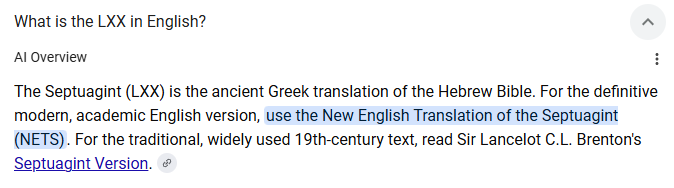
reads, “The spirit of the Lord is upon me, because he has anointed me; he has sent me to bring good news to the poor, to heal the brokenhearted, to proclaim the release of the captives, and recovery of sight to the blind, to summon the acceptable year of the Lord” (NETS). Jesus (or Luke) gets the “recovery of sight to the blind” line from the Septuagint. The Septuagint also contains a line from the traditional Old Testament that isn’t in Luke’s record!
This example shows that it’s worth our time to check cross-references, especially in quotations. Do it yourself by comparing New Testament quotations
both to translations of the traditional Hebrew text, like the NASB or ESV, and an up-to-date English translation of the Septuagint.
We often don’t realize that even biblical writers depended on translations that they considered the Word of God. In the same manner, we can consider our own translations the Word of God."
Different articles, different sites.