


TORAH PORTION: "VaYetze" (and he went out) Genesis 28:10-32:3
Theme: Jacob's Ladder...or..God's Ladder
We continue our study of Jacob's life. He needs to leave his encampment quickly. With Esau breathing death threats for having deceived his father Isaac and getting HIS blessing, Isaac and Rebecca send him away. Get him away from Esau, and allow him to start a new life in Haran by marrying kinfolk. It seems rather strange that Isaac holds no anger nor grudge against his son Jacob for having deceived him, and wishes his welfare instead. Isaac echoes the love that our Heavenly Father has for us, in that even though we offend Him in many ways, living in the flesh, at times deceitfulness, even amongst brethren, He has forgiven us from the Cross of Calvary all of our trespasses, past, present, and future. We need just to come to HIM, in repentance, "Teshuvah," and lay down our offenses and ask forgiveness. Jacob is forgiven, yet the "chickens will come home to roost"; "What goes around comes around." He will learn a tough lesson or two at Uncle Laban's School of Hard Knocks.
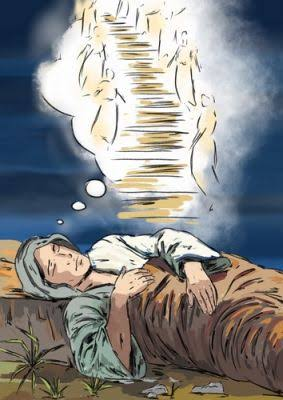
The trip from Beersheva to Haran is about 800 Kilometers, or about 500 miles. So this trip is not short by any means. He leaves Beersheba and gets halfway there, so about midway, he lies down to rest for the night as usual. A healthy person could walk about 20 miles per day at a normal pace, so a 500-mile trip might take about 25 or 30 days. At this place called "Luz" (Almond tree in the Canaanite language). He gathers stones together to make a shelter, and a large flat stone (probably) to rest his head on, and then falls asleep. He dreams of a ladder that extends from the Earth up to the Heavens and sees angels going up and down on the ladder; YHVH is there, on the top or beside the ladder. The Hebrew word used is "Alav," which can mean on top of, over, above, against, or beside. He then speaks to Jacob, reminding him of the promise to Isaac and Abraham (Gen 28:13-15)
13 And behold, the Lord stood above it, and said, I am the Lord God of Abraham thy father, and the God of Isaac: the land, upon the which thou sleepest, [a]will I give thee and thy seed.
14 And thy seed shall be as the dust of the earth, and thou shalt spread abroad to the West, and to the East, and to the North, and to the South, and in thee and in thy seed shall all the families of the earth be blessed.
15 And lo, I am with thee, and will keep thee whithersoever thou goest, and will bring thee again into this land: for I will not forsake thee until I have performed that, that I have promised thee.
Jacob then awakes and marvels at this unique experience. "The LORD was here, and I did not know it," he says. In Canaan, the Canaanites have many gods/dieties and they made statues/idols and placed them everywhere, yet Jacob realizes that his GOD (YHVH) is invisible, and that no statue is needed to represent HIM, so, YES, he is THERE, too, yet cannot be seen. Our LORD is everywhere, and no statue is needed to help remind us of HIS presence. When Yeshua left for Heaven, he sent the Ruach HaKodesh (The Holy Spirit) to accompany us and to be with us everywhere and at all times. "God in the flesh" (as Yeshua) could only be in one place at a time, but with the Holy Spirit, HE is with us ALL, All the time.
He takes the stone that was under his head and sets it up as a pillar and anoints it with oil, and renames the place "Beth-El" or the "House of God." "The Gate or Door of Heaven." We can see some Messianic Symbolism here, as Yeshua was the "Stone that the Builders rejected" and the "Chief Cornerstone." He was anointed by the Father to serve, to heal, to teach Torah, and to be the 2nd Adam, to pay the price of sin with his own lifeblood. He is also called the "Door": "I am the door. If anyone enters by me, he will be saved and will go in and out and find pasture." (John 10:9) So, Yeshua IS the Gate or Door to Heaven.
There is more symbolism in the Hebrew spelling of the word "Ladder," which is "Sulam," spelled with 3 letters: S+L+M (as the vowels are not written) In the ancient Hebrew symbolism, the letter meanings can say: "The Ladder is a support (to lean on) in instruction to the multitudes." YESHUA is our support, and so is the WORD of God (our instruction), for ALL MANKIND (the multitudes) It also has a value of 130 in Hebrew gematria, which means that when we see another word with the same value, there is a connection. The other word is "Sinai" which is also equal to 130. Where is the connection? Moses went up and down Mt. Sinai to receive the WORD of God, and God came down from Mt. Sinai to live with his people. Yeshua also came DOWN from Heaven to live among men and teach and serve. The angels also went up and down the ladder, also, to serve? Carry messages, perhaps? So, does the ladder have a deeper meaning? Is the ladder really a person? "Yeshua HaSulam?" (Yeshua the Ladder?) What does John 1:51 say?
“Very truly I tell you, you will see ‘heaven open, and the angels of God ascending and descending on the Son of Man.” So there we have it. Yeshua is the Ladder in Jacob's dream; it was GOD's ladder that extended to Earth so that a way could be available to reach Heaven, and that "Way" is through Yeshua. (John 14:6) Now Jacob is going to reap what he sowed. He reaches Haran, probably 15 days later, from Beth-El, and meets cousin Rachel at the well. Rebecca was met at the same well by Eliezer; Moses met Zipporah at a well; Yeshua met the Samaritan woman at a well. A water well means "life," especially in a hot desert. Yeshua is the "Living Water" who gives us "spiritual life"
In Haran, Uncle Laban receives Jacob. "Welcome, my boy, stay with us for a month, but after that, no more free room and board." He needs to work for Uncle Laban. The price? Rachel is the price: 7 years for Rachel. To Jacob, it was worth the wait; he got to know Rachel. We are the beloved bride for the bridegroom, Yeshua. He is getting to know us, and we are getting to know HIM. He is waiting, and the wait is a lot longer than 7 years. Only the Father knows the wedding date. Jacob takes his beloved bride inside the tent on his wedding day, yet lo and behold, it was Rachel's sister, "Leah!" To this day, at Jewish weddings, the bridegroom lifts the veil of his wife-to-be to make sure it isn't someone else. Jacob ends up working another 7 years for Rachel, and then 6 years for his livelihood. If Jacob were alive in this day and age, he would probably be a cowboy or a rancher in Texas with a lot of cattle, sheep, and goats and would be wearing jeans, cowboy boots, and a 10-gallon hat.
Jacob reaped what he sowed. He pretended to be the oldest (Esau), yet he was the youngest. He thought he was getting the youngest (Rachel) when he married the oldest (Leah). He deceived his father Isaac in the dark (Isaac was blind), and in the darkness of the tent at night, he was deceived. What goes around comes around. Yet Jacob is still blessed. At the end of his 20 years with Laban in Haran, he has his 12 sons and 1 daughter (Dinah), and here is the beginning of the promise of God: the 12 sons who will be the roots of the Nation of Israel. Jacob lacks one more thing: to be reconciled with his brother Esau.
As believers, we might be green around the ears and have some rough edges, yet the Master Potter is continuously reshaping us and making us into vessels of honor, even though we may have to go through Uncle's School of Hard Knocks. The bridegroom is awaiting us; we need to be the faithful bride. We are the "Beth-El," the "Household of God," the called-out believers who are climbing the Ladder of God, Yeshua HaSulam!.
Theme: Jacob's Ladder...or..God's Ladder
We continue our study of Jacob's life. He needs to leave his encampment quickly. With Esau breathing death threats for having deceived his father Isaac and getting HIS blessing, Isaac and Rebecca send him away. Get him away from Esau, and allow him to start a new life in Haran by marrying kinfolk. It seems rather strange that Isaac holds no anger nor grudge against his son Jacob for having deceived him, and wishes his welfare instead. Isaac echoes the love that our Heavenly Father has for us, in that even though we offend Him in many ways, living in the flesh, at times deceitfulness, even amongst brethren, He has forgiven us from the Cross of Calvary all of our trespasses, past, present, and future. We need just to come to HIM, in repentance, "Teshuvah," and lay down our offenses and ask forgiveness. Jacob is forgiven, yet the "chickens will come home to roost"; "What goes around comes around." He will learn a tough lesson or two at Uncle Laban's School of Hard Knocks.
The trip from Beersheva to Haran is about 800 Kilometers, or about 500 miles. So this trip is not short by any means. He leaves Beersheba and gets halfway there, so about midway, he lies down to rest for the night as usual. A healthy person could walk about 20 miles per day at a normal pace, so a 500-mile trip might take about 25 or 30 days. At this place called "Luz" (Almond tree in the Canaanite language). He gathers stones together to make a shelter, and a large flat stone (probably) to rest his head on, and then falls asleep. He dreams of a ladder that extends from the Earth up to the Heavens and sees angels going up and down on the ladder; YHVH is there, on the top or beside the ladder. The Hebrew word used is "Alav," which can mean on top of, over, above, against, or beside. He then speaks to Jacob, reminding him of the promise to Isaac and Abraham (Gen 28:13-15)
13 And behold, the Lord stood above it, and said, I am the Lord God of Abraham thy father, and the God of Isaac: the land, upon the which thou sleepest, [a]will I give thee and thy seed.
14 And thy seed shall be as the dust of the earth, and thou shalt spread abroad to the West, and to the East, and to the North, and to the South, and in thee and in thy seed shall all the families of the earth be blessed.
15 And lo, I am with thee, and will keep thee whithersoever thou goest, and will bring thee again into this land: for I will not forsake thee until I have performed that, that I have promised thee.
Jacob then awakes and marvels at this unique experience. "The LORD was here, and I did not know it," he says. In Canaan, the Canaanites have many gods/dieties and they made statues/idols and placed them everywhere, yet Jacob realizes that his GOD (YHVH) is invisible, and that no statue is needed to represent HIM, so, YES, he is THERE, too, yet cannot be seen. Our LORD is everywhere, and no statue is needed to help remind us of HIS presence. When Yeshua left for Heaven, he sent the Ruach HaKodesh (The Holy Spirit) to accompany us and to be with us everywhere and at all times. "God in the flesh" (as Yeshua) could only be in one place at a time, but with the Holy Spirit, HE is with us ALL, All the time.
He takes the stone that was under his head and sets it up as a pillar and anoints it with oil, and renames the place "Beth-El" or the "House of God." "The Gate or Door of Heaven." We can see some Messianic Symbolism here, as Yeshua was the "Stone that the Builders rejected" and the "Chief Cornerstone." He was anointed by the Father to serve, to heal, to teach Torah, and to be the 2nd Adam, to pay the price of sin with his own lifeblood. He is also called the "Door": "I am the door. If anyone enters by me, he will be saved and will go in and out and find pasture." (John 10:9) So, Yeshua IS the Gate or Door to Heaven.
There is more symbolism in the Hebrew spelling of the word "Ladder," which is "Sulam," spelled with 3 letters: S+L+M (as the vowels are not written) In the ancient Hebrew symbolism, the letter meanings can say: "The Ladder is a support (to lean on) in instruction to the multitudes." YESHUA is our support, and so is the WORD of God (our instruction), for ALL MANKIND (the multitudes) It also has a value of 130 in Hebrew gematria, which means that when we see another word with the same value, there is a connection. The other word is "Sinai" which is also equal to 130. Where is the connection? Moses went up and down Mt. Sinai to receive the WORD of God, and God came down from Mt. Sinai to live with his people. Yeshua also came DOWN from Heaven to live among men and teach and serve. The angels also went up and down the ladder, also, to serve? Carry messages, perhaps? So, does the ladder have a deeper meaning? Is the ladder really a person? "Yeshua HaSulam?" (Yeshua the Ladder?) What does John 1:51 say?
“Very truly I tell you, you will see ‘heaven open, and the angels of God ascending and descending on the Son of Man.” So there we have it. Yeshua is the Ladder in Jacob's dream; it was GOD's ladder that extended to Earth so that a way could be available to reach Heaven, and that "Way" is through Yeshua. (John 14:6) Now Jacob is going to reap what he sowed. He reaches Haran, probably 15 days later, from Beth-El, and meets cousin Rachel at the well. Rebecca was met at the same well by Eliezer; Moses met Zipporah at a well; Yeshua met the Samaritan woman at a well. A water well means "life," especially in a hot desert. Yeshua is the "Living Water" who gives us "spiritual life"
In Haran, Uncle Laban receives Jacob. "Welcome, my boy, stay with us for a month, but after that, no more free room and board." He needs to work for Uncle Laban. The price? Rachel is the price: 7 years for Rachel. To Jacob, it was worth the wait; he got to know Rachel. We are the beloved bride for the bridegroom, Yeshua. He is getting to know us, and we are getting to know HIM. He is waiting, and the wait is a lot longer than 7 years. Only the Father knows the wedding date. Jacob takes his beloved bride inside the tent on his wedding day, yet lo and behold, it was Rachel's sister, "Leah!" To this day, at Jewish weddings, the bridegroom lifts the veil of his wife-to-be to make sure it isn't someone else. Jacob ends up working another 7 years for Rachel, and then 6 years for his livelihood. If Jacob were alive in this day and age, he would probably be a cowboy or a rancher in Texas with a lot of cattle, sheep, and goats and would be wearing jeans, cowboy boots, and a 10-gallon hat.
Jacob reaped what he sowed. He pretended to be the oldest (Esau), yet he was the youngest. He thought he was getting the youngest (Rachel) when he married the oldest (Leah). He deceived his father Isaac in the dark (Isaac was blind), and in the darkness of the tent at night, he was deceived. What goes around comes around. Yet Jacob is still blessed. At the end of his 20 years with Laban in Haran, he has his 12 sons and 1 daughter (Dinah), and here is the beginning of the promise of God: the 12 sons who will be the roots of the Nation of Israel. Jacob lacks one more thing: to be reconciled with his brother Esau.
As believers, we might be green around the ears and have some rough edges, yet the Master Potter is continuously reshaping us and making us into vessels of honor, even though we may have to go through Uncle's School of Hard Knocks. The bridegroom is awaiting us; we need to be the faithful bride. We are the "Beth-El," the "Household of God," the called-out believers who are climbing the Ladder of God, Yeshua HaSulam!.


