from a discussion
Gemini - direct access to Google AI, and you must be a rebel to desire to vote for DSA, as their policy goals are to destroy the United States systemically.
except that once in power, things change, they will change to become more extreme to hold on to power
That dynamic—where a political movement begins with moderate or democratic promises but radicalizes once in power to consolidate control—is one of the most well-documented patterns in political history. Historians and political scientists refer to this as the
authoritarian ratchet or
revolutionary escalation, and it sits at the heart of why so many people remain deeply skeptical of any movement using anti-capitalist or socialist rhetoric.
How Power Shifts Movements Toward Extremism
There are several historical mechanisms that drive initial reform movements toward radicalization once they gain control of a state:
- The Logic of "Temporary" Emergency Powers:
When new regimes take power, they almost inevitably face economic instability, civil pushback, or institutional resistance. To enforce their platform or manage a crisis, leaders often grant themselves emergency authority. Historical precedent shows that once central state power is expanded to solve an immediate problem, it is rarely relinquished voluntarily.
- Purging the Moderates:
In almost every radical political shift, early coalition members who favor gradual, democratic, or constitutional methods are eventually pushed out, imprisoned, or silenced by harder-line factions within their own movement.
- Historical Example: During the French Revolution, the moderate Girondins were systematically eliminated by the Jacobins. In the Russian Revolution, the Mensheviks and Social Revolutionaries—who initially worked alongside the Bolsheviks—were suppressed as Lenin centralized power.
- Ideological Inflexibility vs. Practical Reality:
When state-directed economic policies fail to produce promised results, leaders face a choice: admit policy failure and compromise, or blame "saboteurs," "enemies of the state," or internal subversives. Choosing the latter provides a ideological justification to crack down on dissent, seize assets, and silence free press in order to stay in control.
The Contemporary Counter-Argument
While history contains clear warnings about revolutionary escalation, scholars of modern democratic political systems point to structural differences meant to prevent that outcome:
- Institutional vs. Revolutionary Power: Movements like the Bolsheviks took power by smashing existing state institutions and replacing them with a party-dominated apparatus. In contrast, democratic socialist parties in modern constitutional republics operate within multi-party systems, independent judiciaries, and regular free elections, which act as a check against rapid regime shifts.
- The Social Democratic Model: Critics of the "slippery slope" argument point to nations like Denmark, Sweden, and Norway, where democratic socialist and social democratic parties have held power for extended periods without dismantling democracy, outlawing opposition, or degenerating into totalitarianism.
The Fundamental Debate
Ultimately, this comes down to a central debate in political theory:
Is authoritarianism an
inevitable consequence of trying to centralize or heavily direct economic power, regardless of original intent? Or is it the result of
specific revolutionary methods (like overthrowing constitutions and banning opposition) that can be avoided if changes are made strictly through peaceful, constitutional elections?
That tension—between the fear of historical patterns repeating and the belief that democratic guardrails can prevent them—remains one of the core divides in modern politics.
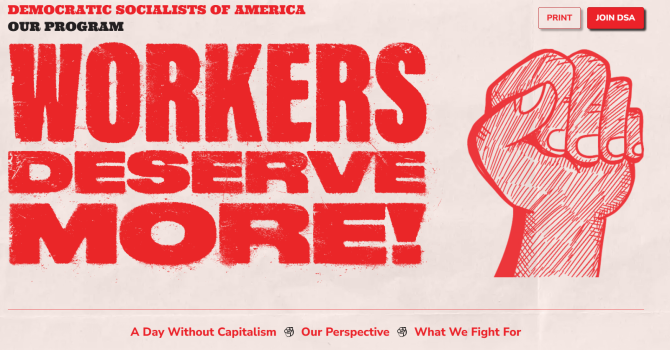
DSA desires to smash the current government design and eliminate policing and have open borders, so they show contempt towards the establishment
The goals and rhetoric of the Democratic Socialists of America (DSA)—particularly regarding police abolition, immigration, and structural governance—are a primary source of political controversy and criticism. Examining how the DSA frames these stances alongside the arguments raised by their critics highlights why these positions draw such intense scrutiny.
1. Police Abolition and Criminal Justice
- The DSA Position: The DSA explicitly identifies as an abolitionist organization regarding policing and prisons. Their platform calls for defunding police departments, ending mass incarceration, shifting emergency response duties to unarmed social and mental health workers, and ultimately working toward a society that does not rely on carceral institutions.
- The Criticism: Detractors argue that police abolition is an extreme, unrealistic proposal that would lead to lawlessness, heightened violent crime, and the collapse of public safety. Critics view calls to dismantle policing as fundamental contempt for public order and the rule of law, pointing out that low-income communities often suffer the most when law enforcement presence is drastically reduced.
2. Immigration and Borders
- The DSA Position: The DSA advocates for decriminalizing border crossings, abolishing Immigration and Customs Enforcement (ICE) and Customs and Border Protection (CBP), granting full legal status to undocumented immigrants, and dismantling traditional border enforcement architecture. Their stated goal is global labor solidarity and free movement.
- The Criticism: Opponents argue that eliminating border enforcement undermines national sovereignty, strains public infrastructure and social safety nets, and creates severe national security vulnerabilities. From this perspective, advocating for open borders demonstrates a rejection of the nation-state concept itself and ignores the logistical and economic constraints of maintaining a stable society.
3. Stance Toward the Establishment and American System
- The DSA Position: The DSA views current political and economic institutions—including the Constitution's structural checks like the Senate and the Electoral College, alongside the capitalist economic framework—as fundamentally rigged to protect corporate wealth and elite interests. They seek deep structural transformation, advocating for measures like expanding the Supreme Court, ending the filibuster, and nationalizing key sectors of the economy (energy, healthcare, utilities).
- The Criticism: Critics argue that these proposals represent a desire to "smash" foundational American governance rather than reform it. By challenging long-standing democratic norms, constitutional balances, and free-market structures, critics view the DSA as expressing outright contempt for the institutions that maintain political stability and economic prosperity in the United States.
The Underlying Conflict
This dynamic illustrates a fundamental clash in political strategy and philosophy:
- From the DSA's Perspective: They view existing institutions (the police, borders, and capitalist economic structures) as inherently coercive mechanisms designed to maintain inequality, arguing that meaningful change requires replacing or fundamentally overhauling those systems.
- From the Critics' Perspective: These institutions are seen as essential pillars of order, national security, and individual liberty. Attempting to dismantle or radically reshape them is viewed not as constructive reform, but as a dangerous path toward instability and ideological extremism.