From Gemini AI,
The Boat
The engineering achievement of the Saronic
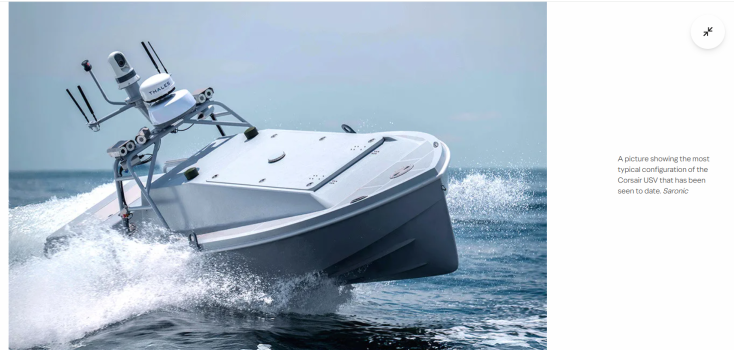
Corsair autonomous surface vessel (USV) comes down to a highly optimized marriage of a specialized powertrain, hull design, and strict weight management.
While the exact internal components of military hardware are often proprietary, the physics and engineering principles behind how a 24-foot vessel achieves a
1,000 nautical mile range and a
35-knot (approx. 40 mph) top speed are well understood in high-performance marine design.
1. The Powerplant: Diesel-Electric Hybrid Architecture
To get that kind of range, the Corsair does not rely on traditional gasoline outboards. Instead, it utilizes a
diesel-electric hybrid propulsion system or a highly efficient, lightweight marine diesel inboard coupled with a surface drive or waterjet.
- Energy Density of Diesel: Diesel fuel contains about 15% more energy by volume than gasoline and burns much more efficiently under steady loads. For a long-range military drone, diesel is mandatory not just for the range, but because the U.S. Navy strictly limits gasoline storage on ships for safety reasons.
- The Hybrid Advantage: For maximum range, the boat doesn't run flat-out at 35 knots. It likely features an electric loiter mode or a highly optimized "cruise speed" (typically around 10–12 knots). At loiter speeds, an electric motor powered by a diesel generator uses a fraction of the energy, stretching the fuel supply across days of operation.
2. Hull Design: Minimizing Hydrodynamic Drag
A major factor in a boat's range is overcoming water resistance. The Corsair uses a low-profile, "speedboat-like" deep-V or stepped hull design optimized for planing.
- Getting on Plane Quickly: At low speeds, a boat pushes water out of the way (displacement mode), which takes immense power. At higher speeds, a planing hull lifts out of the water, dramatically reducing wetted surface area and hydrodynamic drag.
- Stepped Hull Efficiency: Many modern military USVs use a "stepped" hull design. These steps introduce air underneath the hull as it moves, creating a cushion of air bubbles that reduces friction between the water and the fiberglass/composite hull, improving fuel economy by up to 15% to 20% compared to a traditional smooth hull.
3. Weight and Payload Management
The article notes that the Corsair has a
1,000-pound payload capacity. Because it is entirely uncrewed, the boat eliminates thousands of pounds of human-centric weight:
- No cabin, seats, or consoles.
- No heavy armored glass, windshields, or pilot suspension seats.
- No human provisions (potable water, crew gear, safety equipment).
By shedding this structural weight, a massive percentage of the boat's total displacement can be dedicated strictly to fuel storage (diesel) and the structural reinforcement needed to handle rough seas.
How the Math Works Out
To put a 1,000-mile range into perspective, marine transport efficiency is calculated by the trade-off between speed and fuel burn.
- If the Corsair carries roughly 100 to 150 gallons of diesel fuel, a modern marine diesel engine burning 1.5 to 2 gallons per hour at a 10-knot economy cruise speed would easily achieve the 1,000 nautical mile threshold.
- When a critical mission arises—like the Apache crew rescue in the Gulf of Oman—the system can open up the throttles to its 35-knot max speed, sacrificing maximum range for rapid intercept capability.
~~~~~~~~~~~~~~~~~~~~~~~~~~~~~~~~~~~~~~~~~~~~~~~~~~~~~~~~~~~~~~~~~~
The Rescue
While the exact mission-log specifics remain classified, military reports and the physical design of the
Saronic Corsair explain how the two downed aviators got onto a completely uncrewed vessel in the middle of the night.
1. Passive Sensing and Tracking
Before the pilots could board, the boat had to find them in the dark. The Corsair is equipped with a
360-degree passive sensing payload, which includes high-resolution thermal imaging and infrared cameras. Even in pitch-black conditions, the human body heat of the pilots floating in the Gulf of Oman would stand out sharply against the colder ocean water.
Operating autonomously or via remote command from Task Force 59 operators in Bahrain, the USV maneuvered directly to their exact location within two hours of the crash.
2. Low Freeboard and Hull Entry
The physical profile of a 24-foot boat like the Corsair makes boarding from the water far easier than climbing onto a massive, crewed naval ship:
- Low Freeboard: "Freeboard" is the distance from the waterline to the top of the boat's deck. Because the Corsair is a sleek, low-profile tactical craft, its gunwales (edges) sit low to the water.
- Built-in Handholds and Steps: For a craft designed to operate with special forces and intercept operations, the hull exterior includes integrated steps, heavy-duty handles, or soft-loop grab lines.
Once the USV cut its propulsion to sit idle next to them, the pilot and gunner—clothed in their aviation survival vests and life preservers—were able to swim up, grab the side, and clamber over the side directly onto the open deck deck-space.
3. Clear Open Deck Space
Because the boat eliminates a physical crew cabin, windshields, steering consoles, and pilot seats, the entire center and rear of the 24-foot hull is essentially an open, flat payload deck. This layout provides an unobstructed area for personnel to pull themselves out of the water without getting tangled in gear or hitting structural obstacles.
Once onboard, the pilots remained on the Corsair as it autonomously transported them to a secure, coordinated location farther out at sea. From there, they were safely hoisted up by a crewed rescue helicopter and taken to shore.



 www.yahoo.com

 www.saronic.com