


FlySwatter
Member
How do you square that with the fact that Heaven wasn't created until Day 2? (Genesis 1:8)
"God called the vault “sky.” And there was evening, and there was morning—the second day."
How are you equating the "heavens" with the sky?
Welcome to Christian Forums, a Christian Forum that recognizes that all Christians are a work in progress.
You will need to register to be able to join in fellowship with Christians all over the world.
We hope to see you as a part of our community soon and God Bless!
How do you square that with the fact that Heaven wasn't created until Day 2? (Genesis 1:8)

The Genesis narrative disproves pagan concepts that was common throughout the ancient world.@Illuminator said:
I'm not the one making that claim. The author of the story made it, not me. As I said in several previous postings on this thread the idea that the universe was created from preexisting matter was common throughout the ancient world.
But you don't explain how preexisting matter got there in the first place. This is magical creationism, not biblical or scientific creationism.Where did the preexisting matter come from, and when did it appear? I have no idea how the author of the story would have answered that question, but I'm pretty sure he wouldn't have been bothered by the idea that the preexisting matter was always just "there."
Your "sequence of statements" is based on a 3000 year old manner of writing history. "The earth was. The waters were." is a private interpretation that ignores the various means of expression used by ancient writers.Here's how I explained it in a previous posting (#845):
The author of the creation fairy tale clearly cared greatly about the sequence of statements in his story as he went to the trouble of enumerating each of the days of the creation. Each day of the story has clear boundary markers. Each begins with "And God said...", and each ends with "And there was evening and there was morning a <nth> day." There are no such boundary markers around the second sentence of the first paragraph. That's because that sentence does not describe any actions taken by God, but instead describes the state of the universe before the first day. Note that the second sentence is written in past tense. That's because it describes how things were before God began the act of creation. The earth was. The waters were. I maintain that the author of the story wrote it that way deliberately because he believed that the material substances of the earth and the waters preexisted.
Science proves our solar system is NOT the center of the galaxy. Had the Pope hastily accepted Galileo's theories, science would later prove the pope wrong. It appears you make the same mistake as Galileo, using theories to disprove what he thought the Bible says. Besides, there was no big fuss when heliocentrism was presented to the Church by Copernicus some 100 years earlier.@Illuminator said:
Psalm 93:1, Psalm 96:10, and Psalm 104:5 all say that the earth cannot move:
Yea, the world is established; it shall never be moved;(Psalm 93:1)
These were among the passages cited by the Pope when he turned Galileo over to the Inquisition for the investigation of heresy. The fact is that the earth does move. It spins on its axis, it revolves around the sun, and the entire solar system is revolving around the center of the galaxy. So yes, it is perfectly possible that the facts discerned by the scientific method can directly contradict both the actual words of the Bible and the teachings of the faith.

You got that wrong too.@Illuminator said:
I'm not the one making that claim. The author of the story made it, not me. As I said in several previous postings on this thread the idea that the universe was created from preexisting matter was common throughout the ancient world. Where did the preexisting matter come from, and when did it appear? I have no idea how the author of the story would have answered that question, but I'm pretty sure he wouldn't have been bothered by the idea that the preexisting matter was always just "there."
Here's how I explained it in a previous posting (#845):
The author of the creation fairy tale clearly cared greatly about the sequence of statements in his story as he went to the trouble of enumerating each of the days of the creation. Each day of the story has clear boundary markers. Each begins with "And God said...", and each ends with "And there was evening and there was morning a <nth> day." There are no such boundary markers around the second sentence of the first paragraph. That's because that sentence does not describe any actions taken by God, but instead describes the state of the universe before the first day. Note that the second sentence is written in past tense. That's because it describes how things were before God began the act of creation. The earth was. The waters were. I maintain that the author of the story wrote it that way deliberately because he believed that the material substances of the earth and the waters preexisted.
@Illuminator said:
Psalm 93:1, Psalm 96:10, and Psalm 104:5 all say that the earth cannot move:
Yea, the world is established; it shall never be moved;(Psalm 93:1)
These were among the passages cited by the Pope when he turned Galileo over to the Inquisition for the investigation of heresy.
A non-sequitur fallacy. You seem to be demanding that the Church change its understanding of Scripture to fit yours, making the same mistake as Galileo.The fact is that the earth does move. It spins on its axis, it revolves around the sun, and the entire solar system is revolving around the center of the galaxy. So yes, it is perfectly possible that the facts discerned by the scientific method can directly contradict both the actual words of the Bible and the teachings of the faith.

"God called the vault “sky.” And there was evening, and there was morning—the second day."
How are you equating the "heavens" with the sky?
I take it that you are using the New International Version. Here's how the Revised Standard Version has it:
And God called the firmament Heaven.(Genesis 1:8, RSV)
You should be aware that the New International Version was commissioned by the Evangelical churches of America as a reaction to the Revised Standard Version. Evangelicals were outraged that the RSV did not preserve the Septuagint's rendition of Isaiah 7:14, among other horrors.
The Genesis narrative disproves pagan concepts that was common throughout the ancient world.
But you don't explain how preexisting matter got there in the first place. This is magical creationism, not biblical or scientific creationism.
Your "sequence of statements" is based on a 3000 year old manner of writing history. "The earth was. The waters were." is a private interpretation that ignores the various means of expression used by ancient writers.
Science proves our solar system is NOT the center of the galaxy. Had the Pope hastily accepted Galileo's theories, science would later prove the pope wrong. It appears you make the same mistake as Galileo, using theories to disprove what he thought the Bible says. Besides, there was no big fuss when heliocentrism was presented to the Church by Copernicus some 100 years earlier.
It is a good thing that the Church did not rush to embrace Galileo’s views, because it turned out that his ideas were not entirely correct, either. Galileo believed that the sun was not just the fixed center of the solar system but the fixed center of the universe. We now know that the sun is not the center of the universe and that it does move—it simply orbits the center of the galaxy rather than the earth.
Had the Catholic Church rushed to endorse Galileo’s views—and there were many in the Church who were quite favorable to them—the Church would have embraced what modern science has disproved.
Unfortunately, throughout Church history, there have been those who insist on reading the Bible in a more literal sense than it was intended. They fail to appreciate, for example, instances in which Scripture uses what is called “phenomenological” language—that is, the language of appearances. Just as we today speak of the sun rising and setting to cause day and night, rather than the earth turning, so did the ancients. From an earthbound perspective, the sun does appear to rise and appear to set, and the earth appears to be immobile. When we describe these things according to their appearances, we are using phenomenological language.
From an earthbound perspective, the sun does appear to rise and appear to set, and the earth appears to be immobile. When we describe these things according to their appearances, we are using phenomenological language.
From an earthbound perspective, "The earth was. The waters were." is NOT the focus of Genesis 1.
The phenomenological language concerning the motion of the heavens and the non-motion of the earth is obvious to us today but was less so in previous centuries. Scripture scholars of the past were willing to consider whether particular statements were to be taken literally or phenomenologically, but they did not like being told by a non-Scripture scholar, such as Galileo, that the words of the sacred page must be taken in a particular sense. This is why you make the same mistake as Galileo.
During this period, personal interpretation of Scripture was a sensitive subject. In the early 1600s, the Church had just been through the Reformation experience, and one of the chief quarrels with Protestants was over individual interpretation of the Bible.
Theologians were not prepared to entertain the heliocentric theory based on a layman’s interpretation. There is little question that if Galileo had kept the discussion within the accepted boundaries of astronomy (i.e., predicting planetary motions) and had not claimed physical truth for the heliocentric theory, the issue would not have escalated to the point it did. After all, he had not proved the new theory beyond reasonable doubt.
The Galileo Controversy
The Galileo case, for many anti-Catholics, is thought to prove that the Church abhors science, refuses to abandon outdated teachings and is not infallible.www.catholic.com
But you don't explain how preexisting matter got there in the first place. This is magical creationism, not biblical or scientific creationism.
Science proves our solar system is NOT the center of the galaxy. Had the Pope hastily accepted Galileo's theories, science would later prove the pope wrong. It appears you make the same mistake as Galileo, using theories to disprove what he thought the Bible says. Besides, there was no big fuss when heliocentrism was presented to the Church by Copernicus some 100 years earlier.
Methodical research in all branches of knowledge, provided it is carried out in a truly scientific manner and does not override moral laws, can never conflict with the faith, because the things of the world and the things the of the faith derive from the same God.
After all, he had not proved the new theory beyond reasonable doubt.
Those are all valid observations. I won't press the point further.I'm not a fan of people picking out specific versions to claim a point. If there is truth then it will be spread across the majority of Bible versions.
However even in your chosen RSV we have a difference.
Gen 1:1 refers to the "heavens" - plural, no capitalisation
Gen 1:8 refers to "Heaven" - singular, capitalised
The "heavens" are thus a multiplicity of something whatever the term refers to. Heaven is a noun, and a location.
Also worth noting that Gen 1:1 dos NOT say "In the beginning God created the firmament and the earth"
Verse 9 goes back to the plural term:
"Let the waters under the heavens be gathered together into one place,"
Not "let the waters under Heaven be gathered together"
Then verse 14:
"And God said, “Let there be lights in the firmament of the heavens to separate the day from the night;"
So the firmament is a part of the "heavens" not the heavens themselves. Thus if God named the firmament "Heaven" then "Heaven" is a part of the "heavens", not one and the same.
More confirmation that the "heavens" and the firmament are not one and the same
Psalms 19:1
"The heavens are telling the glory of God;
and the firmament proclaims his handiwork."
Sirach 43:8
"The month is named for the moon,
increasing marvelously in its phases,
an instrument of the hosts on high
shining forth in the firmament of heaven."
Because there was NOTHING. You can't explain how preexisting matter appeared, so your claim about preexisting matter even existing has no rational basis. Worse, it's an assault on God's sovereignty. You are proposing a pre-creation, non-created creation, which makes no sense. God is Creator with no need of props.I hardly know where to being in responding to the above. You have turned most of what I said upside down. Here's one of your comments:
That's true-- I made no attempt whatsoever to explain how the preexisting matter appeared.
Yea, right, by forcing 2300 A.D. English literalism to fit a 3000 year old style of writing history, that was never read or meant to be literal until the 16th century.I was merely commenting on what the author actually said. It is the author who believed in the preexistence of the substance of the earth and the waters. That's what the second sentence of the creation story means.

Preexisting matter is a fairy tale you personally believe.And most unfortunately for all of us the author never explained where the preexisting matter came from. Bummer. You have somehow got it into your head that I share the ideas and thoughts of the author of the fairy tale. I DON'T. So stop accusing me of believing something that I NEVER ONCE said I personally believe.
"What the Psalms say is wrong" if you're an arrogant scientist pretending to be a scripture scholar.Here's another comment:
True, Galileo's understanding wasn't totally correct. Like both Copernicus and Kepler he assumed that the sun was at the center of the universe. But so what? That doesn't change the fact that Copernicus and Kepler and Galileo were all correct that the earth does in fact move! The 3 Psalms I cited state that the earth cannot move. That is the exact opposite of what the combined studies of Copernicus, Kepler, and Galileo showed. So what the Psalms say was contradicted by observations made in the time of Galileo. What the Psalms say is wrong. You cited the following from the Catholic Catechism:
The Pope cites scripture correctly. I explained phenomenological language that you either fail to understand or ignore it all together.The example of the Psalms cited by the Pope clearly show that the above quote is simply not true.
To avoid scams. When any given phenomenon occurs that effects a lot of people, the Church sets up an investigative committee to rule out con jobs, and they happen all the time. But no scientist will declare a miracle, they can only say they have no explanation.You seem to be implying that the Church should never make any pronouncements about science until every last detail has been utterly nailed down.
No, you are, and your question is stupid. The Pope lets scientists do their job, and theologians do theirs.The fact that our galaxy rotates on its own axis and that our solar system is some 25,000 light years from its center wasn't known until the 20th century-- 300 years after the time of Galileo. Are you suggesting that the Pope should have waited another 300 years before finally acknowledging that the earth moves just because Galileo wasn't TOTALLY correct?

In a minor astronomical work, Commentariolus, not printed during his lifetime, he first proposed a heliocentric theory of cosmology, placing the sun at the center of the solar system. This led many of his friends to request that he publish his findings. Among these were Cardinal Schonberg of the Roman Curia, Bishop Giese of Culm, and the future Pope Paul III. Schonberg insisted that Copernicus publish his material in the interest of science.You said there was no big fuss when Copernicus introduced the idea of helocentrism. You're overlooking the fact that Copernicus didn't release his book for publication until the very last year of his life because he was afraid of how it would be received. You're omitting the fact that the introduction to his book, which was not written by Copernicus, stated that his book was presented as speculation, not as fact, because the publishers were afraid of what the Church's reaction would be. And you're neglecting the fact that Giordano Bruno was burned alive at the stake in 1600 for his terrible, horrible, awful speculation that there might be life on other planets in other parts of the universe. Even such very tame speculations at the time could get you killed.
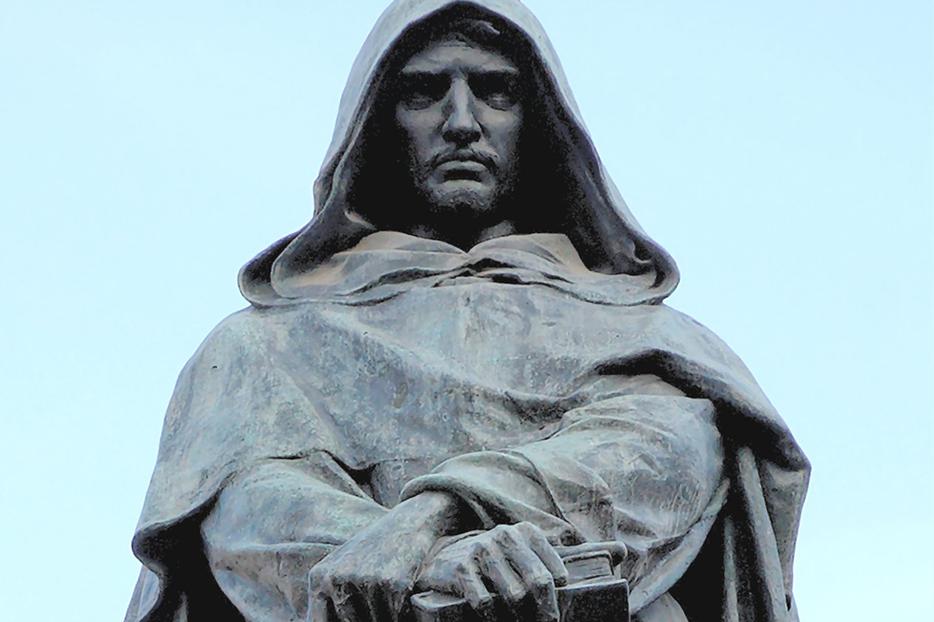
Bruno was burned at the stake in 1600 in the Campo de’ Fiori in Rome — but not for the reasons most people think.And you're neglecting the fact that Giordano Bruno was burned alive at the stake in 1600 for his terrible, horrible, awful speculation that there might be life on other planets in other parts of the universe. Even such very tame speculations at the time could get you killed.
Those are all valid observations. I won't press the point further.
My interpretation of the first paragraph-- that it is an introduction, not a description of events that occurred prior to Day 1-- is unchanged. But you are entitled to your own interpretation.
@Illuminator said:Because there was NOTHING. You can't explain how preexisting matter appeared, so your claim about preexisting matter even existing has no rational basis. Worse, it's an assault on God's sovereignty. You are proposing a pre-creation, non-created creation, which makes no sense. God is Creator with no need of props.
You reduce Him to a craftsman relying on "preexistent matter".
Yea, right, by forcing 2300 A.D. English literalism to fit a 3000 year old style of writing history, that was never read or meant to be literal until the 16th century.
Preexisting matter is a fairy tale you personally believe.
"What the Psalms say is wrong" if you're an arrogant scientist pretending to be a scripture scholar.
The Pope cites scripture correctly. I explained phenomenological language that you either fail to understand or ignore it all together.
To avoid scams. When any given phenomenon occurs that effects a lot of people, the Church sets up an investigative committee to rule out con jobs, and they happen all the time. But no scientist will declare a miracle, they can only say they have no explanation.
No, you are, and your question is stupid. The Pope lets scientists do their job, and theologians do theirs.
The Pontifical Academy of Sciences
Official website of the Pontifical Academy of Sciences in the Vatican. Located in the Casina Pio IV in the Vatican Gardens since 1936.www.pas.va
In a minor astronomical work, Commentariolus, not printed during his lifetime, he first proposed a heliocentric theory of cosmology, placing the sun at the center of the solar system. This led many of his friends to request that he publish his findings. Among these were Cardinal Schonberg of the Roman Curia, Bishop Giese of Culm, and the future Pope Paul III. Schonberg insisted that Copernicus publish his material in the interest of science.
A young Lutheran scholar, Rheticus, left his chair of mathematics at Wittenberg (where, in 1517, Martin Luther had posted his 95 theses on a church door) to work with Copernicus in Poland and to prepare the scientist’s manuscripts for publication–an early example of ecumenical cooperation. A summary of Coper-nicus’s findings was released, and it met with tremendous hostility from Protestant theologians; there was no such general hostility from Catholics. Rheticus was barred from returning to his post at Wittenberg.
At the insistence of Clement VII the material was expanded into the great work of Copernicus’ career, De Revolutionibus Orbium Coelestium (On the Revolutions of the Heavenly Spheres), which officially proposed a sun-centered theory to the world. The printed book, dedicated to Clement’s successor, Paul III, reached Copernicus just hours before his death on May 24, 1543.
I explained phenomenological language that you either fail to understand or ignore it all together.
Yea, the world is established; it shall never be moved.
| Year | Event | Bible Day |
| 0 | Big Bang | N/A |
| 100,000 | Recombination: The universe has sufficiently cooled that the first atoms are formed | N/A |
| 100,000 | The newly formed atoms emit the Cosmic Background Radiation | 1 |
| < 1 billion | Creation of the first stars | 4 |
| 1 - 2 billion | Creation of the Milky Way galaxy | N/A |
| 9.12 billion | Creation of the sun | 4 |
| 9.18 billion | Creation of the earth | N/A |
| 9.22 billion | Creation of the moon | 4 |
| 11.62 billion | First eukaryotes | N/A |
| 12.52 billion | First multi-celled organisms | N/A |
| 13.085 billion | First complex (marine) life | 5 |
| 13.287 billion | First land plant | 3 |
| 13.282 billion | First land animals | 6 |
| 13.565 billion | First bird | 5 |
| 13.71985 billion | First Homo sapiens | 6 |
| 13.72 billion | Present day | N/A |
More info on the interpretation of Genesis 1:8:I didn't think I was particularly interpreting anything. Just pointing out plain English and the structure of the verse which very clearly make a distinction between the "heavens" and the "firmament" and "Heaven". Can you not address those points? Are you so intellectually invested in what you think is an error and slam dunk failing of the RC doctrine that you're not open to debate? Do you need your theory to be right that badly ? Why is that?
Genesis 1:1: In the beginning God created the heaven and the earth. (Note that it is "heaven" singular, not plural.)
Genesis 1:8: And God called the firmament Heaven.
Genesis 1:1: In the beginning God created the heavens and the earth.
Genesis 1:8: God called the firmament the heavens. (Note: Plural, and not capitalized)
Genesis 1:1: In the beginning God created the heavens and the earth.
Genesis 1:8: And God called the firmament Heaven.
Genesis 1:1: In the beginning God created the heavens and the earth.
Genesis 1:8: God called the expanse "sky."
When God began to create the heavens and the earth, the earth was complete chaos, and darkness covered the face of the deep, while a wind from God swept over the face of the waters. Then God said, “Let there be light,” and there was light. And God saw that the light was good, and God separated the light from the darkness. God called the light Day, and the darkness he called Night. And there was evening and there was morning, the first day.
And God said, “Let there be a dome in the midst of the waters, and let it separate the waters from the waters.” So God made the dome and separated the waters that were under the dome from the waters that were above the dome. And it was so. God called the dome Sky. And there was evening and there was morning, the second day.
This clearly proves you are resistant to any explanation of phenomenological language and oblivious to a style of writing used 3000 years ago. The Bible contains some science, but it is not a science book. You offer no "scientific facts" supporting preexisting matter by any renowned cosmologist, and here you are arguing from a science of your own making, just like you argue from God of your own making.I interpret these observations to mean that the story of creation could not possibly be true, regardless of one's geographical perspective. So phenomenological language is irrelevant. This I think clearly proves that it is indeed possible for statements in the Bible to be completely at odds with known scientific facts.
God created the universe out of nothing. That makes more sense than you reducing God to a craftsman who needs props. That is NOT an omnipotent God. God made man in His image, you make God in your image with an unscientific opinion and claim science is on your side. You are a slave to a ridiculous literal approach to Genesis which is not far removed from the fundamentalist approach that you fail to see.What exactly is your interpretation?

I meant to ask about your name, particularly the reverent part. Very provocative name and you are nice, intelligent addition to this comunity.More info on the interpretation of Genesis 1:8
This is such a critical point! Thank you for making it.This clearly proves you are resistant to any explanation of phenomenological language and oblivious to a style of writing used 3000 years ago. The Bible contains some science, but it is not a science book.
Do you suppose Psalm 93 is talking astronomy or the power of YHWH?Psalm 93:1 says: Yea, the world is established; it shall never be moved.
No. You are imposing your take on what the author actually said. God is the Creator of everything, expressed at the time as "Heaven and Earth."That's true-- I made no attempt whatsoever to explain how the preexisting matter appeared. I was merely commenting on what the author actually said.


