1. You can’t talk about David without talking about who David
was.
1 Samuel 16:12 doesn’t just say “ruddy” — the Hebrew
admoni means reddish in skin tone, visible through light skin, plus “beautiful countenance” and “goodly to look at.” That’s a phenotype marker.
2. Lamentations 4:7 describes the Nazarites (royal/priestly Israelites) as “
purer than snow, whiter than milk, more ruddy in body than rubies, polishing of sapphire.” That’s pale skin, visible blush, and a bluish cast from veins;
not a Middle Eastern olive complexion, and not an Ashkenazi mix at all.
3. Ezekiel 1:26 describes the throne vision with the
“appearance of sapphire” — a term (
sapir) used elsewhere to describe the eye-color imagery in Israelite glory descriptions. In Hebrew,
sapir isn’t just a generic gemstone term; it evokes the same vivid blue used in passages like Song of Solomon 5:12 — “His eyes are as the eyes of doves by the rivers of waters, washed with milk, and fitly set” —
a direct ocean-water blue comparison. This is not left as vague “symbolism”; it’s concrete, physical imagery.
4. Ezra 9:6 — “I blush to lift my face” — The Biblical Israelites blushed visibly red; you need very light skin for that to register. Scripture wouldn’t use this imagery if it wasn’t culturally and physically true for Israel. They were a very pale-skinned people — think 1700s Vienna aristocracy stereotype, not a sunbaked desert complexion.
5. Song of Solomon 5:13 — “His cheeks are as a bed of spices, as sweet flowers” — the floral imagery matches the “lily-white with blush” metaphor common in Hebrew poetic description. Again, phenotypic anchor. '
Rosy cheeks'
6. None of these descriptions fit the modern Ashkenazi look, which is the product of Khazar conversion (8th century A.D.) mixed with European blood;
not direct Davidic lineage.
7. Scripture makes a point of telling us what Israel’s kings and Nazarites looked like
because identity mattered under covenant.
Physical markers were part of recognition.
8. Wrongly pretending David was some vaguely “Middle Eastern” or Ashkenazi-looking figure is historical and theological revisionism — the same sleight of hand Christ warned about in Revelation 2:9 (“those who say they are Jews and are not, but are a synagogue of Satan”).
9. The Israelites in the wilderness were not an anonymous brown mass of “desert slaves.” They were a distinct covenant people whose look, customs, and laws set them apart from all other nations; that’s why other nations noticed them. -
“Skin purer than snow, whiter than milk, more ruddy in body than rubies, arms had a polishing of sapphire (veins under the skin)
, eyes the color of the oceans and sapphire". (the bluest of blue)
I don’t know about you all, but that description doesn’t sound like Gabe Kaplan to me, bud.
Sounds more like Dolph Lundgren. And to anyone with two brain cells to rub together who actually wants to follow the Word of God verbatim, this is the only truth that holds up to Scripture. To claim otherwise is to call God a liar.
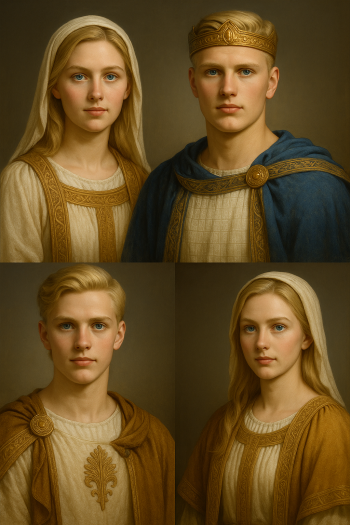
AI, can you please create me a .JPG image of King David, Christ or any random Israelite exactly as they were described by God in His own Words in the Bible?
"Sure"
View attachment 68340
Boom
That’s why Pharaoh’s daughter freaked out when she found Moses floating in the basket.
She wasn’t looking at some generic “Hebrew slave.” She was staring at one of the
star-children of God —
purer than snow, with skin whiter than milk, ruddy with life, rosy cheeked and eyes like sapphires — marked from birth as one of
His covenant people. And yes, that’s not my “take,” that’s straight from the Word of God itself when you follow His exact descriptions without letting outside influence from demons rewrite the image.
AI innocently made that imagine ^ above, from following
nothing but the naked Word of God.
What say you?