The first anointing took place in
Luke 7:36-50. The second anointing ( Was done by Mary) took place in
John 12:1-8,
more than a year after the first anointing in Luke 7.
As I said, there were only two separate occasions in all the four Gospels where a woman came to Jesus bringing an alabaster jar of ointment, and made the same personal gesture of anointing Him and wiping His feet with her hair: in the house of Simon the Pharisee (
Lk. 7:36-50), and in the house of Simon the Leper in Bethany. (
Matt. 26:6-13,
Mk. 14:3-9,
Jn. 12:1-8)
The first event took place in Simon the Pharisee’s home (
Luke 7:36,
40), somewhere in Galilee. The second event took place in Simon the leper’s home in Bethany (
Matt. 26:6;
Mark 14:3). Two different Simons. Two different cities.
Each of the two scenes mentioning a different Simon, and the city/town of Simon the Pharisee's house in Luke's account (
Lk. 7:36-50) having been located in Galilee and not Bethany, doesn't rule out Mary of Bethany as having been the unnamed woman in Luke's account, because it's possible for a person to make a personal gesture in one location, and then repeat that personal gesture(s) to another person who shares the same name, either in the same or different location(s).
The first woman is described as “a woman in the city who was a sinner” (
Luke 7:37), but she is not named. The second woman is identified as Mary, the sister of Lazarus and Martha (
John 12:3;
11:2). Two different women.
If you can identify by name the unnamed woman in the scene recounted by Luke (
Lk. 7:36-50) as being anyone other than Mary of Bethany,
then you can definitively say two different women made the same personal gesture to Jesus. Can you do this?
Both women brought fragrant oil, both anointed Jesus’ feet, and both wiped His feet with their hair (
Luke 7:37-38;
John 12:3). The first woman also washed “His feet with her tears…and she kissed His feet” (
Luke 7:38). It may be that the first woman recognized her sinful condition before the sinless Jesus and was seeking forgiveness, since Jesus did forgive her “many” sins (
Luke 7:47-50). But, Jesus specified that the second woman (Mary) was preparing “My body for burial” (
Mark 14:8). Two different women. Two different occasions. Two different purposes.
In Simon the Pharisee's house, a woman, a well-known sinner, came to see Jesus with trust, having brought with her an alabaster jar filled with ointment, already feeling repentant for her many sins, and weeping she accused herself, humiliating herself in a humble public confession represented by her tears. Using her hair, she wiped the tears, as well as the ointment, onto Jesus's feet, thus consecrating herself as a disciple of His. In return, Jesus said to her that she was forgiven and saved, because she showed much love. (
Lk. 7:36-50)
In Simon the Leper's house, Mary of Bethany displayed the same personal gesture as the woman in Simon the Pharisee's house, though it was not humiliated so much, and it was more confidential in its reverent adoration. She came to Jesus having brought with her an alabaster jar filled with ointment, which she had kept for him, and poured the ointment onto His head and feet, without shedding any tears. She felt that Jesus was about to die, and she wanted to anticipate the burial anointing for His body. (
Matt. 26:6-13,
Mk. 14:3-9,
Jn. 12:1-8)
In conclusion, yes, at Simon the Leper's house, the personal gesture was not humiliated so much as it was in Simon the Pharisee's house, and it was more confidential in its reverent adoration, and both took place in different locations, but still the same personal gesture in each instance. There are personal gestures which are repeated and are peculiar to a person, like the person’s style. They are unmistakable gestures. The gesture in question being made on two separate occasions, each with a different feeling or purpose behind it, doesn't rule out Mary of Bethany as having been the unnamed woman in Luke's account, because it's possible for a person to repeat a personal gesture without having the same feeling(s) or purpose(s) behind it each time.
The first event took place in Simon the Pharisee’s home (
Luke 7:36,
40),
somewhere in Galilee.
Correct.
FYI: Lk. 7:11-35 places Jesus in the region of Nain in Galilee, and in
Lk. 7:30, Luke mentions the Pharisees and the lawyers rejecting the counsel of God, not being baptized by him [John the Baptist] themselves. In
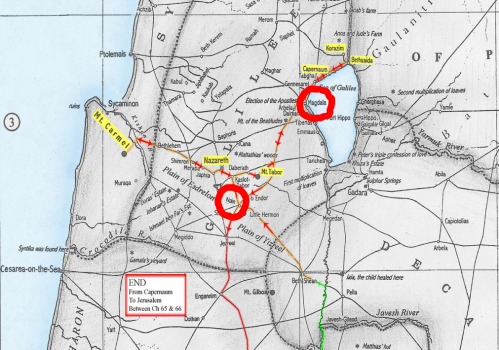
Lk. 7:36, Luke begins his recounting of Jesus in the house of Simon the Pharisee. This is scriptural support for what Maria Valtorta—another true spokesperson of God, who received and described visions of scenes from Jesus's life on earth— said, which was that Simon the Pharisee's house was located specifically in Nain in Galilee. She also confirmed that Mary of Magdala, Mary of Bethany, and the unnamed repentant woman in Simon the Pharisee's house were the same woman, and at the time Mary came to see Jesus there, she was living in Magdala, also located in Galilee. See map attached. Later on, Mary came to live in Bethany in the house of her brother, Lazarus, whom Simon the Leper was a servant of. I highly recommend reading
The Story of Mary Magdalene (extracts from
The Gospel as Revealed to Me, or
The Poem of the Man-God), as well as
A Summa and Encyclopedia to Maria Valtorta's Extraordinary Work, especially the chapters on the proofs in support of her writings having a supernatural origin.