Was Mary Magdalene the sister of Lazarus?

  • Welcome to Christian Forums, a Christian Forum that recognizes that all Christians are a work in progress.

    You will need to register to be able to join in fellowship with Christians all over the world.

    We hope to see you as a part of our community soon and God Bless!

JohnDB

Well-Known Member
Feb 7, 2010
5,879
3,759
113
TN
Faith
Christian
Country
United States
Gender
Male
Some people think that Magdalene means Magdela and some believe that Magdalene means female from the Magi, but both are speculations because the scriptures do not indicate either one.
Archeological proof of Magdela is fairly certain.

About as certain as Sepphoris.
 

Grailhunter

Well-Known Member
Jun 19, 2019
14,286
6,194
113
69
FARMINGTON
Faith
Christian
Country
United States
Gender
Male
Archeological proof of Magdela is fairly certain.

About as certain as Sepphoris.

Oh Magdala existed but back in Christ’s time it was called Tarichaea. And the scriptures do not say Mary from Magdalene but rather Mary the Magdalene. One of the reasons why some believe she was Mary the female Magi.

We can make up things as we go and it may be more entertaining but not the truth.
 
  • Love
Reactions: JohnDB

JohnDB

Well-Known Member
Feb 7, 2010
5,879
3,759
113
TN
Faith
Christian
Country
United States
Gender
Male
Oh Magdala existed but back in Christ’s time it was called Tarichaea. And the scriptures do not say Mary from Magdalene but rather Mary the Magdalene. One of the reasons why some believe she was Mary the female Magi.

We can make up things as we go and it may be more entertaining but not the truth.
And the Sea of Galilee was called Lake Tiberius....but scriptures never call it that.

And the name of the town was Magdela....she was a Magdalene.

Jesus was from Nazareth but called a Nazarene.

Caleb's city never got a name change though....except for the Name he gave it. Even his farm is still called by his name.

I guess everyone is still scared of him.
 

Sabé

Active Member
Dec 25, 2024
509
83
43
Pacific Northwest
Faith
Christian
Country
United States
Gender
Female
This is one of the reasons that I don't want to talk to you about this because you keep trying to twist things around.

I didn't twist. I asked you a question. And, the reason why I asked you what I did is because I needed clarification.
 
Last edited:

Grailhunter

Well-Known Member
Jun 19, 2019
14,286
6,194
113
69
FARMINGTON
Faith
Christian
Country
United States
Gender
Male
I didn't twist. I asked you a question. And, the reason why I asked you what I did is because I needed clarification.


That Mary of Bethany was the sister of Lazarus and Martha (Jn. 11:1-2). And, in post #74, I showed you how the apostle John identified her as being the repentant prostitute. Did you understand how he did?

There is nothing in post #74 that shows the apostle John identifing Mary of Bethany as the repentant prostitute.
 
Last edited:

Grailhunter

Well-Known Member
Jun 19, 2019
14,286
6,194
113
69
FARMINGTON
Faith
Christian
Country
United States
Gender
Male
In ch. 11:1-2, John introduced Lazarus, Martha, and Mary as siblings, as well as identified Mary as having been "that Mary who had anointed the Lord with ointment and wiped his feet with her hair" at a point when "Lazarus was alive and sick". In ch. 12:1-8, he recounted Lazarus and Martha's sister, Mary, in Lazarus's house in Bethany, anointed Jesus with expensive ointment and wiped His feet with her hair, but at a point after "Lazarus had died and was resurrected". These verses show that Mary made the same gesture to Jesus on two separate occasions: [1] when Lazarus was alive and sick and [2] after Lazarus had died and was resurrected. The scene of Mary making the aforementioned gesture to Jesus at a point after Lazarus had died and resurrected is recounted in Matt. 26:6-13, Mk. 14:3-9, and Jn. 12:1-8, and therefore the scene where the apostle John said Lazarus and Martha's sister, Mary, or Mary of Bethany, was "that Mary" who "anointed Jesus with her hair" at a point when Lazarus was "alive and sick" could've only been referring to Lk. 7:36-50, making her the repentant prostitute. Do you still think the apostle John wasn't showing Mary of Bethany was the repentant prostitute? If so, why?

Now a man named Lazarus was sick. He was from Bethany, the village of Mary and her sister Martha. 2 (This Mary, whose brother Lazarus now lay sick, was the same one who poured perfume on the Lord and wiped his feet with her hair.) John 11:1-2

Six days before the Passover, Jesus therefore came to Bethany, where Lazarus was, whom Jesus had raised from the dead. So they gave a dinner for him there. Martha served, and Lazarus was one of those reclining with him at table. Mary therefore took a pound of expensive ointment made from pure nard, and anointed the feet of Jesus and wiped his feet with her hair. The house was filled with the fragrance of the perfume. But Judas Iscariot, one of his disciples (he who was about to betray him), said, “Why was this ointment not sold for three hundred denarii and given to the poor?” ... John 12:1-8

6 Now when Jesus was at Bethany in the house of Simon the leper, 7 a woman came up to him with an alabaster flask of very expensive ointment, and she poured it on his head as he reclined at table. 8 And when the disciples saw it, they were indignant, saying, “Why this waste? 9 For this could have been sold for a large sum and given to the poor.” 10 But Jesus, aware of this, said to them, “Why do you trouble the woman? For she has done a beautiful thing to me. 11 For you always have the poor with you, but you will not always have me. 12 In pouring this ointment on my body, she has done it to prepare me for burial. 13 Truly, I say to you, wherever this gospel is proclaimed in the whole world, what she has done will also be told in memory of her.” Mathew 26:6-13

Again twisting…..
Mary Magdalene did anoint Christ’s feet and wiped them with her hair, but that was in Bethany where Lazarus and his disciples were at Simon the Leper house. That was not at the Pharisee's house. At Simon Leper house Christ said she anointed for Him for burial. At the Pharisee’s house the repentant prostitute anointed his feet for forgiveness.

Again why do you want to believe Mary Magdalene was a prostitute?

 
Last edited:

Grailhunter

Well-Known Member
Jun 19, 2019
14,286
6,194
113
69
FARMINGTON
Faith
Christian
Country
United States
Gender
Male
And the Sea of Galilee was called Lake Tiberius....but scriptures never call it that.

And the name of the town was Magdela....she was a Magdalene.

Jesus was from Nazareth but called a Nazarene.

Caleb's city never got a name change though....except for the Name he gave it. Even his farm is still called by his name.

I guess everyone is still scared of him.

 
  • Like
Reactions: JohnDB

Sabé

Active Member
Dec 25, 2024
509
83
43
Pacific Northwest
Faith
Christian
Country
United States
Gender
Female
Again twisting…..

The apostle John identified Lazarus and Martha's sister as "Mary", and as "that Mary who had anointed the Lord with ointment and wiped His feet with her hair", which is precisely what I said, and thus I didn't twist his words.
 
Last edited:

Grailhunter

Well-Known Member
Jun 19, 2019
14,286
6,194
113
69
FARMINGTON
Faith
Christian
Country
United States
Gender
Male
The apostle John identified Lazarus and Martha's sister as "Mary", and as "that Mary who had anointed the Lord with ointment and wiped His feet with her hair", which is precisely what I said, and thus I didn't twist his words.

Again, in ch. 11:1-2, John identified Lazarus and Martha's sister as "Mary", and as "that Mary who had anointed the Lord with ointment and wiped His feet with her hair", and indicated it occurred at a point when Lazarus was alive by having said that he was "sick". In ch. 12:1-8, he recounts a scene where the same Mary anointed Jesus with her hair, but this time he indicated it occurred at a point after Lazarus died and resurrected by having said, "Lazarus [...] who had been dead, whom he raised from the dead." Therefore, this Mary made the gesture to Jesus on two separate occasions. Again, one of those two occasions took place in Simon the Leper's house in Bethany, as recounted by Matthew (26:6-13), Mark (14:3-9), and John (12:1-8). The other of those two occasions could've only been the one that took place in Simon the Pharisee's house in Bethany by the unnamed repentant and forgiven prostitute (Lk. 7:36-50), and thus that woman was Mary, the sister of Lazarus and Martha. [Note: Notice the words "repentant and forgiven prostitute" aren't indicative that she continued to be a practicing prostitute as a new disciple of Jesus.]

Nope.
Mary Magdalene anointed Christ’s feet and wiped them with her hair at Simon the Leper’s house with Lazarus and his disciples for the purpose of preparing Him for burial. And His disciples protested over the use of expensive nard. And Judas went to betray Him.

Then the repentant prostitute anointed Christ’s feet and wiped them with her hair at Simon the Pharisee's house for the purpose of forgiveness….no mention of Lazarus and His disciples. And those there protested over Christ letting a sinner touch Him.
 

Grailhunter

Well-Known Member
Jun 19, 2019
14,286
6,194
113
69
FARMINGTON
Faith
Christian
Country
United States
Gender
Male
John didn't identify Lazarus and Martha's sister, who anointed Jesus and wiped His feet with her hair, as "Mary Magdalene", but rather "Mary". (Jn. 11:1-2)

Simon the Leper emerges in a brief but dramatic scene recorded in Matthew 26:6–13 and Mark 14:3–9. While Jesus was staying in Bethany, one night He and the disciples were invited for a meal at the home of Simon the Leper. As Jesus reclined at the dinner table, an unnamed woman came in, broke an expensive flask of perfume and poured the oil over the Lord’s head, anointing Him in an extravagant act of worship. The disciples reacted with indignation at the woman’s waste of valuable resources. But Jesus told them to leave the woman alone, “for she has done a beautiful thing to me” (Matthew 26:10, ESV). Her anointing was a fitting way to honor the Messiah-King and prepare Him for burial. This dinner at Simon the Leper’s home took place about one week before Jesus was crucified.

Similar but distinct episodes are featured in Luke 7:36–50 and John 12:1–8. The event in Luke transpired at the home of a different Simon, “Simon the Pharisee,” with a woman referred to as only “a sinner.” The event in John happened on a different day and involved Mary of Bethany.
 

JohnDB

Well-Known Member
Feb 7, 2010
5,879
3,759
113
TN
Faith
Christian
Country
United States
Gender
Male
Liked the article,
I'm not exactly a huge fan of this publication because they tend to sensationalize too much. They hit the truth often....but are susceptible to political pressure too often.

They did answer the questions I had this time though....but provided none of the citations I was especially interested in.
(I do love my proofs)
But suffice it to say that Tarichaea is the most likely Magdala ....(due to the church built there in her name and the tower)
Records are sparse and extra-biblical....it was 2,000 years ago.

Now wouldn't it be funny if Mary herself was the "tower" an Amazon of a woman and huge in stature? But absolutely devoted to Jesus.

Nobody messed with Mary because she could hurt you.....

That would not be surprising either....
 

Grailhunter

Well-Known Member
Jun 19, 2019
14,286
6,194
113
69
FARMINGTON
Faith
Christian
Country
United States
Gender
Male
Liked the article,
I'm not exactly a huge fan of this publication because they tend to sensationalize too much. They hit the truth often....but are susceptible to political pressure too often.

They did answer the questions I had this time though....but provided none of the citations I was especially interested in.
(I do love my proofs)
But suffice it to say that Tarichaea is the most likely Magdala ....(due to the church built there in her name and the tower)
Records are sparse and extra-biblical....it was 2,000 years ago.

Now wouldn't it be funny if Mary herself was the "tower" an Amazon of a woman and huge in stature? But absolutely devoted to Jesus.

Nobody messed with Mary because she could hurt you.....

That would not be surprising either....

Understanding what is said and what is not said….
Mary Magdalene figures prominently into the narrative of the four Gospels, even more so than Christ’s mother.
But then the females mostly disappear from the narratives which leads scholars to suspect disagreements and possible jealousies. And then you have the shift by upper echelons to demonize sexuality which lead Christianity down a dark path until Martin Luther did a reset of values.

Mary the Mother and Mary Magdalene appear in extra-biblical writings and traditions and tales. Some of which can be shocking.

And one of the most telling questions......Christ was anointed by women five times....why? This is the only example in the Bible of women anointing.
 
Last edited:

Grailhunter

Well-Known Member
Jun 19, 2019
14,286
6,194
113
69
FARMINGTON
Faith
Christian
Country
United States
Gender
Male
John introduced and identified Lazarus and Martha's sister, Mary, or Mary of Bethany, as being that "that Mary" who anointed and wiped Jesus's feet with her hair at a point when her brother, Lazarus, was alive and "sick". Later, he recounted a scene where she made that gesture to Jesus, but this time at a point after her brother had "died and resurrected", thus indicating she made the gesture to Jesus on two separate occasions. Since one of those two occasions, the anointing scene in Simon the Leper's house recounted by Matthew (26:6-13), Mark (14:3-9), and John (12:1-8), is the one that took place after Lazarus died and resurrected, why would the other of those two occasions, the one that took place at a point when Lazarus was alive and sick, not have been the anointing scene in Simon the Pharisee's house recounted by Luke (7:36-50)?

Mary Magdalene anointed Christ once.
 

Sabé

Active Member
Dec 25, 2024
509
83
43
Pacific Northwest
Faith
Christian
Country
United States
Gender
Female
Mary Magdalene anointed Christ once.

The apostle John didn't identify Lazarus and Martha's sister as "Mary Magdalene", but rather "Mary". And, he didn't say that she anointed Jesus once, but rather said she was "that Mary who anointed Jesus and wiped His feet with her hair, whose brother, Lazarus, was sick".

There were only two separate occasions in all the four Gospels where a woman came to Jesus bringing an alabaster jar of ointment, and made the same personal gesture of anointing Him and wiping His feet with her hair: in the house of Simon the Pharisee (Lk. 7:36-50), and in the house of Simon the Leper in Bethany. (Matt. 26:6-13, Mk. 14:3-9, Jn. 12:1-8)

John identified that woman as being Lazarus and Martha's sister, Mary, or Mary of Bethany, in the latter scene, and thus why would, and how could, she not have also been the repentant and forgiven sinner in the former scene?
 
Last edited:

Grailhunter

Well-Known Member
Jun 19, 2019
14,286
6,194
113
69
FARMINGTON
Faith
Christian
Country
United States
Gender
Male
The apostle John didn't identify Lazarus and Martha's sister as "Mary Magdalene", but rather "Mary". And, he didn't say that she anointed Jesus once, but rather said she was "that Mary who anointed Jesus and wiped His feet with her hair, whose brother, Lazarus, was sick".

There's only two occurances in all of the four gospels where a woman made that gesture of anointing Jesus and wiping His feet with her hair: in the house of Simon the Pharisee in Bethany (Matt. 26:6-13, Mk. 14:3-9, and Jn. 12:1-8), and in the house of Simon the Leper in Bethany. (Lk. 7:36-50)

John identified that woman as being Lazarus and Martha's sister, Mary, or Mary of Bethany, in the latter scene, and thus why would, and how could, she not have also been the repentant and forgiven sinner in the former scene?

Some Bible students find interest in realizing that Jesus’ feet were anointed with oil and wiped with a woman’s hair on two different occasions. Sometimes these two events get confused as one event, because of the similarities between them, but they are definitely two distinct times in the life of Jesus. Let’s consider them.

The first anointing took place in Luke 7:36-50. Luke is the only gospel record to include this event. Unfortunately, some Bibles place a footnote with a cross-reference to Matthew 26, Mark 14 and John 12. This is an obvious mistake on their part (when the passages are all studied in context) and has led to confusion for some Bible students.

The second anointing ( Was done by Mary) took place in John 12:1-8, more than a year after the first anointing in Luke 7. This anointing is also recorded in parallel accounts in Matthew 26:6-13 and Mark 14:3-9. Again, some translations have a cross-reference to Luke 7, which confuses a Bible student with misinformation. Let’s compare these events.

The first event took place in Simon the Pharisee’s home (Luke 7:36, 40), somewhere in Galilee. The second event took place in Simon the leper’s home in Bethany (Matt. 26:6; Mark 14:3). Two different Simons. Two different homes. Two different cities. (And the woman was not named and nowhere in the scriptures is this event reference again.)

The first woman is described as “a woman in the city who was a sinner” (Luke 7:37), but she is not named. The second woman is identified as Mary, the sister of Lazarus and Martha (John 12:3; 11:2). Both women brought fragrant oil, both anointed Jesus’ feet, and both wiped His feet with their hair (Luke 7:37-38; John 12:3). The first woman also washed “His feet with her tears…and she kissed His feet” (Luke 7:38). It may be that the first woman recognized her sinful condition before the sinless Jesus and was seeking forgiveness, since Jesus did forgive her “many” sins (Luke 7:47-50). But, Jesus specified that the second woman (Mary) was preparing “My body for burial” (Mark 14:8). Two different women. Two different occasions. Two different purposes.

 
Last edited:

Sabé

Active Member
Dec 25, 2024
509
83
43
Pacific Northwest
Faith
Christian
Country
United States
Gender
Female
The first anointing took place in Luke 7:36-50. The second anointing ( Was done by Mary) took place in John 12:1-8, more than a year after the first anointing in Luke 7.

As I said, there were only two separate occasions in all the four Gospels where a woman came to Jesus bringing an alabaster jar of ointment, and made the same personal gesture of anointing Him and wiping His feet with her hair: in the house of Simon the Pharisee (Lk. 7:36-50), and in the house of Simon the Leper in Bethany. (Matt. 26:6-13, Mk. 14:3-9, Jn. 12:1-8)

The first event took place in Simon the Pharisee’s home (Luke 7:36, 40), somewhere in Galilee. The second event took place in Simon the leper’s home in Bethany (Matt. 26:6; Mark 14:3). Two different Simons. Two different cities.

Each of the two scenes mentioning a different Simon, and the city/town of Simon the Pharisee's house in Luke's account (Lk. 7:36-50) having been located in Galilee and not Bethany, doesn't rule out Mary of Bethany as having been the unnamed woman in Luke's account, because it's possible for a person to make a personal gesture in one location, and then repeat that personal gesture(s) to another person who shares the same name, either in the same or different location(s).

The first woman is described as “a woman in the city who was a sinner” (Luke 7:37), but she is not named. The second woman is identified as Mary, the sister of Lazarus and Martha (John 12:3; 11:2). Two different women.

If you can identify by name the unnamed woman in the scene recounted by Luke (Lk. 7:36-50) as being anyone other than Mary of Bethany, then you can definitively say two different women made the same personal gesture to Jesus. Can you do this?

Both women brought fragrant oil, both anointed Jesus’ feet, and both wiped His feet with their hair (Luke 7:37-38; John 12:3). The first woman also washed “His feet with her tears…and she kissed His feet” (Luke 7:38). It may be that the first woman recognized her sinful condition before the sinless Jesus and was seeking forgiveness, since Jesus did forgive her “many” sins (Luke 7:47-50). But, Jesus specified that the second woman (Mary) was preparing “My body for burial” (Mark 14:8). Two different women. Two different occasions. Two different purposes.

In Simon the Pharisee's house, a woman, a well-known sinner, came to see Jesus with trust, having brought with her an alabaster jar filled with ointment, already feeling repentant for her many sins, and weeping she accused herself, humiliating herself in a humble public confession represented by her tears. Using her hair, she wiped the tears, as well as the ointment, onto Jesus's feet, thus consecrating herself as a disciple of His. In return, Jesus said to her that she was forgiven and saved, because she showed much love. (Lk. 7:36-50)

In Simon the Leper's house, Mary of Bethany displayed the same personal gesture as the woman in Simon the Pharisee's house, though it was not humiliated so much, and it was more confidential in its reverent adoration. She came to Jesus having brought with her an alabaster jar filled with ointment, which she had kept for him, and poured the ointment onto His head and feet, without shedding any tears. She felt that Jesus was about to die, and she wanted to anticipate the burial anointing for His body. (Matt. 26:6-13, Mk. 14:3-9, Jn. 12:1-8)

In conclusion, yes, at Simon the Leper's house, the personal gesture was not humiliated so much as it was in Simon the Pharisee's house, and it was more confidential in its reverent adoration, and both took place in different locations, but still the same personal gesture in each instance. There are personal gestures which are repeated and are peculiar to a person, like the person’s style. They are unmistakable gestures. The gesture in question being made on two separate occasions, each with a different feeling or purpose behind it, doesn't rule out Mary of Bethany as having been the unnamed woman in Luke's account, because it's possible for a person to repeat a personal gesture without having the same feeling(s) or purpose(s) behind it each time.

The first event took place in Simon the Pharisee’s home (Luke 7:36, 40), somewhere in Galilee.

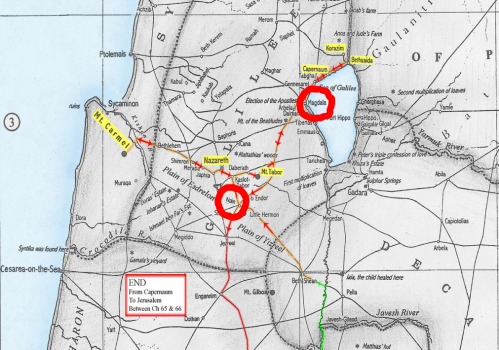
Correct. FYI: Lk. 7:11-35 places Jesus in the region of Nain in Galilee, and in Lk. 7:30, Luke mentions the Pharisees and the lawyers rejecting the counsel of God, not being baptized by him [John the Baptist] themselves. In Lk. 7:36, Luke begins his recounting of Jesus in the house of Simon the Pharisee. This is scriptural support for what Maria Valtorta—another true spokesperson of God, who received and described visions of scenes from Jesus's life on earth— said, which was that Simon the Pharisee's house was located specifically in Nain in Galilee. She also confirmed that Mary of Magdala, Mary of Bethany, and the unnamed repentant woman in Simon the Pharisee's house were the same woman, and at the time Mary came to see Jesus there, she was living in Magdala, also located in Galilee. See map attached. Later on, Mary came to live in Bethany in the house of her brother, Lazarus, whom Simon the Leper was a servant of. I highly recommend reading The Story of Mary Magdalene (extracts from The Gospel as Revealed to Me, or The Poem of the Man-God), as well as A Summa and Encyclopedia to Maria Valtorta's Extraordinary Work, especially the chapters on the proofs in support of her writings having a supernatural origin.

1756396813915.png
 
Last edited:

Grailhunter

Well-Known Member
Jun 19, 2019
14,286
6,194
113
69
FARMINGTON
Faith
Christian
Country
United States
Gender
Male
As I said, there were only two separate occasions in all the four Gospels where a woman came to Jesus bringing an alabaster jar of ointment, and made the same personal gesture of anointing Him and wiping His feet with her hair: in the house of Simon the Pharisee (Lk. 7:36-50), and in the house of Simon the Leper in Bethany. (Matt. 26:6-13, Mk. 14:3-9, Jn. 12:1-8)

So
 

Grailhunter

Well-Known Member
Jun 19, 2019
14,286
6,194
113
69
FARMINGTON
Faith
Christian
Country
United States
Gender
Male
If you can specify the city/town of Simon the Pharisee's house in Luke's account (Lk. 7:36-50) as being any other than Bethany, then you can definitively say the same personal gesture wasn't made twice in Bethany. Can you do this? And, whether you can or can't, it doesn't rule out Mary of Bethany as having been the unnamed woman in Luke's account, because it's possible for a person to repeat the same personal gesture(s) in the same or different locations.

Some Bible students find interest in realizing that Jesus’ feet were anointed with oil and wiped with a woman’s hair on two different occasions. Sometimes these two events get confused as one event, because of the similarities between them, but they are definitely two distinct times in the life of Jesus. Let’s consider them.

The first anointing took place in Luke 7:36-50. Luke is the only gospel record to include this event. Unfortunately, some Bibles place a footnote with a cross-reference to Matthew 26, Mark 14 and John 12. This is an obvious mistake on their part (when the passages are all studied in context) and has led to confusion for some Bible students.

The second anointing ( Was done by Mary) took place in John 12:1-8, more than a year after the first anointing in Luke 7. This anointing is also recorded in parallel accounts in Matthew 26:6-13 and Mark 14:3-9. Again, some translations have a cross-reference to Luke 7, which confuses a Bible student with misinformation. Let’s compare these events.

The first event took place in Simon the Pharisee’s home (Luke 7:36, 40), somewhere in Galilee. The second event took place in Simon the leper’s home in Bethany (Matt. 26:6; Mark 14:3). Two different Simons. Two different homes. Two different cities. (And the woman was not named and nowhere in the scriptures is this event reference again.)

The first woman is described as “a woman in the city who was a sinner” (Luke 7:37), but she is not named. The second woman is identified as Mary, the sister of Lazarus and Martha (John 12:3; 11:2). Both women brought fragrant oil, both anointed Jesus’ feet, and both wiped His feet with their hair (Luke 7:37-38; John 12:3). The first woman also washed “His feet with her tears…and she kissed His feet” (Luke 7:38). It may be that the first woman recognized her sinful condition before the sinless Jesus and was seeking forgiveness, since Jesus did forgive her “many” sins (Luke 7:47-50). But, Jesus specified that the second woman (Mary) was preparing “My body for burial” (Mark 14:8). Two different women. Two different occasions. Two different purposes.