

The Law 430 years later did not...

  • Welcome to Christian Forums, a Christian Forum that recognizes that all Christians are a work in progress.

    You will need to register to be able to join in fellowship with Christians all over the world.

    We hope to see you as a part of our community soon and God Bless!

Hiddenthings

Well-Known Member
May 19, 2025
3,777
415
83
Leeton NSW
Faith
Christian
Country
Australia
Here @dak I'll help you to make a start....

Galatians 3:18 "For if the inheritance comes by the law, it no longer comes by promise; but God gave it to Abraham by a promise."

The Law, introduced 430 Years Later, Does Not Nullify the Covenant God Previously Established:


The promise to Abraham, also called the Abrahamic covenant was given 430 years before the covenant made with Moses and Israel, described in Exodus 24. Yet, curiously, the Mosaic covenant is often treated as the “older” covenant, while the Abrahamic covenant, spoken long before, is seen as the “newer” one. This distinction arises because the Mosaic covenant was immediately confirmed through the sprinkled blood of sacrifices and the fellowship meal, whereas the Abrahamic covenant was not confirmed at the outset.

To illustrate, imagine two contracts: one drawn up in 1950 but not signed or sealed, and another drawn up in 1960 and signed immediately. Though the first contract was written earlier, it remains legally incomplete until it is signed, say, in 1980. In that sense, it becomes the “later” contract, even though it was drafted first.

Similarly, the Mosaic covenant was confirmed at once, but the Abrahamic covenant required faith from Abraham and his descendants. Paul and other New Testament writers emphasize this: Abraham was justified by faith in God’s promises (Romans 4), even though he did not personally receive them, only seeing them from afar (Hebrews 11:13).

The Abrahamic covenant could only be fully confirmed, “signed, sealed, and delivered” through the shed blood of Christ, the covenant sacrifice (Galatians 3:1, 13, 16, 19–20). This is why Jesus declared, “This is the new covenant in My blood!” Once confirmed in Christ, the Abrahamic covenant becomes the eternal covenant, in contrast to the Mosaic covenant, which was temporary and destined to fade away (Hebrews 8:13)

Hebrews 8:13 "In speaking of a new covenant, he makes the first one obsolete. And what is becoming obsolete and growing old is ready to vanish away."
 

Hiddenthings

Well-Known Member
May 19, 2025
3,777
415
83
Leeton NSW
Faith
Christian
Country
Australia
Hebrews 8:13 "In speaking of a new covenant, he makes the first one obsolete. And what is becoming obsolete and growing old is ready to vanish away."

By calling this covenant “new,” He has made the first one obsolete, and what is obsolete, and aging will soon disappear:

The same God who established the old covenant in anticipation of the new has now brought the fulfillment of the new covenant. The new covenant is so much better than the old that the old must yield to it. Its purpose has been fulfilled, and therefore it is destined to vanish.

Made: The term can also be translated as “pronounced” (NEB) or “rendered” (Diag), indicating a declaration made solely by God’s decree—even as in Jeremiah’s day.

First: The repeated use of this term in the argument that follows (Hebrews 9:1, 15, 18; 10:9) emphasizes that the first covenant is now obsolete.

Obsolete and aging: The Law has grown old, has been set aside, and will shortly disappear (Hebrews 12:26–29; Haggai 2:6). This was foretold in Daniel 8:9–12, 24; 9:26, and Isaiah 50:9, which likens it to a garment that wears out and is consumed by moths.

Soon: This likely situates the writing of Hebrews close to the destruction of Jerusalem and the temple in 70 AD. The author appears to anticipate Jesus’ prophecy regarding Jerusalem’s fall (Mark 13:2). Had Hebrews been written after these events, the writer would likely have cited them explicitly to confirm his argument.
 

dak

Well-Known Member
Feb 9, 2013
1,520
200
63
Messianica
sites.google.com
Faith
Other Faith
Country
United States
Gender
Male
If you would have listened, and if you had believed all the scripture that has been quoted up to now, (and at least have understood the points that have been made, (whether you agreed with them or not)), you might almost be at the point where you might start to begin understanding all these things.

Too bad you plugged your ears and closed your eyes. It is not possible to explain all these things in a post or two: it takes time, a lot of time, so that you may prove your love for the Father and His Word. I've never claimed to be anyone's teacher, though you seek to be my teacher, and as I have said to you before: we are all to be taught of Elohim, not of men, but those scripture quotes and passages did not sink down into your heart either. It is as if the seed of the Word fell upon the compacted-hardened soil of the heart by the wayside, and the wicked one, the devil, and the satan came immediately and stole away the seed of the Word from the compacted soil of the hardened heart.

Perhaps someone else will be interested in your thread.
 

Hiddenthings

Well-Known Member
May 19, 2025
3,777
415
83
Leeton NSW
Faith
Christian
Country
Australia
Perhaps someone else will be interested in your thread.
Some truths are too hard for you to hear, Dak—confirmation bias shuts your ears and makes it impossible for you to perceive God’s wisdom in the Covenants.

You can't say it wasn't for trying!
 
Last edited:

Hiddenthings

Well-Known Member
May 19, 2025
3,777
415
83
Leeton NSW
Faith
Christian
Country
Australia
It is as if the seed of the Word fell upon the compacted-hardened soil of the heart by the wayside, and the wicked one, the devil, and the satan came immediately and stole away the seed of the Word from the compacted soil of the hardened heart.

Perhaps someone else will be interested in your thread.
For someone raised under the Torah, how could such deception slip past you? The Torah is completely silent on such a being! No amount of content development and lengthy threads could help you with this one.
 

Hiddenthings

Well-Known Member
May 19, 2025
3,777
415
83
Leeton NSW
Faith
Christian
Country
Australia
If you would have listened, and if you had believed all the scripture that has been quoted up to now, (and at least have understood the points that have been made, (whether you agreed with them or not)), you might almost be at the point where you might start to begin understanding all these things.
I’ll be waiting for your next thread with great anticipation… who knows, you might even make it to the New Covenant! Here's hoping!
 

Jay Ross

Well-Known Member
Jun 20, 2011
9,518
3,547
113
QLD
Faith
Christian
Country
Australia
Gender
Male
The Law, introduced 430 Years Later, Does Not Nullify the Covenant God Previously Established:

But God gave the "Abrahamic Covenant" to Abraham, Isaac and Jacob, over a period, as some suggest, of 240 years where the last part of the Abrahamic Covenant was given to Jacob at Beersheba just before he travelled down to Egypt. After Jacob went down to Egypt, at the invitation of the Pharoh, Israel spent 430 years in Egypt before God brought Israel up out of Egypt and Moses lead Israel to the foot of Mt Sinai, where over a period of time Moses expanded on the Law that He had received from the Lord to the Nation of Israel.

The Laws surrounding the Passover Feast was given just a day or two before the Pharoh initially told Israel to leave.

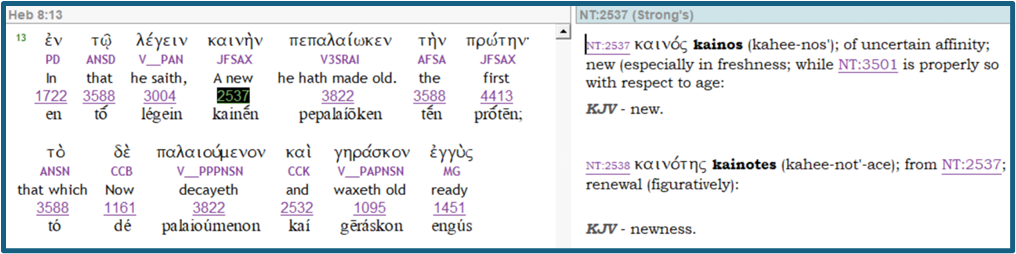
Hebrews 8:13 "In speaking of a new covenant, he makes the first one obsolete. And what is becoming obsolete and growing old is ready to vanish away."

1756361553082.png

So, the verse perhaps should be understood to read like this, " Hebrews 8:13 "In speaking of a renewed/refreshed covenant, . ." where the author is not talking about a brand-new covenant but about a covenant that has been refreshed like new again for the Nation of Israel.

Sadly, so many Christians want a brand-new covenant that they miss the fact that the Salvation Covenant has been available for all of mankind, in its various forms, from the beginning, from the time that Adam was created. The difference in the covenant today is the process by which we are redeemed. No longer are we required to present animal sacrifices, but rather by faith accept that Jesus, is the Son of God, and by His sacrifice on the cross all of the sins that they may have, have been covered and we are redeemed when they bow down and worship Him.
 

Hiddenthings

Well-Known Member
May 19, 2025
3,777
415
83
Leeton NSW
Faith
Christian
Country
Australia
So, the verse perhaps should be understood to read like this, " Hebrews 8:13 "In speaking of a renewed/refreshed covenant, . ." where the author is not talking about a brand-new covenant but about a covenant that has been refreshed like new again for the Nation of Israel.

Sadly, so many Christians want a brand-new covenant that they miss the fact that the Salvation Covenant has been available for all of mankind, in its various forms, from the beginning, from the time that Adam was created. The difference in the covenant today is the process by which we are redeemed. No longer are we required to present animal sacrifices, but rather by faith accept that Jesus, is the Son of God, and by His sacrifice on the cross all of the sins that they may have, have been covered and we are redeemed when they bow down and worship Him.
Hebrews 8:8,13 “Behold, the days come, saith the Lord, when I will make a new covenant…In that he saith, A new covenant, he hath made the first old.”

The word translated “new” is the Greek kainos (Strong’s #2537). This does not simply mean “new” in the sense of time (neos, Strong’s #3501), but “new” in quality, fresh, superior, and unlike what came before (Vine’s Expository Dictionary).

The writer to the Hebrews builds this truth throughout the epistle:
  • Jesus is a greater High Priest than Aaron and his line (Heb 5:1–7).
  • He mediates a superior covenant (Heb 8:1–13).
  • He ministers in a greater sanctuary (Heb 9:1–12).
  • He offers a better sacrifice than the blood of animals (Heb 9:13–10:18).
  • This covenant rests on better promises (Heb 10:19–12:3).
In Jesus alone we have “a great high priest over the house of God” (Heb 10:21). The new covenant is both new in time (neos, Heb 12:24) and new in quality (kainos, Heb 9:15). Only in him can there be a truly new relationship with God.

The old covenant was typological it foreshadowed. The sacrifices, the priesthood, and the sanctuary were all provisional. They pointed forward to the eschatological reality fulfilled in Christ: the saving work accomplished through His death and resurrection. Now, in him, we approach God through “a new and living way” (Heb 10:20).
 
Last edited:

Jay Ross

Well-Known Member
Jun 20, 2011
9,518
3,547
113
QLD
Faith
Christian
Country
Australia
Gender
Male
Hebrews 8:8,13 “Behold, the days come, saith the Lord, when I will make a new covenant…In that he saith, A new covenant, he hath made the first old.”

The word translated “new” is the Greek kainos (Strong’s #2537). This does not simply mean “new” in the sense of time (neos, Strong’s #3501), but “new” in quality, fresh, superior, and unlike what came before (Vine’s Expository Dictionary).

But the translators have left the meaning vague by wrongly translating "kainos" with just the one English word "new," which is misleading for those who have little laughing matter with which to ponder this dilemma that the English translations have created.

If we are to understand God's salvation promises, we need to go back to the beginning, around some 2,000 years prior to the Abrahamic Covenant. Jesus even referred to this in Matthew 13.
 
Last edited:
  • Like
Reactions: Hiddenthings

Hiddenthings

Well-Known Member
May 19, 2025
3,777
415
83
Leeton NSW
Faith
Christian
Country
Australia
But the translators have left the meaning vague by wrongly translating "kainos" with just the one English word "new," which is misleading for those who have little laughing matter with which to ponder this dilemma that the English translations have created.

If we are to understand God's salvation promises, we need to go back to the beginning, around some 2,000 years prior to the Abrahamic Covenant. Jesus even referred to this in matthew 13.
It all starts with the Edenic Covenant - agree
 

Hiddenthings

Well-Known Member
May 19, 2025
3,777
415
83
Leeton NSW
Faith
Christian
Country
Australia
If we are to understand God's salvation promises, we need to go back to the beginning, around some 2,000 years prior to the Abrahamic Covenant. Jesus even referred to this in matthew 13.
If you mean the Seed of the Serpent and the Seed of the Woman, then yes, over time, as knowledge unfolded, one can perceive how God would reconcile those of the flesh (the serpent’s seed) into the body of Christ through His great and precious promises.
 

Jay Ross

Well-Known Member
Jun 20, 2011
9,518
3,547
113
QLD
Faith
Christian
Country
Australia
Gender
Male
I do not accept that there is a "brand-new" covenant that is just applicable to this particular era.

I do accept that over time the Salvation Covenant has been refreshed a number of times and that it seems to be "like new" once more for us to respond too.
 

Hiddenthings

Well-Known Member
May 19, 2025
3,777
415
83
Leeton NSW
Faith
Christian
Country
Australia
I do not accept that there is a "brand-new" covenant that is just applicable to this particular era.
Agree as the OP clearly shows - the Abrahamic Covenant is the Eternal Covenant by Promise!
I do accept that over time the Salvation Covenant has been refreshed a number of times and that it seems to be "like new" once more for us to respond too.
It's made new in Christ - all promises are yes in him!
 

Hiddenthings

Well-Known Member
May 19, 2025
3,777
415
83
Leeton NSW
Faith
Christian
Country
Australia
@Jay Ross, the Abrahamic Covenant is paramount, for it alone brings life.

Do you see this? No other covenant can justify a person (to be made right) .

A clear illustration is Jesus’ encounter with the woman in Luke 13:10–17, where she is called a daughter of Abraham (cf. Luke 13:25, 28; 19:9; John 8:33, 39).

To disregard Abraham’s faith is, in effect, to deny Christ himself.
 

Hiddenthings

Well-Known Member
May 19, 2025
3,777
415
83
Leeton NSW
Faith
Christian
Country
Australia
Christ’s use of the word “new” links the Abrahamic Covenant directly to his own death and its ratification through His blood: “This is my blood of the new covenant.” Abraham looked forward in faith to that fulfillment and, in a sense, participated in it symbolically in Genesis 15, where God Himself is represented by a burning lamp passing between the pieces of the future sacrificial offering of Christ. The patriarch entered the deep sleep of death, and the generations passed, yet he awoke to find that “on the same day” the Lord had renewed the covenant. Abraham rejoiced to see the day of Christ, for though he did not receive the promise in its full temporal fulfillment, he was assured of the better thing, a blessing that far surpassed any immediate possession for a childless man in the land where he lay.

The New Covenant in Christ remains very much in effect, though much of it is still unfulfilled. Its ultimate fulfillment will occur during the Kingdom Age. This covenant rests upon Christ’s sacrifice and secures the eternal blessedness of Israel and Judah, as well as all who believe (Hebrews 8:10–13; cf. Jeremiah 31:31–34; Galatians 3:13–29). Both Israel and Judah will be forgiven and restored, not on the basis of the conditional Mosaic Covenant, but through the New Abrahamic Covenant in Christ, which remains unconditional and awaits fulfillment (cf. Galatians 3:15–18; Hebrews 6:13–20).

The Abrahamic Covenant illustrates that a covenant can be signed and sealed, yet not all provisions take immediate effect. Some provisions were implemented right away, such as the changes of names and circumcision. Others, like the birth of Isaac, occurred 25 years later; the conquest of Canaan followed some 400 years after. Certain promises, including the full settlement of the Promised Land, remain future, awaiting the return of Christ, the resurrection of the dead, and the ultimate redemption and restoration of Israel.
 

Jay Ross

Well-Known Member
Jun 20, 2011
9,518
3,547
113
QLD
Faith
Christian
Country
Australia
Gender
Male
The Salvation Covenant started in the Garden of Eden, some 2,000 years before God entertained a covenant with Abraham which was a continuation of the Covenant that had existed from the very beginning.

We have a very different understanding.

Sorry, you need to work out the solution by yourself.
 
Last edited:

Hiddenthings

Well-Known Member
May 19, 2025
3,777
415
83
Leeton NSW
Faith
Christian
Country
Australia
The Salvation Covenant started in the Garden of Eden, some 2,000 years before God entertained a covenant with Abraham which was a continuation of the Covena that had existed from the very beginning.

We have a very different understanding.

Sorry, you need to work out the solution by yourself.
No same understanding - The Edenic Covenant is the first Covenant! Will get to this at some point.
 

Hiddenthings

Well-Known Member
May 19, 2025
3,777
415
83
Leeton NSW
Faith
Christian
Country
Australia
The Salvation Covenant started in the Garden of Eden, some 2,000 years before God entertained a covenant with Abraham which was a continuation of the Covena that had existed from the very beginning.

We have a very different understanding.

Sorry, you need to work out the solution by yourself.
  • Edenic Covenant
  • Noahic Covenant
  • Abrahamic Covenant
  • Mosaic Covenant
  • Phinehas Covenant
  • Davidic Covenant
  • New Covenant
All are fulfilled in Christ, and each offer us an unfolding revelation of God's Plan with His Creation and People.
 

dak

Well-Known Member
Feb 9, 2013
1,520
200
63
Messianica
sites.google.com
Faith
Other Faith
Country
United States
Gender
Male
Here @dak I'll help you to make a start....

Galatians 3:18 "For if the inheritance comes by the law, it no longer comes by promise; but God gave it to Abraham by a promise."

The Law, introduced 430 Years Later, Does Not Nullify the Covenant God Previously Established:

True, but neither does the covenant with Abraham nullify the Torah penned by Mosheh just because it came 430 years later.

The promise to Abraham, also called the Abrahamic covenant was given 430 years before the covenant made with Moses and Israel, described in Exodus 24. Yet, curiously, the Mosaic covenant is often treated as the “older” covenant, while the Abrahamic covenant, spoken long before, is seen as the “newer” one. This distinction arises because the Mosaic covenant was immediately confirmed through the sprinkled blood of sacrifices and the fellowship meal, whereas the Abrahamic covenant was not confirmed at the outset.

The promised seed, Yitzhak, is Meshiah even according to Paul: Abraham therefore did receive that promise, and moreover, the righteousness accounted to Abraham in Gen 15:6 was not fulfilled until he was tested many years later in Gen 22, (which we've already been over and you ignored). Moreover the covenant with Abraham includes circumcision and, in fact, if he had not been circumcised and done the will of the Father then Yitzhak/Meshiah, the promised seed, would not have been born.

To illustrate, imagine two contracts: one drawn up in 1950 but not signed or sealed, and another drawn up in 1960 and signed immediately. Though the first contract was written earlier, it remains legally incomplete until it is signed, say, in 1980. In that sense, it becomes the “later” contract, even though it was drafted first.

Similarly, the Mosaic covenant was confirmed at once, but the Abrahamic covenant required faith from Abraham and his descendants. Paul and other New Testament writers emphasize this: Abraham was justified by faith in God’s promises (Romans 4), even though he did not personally receive them, only seeing them from afar (Hebrews 11:13).

The Mosaic covenant "to/for/concerning the many" was confirmed by the Meshiah at the last Seder in Matthew and Mark. The new-renewed covenant "for you", (the talmidim of the Master), is confirmed in Luke 22 and is the second cup mentioned in that passage, (there are three to four cups at the Seder, (even now some still set out an extra table and cup in case Eliyahu happens to come)). The first three cups may be one cup refilled but are still considered three cups: only two cups are mentioned in the Gospel narratives.

The Abrahamic covenant could only be fully confirmed, “signed, sealed, and delivered” through the shed blood of Christ, the covenant sacrifice (Galatians 3:1, 13, 16, 19–20). This is why Jesus declared, “This is the new covenant in My blood!” Once confirmed in Christ, the Abrahamic covenant becomes the eternal covenant, in contrast to the Mosaic covenant, which was temporary and destined to fade away (Hebrews 8:13)

Hebrews 8:13 "In speaking of a new covenant, he makes the first one obsolete. And what is becoming obsolete and growing old is ready to vanish away."
I fully disagree with your exegesis and lack of understanding of the covenants.
Study the Torah.
 

Hiddenthings

Well-Known Member
May 19, 2025
3,777
415
83
Leeton NSW
Faith
Christian
Country
Australia
True, but neither does the covenant with Abraham nullify the Torah penned by Mosheh just because it came 430 years later.
Nullify to mean it's been completed.

Once that covenant guided its people toward the New Covenant in Christ, the Torah had fulfilled its purpose. This does not mean the Law could no longer instruct us; rather, now that all things are revealed in Christ, we can look back at the Law and recognize him as its central
focus.

I could give you many examples, but you already know them.

The promised seed, Yitzhak, is Meshiah even according to Paul: Abraham therefore did receive that promise, and moreover, the righteousness accounted to Abraham in Gen 15:6 was not fulfilled until he was tested many years later in Gen 22, (which we've already been over and you ignored). Moreover the covenant with Abraham includes circumcision and, in fact, if he had not been circumcised and done the will of the Father then Yitzhak/Meshiah, the promised seed, would not have been born.

Correct the promised seed is Christ.

Romans 2:25–29 “For circumcision indeed is of value if you obey the law, but if you break the law, your circumcision becomes uncircumcision. … But a Jew is one inwardly, and circumcision is a matter of the heart, by the Spirit, not by the letter. His praise is not from man but from God.

Can you obey the Law dak? Rom 3:23!!!

“As though you had not been circumcised” because circumcision, if not properly observed, brought a curse under the very law that established it (Gen. 17:14).

See the implication?

“Circumcision and uncircumcision are of no consequence; what truly matters is keeping God’s commands” (1 Cor 7:19).
“In Christ Jesus, neither circumcision nor uncircumcision counts, what matters is faith working through love” (Gal 5:6).
“Neither circumcision nor uncircumcision carries any weight; what counts is becoming a new creation” (Gal 6:15).
“Therefore, if anyone belongs to Christ, they are a new creation: the old has passed away, and the new has come” (2 Cor 5:17).

You must feel the weight dak?

The Mosaic covenant "to/for/concerning the many" was confirmed by the Meshiah at the last Seder in Matthew and Mark. The new-renewed covenant "for you", (the talmidim of the Master), is confirmed in Luke 22 and is the second cup mentioned in that passage, (there are three to four cups at the Seder, (even now some still set out an extra table and cup in case Eliyahu happens to come)). The first three cups may be one cup refilled but are still considered three cups: only two cups are mentioned in the Gospel narratives.

Correct, now you need to understand that Jesus links the cup with the new covenant, turning the ritual of the Passover into a memorial of his sacrifice.

I fully disagree with your exegesis and lack of understanding of the covenants.
Study the Torah.
It's not I who you disagree with but the Apostle Paul.