Songs of the Scroll

  • Welcome to Christian Forums, a Christian Forum that recognizes that all Christians are a work in progress.

    You will need to register to be able to join in fellowship with Christians all over the world.

    We hope to see you as a part of our community soon and God Bless!

dak

Well-Known Member
Feb 9, 2013
1,457
188
63
Messianica
sites.google.com
Faith
Other Faith
Country
United States
Gender
Male
Tehillim-Psalms 40:1-6
1 For the End, A Psalm of David. Waiting, I waited (patiently) on YHWH, and He inclined unto me, and heard my cry.
2 And He has brought me up from the pit of desolation, out of the miry clay, and has set my feet upon the Rock and has established my steps.
3 He has put a new song in my mouth, a hymn of praise unto our Elohim: many shall see, and shall fearfully reverence, (reverential fear), and shall put their trust in YHWH.
4 Blessed is the man who makes YHWH his confidence, and has not turned to the proud, or to those that turn aside to falsehood.
5 Many are the wondrous works that You have done, O YHWH my EL, and Your thoughts toward us no one can fully recount to You: I declare and proclaim, they are too numerous to number.
6 Sacrifice and offering You have not desired, my ears You have pierced, burnt offering and sin offering You have not required.

My ears You have pierced:
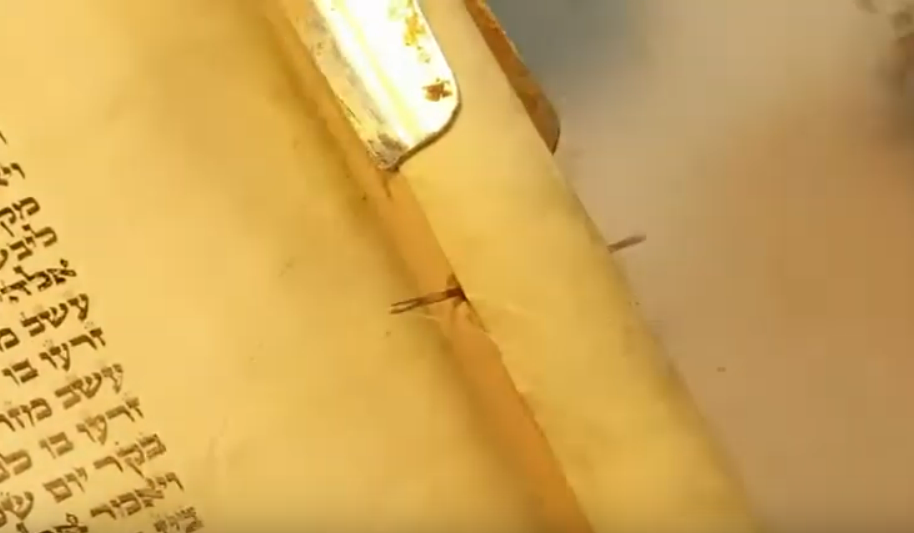
torah-scroll-earlets3.png


מדריך לתפירת ספר תורה לעצי חיים
Video Title/Description "Guide (Tutorial) for Sewing a Sefer Torah to the Trees of Life"
(Screen capture above is from minute mark 2:04).

If therefore one is willing to look upon the ears having been pierced as the ends of the scroll, which are pierced with a needle so as to attach each end of the scroll to its respective tree of life, it becomes more clear what the author of Hebrews is doing in Heb 10:5, where Psa 40:6 is quoted but the word body is found instead. He is not getting this from the OG LXX because it also reads ears, (only the later ABPolyglot LXX now reads body). This is a metonym, (metonymy), and is therefore surely acceptable because from one ear to the other ear implies the whole body of the Torah Scroll. Also, in the broader sense of a body, (like the body of the great assembly of the faithful), each page or sheet of the scroll is joined to its brethren, sewn together as one whole unit, making up the heart of the Torah scroll, even like David and Yonathan whose hearts and souls were knit together as one, (1Sam 18:1, see also 1Chr 12:7).

Moreover the author of Hebrews adds critical information to this passage where he states, Therefore, entering into the world, he says, and that is when the author quotes Psalm 40:6, Sacrifice and offering you have not desired. What does that mean? Where is it that he enters into the world? Where does the Torah begin to speak? What does the Torah say to us? As we all know, it commences thus: In the beginning...

Thus the opening creation account contains the mgillat or kephalidi, (LXX and epistle to the Hebrews), which is the header of the Sefer. Kephalidi, (kephalis), is employed several times in the LXX for the chapiters or crowns of columns, (in architecture). In writings, such as a scroll or book, which also have columns, this would necessarily specify a head section or header of a passage, (modern chapter), not a whole sefer, or scroll, or entire "volume of the book". At the very least this would point to Gen 1:1, but more likely the first few verses, if not the entire opening creation account, (down to the colophon statement in Gen 2:4a). This is critical to understand because, according to the author of Hebrews, it pertains to when the Word enters into the world, and the text says that it is written of him in the mgillat-kaphalidi-header of the Sefer, (the header at the beginning of the Torah Scroll).

The Aramaic scriptures relate the same idea from the Psalm, which they would only have taken from a pretty ancient understanding of the Hebrew word used therein, (mgillat).

Psalm 40:7 Peshitta Holy Bible Translated
7 Then I said, " Behold, I have come, for in the first of The Writings it is written about me:"

Psalm 40:7 Lamsa Bible
7 Then said I, Lo, I come; in the beginning of the books, it is written of me,

The new song of king David is a song or hymn about a Torah Scroll: the Word of the Father.

Tehillim-Psalms 40:7-17
7 Then said I, Behold, I have come: (or I am present), in the header of the Sefer it is written concerning me,
8 I delight to do Your will, O my EL, and Your Torah-Instruction is in the midst of my inward parts.
9 I have preached righteousness in the great congregation: behold, You know I have not refrained my lips, O YHWH.
10 I have not concealed Your righteousness within my heart, I have declared Your faithfulness and Your salvation: I have not concealed Your loving-kindness and Your truth from the great congregation.
11 Withhold not Your tender mercies from me, O YHWH, let Your loving-kindness and Your truth continually preserve me:
12 For innumerable evils have compassed me about: my contortions have taken hold upon me, so that I am not able to be looked upon; they are more numerous than the hairs of my head, and my heart fails me.
13 Be pleased to deliver me, O YHWH, make haste to help me, O YHWH!
14 Let them be ashamed and confounded together who seek after my soul to destroy it: let them that wish me evil be driven aback and put to shame.
15 Let those who say to me, Aha! Aha! be desolate as the reward for their shame.
16 Let all those that seek You rejoice and be glad in You: let those that love Your salvation continually say, YHWH be magnified!
17 And though I am afflicted and destitute, Adonai thinks upon me: You are my help and my deliverer, tarry not, O my EL!

The final problematic statement concerns iniquity, (עָוֹן `avon), for this word does not always mean sins and transgressions but is sometimes also used for punishments, in the sense of punishments for iniquities. Because of this it is also sometimes used for the results of punishments, such as disfigurations and contortions from punishments or beatings. One may see this understanding implied in some of the places this word is employed where it does not seem to make sense in translation.

Exodus 28:38 KJV
38 And it shall be upon Aaron's forehead, that Aaron may bear the iniquity of the holy things, which the children of Israel shall hallow in all their holy gifts; and it shall be always upon his forehead, that they may be accepted before the LORD.

Is there iniquity concerning the holy things? Could it rather speak of imperfections due to the fact that physical objects are going to be used as representations of supernal and spiritual things? Something is not quite right about the above rendering.

Numbers 18:1 KJV
1 And the LORD said unto Aaron, Thou and thy sons and thy father's house with thee shall bear the iniquity of the sanctuary: and thou and thy sons with thee shall bear the iniquity of your priesthood.
2 And thy brethren also of the tribe of Levi, the tribe of thy father, bring thou with thee, that they may be joined unto thee, and minister unto thee: but thou and thy sons with thee shall minister before the tabernacle of witness.
3 And they shall keep thy charge, and the charge of all the tabernacle: only they shall not come nigh the vessels of the sanctuary and the altar, that neither they, nor ye also, die.
4 And they shall be joined unto thee, and keep the charge of the tabernacle of the congregation, for all the service of the tabernacle: and a stranger shall not come nigh unto you.

We have thus a general daily usage of vessels and instruments, which are going to take "a beating" with that daily usage, and this seems to be the meaning of `avon in the above passage. Then we also see that the Kohen is to bear the iniquities of the congregation, iniquities that are neither his own, nor his fault.

Leviticus 10:17 KJV
17 Wherefore have ye not eaten the sin offering in the holy place, seeing it is most holy, and God hath given it you to bear the iniquity of the congregation, to make atonement for them before the LORD?

The ultimate Kohen Gadol is the Word of the Father because the Word of the Father is the mediator between the Father and His people. Thus we have a number of variations in the meaning and usage of the word `avon. The more important point is that the Torah Scroll itself, being flesh, (originally LAMB skins), is going to take "a beating" over its lifespan but the Word written therein is eternal. So by the time the king has studied his copy of the Torah all his days, (as commanded in the Torah), his copy of the Torah will become tattered, torn, with ripped panels, splitting and fraying seems, even though it may have been repaired who knows how many times. And eventually the ink dries out to the point that it begins to flake off in places, and near the end there are passages that can hardly even be read because the ink has flaked away, so that the Torah Scroll eventually reaches the point where it can no longer even be looked upon due to all of its rips, tears, split seams, contortions, and disfigurations, (`avon), all merely because of the daily usage and beating it has taken so as to impart the Word of the Father into the heart and mind of the king, (David).

Psalms 40:14-15 contains a teaching: you shall not destroy or put to the flame an old wornout Torah Scroll, but it shall be laid to rest, (preferably in a sealed container), in a safe place, and allowed to return to dust of its own accord: for the Word continues on, and yet lives in the heart of the one who owned it, (in this case king David), and in the hearts of those with whom he has shared it, and it is the same with synagogues and congregations where the Torah tabernacles among the people.
 
Last edited:
  • Like
Reactions: shepherdsword

dak

Well-Known Member
Feb 9, 2013
1,457
188
63
Messianica
sites.google.com
Faith
Other Faith
Country
United States
Gender
Male
Isaiah 40:6-8 KJV
6 The voice said, Cry. And he said, What shall I cry? All flesh is grass, and all the goodliness thereof is as the flower of the field:
7 The grass withereth, the flower fadeth: because the spirit of the LORD bloweth upon it: surely the people is grass.
8 The grass withereth, the flower fadeth: but the word of our God shall stand for ever.

1 Corinthians 15:39-44 ASV
39 All flesh is not the same flesh: but there is one flesh of men, and another flesh of beasts, and another flesh of birds, and another of fishes.
40 There are also celestial bodies, and bodies terrestrial: but the glory of the celestial is one, and the glory of the terrestrial is another.
41 There is one glory of the sun, and another glory of the moon, and another glory of the stars; for one star differeth from another star in glory.
42 So also is the resurrection of the dead. It is sown in corruption; it is raised in incorruption:
43 it is sown in dishonor; it is raised in glory: it is sown in weakness; it is raised in power:
44 it is sown a natural body; it is raised a spiritual body. If there is a natural body, there is also a spiritual body.

Personification of the Torah Scroll as Kohen and King:

Revelation 1:12-18
12 And I turned to see the voice that spoke with me: and having turned, I saw seven golden menorahs.
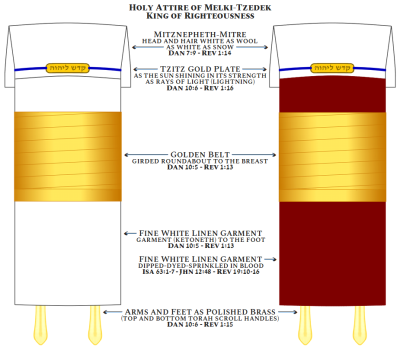
13 And in the midst of the seven menorahs one like unto the Son of Adam, clothed in a podera, [the fine white linen foot-length garment] and girded roundabout unto the chest with a golden belt.
14 And his head and his hairs white as wool, white as snow, [the Ancient of Days, Dan 7] and his eyes as a flame of fire,
15 And his feet like unto polished brass, as having been refined in a furnace, and his voice as the sound of many waters.
16 And he had in his right hand seven stars, and out of his mouth went a swift double-edged rhomphaia-sword, and his countenance was as the sun shining forth in its strength.
17 And when I saw him, I fell at his feet as dead: and he placed his right hand upon me, saying,
18 Fear not, I am the First and the Last, I am he who lives: and I had become dead, and behold, I am alive into the ages of the ages, and I have the keys of Death and of Sheol [Hades].

In the right hand side of the Torah Scroll, (Gen 1), there are seven stars, (see also Amos 5:8), which are seven horns of power, (Hab 3:4, Rev 5:6), and his eyes are as a flame of fire, (Rev 1:14, Dan 10:6), and there are seven lamps of fire burning before the throne, which are the seven Spirits of Elohim before the throne, (Rev 4:5), and those seven are the seven eyes of HE WHO WAS AND WHO IS AND WHO SHALL BE, which are sent forth into all His land, (Zec 3:9, Zec 4:10, Rev 5:6).

Kiss the Son, lest he be angry, and you perish from the way when his wrath is kindled but a little: blessed are all who put their trust in him. (Psa 2:12).
 
Last edited:

dak

Well-Known Member
Feb 9, 2013
1,457
188
63
Messianica
sites.google.com
Faith
Other Faith
Country
United States
Gender
Male
1 John 1:1-3
1 That which was from the beginning, which we have heard, which we have seen with our eyes, which we have looked upon and our hands have handled, concerning the Word of life:
2 And the life was rendered apparent, and we have clearly discerned, and bear witness, and announce to you the life eternal which was with the Father and was manifestly declared unto us.
3 We announce to you what we have seen and heard, so that you also might have fellowship with us: and truly our fellowship is with the Father and with His Son, Ι̅Η Χ̅Ρ.

That which was from the beginning, which we have heard, which we have seen with our eyes, which we have looked upon and our hands have handled, concerning the Word of life

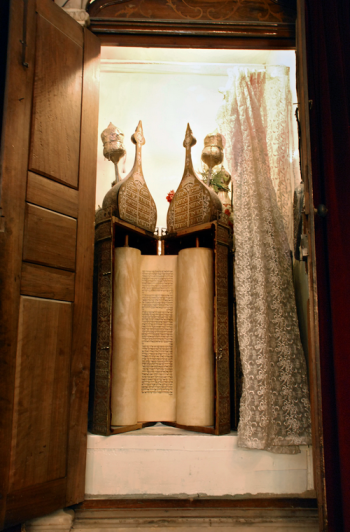
torahscroll.jpg


John 1:18
18 No one has seen Elohim at any time: the one-of-a-kind Elohim-Son who exists in the bosom of the Father, that one has been exegeted [expounded].
(εξηγησατο he/she/it was exegeted-expounded, katabiblon).

1 John 4:12
12 No one has beheld Elohim at any time: if we love one another, Elohim dwells within us, and His love is perfected in us.

1 John 4:1-3
1 Beloved, believe not every spirit, but test the spirits, whether they are of Elohim: for many false prophets are gone out into the world.
2 Hereby you know the Spirit of Elohim: every spirit confessing that Ι̅Η Χ̅Ρ has come in flesh is of Elohim.
3 And every spirit not confessing that Ι̅Η Χ̅Ρ has come in flesh is not of Elohim: and this is the spirit of antichrist, which you have heard is coming, and is now already in the world.

2 John 1:6-11
6 And this is love, that we should walk according to His commandments: this is the commandment, even as you have heard from the beginning, that you should walk in it.
7 For many deceivers are gone forth into the world, those confessing not that Ι̅Η Χ̅Ρ comes in flesh: that one is the deceiver and the antichrist.
8 Look to yourselves, that you lose not the things which we have wrought, but that you receive a full reward.
9 Whosoever is transgressing, and abiding not in the Doctrine-Teaching of Χ̅Ρ, does not have Elohim: the one abiding in the Doctrine-Teaching, the same has both the Father and the Son.
10 If any one comes unto you, and brings not this Doctrine, receive him not into your house, and give him no greeting:
11 For the one speaking salutations unto him partakes in his evil works.

No one has seen or beheld Elohim at any time, John 1:18, 1John 4:12.
Ι̅Η Χ̅Ρ has come in flesh, 1 John 4:2
Ι̅Η Χ̅Ρ comes in flesh, 2 John 1:7

But all flesh is the same flesh: there is one flesh of men, and another flesh of beasts, and another flesh of birds, and another of fishes, and therefore also lambs and, of course, their skins which are used to make scrolls. So the Word became flesh, and tabernacled among us:

Ancient-Torah-Scroll-Jobar-Damascus.png
Ancient Torah Scroll at the Jobar-Damascus, Syria

As soon as Mosheh began to write the first Torah Scroll by the command of Elohim.......
 
Last edited:

Hiddenthings

Well-Known Member
May 19, 2025
3,777
415
83
Leeton NSW
Faith
Christian
Country
Australia
Exodus 28:38 KJV
38 And it shall be upon Aaron's forehead, that Aaron may bear the iniquity of the holy things, which the children of Israel shall hallow in all their holy gifts; and it shall be always upon his forehead, that they may be accepted before the LORD.

Is there iniquity concerning the holy things? Could it rather speak of imperfections due to the fact that physical objects are going to be used as representations of supernal and spiritual things? Something is not quite right about the above rendering.

"And it shall be upon Aaron's forehead, that Aaron may bear the iniquity of the holy things, which the children of Israel shall hallow in all their holy gifts."

These “gifts” were the offerings of Israel. They were made holy because they were consecrated to Yahweh, yet they were still linked with “iniquity,” since they came from a people who themselves were unclean. Because of this, the offerings were not suitable to present directly to Yahweh without mediation. The high priest served as that cleansing medium, ensuring the defilement was covered by the constant reminder of Yahweh’s holiness.

In the greater fulfillment, the Lord Jesus “bare our sins in his own body on the tree” (1 Pet. 2:24). He shared our nature, the very source of sin (Mark 7:15–23). Thus, “the iniquity of us all” was laid upon him (Isa. 53:6), for he came in our fallen condition. Yet, unlike us, he bore this burden while rendering perfect obedience, because his mind was wholly dedicated to God. In this way, he revealed “the righteousness of God” (Rom. 3:25–26; cf. Num. 18:1). His triumph was not achieved by his own strength alone, but through the divine power granted to him by his Father. Likewise, we cannot render obedience acceptable to God by our own ability, but only through the strength we receive in Christ.

Here, Scripture sets a sharp contrast: the golden plate on the high priest’s forehead, declaring “Holiness to Yahweh,” versus the leprosy that appeared on the forehead of King Uzziah when he presumptuously forced his way into the holy place. His sin began in the mind, for the record says: “when he was strong, his heart (the seat of intelligence) was lifted up to his destruction” (2 Chr. 26:16–21). Because of his pride, he was struck and driven from the temple as a leper.

By contrast, those in Christ are called to “bring into captivity every thought to the obedience of Christ” (2 Cor. 10:5). That is the divine standard, even though, in our weakness, we fall short of it.
 

dak

Well-Known Member
Feb 9, 2013
1,457
188
63
Messianica
sites.google.com
Faith
Other Faith
Country
United States
Gender
Male
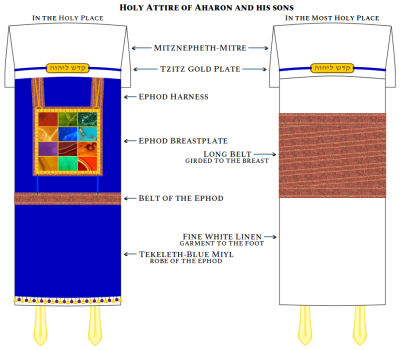
More concerning the personification of the Torah Scroll as Kohen and King:

Torah-Garments-Aharon.png

Torah-Garments-Melki-Tzedek.png

Daniel 10:4-6
4 And in the twenty-fourth day of the rishon hodesh, [Abib], I was by the edge of the great river, which is Hiddekel.
5 And I lifted up my eyes and looked, and behold, a certain iysh clothed in fine linen, and his loins belted roundabout with fine gold of Uphaz.
6 And his body was as tarshish, [fiery-carnelian] and his face as the appearance of lightrays, and his eyes were as lamps of fire, and his arms and his feet were as the color of polished brass, and the voice of his words like the voice of a multitude.

Revelation 1:12-16
12 And I turned to see the voice that spoke with me: and having turned, I saw seven golden menorahs.
13 And in the midst of the seven menorahs one like unto the Son of Adam, clothed in a podera, [the fine white linen foot-length garment] and girded roundabout unto the breasts with a golden belt.
14 And his head and his hairs white as wool, white as snow, [the Ancient of Days, (Dan 7)] and his eyes as a flame of fire,
15 And his feet like unto polished brass, as having been refined in a furnace, and his voice as the sound of many waters.
16 And he had in his right hand seven stars, and out of his mouth went a swift double-edged rhomphaia-sword, and his countenance was as the sun shining forth in its strength.

John 12:47-50
47 And if anyone hears my words, (rhema), and believes not, I judge him not: for I came not to judge the world, but to save-deliver the world.
48 The one rejecting me, and receiving not my words, (rhema), has One that judges him: the Logos that I have spoken, that one shall judge him in the last day.
49 For I have not spoken of myself: but the Father who sent me, He gave me a commandment, what I should say, and what I should speak.
50 And I know that His commandment is life eternal: whatsoever therefore I speak, even as the Father has said unto me, so I speak.


Hebrews 7:1-8 KJV
1 For this Melchisedec, king of Salem, priest of the most high God, who met Abraham returning from the slaughter of the kings, and blessed him;
2 To whom also Abraham gave a tenth part of all; first being by interpretation King of righteousness, and after that also King of Salem, which is, King of peace;
3 Without father, without mother, without descent, having neither beginning of days, nor end of life; but made like [G871 ἀφομοιόω aphomoioo, (study it)] unto the Son of God; abideth a priest continually.
4 Now consider how great this man was, unto whom even the patriarch Abraham gave the tenth of the spoils.
5 And verily they that are of the sons of Levi, who receive the office of the priesthood, have a commandment to take tithes of the people according to the law, that is, of their brethren, though they come out of the loins of Abraham:
6 But he whose descent is not counted from them received tithes of Abraham, and blessed him that had the promises.
7 And without all contradiction the less is blessed of the better.
8 And here men that die receive tithes; but there he receiveth them, of whom it is witnessed that he liveth.
 

Hiddenthings

Well-Known Member
May 19, 2025
3,777
415
83
Leeton NSW
Faith
Christian
Country
Australia
Speaking of the work of Christ, Isaiah declared: "righteousness shall be the girdle of his loins and faithfulness the girdle of his reins" (ch. 11:5)

His activities in the kingdom will be strengthened by righteousness and faithfulness manifested in laws of wisdom that will emanate from Zion through the instrumentality of the saints. Paul urges us to "have our loins girt about (i.e. strengthened) with truth", so that our activities and labors will be dictated by the instructions of the Word (Eph. 6:14; cp. 1 Pet. 1:13)

It's noticeable how difficult it would be to run in such a garment without girding up the loins (of the mind as Peter taught).

Long robes worn in the Eastern countries impeded progress in running or similar exertion unless they were gathered around the waist to give the greatest freedom of movement. A man about to engage in action would tuck their robe into the belt to enable movement.

Exodus 20:26 "And you shall not go up by steps to my altar, that your nakedness be not exposed on it."

God. not man was to be the Father, and to highlight this truth, a specific prohibition was built into the Law concerning the Altar. It was crucial to acknowledge that humanity’s sinful condition was so weakened that only a divine intervention a divinely provided Saviour and altar could bring salvation.

The organs by which humans reproduce might be misconstrued as giving them a kind of creative power comparable to God’s. This distorted idea underpinned the depraved fertility cults of ancient (and later) times. Such practices were detestable to the Creator. Therefore, no part of His altar, nor the service at it, was to be tainted, even indirectly by any suggestion of those pagan rituals. Unlike the priests of false gods, who often served naked at their altars, those who ministered before the Lord were to uphold purity and reverence in every aspect.

Exodus 28:42-43 "You shall make for them linen undergarments to cover their naked flesh. They shall reach from the hips to the thighs. "They shall be on Aaron and on his sons when they go into the tent of meeting or when they come near the altar to minister in the Holy Place, lest they bear guilt and die. This shall be a statute forever for him and for his offspring after him."

To "bear iniquity" means to incur guilt, or to have sin imputed to a person. If a priest, whether through forgetfulness or negligence, entered the sanctuary without the required undergarment, thereby risking an unseemly exposure of his person, he would be considered guilty and subject to the penalty of death.

This strict requirement taught that utmost reverence and circumspection are necessary when approaching Yahweh in worship. Immodest dress or any unseemly display of flesh was entirely inappropriate. Therefore, believers are expected to uphold the highest standards of modesty and attire in the presence of the Deity.

The people of Israel were also commanded to abstain even from legitimate sexual relations when preparing to meet with God (cf. Exodus 19:15). In the case of the priests, even the thought of such matters was to be excluded, and the corresponding parts of the body were to be completely covered. Sexual thoughts or associations were to be entirely absent when the priest was performing sacred service before the Lord.
 

Hiddenthings

Well-Known Member
May 19, 2025
3,777
415
83
Leeton NSW
Faith
Christian
Country
Australia

Leviticus 8:7 (ESV) "And he put the coat on him and tied the sash around his waist and clothed him with the robe and put the ephod on him and tied the skillfully woven band of the ephod around him, binding it to him with the band."


High Priest had two (belt / sash) ?

Interesting in light of Isaiah 11:5
 

dak

Well-Known Member
Feb 9, 2013
1,457
188
63
Messianica
sites.google.com
Faith
Other Faith
Country
United States
Gender
Male

Leviticus 8:7 (ESV) "And he put the coat on him and tied the sash around his waist and clothed him with the robe and put the ephod on him and tied the skillfully woven band of the ephod around him, binding it to him with the band."


High Priest had two (belt / sash) ?

Interesting in light of Isaiah 11:5

All the important key words in that passage align with the image above with the ephod and the blue miyl-robe which has the fine linen ketoneth and its long belt underneath it, (hence, not in the drawing, except for a small length of the white linen robe at the bottom of the blue robe which is covering the white robe for the most part).

ויקרא 8:7 Hebrew OT: WLC (Consonants Only)
ויתן עליו את־הכתנת ויחגר אתו באבנט וילבש אתו את־המעיל ויתן עליו את־האפד ויחגר אתו בחשב האפד ויאפד לו בו׃

And he put upon him the kutoneth, [fine white linen garment down to the foot] and girded-belted him with the abnet, [belt] and he clothed him with the miyl, [all-blue robe] and put upon him the ephod, and strapped-girded him with the belt of the ephod and fastened it to him with it:

It is my opinion that the ephod is like a harness, and its waist belt fastens or ties on the back side, not the front, and there at the back side the waist belt meets with the two shoulder belts or straps that come down to the waist on the backside, like a harness. Most people speculate that the ephod had an apron, but speaking only according to the scripture, I see no evidence of for that, although that is what you will see in most drawings, (generally based on the Israeli Temple Institute's drawings posted online).
 
  • Like
Reactions: Hiddenthings

dak

Well-Known Member
Feb 9, 2013
1,457
188
63
Messianica
sites.google.com
Faith
Other Faith
Country
United States
Gender
Male
Interesting in light of Isaiah 11:5

If you mean Isaiah 59:15 the cloak there is the all-blue miyl: therefore it represents zeal, even the Zeal of the Most High. Remember what is said in John 2:17 where Psalms 69:9 is quoted, ("the zeal of Your house has devoured me"). There is an old tradition that when he overturned the tables in this passage, as well as the other passages toward the end of his ministry, that from his eyes went forth lightrays, (some say blue). Was the Master wearing the tekeleth-blue miyl? That is the robe that had the hole of a habergeon at the neck so that the coat not be rent, (Exo 28:32). It was all one piece: therefore they cast lots for it.

John 19:23-24 KJV
23 Then the soldiers, when they had crucified Jesus, took his garments, and made four parts, to every soldier a part; and also his coat: now the coat was without seam, woven from the top throughout.
24 They said therefore among themselves, Let us not rend it, but cast lots for it, whose it shall be: that the scripture might be fulfilled, which saith, They parted my raiment among them, and for my vesture they did cast lots. These things therefore the soldiers did.
 

Hiddenthings

Well-Known Member
May 19, 2025
3,777
415
83
Leeton NSW
Faith
Christian
Country
Australia
If you mean Isaiah 59:15 the cloak there is the all-blue miyl: therefore it represents zeal, even the Zeal of the Most High.

Did you mean Isaiah 59:15 Truth is lacking, and he who departs from evil makes himself a prey. The Lord saw it, and it displeased him
that there was no justice.


I meant

Isaiah 11:5 Righteousness shall be the belt of his waist, and faithfulness the belt of his loins.

Remember what is said in John 2:17 where Psalms 69:9 is quoted, ("the zeal of Your house has devoured me"). There is an old tradition that when he overturned the tables in this passage, as well as the other passages toward the end of his ministry, that from his eyes went forth lightrays, (some say blue). Was the Master wearing the tekeleth-blue miyl? That is the robe that had the hole of a habergeon at the neck so that the coat not be rent, (Exo 28:32). It was all one piece: therefore they cast lots for it.

John 19:23-24 KJV
23 Then the soldiers, when they had crucified Jesus, took his garments, and made four parts, to every soldier a part; and also his coat: now the coat was without seam, woven from the top throughout.
24 They said therefore among themselves, Let us not rend it, but cast lots for it, whose it shall be: that the scripture might be fulfilled, which saith, They parted my raiment among them, and for my vesture they did cast lots. These things therefore the soldiers did.
Nice.
 

dak

Well-Known Member
Feb 9, 2013
1,457
188
63
Messianica
sites.google.com
Faith
Other Faith
Country
United States
Gender
Male
Did you mean Isaiah 59:15 Truth is lacking, and he who departs from evil makes himself a prey. The Lord saw it, and it displeased him
that there was no justice.

I meant

Isaiah 11:5 Righteousness shall be the belt of his waist, and faithfulness the belt of his loins.


Nice.

Yikes, I was pretty tired and messed that one up: I meant Isaiah 59:17, and I suppose now I should have just quoted it, for at least that way I might have caught my own error.

Isaiah 59:17 KJV
17 For he put on righteousness as a breastplate, and an helmet of salvation upon his head; and he put on the garments of vengeance for clothing, and was clad with zeal as a cloke.

The cloke in the above is the all-blue miyl, hence the color tekeleth-blue signifies zeal, (showing also that even scripture colors have meaning and symbolism).
 
  • Like
Reactions: Hiddenthings

shepherdsword

Encounter Team - Eagle
Staff member
Encounter Team
Feb 12, 2009
2,034
1,631
113
Millington
Faith
Christian
Country
United States
Gender
Male
Psalms 40:14-15 contains a teaching: you shall not destroy or put to the flame an old wornout Torah Scroll, but it shall be laid to rest, (preferably in a sealed container), in a safe place, and allowed to return to dust of its own accord: for the Word continues on, and yet lives in the heart of the one who owned it, (in this case king David), and in the hearts of those with whom he has shared it, and it is the same with synagogues and congregations where the Torah tabernacles among the people.
I didn't see that teaching in 40:14-15. However, I did look up the "piercing" in verse 6 and was surprised.
"כָּרָה (karah) can be used for pierce. My mind went immediately to:

Ex 21:5-6
And if the servant shall plainly say, I love my master, my wife, and my children; I will not go out free: Then his master shall bring him unto the judges; he shall also bring him to the door, or unto the door post; and his master shall bore his ear through with an aul; and he shall serve him for ever.

I see a beautiful picture of redemption here. Jesus forever committing to human form to redeem His bride.
Another possible use for "כָּרָה" is "banquet". That could conceivably draw a picture of the wedding supper of the lamb

Rv 19:7-9
Let us be glad and rejoice, and give honour to him: for the marriage of the Lamb is come, and his wife hath made herself ready. And to her was granted that she should be arrayed in fine linen, clean and white: for the fine linen is the righteousness of saints. And he saith unto me, Write, Blessed are they which are called unto the marriage supper of the Lamb.

I am not saying this is written in stone. I just find the possible allegory interesting
 
  • Like
Reactions: dak

dak

Well-Known Member
Feb 9, 2013
1,457
188
63
Messianica
sites.google.com
Faith
Other Faith
Country
United States
Gender
Male
I didn't see that teaching in 40:14-15. However, I did look up the "piercing" in verse 6 and was surprised.
"כָּרָה (karah) can be used for pierce. My mind went immediately to:

Ex 21:5-6
And if the servant shall plainly say, I love my master, my wife, and my children; I will not go out free: Then his master shall bring him unto the judges; he shall also bring him to the door, or unto the door post; and his master shall bore his ear through with an aul; and he shall serve him for ever.

I see a beautiful picture of redemption here. Jesus forever committing to human form to redeem His bride.
Another possible use for "כָּרָה" is "banquet". That could conceivably draw a picture of the wedding supper of the lamb

Rv 19:7-9
Let us be glad and rejoice, and give honour to him: for the marriage of the Lamb is come, and his wife hath made herself ready. And to her was granted that she should be arrayed in fine linen, clean and white: for the fine linen is the righteousness of saints. And he saith unto me, Write, Blessed are they which are called unto the marriage supper of the Lamb.

I am not saying this is written in stone. I just find the possible allegory interesting

There is a Pauline allegory also based somewhat on this type of thinking.

2 Corinthians 3:1-3 ASV
1 Are we beginning again to commend ourselves? or need we, as do some, epistles of commendation to you or from you?
2 Ye are our epistle, written in our hearts, known and read of all men;
3 being made manifest that ye are an epistle of Christ, ministered by us, written not with ink, but with the Spirit of the living God; not in tables of stone, but in tables that are hearts of flesh.

Colossians 2:1-3 ASV
1 For I would have you know how greatly I strive for you, and for them at Laodicea, and for as many as have not seen my face in the flesh;
2 that their hearts may be comforted, they being knit together in love, and unto all riches of the full assurance of understanding, that they may know the mystery of God, even Christ,
3 in whom are all the treasures of wisdom and knowledge hidden.

Neither is Torah written on tables of stone, but written on flesh, (originally lambskins), and each panel, (except for the first and last), is sewn together with its brethren on either side throughout the scroll, to make one great scroll: all of them like hearts and-or souls of like minded brethren which have been knitted together as one, even as David and Yonathan whose souls were knit together as one.

1 Samuel 18:1 KJV
1 And it came to pass, when he had made an end of speaking unto Saul, that the soul of Jonathan was knit with the soul of David, and Jonathan loved him as his own soul.

Judges 20:11 KJV
11 So all the men of Israel were gathered against the city, knit together as one man.

And look what happened to Paul's epistles: we now read them compiled into one book seeing all seven of his assemblies as one congregation. The epistles of Paul to his assemblies were indeed written on his own heart and read of all men, (even to this day, as we all know).

Not exactly the same but the same type of thinking.
 

shepherdsword

Encounter Team - Eagle
Staff member
Encounter Team
Feb 12, 2009
2,034
1,631
113
Millington
Faith
Christian
Country
United States
Gender
Male
There is a Pauline allegory also based somewhat on this type of thinking.

2 Corinthians 3:1-3 ASV
1 Are we beginning again to commend ourselves? or need we, as do some, epistles of commendation to you or from you?
2 Ye are our epistle, written in our hearts, known and read of all men;
3 being made manifest that ye are an epistle of Christ, ministered by us, written not with ink, but with the Spirit of the living God; not in tables of stone, but in tables that are hearts of flesh.

Colossians 2:1-3 ASV
1 For I would have you know how greatly I strive for you, and for them at Laodicea, and for as many as have not seen my face in the flesh;
2 that their hearts may be comforted, they being knit together in love, and unto all riches of the full assurance of understanding, that they may know the mystery of God, even Christ,
3 in whom are all the treasures of wisdom and knowledge hidden.

Neither is Torah written on tables of stone, but written on flesh, (originally lambskins), and each panel, (except for the first and last), is sewn together with its brethren on either side throughout the scroll, to make one great scroll: all of them like hearts and-or souls of like minded brethren which have been knitted together as one, even as David and Yonathan whose souls were knit together as one.

1 Samuel 18:1 KJV
1 And it came to pass, when he had made an end of speaking unto Saul, that the soul of Jonathan was knit with the soul of David, and Jonathan loved him as his own soul.

Judges 20:11 KJV
11 So all the men of Israel were gathered against the city, knit together as one man.

And look what happened to Paul's epistles: we now read them compiled into one book seeing all seven of his assemblies as one congregation. The epistles of Paul to his assemblies were indeed written on his own heart and read of all men, (even to this day, as we all know).

Not exactly the same but the same type of thinking.
How about this?

Isa 40:31
But they that wait(
קָוָה (qavah) upon the Lord shall renew their strength; they shall mount up with wings as eagles; they shall run, and not be weary; and they shall walk, and not faint.

Where "קָוָה" means to bind or twist together (those that are bound together with YHVH shall renew their strength.

It is similar, but not quite the same, to this when Abigail spoke this to David:

1 Sa 25:29
Yet a man is risen to pursue thee, and to seek thy soul: but the soul of my lord shall be bound in the bundle of life with the Lord thy God; and the souls of thine enemies, them shall he sling out, as out of the middle of a sling.
 

dak

Well-Known Member
Feb 9, 2013
1,457
188
63
Messianica
sites.google.com
Faith
Other Faith
Country
United States
Gender
Male
How about this?

Isa 40:31
But they that wait(
קָוָה (qavah) upon the Lord shall renew their strength; they shall mount up with wings as eagles; they shall run, and not be weary; and they shall walk, and not faint.

Where "קָוָה" means to bind or twist together (those that are bound together with YHVH shall renew their strength.

It is similar, but not quite the same, to this when Abigail spoke this to David:

1 Sa 25:29
Yet a man is risen to pursue thee, and to seek thy soul: but the soul of my lord shall be bound in the bundle of life with the Lord thy God; and the souls of thine enemies, them shall he sling out, as out of the middle of a sling.

I would say that Paul's allegory is much closer because of the design of the Torah, (or any other scroll of the Tanak), because of the way the panels of the Torah scroll are sewn, stitched, or knit together as one, (sewn together with bleached white "hairs", white as wool, white as snow, just as mentioned of the garment and hair of the Ancient of Days, Dan 7:9, and likewise the Messenger in Rev 1:14).
 

shepherdsword

Encounter Team - Eagle
Staff member
Encounter Team
Feb 12, 2009
2,034
1,631
113
Millington
Faith
Christian
Country
United States
Gender
Male
Look a little closer shepherd - he had no choice in being born of a woman - it was his Creators/Father will to be made such.
Jn 10:17-18 Therefore doth my Father love me, because I lay down my life, that I might take it again. No man taketh it from me, but I lay it down of myself. I have power to lay it down, and I have power to take it again. This commandment have I received of my Father.

Php 2:7-8 But made himself of no reputation, and took upon him the form of a servant, and was made in the likeness of men: And being found in fashion as a man, he humbled himself, and became obedient unto death, even the death of the cross.
 

Hiddenthings

Well-Known Member
May 19, 2025
3,777
415
83
Leeton NSW
Faith
Christian
Country
Australia
Jn 10:17-18 This commandment have I received of my Father.

Php 2:7-8 But made himself of no reputation, and took upon him the form of a servant,
Though he was born with the privileges of a son he chooses to be a servant.

Now if you were to go to Isaiah to the exact place Paul's mind was taking this exhortation you would learn something very special.
 

shepherdsword

Encounter Team - Eagle
Staff member
Encounter Team
Feb 12, 2009
2,034
1,631
113
Millington
Faith
Christian
Country
United States
Gender
Male
Though he was born with the privileges of a son he chooses to be a servant.

Now if you were to go to Isaiah to the exact place Paul's mind was taking this exhortation you would learn something very special.
Yes, the pre-existent Word born as a son. Now if you go to Jn 17 you will find the special thing he had with the Father before the world was.
 
  • Like
Reactions: David Lamb

dak

Well-Known Member
Feb 9, 2013
1,457
188
63
Messianica
sites.google.com
Faith
Other Faith
Country
United States
Gender
Male
Psalm 68:1-18
[01] Elohim arises, His enemies are scattered, and those who hate Him flee from before Him!
[02] As smoke being driven away, You drive them away: as wax melts before the fire, the wicked perish before Elohim.
[03] But the righteous are glad: they exult before Elohim, and rejoice with gladness.
[04] Sing to Elohim, sing praises to His name: exalt the One who rode through the desert places in Yah, His name, and rejoice before Him.
[05] A father of the fatherless, and an upright judge for widows is Elohim in His holy habitation.
[06] Elohim settles the solitary ones in houses, He brings forth prisoners into prosperity: only the rebellious shall dwell in a dry land.
[07] O Elohim, in Your going forth before Your people, in Your marching through the desert, Pause,
[08] The earth shook, and the heavens distilled in the presence of Elohim: this Sini shook before Elohim, the Elohim of Yisrael.
[09] You, O Elohim, sent a shower of plenty, You confirmed Your inheritance when it was weary.
[10] Your flock dwelt in therein, You provided from Your goodness for the poor, O Elohim.
[11] Adoni gave the word, and those who proclaimed it were a great company:
[12] Kings of armies fled in haste, and she who remained at home divided the spoil.
[13] Though you have lain the wings of the dove between hooks: it is overlaid with silver, and her pinions with glistening gold.
[14] When the Almighty scattered kings with her, it snowed in Tsalmon.
[15] The hill of Elohim is a fruitful hill: a mountain of heights is the mount of Bashan.
[16] O mountain of heights, why do you gaze with envy at the hill which Elohim has desired to dwell there? Adoni dwells therein to perpetuity.
[17] The chariots of Elohim are two myriads: thousands of changed ones, Adoni is among them in the holy mount Sini.
[18] You have ascended on high, You have led captivity captive, You have brought gifts among men, [Eph 4:8] and wrath upon the rebellious, that Yah Elohim the Blessed might dwell therein.

Ephesians 4:1-24
[01] I therefore, the prisoner in the Master, implore you to walk worthy of the calling with which you were called:
[02] With all lowliness and humility, with patience, bearing with one another in love:
[03] Being eager to keep the unity of the Spirit in the bond of peace.
[04] One body, and one Spirit, even as you also were called in one hope of your calling:
[05] One Master, one faith-belief, one immersion:
[06] One El and Father of all, who is over all, and through all, and in us all.
[07] But grace was given to each one of us according to the measure of the gift of the Χ̅Ρ.
[08] Therefore He says that When He ascended on high, He led captivity captive, and gave gifts unto men. [Psa 68:18]
[09] Now this, "He ascended," what is it but that He also first descended into the lower parts of the earth?
[10] He who descended is the One who also ascended far above all the heavens, that He might fill all things.
[11] And He gave some to be emissaries, [apostles] and some, prophets, and some, evangelists, and some, shepherds and teachers:
[12] For the perfecting of the holy ones, toward the work of serving, to the building up of the body of the Χ̅Ρ,
[13] Until we all attain to the unity of the faith-belief, and of the knowledge of the Son of Elohim, into a fully grown man, to the measure of the stature of the fullness of the Χ̅Ρ,
[14] That we may no longer be children, tossed back and forth and carried about with every wind of doctrine, by the trickery of men, in craftiness, after the wiles of error:
[15] But speaking truth in love, that we may grow up in all things into Him, He who is the head, the Χ̅Ρ,
[16] From whom all the body, being fitted and knit together through that which every joint supplies, according to the working in measure of each individual part, makes the body increase to the building up of itself in love.
[17] This I say therefore, and testify in the Master, that you no longer walk as the rest of the Gentiles also walk, in the futility of their mind:
[18] Being darkened in their understanding, alienated from the life of Elohim, by reason of the ignorance that is in them, because of the hardening of their hearts:
[19] Who, having become callous, gave themselves over to lust, to work all uncleanness with greediness.
[20] But you did not learn the Χ̅Ρ that way:
[21] If indeed you have heard Him, and were taught in Him, even as truth is in Ι̅Η,
[22] That you put away, as concerning your former way of life, the old man, that grows corrupt after the lusts of deceit:
[23] And that you be renewed in the spirit of your mind,
[24] And put on the new man, which, according to Elohim has been created in righteousness and divine holiness in the truth.

Who descended and ascended in Psa 68:18?
Yah Elohim, the one and only-kind Son.

Proverbs 30:1-6
1 The words of Agur, son of Yakeh: the burden, an oracle of the geber to Ithiel, to El is with me, [Ithiel] and I shall come to an end.
2 Surely I am more brutish than anyone, and do not have the understanding of a man:
3 Neither have I learned wisdom, but the knowledge of the holy ones I know.
4 Who has ascended and descended the heavens? Who has gathered the wind in His fists? Who has bound the waters in His garment? Who has established all the ends of the earth? What is His name, and what is the name of His Son? Surely you know!
5 Every word of Eloah is pure: He is a shield unto them that put their trust in Him.
6 Add not unto His words, lest He reprove you, and you be found a liar.
 
Last edited: