- Feb 9, 2013
- 1,555
- 207
- 63
- Faith
- Other Faith
- Country
- United States
- Gender
- Male
Tehillim-Psalms 40:1-6
1 For the End, A Psalm of David. Waiting, I waited (patiently) on YHWH, and He inclined unto me, and heard my cry.
2 And He has brought me up from the pit of desolation, out of the miry clay, and has set my feet upon the Rock and has established my steps.
3 He has put a new song in my mouth, a hymn of praise unto our Elohim: many shall see, and shall fearfully reverence, (reverential fear), and shall put their trust in YHWH.
4 Blessed is the man who makes YHWH his confidence, and has not turned to the proud, or to those that turn aside to falsehood.
5 Many are the wondrous works that You have done, O YHWH my EL, and Your thoughts toward us no one can fully recount to You: I declare and proclaim, they are too numerous to number.
6 Sacrifice and offering You have not desired, my ears You have pierced, burnt offering and sin offering You have not required.
My ears You have pierced:
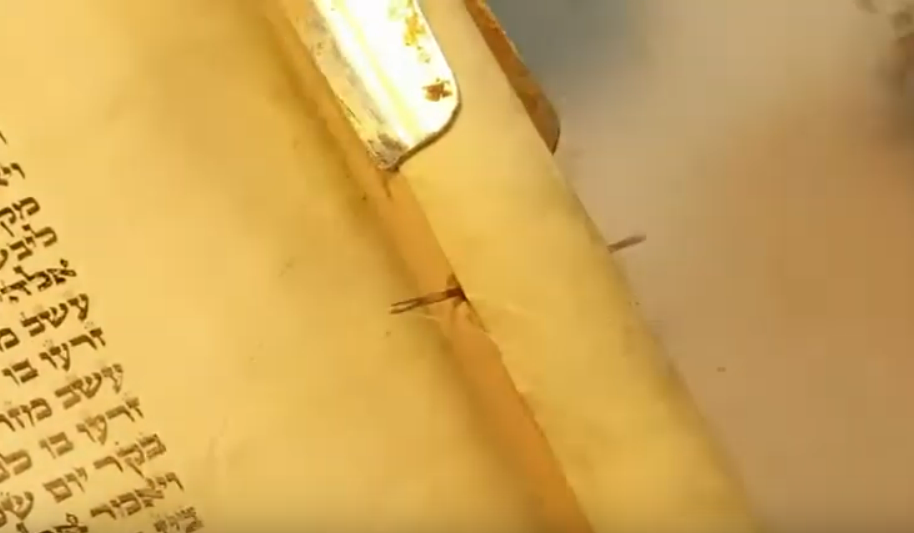
מדריך לתפירת ספר תורה לעצי חיים
Video Title/Description "Guide (Tutorial) for Sewing a Sefer Torah to the Trees of Life"
(Screen capture above is from minute mark 2:04).
If therefore one is willing to look upon the ears having been pierced as the ends of the scroll, which are pierced with a needle so as to attach each end of the scroll to its respective tree of life, it becomes more clear what the author of Hebrews is doing in Heb 10:5, where Psa 40:6 is quoted but the word body is found instead. He is not getting this from the OG LXX because it also reads ears, (only the later ABPolyglot LXX now reads body). This is a metonym, (metonymy), and is therefore surely acceptable because from one ear to the other ear implies the whole body of the Torah Scroll. Also, in the broader sense of a body, (like the body of the great assembly of the faithful), each page or sheet of the scroll is joined to its brethren, sewn together as one whole unit, making up the heart of the Torah scroll, even like David and Yonathan whose hearts and souls were knit together as one, (1Sam 18:1, see also 1Chr 12:7).
Moreover the author of Hebrews adds critical information to this passage where he states, Therefore, entering into the world, he says, and that is when the author quotes Psalm 40:6, Sacrifice and offering you have not desired. What does that mean? Where is it that he enters into the world? Where does the Torah begin to speak? What does the Torah say to us? As we all know, it commences thus: In the beginning...
Thus the opening creation account contains the mgillat or kephalidi, (LXX and epistle to the Hebrews), which is the header of the Sefer. Kephalidi, (kephalis), is employed several times in the LXX for the chapiters or crowns of columns, (in architecture). In writings, such as a scroll or book, which also have columns, this would necessarily specify a head section or header of a passage, (modern chapter), not a whole sefer, or scroll, or entire "volume of the book". At the very least this would point to Gen 1:1, but more likely the first few verses, if not the entire opening creation account, (down to the colophon statement in Gen 2:4a). This is critical to understand because, according to the author of Hebrews, it pertains to when the Word enters into the world, and the text says that it is written of him in the mgillat-kaphalidi-header of the Sefer, (the header at the beginning of the Torah Scroll).
The Aramaic scriptures relate the same idea from the Psalm, which they would only have taken from a pretty ancient understanding of the Hebrew word used therein, (mgillat).
Psalm 40:7 Peshitta Holy Bible Translated
7 Then I said, " Behold, I have come, for in the first of The Writings it is written about me:"
Psalm 40:7 Lamsa Bible
7 Then said I, Lo, I come; in the beginning of the books, it is written of me,
The new song of king David is a song or hymn about a Torah Scroll: the Word of the Father.
Tehillim-Psalms 40:7-17
7 Then said I, Behold, I have come: (or I am present), in the header of the Sefer it is written concerning me,
8 I delight to do Your will, O my EL, and Your Torah-Instruction is in the midst of my inward parts.
9 I have preached righteousness in the great congregation: behold, You know I have not refrained my lips, O YHWH.
10 I have not concealed Your righteousness within my heart, I have declared Your faithfulness and Your salvation: I have not concealed Your loving-kindness and Your truth from the great congregation.
11 Withhold not Your tender mercies from me, O YHWH, let Your loving-kindness and Your truth continually preserve me:
12 For innumerable evils have compassed me about: my contortions have taken hold upon me, so that I am not able to be looked upon; they are more numerous than the hairs of my head, and my heart fails me.
13 Be pleased to deliver me, O YHWH, make haste to help me, O YHWH!
14 Let them be ashamed and confounded together who seek after my soul to destroy it: let them that wish me evil be driven aback and put to shame.
15 Let those who say to me, Aha! Aha! be desolate as the reward for their shame.
16 Let all those that seek You rejoice and be glad in You: let those that love Your salvation continually say, YHWH be magnified!
17 And though I am afflicted and destitute, Adonai thinks upon me: You are my help and my deliverer, tarry not, O my EL!
The final problematic statement concerns iniquity, (עָוֹן `avon), for this word does not always mean sins and transgressions but is sometimes also used for punishments, in the sense of punishments for iniquities. Because of this it is also sometimes used for the results of punishments, such as disfigurations and contortions from punishments or beatings. One may see this understanding implied in some of the places this word is employed where it does not seem to make sense in translation.
Exodus 28:38 KJV
38 And it shall be upon Aaron's forehead, that Aaron may bear the iniquity of the holy things, which the children of Israel shall hallow in all their holy gifts; and it shall be always upon his forehead, that they may be accepted before the LORD.
Is there iniquity concerning the holy things? Could it rather speak of imperfections due to the fact that physical objects are going to be used as representations of supernal and spiritual things? Something is not quite right about the above rendering.
Numbers 18:1 KJV
1 And the LORD said unto Aaron, Thou and thy sons and thy father's house with thee shall bear the iniquity of the sanctuary: and thou and thy sons with thee shall bear the iniquity of your priesthood.
2 And thy brethren also of the tribe of Levi, the tribe of thy father, bring thou with thee, that they may be joined unto thee, and minister unto thee: but thou and thy sons with thee shall minister before the tabernacle of witness.
3 And they shall keep thy charge, and the charge of all the tabernacle: only they shall not come nigh the vessels of the sanctuary and the altar, that neither they, nor ye also, die.
4 And they shall be joined unto thee, and keep the charge of the tabernacle of the congregation, for all the service of the tabernacle: and a stranger shall not come nigh unto you.
We have thus a general daily usage of vessels and instruments, which are going to take "a beating" with that daily usage, and this seems to be the meaning of `avon in the above passage. Then we also see that the Kohen is to bear the iniquities of the congregation, iniquities that are neither his own, nor his fault.
Leviticus 10:17 KJV
17 Wherefore have ye not eaten the sin offering in the holy place, seeing it is most holy, and God hath given it you to bear the iniquity of the congregation, to make atonement for them before the LORD?
The ultimate Kohen Gadol is the Word of the Father because the Word of the Father is the mediator between the Father and His people. Thus we have a number of variations in the meaning and usage of the word `avon. The more important point is that the Torah Scroll itself, being flesh, (originally LAMB skins), is going to take "a beating" over its lifespan but the Word written therein is eternal. So by the time the king has studied his copy of the Torah all his days, (as commanded in the Torah), his copy of the Torah will become tattered, torn, with ripped panels, splitting and fraying seems, even though it may have been repaired who knows how many times. And eventually the ink dries out to the point that it begins to flake off in places, and near the end there are passages that can hardly even be read because the ink has flaked away, so that the Torah Scroll eventually reaches the point where it can no longer even be looked upon due to all of its rips, tears, split seams, contortions, and disfigurations, (`avon), all merely because of the daily usage and beating it has taken so as to impart the Word of the Father into the heart and mind of the king, (David).
Psalms 40:14-15 contains a teaching: you shall not destroy or put to the flame an old wornout Torah Scroll, but it shall be laid to rest, (preferably in a sealed container), in a safe place, and allowed to return to dust of its own accord: for the Word continues on, and yet lives in the heart of the one who owned it, (in this case king David), and in the hearts of those with whom he has shared it, and it is the same with synagogues and congregations where the Torah tabernacles among the people.
1 For the End, A Psalm of David. Waiting, I waited (patiently) on YHWH, and He inclined unto me, and heard my cry.
2 And He has brought me up from the pit of desolation, out of the miry clay, and has set my feet upon the Rock and has established my steps.
3 He has put a new song in my mouth, a hymn of praise unto our Elohim: many shall see, and shall fearfully reverence, (reverential fear), and shall put their trust in YHWH.
4 Blessed is the man who makes YHWH his confidence, and has not turned to the proud, or to those that turn aside to falsehood.
5 Many are the wondrous works that You have done, O YHWH my EL, and Your thoughts toward us no one can fully recount to You: I declare and proclaim, they are too numerous to number.
6 Sacrifice and offering You have not desired, my ears You have pierced, burnt offering and sin offering You have not required.
My ears You have pierced:
Video Title/Description "Guide (Tutorial) for Sewing a Sefer Torah to the Trees of Life"
(Screen capture above is from minute mark 2:04).
If therefore one is willing to look upon the ears having been pierced as the ends of the scroll, which are pierced with a needle so as to attach each end of the scroll to its respective tree of life, it becomes more clear what the author of Hebrews is doing in Heb 10:5, where Psa 40:6 is quoted but the word body is found instead. He is not getting this from the OG LXX because it also reads ears, (only the later ABPolyglot LXX now reads body). This is a metonym, (metonymy), and is therefore surely acceptable because from one ear to the other ear implies the whole body of the Torah Scroll. Also, in the broader sense of a body, (like the body of the great assembly of the faithful), each page or sheet of the scroll is joined to its brethren, sewn together as one whole unit, making up the heart of the Torah scroll, even like David and Yonathan whose hearts and souls were knit together as one, (1Sam 18:1, see also 1Chr 12:7).
Moreover the author of Hebrews adds critical information to this passage where he states, Therefore, entering into the world, he says, and that is when the author quotes Psalm 40:6, Sacrifice and offering you have not desired. What does that mean? Where is it that he enters into the world? Where does the Torah begin to speak? What does the Torah say to us? As we all know, it commences thus: In the beginning...
Thus the opening creation account contains the mgillat or kephalidi, (LXX and epistle to the Hebrews), which is the header of the Sefer. Kephalidi, (kephalis), is employed several times in the LXX for the chapiters or crowns of columns, (in architecture). In writings, such as a scroll or book, which also have columns, this would necessarily specify a head section or header of a passage, (modern chapter), not a whole sefer, or scroll, or entire "volume of the book". At the very least this would point to Gen 1:1, but more likely the first few verses, if not the entire opening creation account, (down to the colophon statement in Gen 2:4a). This is critical to understand because, according to the author of Hebrews, it pertains to when the Word enters into the world, and the text says that it is written of him in the mgillat-kaphalidi-header of the Sefer, (the header at the beginning of the Torah Scroll).
The Aramaic scriptures relate the same idea from the Psalm, which they would only have taken from a pretty ancient understanding of the Hebrew word used therein, (mgillat).
Psalm 40:7 Peshitta Holy Bible Translated
7 Then I said, " Behold, I have come, for in the first of The Writings it is written about me:"
Psalm 40:7 Lamsa Bible
7 Then said I, Lo, I come; in the beginning of the books, it is written of me,
The new song of king David is a song or hymn about a Torah Scroll: the Word of the Father.
Tehillim-Psalms 40:7-17
7 Then said I, Behold, I have come: (or I am present), in the header of the Sefer it is written concerning me,
8 I delight to do Your will, O my EL, and Your Torah-Instruction is in the midst of my inward parts.
9 I have preached righteousness in the great congregation: behold, You know I have not refrained my lips, O YHWH.
10 I have not concealed Your righteousness within my heart, I have declared Your faithfulness and Your salvation: I have not concealed Your loving-kindness and Your truth from the great congregation.
11 Withhold not Your tender mercies from me, O YHWH, let Your loving-kindness and Your truth continually preserve me:
12 For innumerable evils have compassed me about: my contortions have taken hold upon me, so that I am not able to be looked upon; they are more numerous than the hairs of my head, and my heart fails me.
13 Be pleased to deliver me, O YHWH, make haste to help me, O YHWH!
14 Let them be ashamed and confounded together who seek after my soul to destroy it: let them that wish me evil be driven aback and put to shame.
15 Let those who say to me, Aha! Aha! be desolate as the reward for their shame.
16 Let all those that seek You rejoice and be glad in You: let those that love Your salvation continually say, YHWH be magnified!
17 And though I am afflicted and destitute, Adonai thinks upon me: You are my help and my deliverer, tarry not, O my EL!
The final problematic statement concerns iniquity, (עָוֹן `avon), for this word does not always mean sins and transgressions but is sometimes also used for punishments, in the sense of punishments for iniquities. Because of this it is also sometimes used for the results of punishments, such as disfigurations and contortions from punishments or beatings. One may see this understanding implied in some of the places this word is employed where it does not seem to make sense in translation.
Exodus 28:38 KJV
38 And it shall be upon Aaron's forehead, that Aaron may bear the iniquity of the holy things, which the children of Israel shall hallow in all their holy gifts; and it shall be always upon his forehead, that they may be accepted before the LORD.
Is there iniquity concerning the holy things? Could it rather speak of imperfections due to the fact that physical objects are going to be used as representations of supernal and spiritual things? Something is not quite right about the above rendering.
Numbers 18:1 KJV
1 And the LORD said unto Aaron, Thou and thy sons and thy father's house with thee shall bear the iniquity of the sanctuary: and thou and thy sons with thee shall bear the iniquity of your priesthood.
2 And thy brethren also of the tribe of Levi, the tribe of thy father, bring thou with thee, that they may be joined unto thee, and minister unto thee: but thou and thy sons with thee shall minister before the tabernacle of witness.
3 And they shall keep thy charge, and the charge of all the tabernacle: only they shall not come nigh the vessels of the sanctuary and the altar, that neither they, nor ye also, die.
4 And they shall be joined unto thee, and keep the charge of the tabernacle of the congregation, for all the service of the tabernacle: and a stranger shall not come nigh unto you.
We have thus a general daily usage of vessels and instruments, which are going to take "a beating" with that daily usage, and this seems to be the meaning of `avon in the above passage. Then we also see that the Kohen is to bear the iniquities of the congregation, iniquities that are neither his own, nor his fault.
Leviticus 10:17 KJV
17 Wherefore have ye not eaten the sin offering in the holy place, seeing it is most holy, and God hath given it you to bear the iniquity of the congregation, to make atonement for them before the LORD?
The ultimate Kohen Gadol is the Word of the Father because the Word of the Father is the mediator between the Father and His people. Thus we have a number of variations in the meaning and usage of the word `avon. The more important point is that the Torah Scroll itself, being flesh, (originally LAMB skins), is going to take "a beating" over its lifespan but the Word written therein is eternal. So by the time the king has studied his copy of the Torah all his days, (as commanded in the Torah), his copy of the Torah will become tattered, torn, with ripped panels, splitting and fraying seems, even though it may have been repaired who knows how many times. And eventually the ink dries out to the point that it begins to flake off in places, and near the end there are passages that can hardly even be read because the ink has flaked away, so that the Torah Scroll eventually reaches the point where it can no longer even be looked upon due to all of its rips, tears, split seams, contortions, and disfigurations, (`avon), all merely because of the daily usage and beating it has taken so as to impart the Word of the Father into the heart and mind of the king, (David).
Psalms 40:14-15 contains a teaching: you shall not destroy or put to the flame an old wornout Torah Scroll, but it shall be laid to rest, (preferably in a sealed container), in a safe place, and allowed to return to dust of its own accord: for the Word continues on, and yet lives in the heart of the one who owned it, (in this case king David), and in the hearts of those with whom he has shared it, and it is the same with synagogues and congregations where the Torah tabernacles among the people.
Last edited: