John 1:1 and Jesus’ Sonship in Adoptionist thought

  • Welcome to Christian Forums, a Christian Forum that recognizes that all Christians are a work in progress.

    You will need to register to be able to join in fellowship with Christians all over the world.

    We hope to see you as a part of our community soon and God Bless!

ElieG12

Well-Known Member
Oct 8, 2022
1,333
470
83
Atlanta
Faith
Christian
Country
United States
Gender
Male
That's fair criticism. I DON'T believe ALL the Bible is inspired. I only attribute inspiration to the prophets, gospels, and Psalms. That turns out to be most of the Bible, but still...

I'm not sure how you all manage to look at all the Biblical contradictions and still rationalize inspiration for every book. It's pretty clear to me that the Chronicles and Kings cover the same material and diverge significantly. :shrug:
If at any point you tell me something that clearly contradicts Scripture, then I would certainly disagree with you even if you claimed you were right. The truth is not in you but in the Word of God. I would never become your follower, because I already have Jesus to follow; nor would I take you seriously at all if you pretended that your way of thinking, which differs from what the Bible says, was superior.

Jehovah's Witnesses reason from the Scriptures, to get as close as possible to God's way of thinking, and to teach that, not our own ideas.

Acts 17:1 They now (...) came to Thessalonica, where there was a synagogue of the Jews.
2 So according to Paul’s custom he went inside to them, and for three sabbaths he reasoned with them from the Scriptures, 3 explaining and proving by references (...)
 

Wick Stick

Well-Known Member
Sep 21, 2023
2,424
1,486
113
46
Phoenix
Faith
Christian
Country
United States
I would never become your follower, because I already have Jesus to follow; nor would I take you seriously at all if you pretended that your way of thinking, which differs from what the Bible says, was superior.
I'm not looking for followers. I'm here to have conversations.
Jehovah's Witnesses reason from the Scriptures, to get as close as possible to God's way of thinking, and to teach that, not our own ideas.
Let's do that.

How DO you reconcile all the differences in the OT history books with the idea of inspiration?
 

dak

Well-Known Member
Feb 9, 2013
1,457
188
63
Messianica
sites.google.com
Faith
Other Faith
Country
United States
Gender
Male
In other words, He sent His HS to which produce the conception that would eventuate in a Son.
That's one interpretation. The mainstream interpretation.
Not the only interpretation.

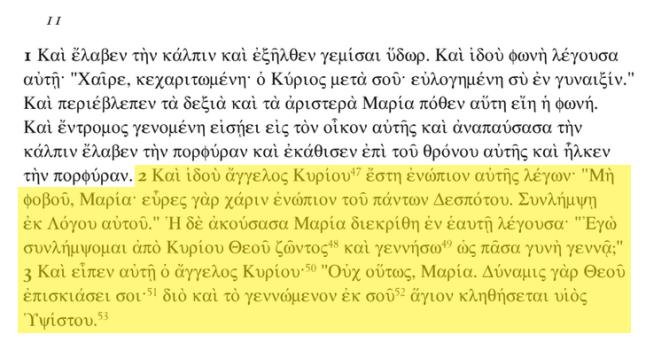
@Wick Stick, have you ever read the "Protoevangelium of James", (aka Yakob), text concerning the same subject matter?

protoevangelium-11.png

Protoevangelium of James (aka Apocalypse-Revelation of Yakob) 11:2-3
2 And behold, an angel of YHWH stood before her, saying, Fear not, Maryah, for you have found favor before the Absolute Master of all, you shall retain [seed] from His Logos: but having heard this, Maryah disputed within herself, saying, Shall I conceive by YHWH Elohim the Living and bring forth the same as every woman brings forth?
3 And the Angel of YHWH said to her, Not in that manner, Maryah, for the Power of Elohim shall cast shadow over you: therefore also the holy one being generated from you shall be called "Son of the Highest" [or "Son of the Most High"?].

Uh-oh, time to restudy the parable of the sower: this one cannot be the same as the physical son born in the days of the census of Quirinus, (6-7AD, after Archelaus was deposed and banished).
 

Wick Stick

Well-Known Member
Sep 21, 2023
2,424
1,486
113
46
Phoenix
Faith
Christian
Country
United States
@Wick Stick, have you ever read the "Protoevangelium of James", (aka Yakob), text concerning the same subject matter?

View attachment 71889

Protoevangelium of James (aka Apocalypse-Revelation of Yakob) 11:2-3
2 And behold, an angel of YHWH stood before her, saying, Fear not, Maryah, for you have found favor before the Absolute Master of all, you shall retain [seed] from His Logos: but having heard this, Maryah disputed within herself, saying, Shall I conceive by YHWH Elohim the Living and bring forth the same as every woman brings forth?
3 And the Angel of YHWH said to her, Not in that manner, Maryah, for the Power of Elohim shall cast shadow over you: therefore also the holy one being generated from you shall be called "Son of the Highest" [or "Son of the Most High"?].

Uh-oh, time to restudy the parable of the sower: this one cannot be the same as the physical son born in the days of the census of Quirinus, (6-7AD, after Archelaus was deposed and banished).
Read it, yes. Studied it in Greek? no

I don't actually see the problem you're pointing out, here, to be honest. It looks the same as Luke 1 to me - conception via "overshadowing." Is it just a problem of chronology?
 

dak

Well-Known Member
Feb 9, 2013
1,457
188
63
Messianica
sites.google.com
Faith
Other Faith
Country
United States
Gender
Male
Read it, yes. Studied it in Greek? no

I don't actually see the problem you're pointing out, here, to be honest. It looks the same as Luke 1 to me - conception via "overshadowing." Is it just a problem of chronology?

Luke is the only one to mention the actual matrix and that is by way of a quote from the Torah.

Luke 2:22-23 ASV
22 And when the days of their purification according to the law of Moses were fulfilled, they brought him up to Jerusalem, to present him to the Lord
23 (as it is written in the law of the Lord, Every male that openeth the womb shall be called holy to the Lord),

The womb in the above is the matrix, G3388 μήτρα metra, which occurs nowhere else in the infancy narratives. In fact both the narrative in Matthew and in the Protoevangelium contain the phrase "in gastri" which is not speaking of a physical birth through the womb because gastri or gaster means in the stomach, thus, by consuming the Logos-Word, (eating, thus the stomach, and even so in spiritual eating of spiritual food, the Word of the Father). Women obviously do not retain physical seed in the stomach.

Matthew 1:18 ASV
18 Now the birth of Jesus Christ was on this wise: When his mother Mary had been betrothed to Joseph, before they came together she was found with child of the Holy Spirit.

In the Greek there is nothing about a child in the above statement:

Matthew 1:18 W/H
18 του δε | [ιησου] | χριστου η γενεσις ουτως ην μνηστευθεισης της μητρος αυτου μαριας τω ιωσηφ πριν η συνελθειν αυτους ευρεθη εν γαστρι εχουσα εκ πνευματος αγιου

G1064 γαστήρ gaster (ğa-steer') n. the stomach.

Maryah was found holding(retaining) in gastri. The narratives are extremely precise and strict: you will not find any mention of the matrix in the Matthew account. It appears that Yoseph and Maryah were born from above first: then they came together and produced the Meshiah, the Anointed One, the Chosen One, (a man), and that birth is expounded in the Luke narrative where the matrix is mentioned, (which is why the Luke narrative is so different from the Matthew narrative).

For all intents and purposes the Gospel now known as Luke is Paul's Gospel.
What does Paul himself say about the Man, the Meshiah:

Romans 1:1-3 ASV
1 Paul, a servant of Jesus Christ, called to be an apostle, separated unto the gospel of God,
2 which he promised afore through his prophets in the holy scriptures,
3 concerning his Son, who was born of the seed of David according to the flesh,

That's a plain bold emphatic statement: one either accepts it or rejects it.
This can only be the one born in the Luke narrative, (Paul's Gospel).
 

Hiddenthings

Well-Known Member
May 19, 2025
3,777
415
83
Leeton NSW
Faith
Christian
Country
Australia
Luke is the only one to mention the actual matrix and that is by way of a quote from the Torah.

Luke 2:22-23 ASV
22 And when the days of their purification according to the law of Moses were fulfilled, they brought him up to Jerusalem, to present him to the Lord
23 (as it is written in the law of the Lord, Every male that openeth the womb shall be called holy to the Lord),

The womb in the above is the matrix, G3388 μήτρα metra, which occurs nowhere else in the infancy narratives. In fact both the narrative in Matthew and in the Protoevangelium contain the phrase "in gastri" which is not speaking of a physical birth through the womb because gastri or gaster means in the stomach, thus, by consuming the Logos-Word, (eating, thus the stomach, and even so in spiritual eating of spiritual food, the Word of the Father). Women obviously do not retain physical seed in the stomach.

Matthew 1:18 ASV
18 Now the birth of Jesus Christ was on this wise: When his mother Mary had been betrothed to Joseph, before they came together she was found with child of the Holy Spirit.

In the Greek there is nothing about a child in the above statement:

Matthew 1:18 W/H
18 του δε | [ιησου] | χριστου η γενεσις ουτως ην μνηστευθεισης της μητρος αυτου μαριας τω ιωσηφ πριν η συνελθειν αυτους ευρεθη εν γαστρι εχουσα εκ πνευματος αγιου

G1064 γαστήρ gaster (ğa-steer') n. the stomach.

Maryah was found holding(retaining) in gastri. The narratives are extremely precise and strict: you will not find any mention of the matrix in the Matthew account. It appears that Yoseph and Maryah were born from above first: then they came together and produced the Meshiah, the Anointed One, the Chosen One, (a man), and that birth is expounded in the Luke narrative where the matrix is mentioned, (which is why the Luke narrative is so different from the Matthew narrative).

For all intents and purposes the Gospel now known as Luke is Paul's Gospel.
What does Paul himself say about the Man, the Meshiah:

Romans 1:1-3 ASV
1 Paul, a servant of Jesus Christ, called to be an apostle, separated unto the gospel of God,
2 which he promised afore through his prophets in the holy scriptures,
3 concerning his Son, who was born of the seed of David according to the flesh,

That's a plain bold emphatic statement: one either accepts it or rejects it.
This can only be the one born in the Luke narrative, (Paul's Gospel).
There is no doubt that Jesus’ conception in Mary was by the Holy Spirit, and that his birth was like ours in every way except that we were conceived by man, and he by divine power. He held no advantage in his nature, only, as Scripture says, He was quick in understanding and grew in stature with both God and man.
 

dak

Well-Known Member
Feb 9, 2013
1,457
188
63
Messianica
sites.google.com
Faith
Other Faith
Country
United States
Gender
Male
There is no doubt that Jesus’ conception in Mary was by the Holy Spirit,

This one is in the Matthew narrative and is not called Jesus, rather, the nomen sacrum Iota-Eta, as previously explained. And he, being Emmanuel, the one and only one-of-a-kind Son who is ever in the bosom of the Father, has no beginning, no ending, and no genealogy. He is the same as Melki-Tzedek.

and that his birth was like ours in every way
He held no advantage in his nature, only, as Scripture says, He was quick in understanding and grew in stature with both God and man.

This one is in the Luke narrative, and is also not called Jesus, rather, the nomen sacrum Iota-Eta, (which, again, is not the same name as the Iota-Eta nomen sacrum in the Matthew narrative, as previously explained), and this one is indeed a man, and conceived by man, of the union of Yoseph and Maryah, born of the seed of David according to the flesh. Welcome to Adoptionism: Paul too was an adoptionist.
 

Hiddenthings

Well-Known Member
May 19, 2025
3,777
415
83
Leeton NSW
Faith
Christian
Country
Australia
This one is in the Matthew narrative and is not called Jesus, rather, the nomen sacrum Iota-Eta, as previously explained. And he, being Emmanuel, the one and only one-of-a-kind Son who is ever in the bosom of the Father, has no beginning, no ending, and no genealogy. He is the same as Melki-Tzedek.
You just quoted he is of the seed of David - in fact even in his glorified state he continues to acknowledge his Adamic heritage.

I am the root and the descendant of David, the bright morning star!” Re 22:16.

But don't be concerned Dak - you have a good many things right in your faith, but this truth will be revealed to you shortly.
This one is in the Luke narrative, and is also not called Jesus, rather, the nomen sacrum Iota-Eta, (which, again, is not the same name as the Iota-Eta nomen sacrum in the Matthew narrative, as previously explained), and this one is indeed a man, and conceived by man, of the union of Yoseph and Maryah, born of the seed of David according to the flesh. Welcome to Adoptionism: Paul too was an adoptionist.
Pre-existence destroys the Atonement principles and like the Trinny's you don't believe life means life or death is death.

Sad really.
 
Last edited:

Hiddenthings

Well-Known Member
May 19, 2025
3,777
415
83
Leeton NSW
Faith
Christian
Country
Australia
@dak You’ve referred to John 1:18 several times, and it seems to function as something of a cornerstone for your view of a pre-existent Christ. However, the phrase “in the bosom of the Father” is widely recognized as an idiom expressing intimacy or closeness (not pre-existence!) (cf. John 13:23), rather than a literal spatial description.

Given this, it is reasonable to understand John’s wording as theological commentary written after the historical events. In other words, John is reflecting on Jesus’ unique relationship with the Father from the vantage point of Christ’s exaltation in heaven, not describing a pre-incarnate state at the time of the incarnation itself.

This reading fits both the linguistic idiom and the literary context of the Gospel: John, as narrator, is identifying who Jesus truly was and is not giving a chronological snapshot of his position during his earthly ministry.
 

dak

Well-Known Member
Feb 9, 2013
1,457
188
63
Messianica
sites.google.com
Faith
Other Faith
Country
United States
Gender
Male
You just quoted he is of the seed of David - in fact even in his glorified state he continues to acknowledge his Adamic heritage.
I am the root and the descendant of David, the bright morning star!” Re 22:16.

Gen 1:11-12 LXX -- "according to its kind", (genos).
Gen 1:21 LXX -- "according to their kinds", (genos).
Gen 1:24 LXX -- "according to its kind", (genos), "according to their kinds" (genos).
Gen 1:25 LXX -- "according to its kind" (genos, (3 times)).

In this context genos means the original pattern, not a descendant: for every descendant is produced according to its original pattern of creation. Genos has multiple meanings. I suggest to you that you have applied the incorrect meaning of genos to Rev 22:26 because Meshiah, (the Man), is not the One speaking in that passage: it is the Son, the mono-genos one-of-a-kind of the Father who is ever-always in the bosom of the Father.
 

dak

Well-Known Member
Feb 9, 2013
1,457
188
63
Messianica
sites.google.com
Faith
Other Faith
Country
United States
Gender
Male
@dak You’ve referred to John 1:18 several times, and it seems to function as something of a cornerstone for your view of a pre-existent Christ.

Incorrect: Christ or Christos, (Meshiah), is the Anointed One, a man.

However, the phrase “in the bosom of the Father” is widely recognized as an idiom expressing intimacy or closeness (not pre-existence!) (cf. John 13:23), rather than a literal spatial description.

Given this, it is reasonable to understand John’s wording as theological commentary written after the historical events. In other words, John is reflecting on Jesus’ unique relationship with the Father from the vantage point of Christ’s exaltation in heaven, not describing a pre-incarnate state at the time of the incarnation itself.

This reading fits both the linguistic idiom and the literary context of the Gospel: John, as narrator, is identifying who Jesus truly was and is not giving a chronological snapshot of his position during his earthly ministry.

No, the eternal Son is indeed ever-always in the bosom of the Father, on the right hand side:

Tetragrammaton.png

How many times has this nomen sacrum been explained to you now?


PS: for those who may be interested, the original most ancient forms of the two nomina sacra pertaining to the Son, and to the Anointed One, did not have case endings: the case endings were added later by church scribes.

 
Last edited:

Wick Stick

Well-Known Member
Sep 21, 2023
2,424
1,486
113
46
Phoenix
Faith
Christian
Country
United States
Luke is the only one to mention the actual matrix and that is by way of a quote from the Torah.

Luke 2:22-23 ASV
22 And when the days of their purification according to the law of Moses were fulfilled, they brought him up to Jerusalem, to present him to the Lord
23 (as it is written in the law of the Lord, Every male that openeth the womb shall be called holy to the Lord),

The womb in the above is the matrix, G3388 μήτρα metra, which occurs nowhere else in the infancy narratives. In fact both the narrative in Matthew and in the Protoevangelium contain the phrase "in gastri" which is not speaking of a physical birth through the womb because gastri or gaster means in the stomach, thus, by consuming the Logos-Word, (eating, thus the stomach, and even so in spiritual eating of spiritual food, the Word of the Father). Women obviously do not retain physical seed in the stomach.

Matthew 1:18 ASV
18 Now the birth of Jesus Christ was on this wise: When his mother Mary had been betrothed to Joseph, before they came together she was found with child of the Holy Spirit.

In the Greek there is nothing about a child in the above statement:

Matthew 1:18 W/H
18 του δε | [ιησου] | χριστου η γενεσις ουτως ην μνηστευθεισης της μητρος αυτου μαριας τω ιωσηφ πριν η συνελθειν αυτους ευρεθη εν γαστρι εχουσα εκ πνευματος αγιου

G1064 γαστήρ gaster (ğa-steer') n. the stomach.

Maryah was found holding(retaining) in gastri. The narratives are extremely precise and strict: you will not find any mention of the matrix in the Matthew account. It appears that Yoseph and Maryah were born from above first: then they came together and produced the Meshiah, the Anointed One, the Chosen One, (a man), and that birth is expounded in the Luke narrative where the matrix is mentioned, (which is why the Luke narrative is so different from the Matthew narrative).
I find that the NT writers are often thinking of the LXX when they are writing. Here, I think Matthew is lifting the phrase en gastri from Isaiah:

Isaiah 7:14 διὰ τοῦτο δώσει κύριος αὐτὸς ὑμῖν σημεῖον ἰδοὺ ἡ παρθένος ἐν γαστρὶ ἕξει καὶ τέξεται υἱόν
καὶ καλέσεις τὸ ὄνομα αὐτοῦ Εμμανο ηλ


Isaiah 7:14 Therefore the Lord himself shall give you a sign; Behold, a virgin shall conceive, and bear a son,
and shall call his name Immanuel.


Is Matthew aware of the underlying Hebrew word in Isaiah, which doesn't mean stomach? Probably not. The way he uses παρθένος from this very same verse suggests that he's reading the LXX without insight from the Hebrew. (So the doctrine of the virgin birth is thus built on Matthew's overly literal reading of a translation... some things never change)

I guess I'm saying that, I think reading 'en gastri' as an idiom indicating pregnancy is perfectly reasonable, BUT... I can't rule out the idea that Matthew is using a very strict literal reading of the Greek and really thinking of the stomach, as you suggest.

Oh, and I also looked up the Aramaic word here in the Peshitta, which seems potentially relevant for Matthew. In case you're interested (but it doesn't refer to the stomach):
The Comprehensive Aramaic Lexicon
1760716924342.png
For all intents and purposes the Gospel now known as Luke is Paul's Gospel.
Theologically, yes - Luke expresses Paul's ideas. His vocabulary is simpler than Paul's, though. whose isn't?
What does Paul himself say about the Man, the Meshiah:

Romans 1:1-3 ASV
1 Paul, a servant of Jesus Christ, called to be an apostle, separated unto the gospel of God,
2 which he promised afore through his prophets in the holy scriptures,
3 concerning his Son, who was born of the seed of David according to the flesh,

That's a plain bold emphatic statement: one either accepts it or rejects it.
This can only be the one born in the Luke narrative, (Paul's Gospel).
Interesting. I tend to skim past Paul's opening doxologies. :sweatsmile:

Luke seems to me to be clearly in the Adoptionist camp. It would make sense that Paul is, too. Paul's writings are so opaque that one could support (wrest?) almost any position out of them, though.
 

Wick Stick

Well-Known Member
Sep 21, 2023
2,424
1,486
113
46
Phoenix
Faith
Christian
Country
United States
I suggest to you that you have applied the incorrect meaning of genos to Rev 22:26 because Meshiah, (the Man), is not the One speaking in that passage: it is the Son, the mono-genos one-of-a-kind of the Father who is ever-always in the bosom of the Father.
Does the latter not inhabit the former? I don't think most Christians even differentiate between the two.
 

dak

Well-Known Member
Feb 9, 2013
1,457
188
63
Messianica
sites.google.com
Faith
Other Faith
Country
United States
Gender
Male
I find that the NT writers are often thinking of the LXX when they are writing. Here, I think Matthew is lifting the phrase en gastri from Isaiah:

Isaiah 7:14 διὰ τοῦτο δώσει κύριος αὐτὸς ὑμῖν σημεῖον ἰδοὺ ἡ παρθένος ἐν γαστρὶ ἕξει καὶ τέξεται υἱόν
καὶ καλέσεις τὸ ὄνομα αὐτοῦ Εμμανο ηλ


Isaiah 7:14 Therefore the Lord himself shall give you a sign; Behold, a virgin shall conceive, and bear a son,
and shall call his name Immanuel.

Yes, either that, or those who rendered the original "Matthew" Hebrew text into Greek did so, (Jerome made the claim, and one other, but I cannot remember the other off hand).

Is Matthew aware of the underlying Hebrew word in Isaiah, which doesn't mean stomach? Probably not. The way he uses παρθένος from this very same verse suggests that he's reading the LXX without insight from the Hebrew. (So the doctrine of the virgin birth is thus built on Matthew's overly literal reading of a translation... some things never change)


I guess I'm saying that, I think reading 'en gastri' as an idiom indicating pregnancy is perfectly reasonable, BUT... I can't rule out the idea that Matthew is using a very strict literal reading of the Greek and really thinking of the stomach, as you suggest.

Another clue in these types of passages are words based on tikto, (G5088), which is more for plant-life generating or producing, matching up with words that mean things like stump, branch, root, stalk, twig, etc., (tzemach, netzer, etc.,). In the Isaiah passage you've quoted notice τέξεται, that is a form of tikto.

Mickelson's
G5088 τίκτω tikto (tiyk'-tō) v.
τέκω teko (te'-kō) [an alternate in certain tenses]
to produce, to bring forth (from seed, as a mother, a plant, the earth, etc.).
{literally or figuratively}
[a strengthened form of a primary teko tek'-o “to comb wool” (which is used only as alternate in certain tenses)]
KJV: bear, be born, bring forth, be delivered, be in travail

Those who rendered the LXX were most likely not reading the Isaiah 7:14 text and thinking of a literal-physical virgin birth, surely they knew better than that: it's speaking of supernal and spiritual things which are nearly always inward.

Oh, and I also looked up the Aramaic word here in the Peshitta, which seems potentially relevant for Matthew. In case you're interested (but it doesn't refer to the stomach):

The Comprehensive Aramaic Lexicon
View attachment 71920

The entry appears to be pertaining to the equivalent word for Hebrew beten, the belly, (H990 בֶּטֶן beten (beh'-ten). At the top, the first entry says "to grow a belly", (which probably speaks of the belly swelling), and in the block script the letters are the same as for the Hebrew word.

Theologically, yes - Luke expresses Paul's ideas. His vocabulary is simpler than Paul's, though. whose isn't?

Interesting. I tend to skim past Paul's opening doxologies. :sweatsmile:

Luke seems to me to be clearly in the Adoptionist camp. It would make sense that Paul is, too. Paul's writings are so opaque that one could support (wrest?) almost any position out of them, though.

:Thumbsup:
 

dak

Well-Known Member
Feb 9, 2013
1,457
188
63
Messianica
sites.google.com
Faith
Other Faith
Country
United States
Gender
Male
Does the latter not inhabit the former? I don't think most Christians even differentiate between the two.

It can be understood either way but remember that David is said to be a man after the Fathers' own heart, (repeated in Acts 13:22), so in that sense David had a particular mold, a particular genos, a pattern or type of which he was by his nature, and which was sought for by the Father: that mold or genos is the Son, imo.
 

Hiddenthings

Well-Known Member
May 19, 2025
3,777
415
83
Leeton NSW
Faith
Christian
Country
Australia
Gen 1:11-12 LXX -- "according to its kind", (genos).
Gen 1:21 LXX -- "according to their kinds", (genos).
Gen 1:24 LXX -- "according to its kind", (genos), "according to their kinds" (genos).
Gen 1:25 LXX -- "according to its kind" (genos, (3 times)).

In this context genos means the original pattern, not a descendant: for every descendant is produced according to its original pattern of creation. Genos has multiple meanings. I suggest to you that you have applied the incorrect meaning of genos to Rev 22:26 because Meshiah, (the Man), is not the One speaking in that passage: it is the Son, the mono-genos one-of-a-kind of the Father who is ever-always in the bosom of the Father.
True the Lord is one of a kind but just not the kind you are implying. You cannot prove pre-existence, I know it and you also. It's futile trying dak. You can prove the Lord is one in character, purpose but not nature.
 

Hiddenthings

Well-Known Member
May 19, 2025
3,777
415
83
Leeton NSW
Faith
Christian
Country
Australia
It can be understood either way
How do you reconcile the idea of inheritance, specifically, Christ receiving immortality from God His Father? I’d be genuinely interested to see how you work through this.

Psalms 21:4 doesn’t seem to make sense in your framework, nor does the way the Lord applies it to himself in relation to receiving eternal life.

"He asked you for life, and you gave it to him, length of days, for ever and ever" (In fact the whole Psalm is discarded if you believe in pre-existence)

Under your view, we’re left with the picture of a pre-existent, eternal being asking for something that was supposedly always his to begin with, including the full, immeasurable substance of the inheritance. That raises serious theological tensions.

Your interpretation results in a paradox riddled with internal contradictions, making a coherent explanation impossible.
 

dak

Well-Known Member
Feb 9, 2013
1,457
188
63
Messianica
sites.google.com
Faith
Other Faith
Country
United States
Gender
Male
You cannot prove pre-existence, I know it and you also.

In the beginning Elohim cuts down the heavens and the earth, and the earth becomes wasted and empty, and darkness upon the face of the deep, and Ruach Elohim is brooding over the face of the waters: [like a Dove]

Matthew 3:16-17
16 And Ι̅Η haven been immersed went up straightway out of the water: and behold, the heavens were opened unto him, and he beheld Ruach Elohim descending as a dove, and coming upon him:
17 And lo, a voice from the heavens, saying [to him], This is My Son, the beloved, with whom I approve.

Again, Ruach Elohim is the Dove, the Son, the Logos Word of the Father, and the Spirit of the Father because testimony is spirit, and the Testimony of the Anointed One is Spirit and Life, (John 6:63), and therefore He it is who speaks through the Anointed One / Chosen One in the Gospel accounts.

Luke 13:34
34 O Yerushalem, Yerushalem, who slays the Prophets and stones those that are sent to her! how often would I have gathered your children together, even as a hen [of the doves] gathers her own brood under her wings, and you would not!

The highlighted above is a reference to Genesis 1:2.
 

dak

Well-Known Member
Feb 9, 2013
1,457
188
63
Messianica
sites.google.com
Faith
Other Faith
Country
United States
Gender
Male
How do you reconcile the idea of inheritance, specifically, Christ receiving immortality from God His Father? I’d be genuinely interested to see how you work through this.

Psalms 21:4 doesn’t seem to make sense in your framework, nor does the way the Lord applies it to himself in relation to receiving eternal life.

"He asked you for life, and you gave it to him, length of days, for ever and ever" (In fact the whole Psalm is discarded if you believe in pre-existence)

Under your view, we’re left with the picture of a pre-existent, eternal being asking for something that was supposedly always his to begin with, including the full, immeasurable substance of the inheritance. That raises serious theological tensions.

Your interpretation results in a paradox riddled with internal contradictions, making a coherent explanation impossible.

You started with an assertion for which you offered not an ounce of evidence or proof. How many pages do you propose it will take for you to actually prove that Psalm 21:4 is not speaking of David and instead speaking of your version of "Christ"?

PS: Let's say you could actually prove your assertion: the problem is that you are still speaking of the Christos, (Χ̅Ρ), while I am speaking of the Chrestos, (Χ̅Ρ). I have already explained this to you many times now and your ignoring it just makes you look more and more foolish. These things are my own testimony sharing with you what I believe and understand from the scripture about these things: if you do not believe my testimony concerning myself and what I believe, how can we even have a discussion about these things when you have no clue where I am coming from? Ignoring what I have said about what I believe just leaves you in the dust fighting your own strawmen which you have tried to foist upon me as if I actually believe the same way you do. Of course it doesn't make any sense to you: you are arguing against a position that I do not hold.

There is the Christos, (Χ̅Ρ), and there is the Chrestos, (Χ̅Ρ), and they are not the same. The Christos, (Χ̅Ρ), is the Meshiah, the Anointed One, the Chosen one. The Chrestos, (Χ̅Ρ), is the one-of-a-kind Son who is ever in the bosom of the Father, the Spirit of the Father, the Dabar-Logos-Word of the Father: and the Father has never been without His Word, and never will be without His Word.

The Christos, (Χ̅Ρ), is a man, the firstborn adopted Son, (and firstborn from the dead, resurrected).
The Chrestos, (Χ̅Ρ), is the eternal Son, having neither beginning nor end.
 
Last edited: