Matthew 24:30 may have a significant mistranslation

  • Welcome to Christian Forums, a Christian Forum that recognizes that all Christians are a work in progress.

    You will need to register to be able to join in fellowship with Christians all over the world.

    We hope to see you as a part of our community soon and God Bless!

David in NJ

Well-Known Member
Jul 20, 2021
16,392
8,944
113
50
Denville
Faith
Christian
Country
United States
Gender
Male
This worldwide coverage with the gospel already occurred back in the first century, as Paul freely testifies in Colossians 1:6 &23 and other texts. After that gospel coverage was accomplished back then, the end spoken of came back then in the first century.
@covenantee

Col 1:6 - which has come to you, as it has also in all the world, and is bringing forth fruit, as it is also among you since the day you heard and knew the grace of God in truth;

v23if indeed you continue in the faith, grounded and steadfast, and are not moved away from the hope of the gospel which you heard, which was preached to every creature under heaven, of which I, Paul, became a minister.

PRESENT Tense and ONGOING = just as the LORD Said = Matt 24:14

***VERY IMPORTANT***
Remind them of these things, charging them before the Lord not to strive about words to no profit, to the ruin of the hearers.
Be diligent to present yourself approved to God, a worker who does not need to be ashamed, rightly dividing the word of truth.
But shun profane and idle babblings, for they will increase to more ungodliness.
And their message will spread like cancer. Hymenaeus and Philetus are of this sort, who have strayed concerning the truth, saying that the resurrection is already past; and they overthrow the faith of some. Nevertheless the solid foundation of God stands, having this seal: “The Lord knows those who are His,” and, “Let everyone who names the name of Christ depart from iniquity.”

Don't be a cancer like Hymenaeus and Philetus
 

3 Resurrections

Active Member
Jan 20, 2024
942
233
43
South Carolina
Faith
Christian
Country
United States
And their message will spread like cancer. Hymenaeus and Philetus are of this sort, who have strayed concerning the truth, saying that the resurrection is already past; and they overthrow the faith of some. Nevertheless the solid foundation of God stands, having this seal: “The Lord knows those who are His,” and, “Let everyone who names the name of Christ depart from iniquity.”
What, do you yourself deny that Christ's resurrection and that of the Matthew 27:52-53 saints already took place? You don't understand what Hymenaeus and Philetus were teaching. Their mistake was in teaching that there would not be another resurrection to follow that "first resurrection" event back in AD 33 that was already past. This was the error that was overthrowing the faith of some in the first century.

Paul had to correct this error by writing 1 Thess. 4, in which he wrote about the next resurrection that was soon coming, and the rapture that would take all those resurrected ones to heaven with the returning Christ. This was the resurrection which Paul wrote was "ABOUT TO BE" in his own generation, with a judgment of both the living and the dead at Christ's appearing and His reign (Acts 24:15 and 2 Tim. 4:1). And this 1 Thess. 4 resurrection and rapture has already occurred back in AD 70. We are currently waiting on the third resurrection at Christ's third coming - not the second coming, which already happened.

PRESENT Tense and ONGOING = just as the LORD Said = Matt 24:14
Of course the gospel continued to be preached after AD 70. Even after it had already gone out into all the world to every creature under heaven back then. That's not the point, however. The point is that this world-wide gospel coverage (predicted to have been done before "the END" came) was already accomplished in Paul's days, just as he wrote in his epistles. "The END" followed soon after, back in the first century days, once that world-wide gospel coverage had taken place in Paul's time.
 

covenantee

Well-Known Member
Feb 22, 2022
7,773
3,438
113
75
Canada
Faith
Christian
Country
Canada
Gender
Male
Col 1:6 - which has come to you, as it has also in all the world, and is bringing forth fruit, as it is also among you since the day you heard and knew the grace of God in truth;

v23if indeed you continue in the faith, grounded and steadfast, and are not moved away from the hope of the gospel which you heard, which was preached to every creature under heaven, of which I, Paul, became a minister.

PRESENT Tense and ONGOING = just as the LORD Said = Matt 24:14
Past and present tense when Paul wrote.

The Gospel did reach the inhabited world of his time.

Acts 2
5 And there were dwelling at Jerusalem Jews, devout men, out of every nation under heaven.

These heard the Gospel message preached by Peter, and certainly took it back to every nation under heaven from whence they had come.
 
Last edited:

David in NJ

Well-Known Member
Jul 20, 2021
16,392
8,944
113
50
Denville
Faith
Christian
Country
United States
Gender
Male
Past and present tense when Paul wrote.

The Gospel did reach the inhabited world of his time.

Acts 2
5 And there were dwelling at Jerusalem Jews, devout men, out of every nation under heaven.

These heard the Gospel message preached by Peter, and certainly took it back to every nation under heaven from whence they had come.
When and where and by whom was the Gospel FIRST preached???
 

Spiritual Israelite

Well-Known Member
Apr 13, 2022
16,902
6,853
113
Midwest
Faith
Christian
Country
United States
Gender
Male
What's the mistake?
Just read what I say. I'm being very straightforward. I said "Paul indicated that Christ's resurrection itself was the firstfruits "of them that slept" (1 Cor 15:20).". That means Christ's resurrection itself is the resurrection referred to when Paul references "Christ the firstfruits". That does not include the resurrection of anyone else but Christ Himself. I don't think I can be more clear than this.

"Christ the First-fruits" as well as the Matthew 27:52-53 saints raised that same day of the "first resurrection" in AD 33 was most definitely a resurrection unto bodily immortality. I agree with that, and have said so many times before.
You agree with who? I did not include the resurrection of Matthew 27:52-53 as part of the "Christ the firstfruits" resurrection. Paul said that Christ Himself is the firstfruits or firstfruit (a few translations have "firstfruit"). The firstfruit(s) of who? Those who slept (the dead in Christ). Paul indicates that the dead in Christ will be resurrected at Christ's second coming, not when He was resurrected (1 Cor 15:22-23). So, the order of resurrections unto bodily immortality that Paul gave in 1 Corinthians 15:22-23 is Christ's resurrection itself first, followed in order by the resurrection of those who belong to Him at His second coming. Very simple. But, nothing is simple in your convoluted doctrine.

Of course there are those believers in Christ that are physically dead in the grave today who have not yet been resurrected. All these are the believers who have died since the AD 70 bodily resurrection took place at Christ's second coming. All the bodies of those believers currently in the grave as well as those believers who will die in our future will be raised in the final, third bodily resurrection event. This does not negate the AD 70 bodily resurrection event, which Paul wrote was about to take place in his own first-century time frame (Acts 24:15).

There is no such thing as a so-called "general" resurrection with all without exception being simultaneously resurrected at the same time. The recorded fact of the Matthew 27:52-53 saints being already raised back in AD 33 denies that assumption of only a single resurrection event happening. The mere fact that John in Rev 20:5 mentions a "FIRST resurrection" tells us that this will be followed by at the very least another resurrection event.


I am not inventing a third resurrection. Paul taught this. The context of 1 Cor. 15 was discussing the progressive, chronological order to the different resurrections - "every man in his own order". The last, third resurrection event would be when Christ "delivered up the kingdom to God". This was going to be Christ delivering up to God His Father the last group of the resurrected children of the kingdom of heaven by "presenting them faultless before the presence of His glory with exceeding joy." This would be "the END" at the culmination of fallen mankind's history on this planet. At that point, no human rule or authority or power structures will be needed anymore once God will have purified the planet of all remaining human evil by then.
You are just making things up. For one thing, if those who were resurrected, as described in Matthew 27:52-53, were resurrected unto bodily immortality, then Paul would have included them in His order of resurrections in 1 Corinthians 15:22-23, but he did not. Also, there is no resurrection referenced in 1 Corinthians 15:24. You are blatantly twisting the text to fit your doctrine.
 
Last edited:
  • Love
Reactions: WPM

claninja

Active Member
Dec 11, 2022
601
117
43
the south
Faith
Christian
Country
United States
Gender
Male
And it's not ironic that you pretend the conversation during the unrecorded hour doesn't exist? A verse next to another verse does not mean no time passed.

Red herring. Whatever conversation (or lack there of) they had during their journey from the temple to the mount is irrelevant to the narrative, since its NOT recorded. Whatever amount of time passed between vs 2 and 3 is irrelevant to the narrative. GRAMMATICALLY, the antecedent of "when will these things be" from vs 3, is found in vs 2: the temple buildings and their destruction.


Nevermind that Jesus never spoke of the temple being destroyed in the OD yet we are wsupposed to use eisegesis to force it there?

He did talk about the destruction of the temple, just not using the specific words that your framework demands.

If I said, “This house is going to be torn down,” and you asked, “When?” and I answered, “First we have to complete inspections and permits, then the crews will arrive, utilities will be shut off, and heavy equipment will be brought in — I don’t know the exact day, but it’ll all happen before the year’s done.”, then my answer to you is about the house being torn down, even if I didn't repeat "the house is going to be torn down" in my response to you.

Same with the account of matthew. If Jesus said "the temple will be torn down", and the disciples asked "when?" and Jesus answers with the Olivet discorse, then CONEXTUALLY, the olivet discourse addresses the question at least in part. Unless there is some clear verbiage that says something like "I'm no longer talking about the temple."


You are employing the argument from silence fallacy.

The disciples asked “when these things will be” in regards to the antecedent “temple buildings" and their destruction. It's not an argument from silence if its set up by the context.

An argument from silence would be that Jesus did not address the disciples question about WHEN the temple would be destroyed because the phrase "temple destruction" is not mentioned in the response.

The question posed by the disciples was "WHEN?". What requirements demand that Jesus must repeat "temple destruction"? If I said It's going to rain today, and you asked when? If respond "possibly after lunch and maybe after dinner", Is my response completely unrelated to your question because I didn't say "its going to rain possibly after lunch and maybe after dinner"?


False. I never said any certain terms have to be present. It's a fact nothing about the Romans or anyone destroying the temple is found in the OD. Go ahead and cite something from it to support your claims.

You literally did. You said: "Not one WORD about the temple being destroyed or the Romans are mentioned in any part of the OD". So you obviously require certain words to be present in the OD to satisfy your demand as to what you believe constitutes "temple destruction by the Romans".

Maybe he spoke some invisible words that can't be seen in the OD that you have the ability to see?

Like the invisible conversation that took place on the journey from the temple to the mount?


again: If I said, “This house is going to be torn down,” and you asked, “When?” and I answered, “First we have to complete inspections and permits, then the crews will arrive, utilities will be shut off, and heavy equipment will be brought in — I don’t know the exact day, but it’ll all happen before the year’s done.”, then my answer to you is about the house being torn down, even if I didn't repeat the phrase or something similar to "the house is going to be torn down" in my response to you.
 
  • Like
Reactions: HealthyShape

Spiritual Israelite

Well-Known Member
Apr 13, 2022
16,902
6,853
113
Midwest
Faith
Christian
Country
United States
Gender
Male
I would argue that the surrounding language, not simple repetition, determines the meaning of γῆ. In verse 35, γῆ appears alongside “heaven,” which naturally suggests a broader sense.
  • a. “The earth as opposed to the heavens” — Matthew 5:18; 5:35; 6:10; 16:19; 18:18; 24:35 (Thayer’s Lexicon).
However, verse 30 uses a different construction: “All the tribes of the γῆ will mourn ‘when’ they see the Son of Man coming on the clouds.” Here γῆ is not contrasted with “heaven”, but connected with “tribes” — a term consistently associated with Israel throughout Scripture (though it could mean a broader sense like nations, peoples, etc…)
Both verses are talking about the second coming of Christ. Don't make something simple into something complicated. The context of His second coming is global. That could not be more clear, especially when you also look at 2 Peter 3:3-13 and compare it to Matthew 24:35-39.

Practically speaking, it’s difficult to imagine how “tribes” in far-off lands like South America or New Zealand could “see” the Son of Man coming on the clouds over Jerusalem.
When did I say anything about Jesus coming on the clouds over Jerusalem? Never. You must have me confused with someone else. I'm not a Premil who thinks Jesus is coming back to earth to stand on the Mount of Olives. We're talking about Jesus here. He is both God and man. I'm sure He will manage to find a way for everyone to see Him when He comes.

The evidence, I think, favors a more narrow view of γῆ in verse 30 rather than a global one. I think this reason is also partly why you can find futurist commentaries that vs 30 is narrow, not broad.
The evidence supports only one coming of Jesus (His second coming) being referenced in the Olivet Discourse and the evidence supports it being a global event, as evidenced by Jesus Himself saying that heaven and earth will pass away when the day or hour that no one knows unexpectedly comes, resulting in mass destruction from His wrath that He compared directly to the flood of Noah's day.
 
Last edited:

Spiritual Israelite

Well-Known Member
Apr 13, 2022
16,902
6,853
113
Midwest
Faith
Christian
Country
United States
Gender
Male
Scripture prophecy can have a double fulfillment - such as "out of Egypt have I called my son" referring to the Israelites' Exodus from bondage as well as to the child Jesus leaving Egypt to come to Nazareth. It is the same case with John 19:37 claiming a fulfillment of "they shall look on Him whom they pierced" at the crucifixion, as well as Revelation 1:7 and Zechariah 12:10 both referring to those Israelite tribes of the earth who pierced Him who would be mourning in Jerusalem. It was "every eye" of those who pierced Him who saw Him coming with clouds during the siege against Judah and Jerusalem in AD 70.
Nope. I don't buy this double fulfillment thing at all. The Israelites had already been called out of Egypt before Hosea 11:1 was written, so that verse was obviously not prophesying about the Israelites' Exodus from bondage. In terms of it being a prophecy, Hosea 11:1 had only one fulfillment, which is described here...

Matthew 2:15 And was there until the death of Herod: that it might be fulfilled which was spoken of the Lord by the prophet, saying, Out of Egypt have I called my son.

A prophecy may allude to a past event, but in terms of prophesying future events, each prophecy only has one fulfillment. So, to try to say that Zechariah 12:10 has a double fulfillment is simply false.

Zechariah 12:10-14 was NOT describing the tribes of the earth looking on the crucifixion taking place and mourning Jesus's death.
I didn't say that. You need to read what I actually say more carefully instead of arguing with your strawman. Zechariah 12:10-14 makes no mention of the tribes of the earth. It refers to the houses of David, Nathan, Levi and Shemei, so the context is obviously in relation to Israel and not the entire earth. Which is different from Revelation 1:7 and Matthew 24:30 that talk about all the tribes of the entire earth seeing Jesus and wailing because of Him (not mourning His death...wailing in fear).

This entire Zechariah 12-14 prophecy for Israel was dedicated to the subject of "the siege both against Judah and against Jerusalem" (Zech. 12:2). There was no siege in Jerusalem taking place at Christ's crucifixion. That happened in AD 66-70, with Christ bodily returning in AD 70 when "every eye" of those who pierced Him saw that bodily return to the Mount of Olives.
You are wrong about Jesus returning bodily in AD 70. That is ridiculous. But, you're not really addressing my points. What I'm saying is that the context of Zechariah 12:10-14 does not match the context of Revelation 1:7 and Matthew 24:30. Zechariah 12:10 has to do with people mourning Jesus's death. Revelation 1:7 and Matthew 24:30 has to do with people wailing in fear because of His coming wrath. Try addressing that.
 
Last edited:

David in NJ

Well-Known Member
Jul 20, 2021
16,392
8,944
113
50
Denville
Faith
Christian
Country
United States
Gender
Male
Mark 1:14
Now after that John was put in prison, Jesus came into Galilee, preaching the gospel of the kingdom of God,
GOD was the First Person to preach the Gospel - HE will also be the Last.

So the LORD God said to the serpent:
“Because you have done this,
cursed are you above all livestock
and every beast of the field!
On your belly will you go,
and dust you will eat,
all the days of your life.
And I will put enmity between you and the woman,
and between your seed and her seed.

He will crush your head,
and you will strike his heel
 

claninja

Active Member
Dec 11, 2022
601
117
43
the south
Faith
Christian
Country
United States
Gender
Male
Both verses are talking about the second coming of Christ. Don't make something simple into something complicated. The context of His second coming is global. That could not be more clear, especially when you also look at 2 Peter 3:3-13 and compare it to Matthew 24:35-39.

Matthew 24:35 is unrelated to my point. γῆ has different meanings in different settings. Matthew 24:35 is not vs 30. focus on vs 30.

When did I say anything about Jesus coming on the clouds over Jerusalem? Never. You must have me confused with someone else. I'm not a Premil who thinks Jesus is coming back to earth to stand on the Mount of Olives. We're talking about Jesus here. He is both God and man. I'm sure He will mange to find a way for everyone to see Him when He comes.

Then wherever he descends from according to the literal interpretation of that passage.......... Practically speaking, all the people's of the earth cannot see Jesus descending from one point in the sky. That was my point.

The evidence supports only one coming of Jesus (His second coming) being referenced in the Olivet Discourse and the evidence supports it being a global event, as evidenced by Jesus Himself saying that heaven and earth will pass away when the day or hour that no one knows unexpectedly comes, resulting in mass destruction from His wrath that He compared directly to the flood of Noah's day.
unrelated to my point.
 

shepherdsword

Encounter Team - Eagle
Staff member
Encounter Team
Feb 12, 2009
2,034
1,631
113
Millington
Faith
Christian
Country
United States
Gender
Male
Did Jesus actually say that the "tribes of the WORLD" would see his coming, or only the tribes "of the land" (Israel)?

Matthew 24:30 KJV
30 And then shall appear the sign of the Son of man in heaven: and then shall all the tribes of the earth mourn, and they shall see the Son of man coming in the clouds of heaven with power and great glory.

Matthew 24:30 CLNT
30 And then shall appear the sign of the Son of Mankind in heaven, and then all the tribes of the land shall grieve, and they shall see the Son of Mankind coming on the clouds of heaven with power and much glory.
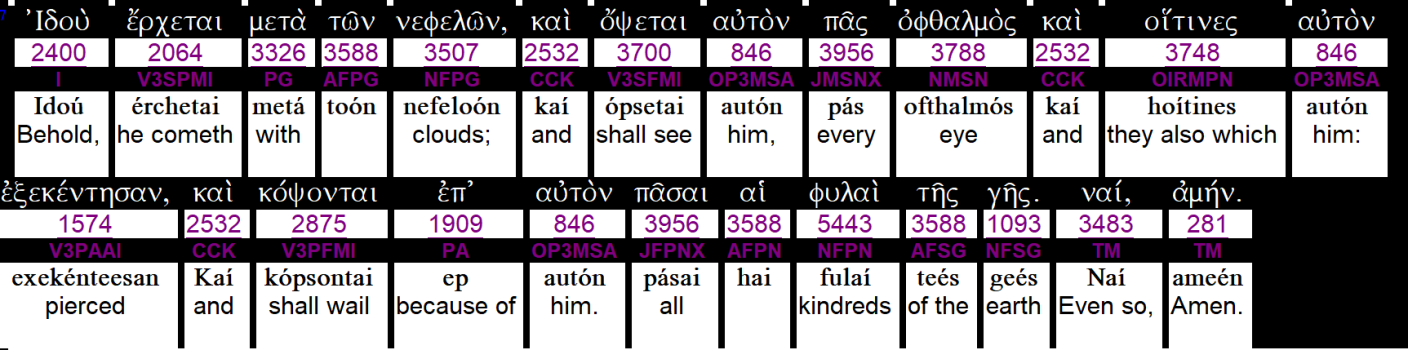
It says "tribes of the earth" so it was referring to the entire planet. This is inline with Rev 1:7 where we see "every eye shall see him" and "all kindreds of the earth. 1762985732797.png
 

Spiritual Israelite

Well-Known Member
Apr 13, 2022
16,902
6,853
113
Midwest
Faith
Christian
Country
United States
Gender
Male
Matthew 24:35 is unrelated to my point. γῆ has different meanings in different settings. Matthew 24:35 is not vs 30. focus on vs 30.
LOL. I'm focusing on context. Both Matthew 24:35 and Matthew 24:30 related directly to the second coming of Christ, so the context of both verses is the same. If Matthew 24:35 shows a global context, as it clearly does, then that is how Matthew 24:30 should be understood as well. What do you think, that Matthew 24:30 and Matthew 24:35 are talking about two different comings of Christ?

Then wherever he descends from according to the literal interpretation of that passage.......... Practically speaking, all the people's of the earth cannot see Jesus descending from one point in the sky. That was my point.
How about speaking spiritually instead of practically for once? Practical discernment means nothing without it being accompanied by spiritual discernment. Scripture says that Jesus will descend from heaven. You understand He's in heaven now, right? So, I don't know where you get this idea of Him descending from one point in the sky from. You seem to want to talk to some strawman instead of talking to me. I understand that not all people on earth could see one point in the sky at the same time. I'm not saying that's what will happen. One way or another, Jesus, being not just a man, but also God, will easily find a way to make everyone see Him when He comes. Whether we can comprehend right now how that will happen is irrelevant.

unrelated to my point.
It was related to the discussion about what Matthew 24:30 means. You can't just say that something is unrelated every time someone takes a different approach to interpreting a verse than you do. Address my point, which is related to your point whether you acknowledge it or not.
 

ewq1938

Mod
Staff member
Jul 11, 2015
8,494
1,698
113
Faith
Christian
Country
United States
Gender
Male
He said "this generation". It is a poor exegesis to suggest He was talking about some distant generation.

A future generation can be called "this generation" plus the Greek word can also mean "that".

Mat 24:34 Verily I say unto you, This generation shall not pass, till all these things be fulfilled.

this:

G3778
houtos houtoi haute¯ hautai
hoo'-tos, hoo'-toy, how'-tay, how'-tahee
Including the nominative masculine plural (second form), nominative feminine signular (third form), and the nominate feminine plural, (fourth form). From the article G3588 and G846; the he (she or it), that is, this or that (often with the article repeated): - he (it was that), hereof, it, she, such as, the same, these, they, this (man, same, woman), which, who.

The verse equally can be translated as, "Verily I say unto you, THAT generation shall not pass, till all these things be fulfilled."

Many people use "this generation" as supposed proof Jesus meant the one he lived in and was speaking to but that is faulty since the word equally can mean "that" so we would have "that generation".

Since the generation he lived in and was speaking to did not see the sun and moon go dark, stars fall, the sign of the son of man nor saw the son of man coming, nor the angels gathering the elect which would have included the disciples means without a doubt Jesus was speaking of a future generation.

Additionally, you can talk about a future generation and refer to it as "this generation". Example, "The generation of 3000AD will populate other planets. This generation will be known as the Space Generation."

Equally a past generation can be referred to as "that generation".

Another example. A man points to a red Corvette in his garage, "This car is mine." or "That car is mine." Same thing.
 

covenantee

Well-Known Member
Feb 22, 2022
7,773
3,438
113
75
Canada
Faith
Christian
Country
Canada
Gender
Male
GOD was the First Person to preach the Gospel - HE will also be the Last.

So the LORD God said to the serpent:
“Because you have done this,
cursed are you above all livestock
and every beast of the field!
On your belly will you go,
and dust you will eat,
all the days of your life.
And I will put enmity between you and the woman,
and between your seed and her seed.

He will crush your head,
and you will strike his heel
Yes, and it was included in the Gospel taken to the entire inhabited world of Paul's day.
 

3 Resurrections

Active Member
Jan 20, 2024
942
233
43
South Carolina
Faith
Christian
Country
United States
Just read what I say. I'm being very straightforward. I said "Paul indicated that Christ's resurrection itself was the firstfruits "of them that slept" (1 Cor 15:20).". That means Christ's resurrection itself is the resurrection referred to when Paul references "Christ the firstfruits". That does not include the resurrection of anyone else but Christ Himself. I don't think I can be more clear than this.
Of course Christ was called the "First-fruits". But that is a plural title, and also applied to the 144,000 First-fruits of Rev. 14:4 whose bodies were redeemed out of the earth and stood together with the risen Lamb on Mount Zion in Jerusalem. In other words, the 144,000 Matthew 27:52-53 saints raised from their graves on that same day as "Christ the First-fruits" also shared the same "First-fruits" title with Him. Together, Christ and the 144,000 Matt. 27 saints all participated in that "first resurrection" event in AD 33. "First-fruits" is an Israelite agricultural term and it does not refer to a single stalk of grain harvested.

You are just making things up. For one thing, if those who were resurrected, as described in Matthew 27:52-53, were resurrected unto bodily immortality, then Paul would have included them in His order of resurrections in 1 Corinthians 15:22-23, but he did not.
No, I'm not making things up. Paul spoke about the church having those "First-fruits" among them in Romans 8:23. And aren't you forgetting John's description of the "first resurrection" in Rev. 20:5? That "remnant (loipoi) of the dead" which came to life again at the end of the millennium was called the "first resurrection" event. In other words, it wasn't Christ alone who was raised to life again that same day in AD 33. There was a certain "remnant" group which also came to life again as participants in that "first resurrection" event. It was the many Matt. 27:52-53 saints. And yes, the Matt. 27:52-53 resurrected saints were raised to incorruptibility and immortality. They never died again afterward a second time - not even possible - since it is appointed unto man ONCE to die - not twice (Heb. 9:27).

Also, there is no resurrection referenced in 1 Corinthians 15:24. You are blatantly twisting the text to fit your doctrine
The context of 1 Cor. 15:20-24 is the subject of the bodily resurrection for those who are "in Christ", and the chronological order of when those bodily resurrection events would take place. Then Paul lists three times when those events would occur in 1 Cor. 15:23-24. I am twisting nothing at all.
 

David in NJ

Well-Known Member
Jul 20, 2021
16,392
8,944
113
50
Denville
Faith
Christian
Country
United States
Gender
Male
Of course Christ was called the "First-fruits". But that is a plural title, and also applied to the 144,000 First-fruits of Rev. 14:4 whose bodies were redeemed out of the earth and stood together with the risen Lamb on Mount Zion in Jerusalem. In other words, the 144,000 Matthew 27:52-53 saints raised from their graves on that same day as "Christ the First-fruits" also shared the same "First-fruits" title with Him. Together, Christ and the 144,000 Matt. 27 saints all participated in that "first resurrection" event in AD 33. "First-fruits" is an Israelite agricultural term and it does not refer to a single stalk of grain harvested.


No, I'm not making things up. Paul spoke about the church having those "First-fruits" among them in Romans 8:23. And aren't you forgetting John's description of the "first resurrection" in Rev. 20:5? That "remnant (loipoi) of the dead" which came to life again at the end of the millennium was called the "first resurrection" event. In other words, it wasn't Christ alone who was raised to life again that same day in AD 33. There was a certain "remnant" group which also came to life again as participants in that "first resurrection" event. It was the many Matt. 27:52-53 saints. And yes, the Matt. 27:52-53 resurrected saints were raised to incorruptibility and immortality. They never died again afterward a second time - not even possible - since it is appointed unto man ONCE to die - not twice (Heb. 9:27).


The context of 1 Cor. 15:20-24 is the subject of the bodily resurrection for the saints and the chronological order of when those bodily resurrection events would take place. Then Paul lists three times when those events would occur in 1 Cor. 15:24. I am twisting nothing at all.
There is not one scripture that denotes "144,000" were Risen unto GLORY with CHRIST

Only CHRIST Rose and ASCENDED back to the FATHER in His physical BODY.
 

kdx

Member
Nov 12, 2025
86
68
18
Frankfurt
Faith
Christian
Country
Germany
There is no such thing as a so-called "general" resurrection with all without exception being simultaneously resurrected at the same time.

Hello I’m curious: what about Jesus statements in John’s Gospel that he will raise up all who belong to him “on the last day”? How do you deal with that?
 
  • Like
Reactions: David in NJ

3 Resurrections

Active Member
Jan 20, 2024
942
233
43
South Carolina
Faith
Christian
Country
United States
Nope. I don't buy this double fulfillment thing at all. The Israelites had already been called out of Egypt before Hosea 11:1 was written, so that verse was obviously not prophesying about the Israelites' Exodus from bondage
A prophecy is not always a prediction of future events. Sometimes it speaks about past events as well. As in Hosea 11:1. "When Israel was a child, I called my son out of Egypt..." When Israel as a nation was called out of Egypt in the Exodus, that young nation was considered a "child" at that point. In Hosea 11:1, God was recounting how He had cared for Israel as a nation from the beginning.

You are wrong about Jesus returning bodily in AD 70. That is ridiculous. But, you're not really addressing my points. What I'm saying is that the context of Zechariah 12:10-14 does not match the context of Revelation 1:7 and Matthew 24:30. Zechariah 12:10 has to do with people mourning Jesus's death
No, I'm not wrong about Christ's bodily return in AD 70, because I quote Jesus, the Apostles, and the prophets directly about this. Call it ridiculous if you will - it won't change Christ's and the Apostles and prophets' words about the timing of His second coming in that first-century generation.

And Zechariah 12 was NOT describing mourning over Christ's death. The mourning of those tribes and families in Israel was described as being just as intense as if they were mourning one of their own first-born sons. Nothing at all about mourning for Christ's death. They would be looking at the bodily-returning Christ and mourning, "Lord, lord, did we not prophecy in thy name..." etc., with weeping and gnashing of teeth to see themselves shut out of entering the kingdom with Christ and the patriarchs. The context of Zechariah 12-14 was the prophecy about "the siege both against Judah and against Jerusalem". I repeat - there was not a siege of Jerusalem taking place during Christ's crucifixion, so your crucifixion setting for this Zech. 12-14 prophecy is wrong.

The Rev. 1:7 reference to "every eye" was specifically of "those who pierced Him" that would view the returning Christ. This duplicates Zechariah 12:10. They both make reference to the very same "tribes of the earth" - namely, of the land of Israel - not the globe in its entirety. It is the same with Matthew 24:30 and those "tribes of the earth" mourning to see Christ's return, immediately after the "great distress in the land, and wrath upon this people" (God's wrath against the first-century Israelites).