I tend to think there might be a connection to 2 Thessalonians 2:4. But I don't take the one meant in that verse to be meaning satan.
2 Thes. 2:3-4 is dealing with the position of 'antichrist', and the 'apostasy' (falling away) that came because of it, also called there, "the man of sin", "the son of perdition" (as Judas was, an internal betrayer who held a position of a bishoprick, as Judas was; and so Paul warned in several places of such, drawing from Dan. 11, and other places in the OT), whom is already present on earth -
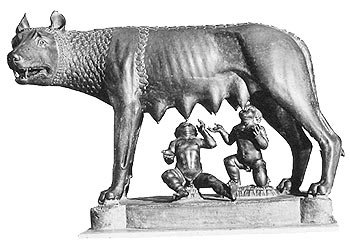
The Romans, with their Capitoline wolf, would come with terrible strength, breaking into pieces other nations (
Dan. 2:33,35,40, 7:7-8,17,19-20,23-24, 8:9-10,23a, 11:20;
Rev. 12:3-4 KJB), but itself would ‘shortly’ (
Psa. 109:8;
Pro. 6:15, see also
Job 14:1;
Heb. 12:10;
Gen. 24:55;
Num. 9:20-22;
Gen. 29:20;
Gen. 27:44-45, 31:41;
Gen. 47:9;
Job 10:20
KJB) break up into pieces itself (
Dan. 2:40-43, 7:24, 11:20b ; see also ‘brake in pieces’:
Exo. 9:25, 23:24, 32:19;
Deu. 9:17, 10:1-2;
1 Kin. 19:11;
2 Kin. 11:18, 18:4, 23:14;
2 Chr. 23:17, 31:1,4;
Psa. 48:7;
Jer. 19:11, 52:17;
Dan. 8:7 KJB). Yet, in its days of strength as a “king of fierce countenance” (
Dan. 8:23a;
Deu. 28:49,50-57 KJB), it would tax the world (
Dan. 2:40, 11:20;
Mat. 10:3, 22:17-21;
Mar. 2:14, 12:14,16,17;
Luk. 2:1,3,5, 5:27,29, 19:2, 20:22,24,25, 23:2;
Rom. 13:7 KJB).
Out of the disharmony and fracturing of the Iron Empire of Pagan Rome into a number of individual nations (
Dan. 2:33,41-42 KJB), would come a differing phase of the Roman element (
Dan. 2:43 KJB), as it donned the outward clothing of the sheep (Christian;
Jhn. 10:26;
Rev. 2:2 KJB), and thus rule (
Dan. 7:8,11,20b-21,24-26, 8:10-12 KJB) in apostasy (
2 Thes. 2:3-4;
1 Tim. 4:1-3;
Rev. 2:20 KJB) as “a king ... understanding dark sentences” (
Dan. 8:23b KJB), or a corruption of the mystery of the Gospel (
Psa. 49:4, 78:2;
Pro. 1:6;
Mat. 13:11,34;
Mar. 4:11,13,34;
Luk. 8:10;
Act. 20:28-30;
Rom. 11:25, 16:25;
1 Cor. 2:7, 4:1, 13:2, 14:2, 15:51;
Eph. 1:9, 3:3,4,5,9, 5:32, 6:19;
Col. 1:26,27, 2:2, 4:3;
2 Thes. 2:7;
1 Tim. 3:9,16; Rev. 1:20, 10:7, 17:5,7 KJB
*). It would come as a “vile person” (
Dan. 11:21 KJB; see also
1 Sam. 3:13 ‘fornication’, ‘idolatry’, ‘theft’, ‘oppression’, 15:9, “vile” beasts;
Job 18:3, “beast”, “vile”;
Psa. 15:4;
Isa. 32:5-6; Jer. 29:17, “vile”, “evil”;
Nah. 1:14, 3:6;
Rom. 1:26 KJB), a “man of sin”, a “son of perdition (destruction)” (
2 Thes. 2:3 KJB; see also
Jhn. 17:12;
1 Thes. 5:3;
2 Thes. 1:9;
1 Tim. 6:9;
2 Pet. 2:1, 3:16;
1 Jhn. 3:4;
Rev. 17:8 KJB), who would take authority deceitfully and subtly (
Gen. 3:1 KJB) by “peace” (
Dan. 8:25, 11:21,32,34 KJB; a perversion of the Gospel of peace;
Jer. 6:14, 8:11, 23:17;
Eze. 13:10,16;
Nah. 1:15;
Luk. 1:19, 2:14;
Rom. 10:15 KJB) so taking upon itself the “daily” (
Act. 2:47 KJB) of Christ’s heavenly ministration (
Dan. 8:11-13, 11:31, 12:11 KJB), obscuring the heavenly sanctuary and God’s true law (
Pro. 24:21;
Dan. 7:25;
Heb. 8:1-2, 9:11-12 KJB), for a very long time.
* See also “riddle” in Num. 12:8; Jdg. 14:12-19 KJB. See also “hard questions” in 1 Kin. 10:1; 2 Chr. 9:1 KJB. See also “... take up a parable ... a taunting proverb ...” (Hab. 2:6 KJB). To speak in proverbs is to speak in symbols, “His disciples said unto him, Lo, now speakest thou plainly, and speakest no proverb.” (Jhn. 16:29 KJB), thus, as it is written, “It is the glory of God to conceal a thing: but the honour of kings is to search out a matter.” (Pro. 25:2 KJB)
The ministration of Jesus Christ (by His shed blood, death & sacrifice in the earthly courtyard), in the Heavenly Sanctuary and True Tabernacle above was obscured, along with His true & faithful remnant church, by an earthly counterfeit system (
Act. 20:28-30;
2 Cor. 11:13-15;
Heb. 7:23;
3 Jhn. 1:9;
Rev. 12:9,13 KJB).
Cardinal Robert Bellarmine, S.J. (Jesuit); Disputationes de Controversiis Christianae Fidei adversus hujus temporis Haereticos; Tom. 2, “Controversia Prima, De Conciliorum Auctoritate), Caput. 17, (1628 ed.) Vol. 1, pp. 266-translated
- [Latin] “Secundo probatur ratione, in Scripturis fundata; nam omnia nomina, quae in Scripturis tribuuntur Christo, unde constat eum esse supra Ecclesiam, eadem omnia tribuuntur Pontifici.” - http://cdigital.dgb.uanl.mx/la/1080015572_C/1080015573_T2/1080015573_21.pdf
- [English] “All names which in the scriptures are applied to Christ, by virtue of which it is established that he is over the church, all the same names are applied to the Pope.”
Roman Catholic Online Encyclopedia
“A”; “Antichrist”:
- “... In composition anti has different meanings: ... Antichrist (Greek Antichristos). ... The word Antichrist occurs only in the Johannine Epistles; but there are so-called real parallelisms to these occurrences in the Apocalypse, in the Pauline Epistles, and less explicit ones in the Gospels and the Book of Daniel. ...” - CATHOLIC ENCYCLOPEDIA: Antichrist
“S”; “Sacrifice”
"
Vicar"
In Latin, “christi” means Christ, Anointed.
“J”, “Origin of the Name of Jesus Christ”:
“V”, “Vicar of Christ”:
- “Vicar of Christ (Latin Vicarius Christi). ... thus, Innocent III appeals for his power to remove bishops to the fact that he is Vicar of Christ (cap. "Inter corporalia", 2, "De trans. ep."). ... and states that it is the Roman Pontiff who is "the successor of Peter and the Vicar of Jesus Christ" (cap. "Licet", 4, ibid.). The title Vicar of God used for the pope by Nicholas III (c. "Fundamenta ejus", 17, "De elect.", in 6) is employed as an equivalent for Vicar of Christ” - CATHOLIC ENCYCLOPEDIA: Vicar of Christ
Papal Encyclicals; The Great Encyclical Letters of Pope Leo XIII”, Encyclical Letter June 20, 1894; Praeclara Gratulationis Publicae:
“C”, “Church”:
- “... It will be enough, however, to refer to the evidence contained in the epistles of St. Ignatius, Bishop of Antioch, himself a disciple of the Apostles. In these epistles (about A.D. 107) he again and again asserts that the supremacy of the bishop is of Divine institution and belongs to the Apostolic constitution of the Church. He goes so far as to affirm that the bishop stands in the place of Christ Himself. ...” - CATHOLIC ENCYCLOPEDIA: The Church
Catholic Online Library; Church Documents; “Ad Sinarum Gentem (1954)”; Point 11:
Catholic Online Library; Church Documents; “In Plurimis (1888)”; Point 2:
Antichrist:
- Lat. - Vicarius Christi
- Lat. Translit. - antichristus
- koine Grk. - αντιχριστος
- koine Grk. translit. - antichristos
- Eng. - antichrist (in the place of christ)
- Heb. - “המשׁיח תחתיו” (see Lev. 6:22; see also Greek Origen's Hexapla - Lev. 6:15, "ὁ χριστὸς ἀντ᾿", "o christos ant'")
- Heb. Translit. - haMäshiyªch Tach'Täy (meaning 'anointed in his stead / place / position)
# 1 Pagan Rome (Capitoline Wolf) ------------ #2 Sheep (Representing Christianity) -------- #3 Wolf in Sheep's Clothing (Papal Rome)