Who were the “brothers” of Jesus?

  • Welcome to Christian Forums, a Christian Forum that recognizes that all Christians are a work in progress.

    You will need to register to be able to join in fellowship with Christians all over the world.

    We hope to see you as a part of our community soon and God Bless!

Soul.og

Member
Feb 8, 2026
95
10
18
Inland Northwest
Faith
Christian
Country
United States
Gender
Female
The account at Matthew 13:55 mentions Jesus' mother and brothers, together.
Verses 54-57 says those He was teaching, "were astonished....they began to find cause for stumbling." Ask yourself: Why? Because they knew His family!

Many times, context (in the Bible) can clear up misunderstandings, and put to rest false ideas.

The context of Matthew 13:55 and Mark 6:3 certainly places Jesus’s adelphoi within His immediate family circle, but the term adelphos itself does not specify biological siblinghood. That’s simply how Koine Greek works, especially in Jewish‑Greek contexts shaped by the Septuagint.

The real question is: where in these passages does the text define the precise nature of that kinship? The verses list names, but they never identify these men as Mary’s children, nor do they describe their parentage at all.

The context shows familiarity and close association within Jesus’s household, but it does not specify biological relationships. Adelphoi can refer to cousins, extended relatives, or close associates depending on context—and Scripture uses it that way frequently.

Later in my opening post, I presented evidence that these individuals were Jesus’s cousins, not children of Mary. Matthew and Mark are fully compatible with that reading because they do not define the relationship more narrowly than the general family term adelphoi.

In other words: the passages show a family connection, but they do not tell you what kind. The assumption that it must be biological siblinghood is coming from outside the text, not from the text itself.
 
Last edited:

rvmb

Well-Known Member
Jul 3, 2025
1,252
330
83
Adelaide
Faith
Christian
Country
Australia
Gender
Male
I’m not approaching the passage with an agenda — I’m simply recognizing that adelphos in Koine Greek doesn’t always mean a biological sibling. That’s not a controversial claim; it’s a well‑attested feature of the language, especially in Jewish‑Greek contexts.

Matt. 13:55 and Mk. 6:3 is clear that Jesus had relatives named Joseph, Simon, James, and Judas. What the passage does not specify is the exact nature of that kinship. That’s why looking at the broader linguistic, cultural, and historical context matters.

If you believe the passage is “clear‑cut", then the question is: clear‑cut in what sense? Clear that these men were related to Jesus — yes. Clear that they were biological children of Mary — that’s precisely what the text does not say.

So this isn’t about agendas. It’s about reading an ancient text in its ancient language, rather than assuming modern English kinship categories apply automatically.
The Perpetual Virgin theory.
Someone forgot to tell Joseph.
Matt 1:25 teaches :-
And knew her not till she had brought forth her firstborn son: and he called his name JESUS.
 

Soul.og

Member
Feb 8, 2026
95
10
18
Inland Northwest
Faith
Christian
Country
United States
Gender
Female
The Perpetual Virgin theory.
Someone forgot to tell Joseph.
Matt 1:25 teaches :-
And knew her not till she had brought forth her firstborn son: and he called his name JESUS.

In Matthew 1:20-25, the Evangelist is not offering commentary on Joseph and Mary’s marital life after Jesus’s birth. His purpose is to anchor Jesus’s conception in the fulfillment of Isaiah 7:14 and to emphasize that the Child was conceived by the Holy Spirit, not by Joseph.

The statement that Joseph “did not know Her until She had given birth” functions to affirm two things:

  • Joseph’s continence prior to the birth, safeguarding the prophetic sign of the Virgin Birth.
  • The divine origin of Christ, which is the entire focus of the passage.
Nothing in the text claims—or even hints—that this statement is meant to describe what happened after the birth. Reading it as a comment on post‑nativity relations imposes a meaning the Evangelist never asserts.

Matthew’s concern is theological and prophetic, not biological speculation about Joseph and Mary’s later marital life. To treat the verse as if it were making that claim is to force the text to answer a question it is not addressing.
 
Last edited:

rvmb

Well-Known Member
Jul 3, 2025
1,252
330
83
Adelaide
Faith
Christian
Country
Australia
Gender
Male
In Matt. 1:20-25, the Evangelist explicitly frames Jesus’s conception as the fulfillment of Isa. 7:14, stressing that Mary conceived through the Holy Spirit. The statement that Joseph “did not know Her until She had given birth” is directed toward affirming the divine origin of Christ and Joseph’s continence prior to the Messiah’s birth. Its purpose is to secure the prophetic sign of the Virgin Birth — not to assert, imply, or even comment on the nature of Joseph and Mary’s marital relations after Jesus’s nativity. Reading it otherwise imposes a meaning the text itself does not claim.
Conclusion :- After Christ was born Mary lost her virginity to Joseph, thereby destroying the man-made nonsense that she remained a virgin for the rest of her life.
 

Soul.og

Member
Feb 8, 2026
95
10
18
Inland Northwest
Faith
Christian
Country
United States
Gender
Female
Conclusion :- After Christ was born Mary lost her virginity to Joseph, thereby destroying the man-made nonsense that she remained a virgin for the rest of her life.

My point is straightforward: Matthew makes no claim at all—positive or negative—about Mary’s marital relations after Jesus’s birth. The verse is addressing only one issue: Joseph’s continence before the birth, in order to underscore the divine origin of Jesus and the fulfillment of Isaiah 7:14.

The text’s purpose is theological, not biographical. It secures the Virgin Birth; it does not comment on what happened afterward. Reading it as a statement about post‑nativity relations goes beyond what Matthew actually says and imports a conclusion the passage itself never makes.
 
Last edited:

rvmb

Well-Known Member
Jul 3, 2025
1,252
330
83
Adelaide
Faith
Christian
Country
Australia
Gender
Male
My point is that Matthew doesn’t make any claim — positive or negative — about Mary’s marital relations after Jesus’s birth. The verse only addresses Joseph’s continence before the birth to emphasize the divine origin of Jesus. Reading it as a statement about what happened after the birth goes beyond what the text actually says.
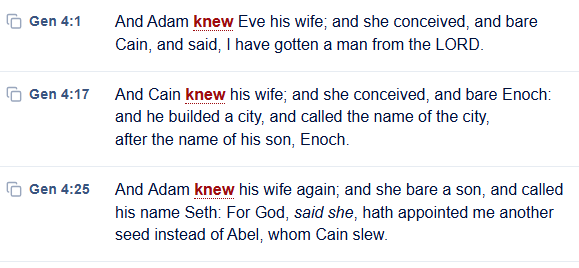
Gen 1:4 And Adam knew Eve his wife; and she conceived
Matt 1:25 And knew her not till she had brought forth her firstborn son.
**
Scripture interprets Scripture "knew" >> had sex
 
  • Like
Reactions: PS95

Soul.og

Member
Feb 8, 2026
95
10
18
Inland Northwest
Faith
Christian
Country
United States
Gender
Female
Gen 1:4 And Adam knew Eve his wife; and she conceived
Matt 1:25 And knew her not till she had brought forth her firstborn son.
**
Scripture interprets Scripture "knew" >> had sex

I agree that “knew” (ginosko) is a standard idiom for sexual relations—Matthew is using it that way. But that doesn’t answer the real question: what does “until” (heos) imply in this construction?

Matthew’s point is simply that Joseph had no relations with Mary before Jesus’ birth in order to underscore the divine origin of Christ. The verse does not say— or even hint—what happened after the birth.

Scriptural Greek regularly uses heos (“until”) in ways that do not imply a later change. A clear example:

  • “Michal had no children until the day of her death.” (2 Samuel 6:23)
Obviously she didn’t start having children after she died. The construction marks a boundary, not a change of state.

So yes—“knew” refers to sexual relations. But the presence of that verb tells us nothing about what happened after the stated time marker. Your conclusion only follows if you assume that “until” implies a later change, but Scripture itself shows that this is not how the phrase functions.

And even if (for the sake of argument) Joseph and Mary had marital relations later—a separate question—that still wouldn’t prove that Jesus’s “brothers” (Joseph, Simon, James, and Judas) were Mary’s biological children. The term adelphoi in Scripture is not restricted to biological siblings; its semantic range includes cousins and extended kin.

So neither the grammar of Matthew 1:25 nor the linguistic evidence about adelphoi supports the conclusion you’re drawing.
 
Last edited:

rvmb

Well-Known Member
Jul 3, 2025
1,252
330
83
Adelaide
Faith
Christian
Country
Australia
Gender
Male
I agree that ‘knew’ can mean sexual relations — Matthew is using the same idiom. But that doesn’t address the actual question: what does the word ‘until’ (ἕως οὗ) imply?

Matthew’s point is simply that Joseph had no relations with Mary before Jesus’ birth.
The verse does not say or imply what happened after the birth.

Biblical Greek regularly uses "until" in ways that do not imply a change afterward. For example:

· "Michal had no children until the day of her death" (2 Sam 6:23).
Obviously she didn’t start having children after she died.

So yes — ‘"knew" means sexual relations.

But the presence of that verb tells us nothing about what happened after the stated time marker. Your conclusion only follows if you assume that ‘until’ implies a later change, but Scripture itself shows that this is not how the construction works.

Additionally, for the sake of argument, even if Joseph and Mary had marital relations later (a separate question), that still wouldn’t prove that Joseph, James, Simon, and Judas were Jesus’s biological siblings. The term adelphoi (“brothers”) in Scripture is not restricted to biological siblings — its semantic range includes extended kin and relatives. So the linguistic evidence doesn’t support the conclusion you’re drawing.
I agree that ‘knew’ can mean sexual relations — Matthew is using the same idiom. But that doesn’t address the actual question: what does the word ‘until’ (ἕως οὗ) imply?

Matthew’s point is simply that Joseph had no relations with Mary before Jesus’ birth.
The verse does not say or imply what happened after the birth.

Biblical Greek regularly uses "until" in ways that do not imply a change afterward. For example:

· "Michal had no children until the day of her death" (2 Sam. 6:23)
Obviously she didn’t start having children after she died.

So yes — ‘"knew" means sexual relations.

But the presence of that verb tells us nothing about what happened after the stated time marker. Your conclusion only follows if you assume that ‘until’ implies a later change, but Scripture itself shows that this is not how the construction works.

Additionally, for the sake of argument, even if Joseph and Mary had marital relations later (a separate question), that still wouldn’t prove that Joseph, James, Simon, and Judas were Jesus’s biological siblings. The term adelphoi (“brothers”) in Scripture is not restricted to biological siblings — its semantic range includes extended kin and relatives. So the linguistic evidence doesn’t support the conclusion you’re drawing.
Good try SG but fail.
Scripture interprets Scripture :-
"knew" as in the following >> had sex.

****
1773616393023.png
1773615878871.png


1773616095346.png
 

Attachments

  • 1773615982175.png
    1773615982175.png
    5.7 KB · Views: 2
  • 1773616045774.png
    1773616045774.png
    6.2 KB · Views: 0
  • 1773616368673.png
    1773616368673.png
    6.9 KB · Views: 0
Last edited:

Soul.og

Member
Feb 8, 2026
95
10
18
Inland Northwest
Faith
Christian
Country
United States
Gender
Female
Good try SG but fail.
Scripture interprets Scripture :-
"knew" as in the following >> had sex.

****
View attachment 81447
View attachment 81442
View attachment 81443

View attachment 81445

I’m not disputing that “knew” (ginosko) refers to sexual relations—Matthew is using the standard idiom. But repeating the meaning of ginosko doesn’t address the real issue: the force of the word “until” (heos).

Matthew is making a statement about what did not happen before Jesus’ birth in order to emphasize His divine origin. He says nothing—literally nothing—about what happened after the birth.

And Scripture itself shows that heos / heos hou does not automatically imply a later change. A clear example:

  • “Michal had no children until the day of her death.” (2 Samuel 6:23)
She obviously didn’t begin having children after she died.

So the logic “X did not happen until Y, therefore X happened after Y” is not a scriptural rule—Scripture explicitly disproves it.

If you want to argue that Joseph and Mary had marital relations later, that would require evidence from a different passage, because Matthew 1:25 simply doesn’t make that claim.

So the meaning of “knew” isn’t the issue here. The unwarranted assumption about “until” is.
 
Last edited:

rvmb

Well-Known Member
Jul 3, 2025
1,252
330
83
Adelaide
Faith
Christian
Country
Australia
Gender
Male
I’m not disputing that ‘knew’ refers to sexual relations — Matthew is using the same idiom. But repeating the meaning of ‘knew’ doesn’t address the actual point under discussion: the force of the word "until" (ἕως οὗ).

Matthew is making a statement about what did not happen before Jesus’ birth. He does not make any statement about what happened after the birth.

And Scripture itself shows that "until" does not automatically imply a later change. For example:

· "Michal had no children until the day of her death" (2 Sam. 6:23).
She obviously didn’t begin having children after she died.

So the logic ‘X did not happen until Y, therefore X happened after Y’ is not a biblical rule — Scripture explicitly disproves it.

If you want to argue that Joseph and Mary had relations later, that would require evidence from a different passage, because Matt. 1:25 simply doesn’t make that claim.

So the meaning of "knew" is not the issue — the assumption about "until" is.
Keep digging SG :)
SG (had sex) knew his wife not until after they were married
In Matt 1:25 context until > not before
KJV ....................And knew her not till
Vulgate .............knew her not till
Duoay Rheims And he knew her not till
**
"Until" acts as a preposition or conjunction indicating a state continues up to a specific time/event and then stops (e.g., "Wait until 5 PM") or, often in negative constructions, means "not before" (e.g., "It didn't start until I arrived"). It can be used for time, actions, or as a boundary.
 

Button

Well-Known Member
Jan 6, 2026
1,348
1,073
113
USA America is Great & Blessed
www.cambridge.org
Faith
Christian
Country
United States
Gender
Female
Do you confess that Jesus came in the flesh?

Yes, the Father sent Jesus and He came through the seed of David:

Ro 1:3 Concerning his Son Jesus Christ our Lord, which was made of the seed of David according to the flesh;
And that seed was of Mary. Because the father of Jesus was God.
 

Soul.og

Member
Feb 8, 2026
95
10
18
Inland Northwest
Faith
Christian
Country
United States
Gender
Female
Keep digging SG :)
SG knew his wife not till after they were married
In Matt 1:25 context until > not before
KJV ....................And knew her not till
Vulgate .............knew her not till
Duoay Rheims And he knew her not till
**
"Until" acts as a preposition or conjunction indicating a state continues up to a specific time/event and then stops (e.g., "Wait until 5 PM") or, often in negative constructions, means "not before" (e.g., "It didn't start until I arrived"). It can be used for time, actions, or as a boundary.

You’re still appealing to the English meaning of “until” rather than dealing with how Scripture itself uses the term. If we’re going to follow the principle that Scripture interprets Scripture, then we have to let Scripture’s own usage guide us—not modern English assumptions.

In Scriptural Greek, heos / heos hou does not automatically imply a change afterward. The clearest example is:

  • “Michal had no children until the day of her death.” (2 Samuel 6:23)
She obviously didn’t begin having children after she died.

This is not an obscure or ambiguous passage—it directly contradicts the idea that “until” must imply the opposite afterward.

So the rule you’re applying—“X did not happen until Y, therefore X happened after Y”— is not a scriptural rule. Scripture itself disproves it.

Matthew 1:25 simply states that Joseph had no relations with Mary before Jesus’ birth to emphasize the divine origin of Christ. It does not say or imply what happened after the birth.

If you want to argue that Joseph and Mary had relations later, that would require evidence from a different passage, because Matthew 1:25 does not make that claim.

So again: The meaning of “knew” isn’t the issue—the assumption about “until” is.
 
Last edited:

Button

Well-Known Member
Jan 6, 2026
1,348
1,073
113
USA America is Great & Blessed
www.cambridge.org
Faith
Christian
Country
United States
Gender
Female
Key points to consider:

· Only Jesus was called "the Carpenter’s Son" (Matt. 13:55)

· Only Jesus was called "the Son of Mary" (Mk. 6:3)

· Scripture calls Joseph, Simon, James, and Judas Jesus's adelphoi (“brothers"), but never sons of Mary (Matt. 13:55; Mk. 6:3)

· The Koine Greek word ἀδελφός (adelphos), usually translated as 'brother' in English, has a wide range of definitions: "a brother, near kinsman, or relative, e.g., cousin, nephew, etc.", "a fellow countryman", "a fellow member of the Christian community", or "an associate". In the plural, ἀδελφοί (adelphoi) often functions as a gender-inclusive term meaning "brothers and sisters".

__________________________________________

Considering the information above, analyze the following to understand the familial relationships among Jesus, James, Judas, and the other individuals listed below.

The Evangelists and the Apostle Paul

· "Is this not the carpenter’s Son? Is not His Mother called Mary? Are not James and Joseph and Simon and Judas His brothers?" (Matt. 13:55)

· "Is this not the carpenter, the Son of Mary, and the brother of James and Joses and Judas and Simon?" (Mk. 6:3)

· "Then after three years, I did go up to Jerusalem to become acquainted with Cephas (Peter), and I stayed with him for fifteen days. However, I did not set eyes on any of the other apostles, except for James, the brother of the Lord" (Gal. 1:18-19)

Contextual evidence strongly suggests that the James mentioned in the Gospels (Matt. 13:55; Mk. 6:3) and by Paul (Gal. 1:19) was the same individual — a kinsman/relative of Jesus who was also one of the Twelve. Given that there were only two apostles named James (of Zebedee and of Alphaeus), and that the latter had a brother named Judas (Jude/Thaddeus), it is reasonable to conclude that this James and Judas of Alphaeus were two of the four brothers of Jesus.

· “When the Sabbath was past, Mary Magdalene, and Mary (of Clopas/Cleophas) the mother of James (the Less), and Salome (the mother of the sons of Zebedee), bought spices, so that they might come and anoint him” (Mk. 16:1)

· Now they were Mary Magdalene, Joanna, and Mary (of Clopas/Cleophas) the mother of James (the Less). The other women with them told these things to the apostles" (Lk. 24:10)

· “Mary Magdalene, Mary (of Clopas/Cleophas) the mother of James (the Less) and Joseph, and the mother of the sons of Zebedee (Salome)” (Matt. 27:56)

· “Mary Magdalene, Mary (of Clopas/Cleophas) the mother of James the Less and Joseph, and Salome (the mother of the sons of Zebedee)” (Mk. 15:40)

· “His Mother (Mary of Joseph), His (Jesus's) Mother’s sister Mary, the wife of Clopas/Cleophas (and the mother of James the Less and Joseph), and Mary Magdalene” (Jn. 19:25)

The Early Church Fathers

· “Mary the wife of Cleophas or Alphaeus (Clopas), who was the mother of James the bishop and apostle, and of Simon and Thaddeus (Judas), and of one Joseph.” (Papias of Hierapolis [c. 60–130 AD], Fragments of Papias, Frag. X, cf. Jn. 19:25)

· “[…] James, who is called the brother of the Lord […] as appears to me, the son of Mary sister of the mother of our Lord […] after ordained by the apostles bishop of Jerusalem, wrote a single epistle, which is reckoned among the seven Catholic epistles” (cf. Jud. 1:1) and “[…] Mary who is described as the mother of James the Less was the wife of Alphaeus and sister of Mary the Lord’s mother.” (Jerome of Stridon [c. 347–420 CE], De Viris Illustribus, De Perpetua Uirginitate Beatae Mariae, cf. Jn. 19:25)

· Eusebius of Caesarea [c. 260–340 AD] relates the following in his Historia Ecclesiastica:

I. “James, the brother of the Lord, was “[…] the author of the first of the so-called catholic epistles” and that while it is disputed, “as is the case likewise with the epistle that bears the name of Jude, which is also one of the seven so-called catholic epistles,” it is known they have been “[…] read publicly in very many churches.” (Bk. I, ch. XXIII, cf. Jud. 1:1)

II. “James […] surnamed the Just […] bishop of the church of Jerusalem. This James was called the brother of the Lord” and “Paul also makes mention of the same James the Just, where he writes, 'Other of the apostles saw I none, save James the Lord’s brother.'” (Bk. II, ch. I)

III. “[…] those of the apostles and disciples of the Lord […] with those that were related to the Lord according to the flesh … pronounced Symeon (Simon), the son of Clopas […] to be worthy of the episcopal throne of that parish. He was a cousin, as they say, of the Saviour. For Hegesippus records that Clopas was a brother of Joseph.” (Bk. III, ch. XI)

IV. “Josephus, at least, has not hesitated to testify this in his writings, where he says, ‘These things happened to the Jews to avenge James the Just, who was a brother of Jesus, that is called the Christ.’” (Bk. II, ch. XXIII)

V. “[…] the brother of Jesus, who was called Christ, whose name was James” (Flavius Josephus [c. 37-100 CE], Antiquitates Iudaicae, Bk. XX, ch. IX)

VI. “[…] James the Just bishop of Jerusalem” and “[…] but there were two Jameses: one called the Just […] thrown from the pinnacle of the temple […] and beaten to death with a club by a fuller, and another who was beheaded.” (Bk. II, ch. I) (Clement of Alexandria [c. 150–215 AD], Hypotyposes, Bk. VII, cf. Ac. 12:1-2)

VII. “[…] James the brother of the Lord, succeeded to the government of the Church […] called the Just […]” (Bk. II, ch. 23) and “after James the Just had suffered martyrdom […] Symeon (Simon), the son of the Lord’s uncle, Clopas, was appointed the next bishop […] because he was a cousin of the Lord.” (Bk. III, ch. XXII) (Hegesippus [c. 110-180 AD], Hypomnemata)

__________________________________________

Summary

The scriptural verses and early Church Father writings above collectively show the following:

· Jesus’s brothers — Joseph, Simon, James, and Judas — were the sons of His Mother’s Spouse’s brother, Alphaeus (Clopas/Cleophas), and his wife, Mary, making them His cousins.

· Jesus’s cousins James and Judas were the same individuals as the apostles James and Judas (Jude/Thaddeus), the sons of Alphaeus (Clopas/Cleophas) among the Twelve.

· Jesus’s cousin — James of the Twelve, also called “James the Less”, “James the brother of the Lord”, “James the Just, and “the bishop of Jerusalem” — was the same individual, and he is the author of the Epistle of James.

· Jesus’s cousin, the apostle Judas (Jude/Thaddeus) of the Twelve, was the author of the Epistle of Jude.

I think you answered your own question on your OP.

"Is this not the carpenter’s Son? Is not His Mother called Mary? Are not James and Joseph and Simon and Judas His brothers?" (Matt. 13:55)

· "Is this not the carpenter, the Son of Mary, and the brother of James and Joses and Judas and Simon?" (Mk. 6:3)

The father of Jesus was not Joseph.

Therefore, any children Mary birthed through the seed of Joseph were if anything, the half brothers of Jesus. Because Mary was the biological mother of all those boys.

And then too remember from the cross Jesus gave John to Mary as her new son. He,it is believed,was to take the place of Jesus in caring for her. Because,if you notice Joseph is not there. So,it is presumed he had already passed. And a woman in first century needed a male to care for her.
 

Soul.og

Member
Feb 8, 2026
95
10
18
Inland Northwest
Faith
Christian
Country
United States
Gender
Female
I think you answered your own question on your OP.

"Is this not the carpenter’s Son? Is not His Mother called Mary? Are not James and Joseph and Simon and Judas His brothers?" (Matt. 13:55)

· "Is this not the carpenter, the Son of Mary, and the brother of James and Joses and Judas and Simon?" (Mk. 6:3)

The context of Matthew 13:55 and Mark 6:3 certainly places Jesus’s adelphoi within His immediate family circle, but the term adelphos itself does not specify biological siblinghood. That’s simply how Koine Greek works, especially in Jewish‑Greek contexts shaped by the Septuagint.

The real question is: where in these passages does the text define the precise nature of that kinship? The verses list names, but they never identify these men as Mary’s children, nor do they describe their parentage at all.

The context shows familiarity and close association within Jesus’s household, but it does not specify biological relationships. Adelphoi can refer to cousins, extended relatives, or close associates depending on context—and Scripture uses it that way frequently.

Later in my opening post, I presented evidence that these individuals were Jesus’s cousins, not children of Mary. Matthew and Mark are fully compatible with that reading because they do not define the relationship more narrowly than the general family term adelphoi.

In other words: the passages show a family connection, but they do not tell you what kind. The assumption that it must be biological siblinghood is coming from outside the text, not from the text itself.
 
Last edited:

rvmb

Well-Known Member
Jul 3, 2025
1,252
330
83
Adelaide
Faith
Christian
Country
Australia
Gender
Male
You’re still appealing to the English meaning of "until" rather than dealing with how Scripture itself uses the term. If we’re going to follow the principle "Scripture interprets Scripture", then we have to let Scripture's own usage guide us — not modern English examples.

In Scripture, "until" (ἕως / ἕως οὗ) does not automatically imply a change afterward. The clearest example is:

· ‘Michal had no children until the day of her death’ (2 Sam. 6:23)
She obviously didn’t start having children after she died.

This is not an obscure passage — it directly contradicts the idea that "until" must imply a later change.

So your rule:

“until = not before, therefore afterward the opposite happened”

is not a scriptural rule. Scripture itself disproves it.

Matt. 1:25 simply says Joseph had no relations with Mary before Jesus’ birth. It does not say or imply what happened afterward.

If you want to argue that Joseph and Mary had relations later, that would require evidence from a different passage, because Matt. 1:25 simply doesn’t make that claim.

So again: The meaning of “knew” is not the issue — the assumption about “until” is.
Sex is a sin UNTIL after marriage.
Mary did not have sex UNTIL after Christ was born.
After the birth of Christ, list the verses that teach or imply even slightly that Mary withheld sex from Joseph.
 
  • Like
Reactions: Button

Button

Well-Known Member
Jan 6, 2026
1,348
1,073
113
USA America is Great & Blessed
www.cambridge.org
Faith
Christian
Country
United States
Gender
Female
While the context of Matt. 13:55 and Mk. 6:3 certainly shows that Jesus’s adelphoi ("brothers") — Joseph, Simon, James, and Judas — belonged to His immediate family circle, the Greek term adelphos does not in itself specify biological siblinghood.

The key question, then, is this: where in these passages does the text define the precise nature of that kinship? The verses list names, but they do not identify these men as Mary’s children, nor do they describe their parentage at all.

The context demonstrates familiarity and close association within Jesus’s household, but it does not specify biological relationships. The term adelphoi can denote cousins, extended relatives, or even close associates, depending on context.

Later in my opening post, I present evidence that these individuals were cousins of Jesus, not children of Mary. The passages in Matthew and Mark are compatible with that interpretation because they do not define the relationship more narrowly than the general family term adelphoi.
As you wish.

Catholics will never deviate from the false idea that Mary was a perpetual virgin.

When the scripture identified those names as brothers of Jesus,there is no need to say they are sons of Mary.
 
Last edited:
  • Like
Reactions: rvmb

Soul.og

Member
Feb 8, 2026
95
10
18
Inland Northwest
Faith
Christian
Country
United States
Gender
Female
Sex is a sin UNTIL after marriage.
Mary did not have sex UNTIL after Christ was born.
After the birth of Christ, list the verses that teach or imply even slightly that Mary withheld sex from Joseph.

Your analogy about sex before marriage doesn’t touch the real issue. The question isn’t how you think “until” works in English—the question is how Scripture uses the term.

And on that point, the scriptural example in 2 Samuel 6:23 remains decisive:

“Michal had no children until the day of her death.”

If “until” always implies a change afterward, then this verse becomes nonsensical. Scripture itself shows that until does not require a later reversal. It simply marks a boundary up to a point in time, without making any claim about what happens afterward.

So your universal rule—“until = the opposite happened later”—is not a scriptural rule. It’s an English assumption that Scripture directly contradicts.

Matthew 1:25 tells us exactly one thing:

  • Joseph did not have sexual relations with Mary before Jesus’ birth.
That’s it. The verse does not say he did afterward, and it does not imply it. If you want to assert that Joseph and Mary later had sexual relations, you need positive scriptural evidence from another passage—not an inference based on a meaning of “until” that Scripture itself disproves.

The burden of proof lies entirely on the person claiming a later change, because Matthew never makes that claim.
 
Last edited:

Soul.og

Member
Feb 8, 2026
95
10
18
Inland Northwest
Faith
Christian
Country
United States
Gender
Female
As you wish.

Catholics will never deviste from the false idea that Mary was a perpetual virgin.

When the scripture identified those names as brothers of Jesus,there is no need to say they are sons of Mary.

This isn’t about Catholic doctrine—it’s about what the text actually says and what it does not say. You’re asserting that these passages identify the named men as Jesus’ biological brothers, but the text never makes that claim. It never calls them Mary’s sons, never names their mother, and never defines the relationship beyond the broad kinship term adelphoi.

Pointing out that adelphos has a wider semantic range isn’t “deviation”; it’s basic textual analysis. If a term can mean multiple kinds of relatives, then you can’t assume the narrowest meaning without explicit support from the passage.

And here’s the key point: if the text does not specify biological parentage, then saying “there is no need to say they are sons of Mary” actually reinforces my argument. The passages don’t say it—and if they don’t say it, they cannot be used as proof that Mary had other children.

You’re trying to draw a conclusion the text itself never states. The burden of proof lies on the person claiming a biological relationship that the passage does not identify.
 
Last edited:

rvmb

Well-Known Member
Jul 3, 2025
1,252
330
83
Adelaide
Faith
Christian
Country
Australia
Gender
Male
Your analogy about sex before marriage doesn’t address the actual issue. The question isn’t what you think “until” means in English — it’s how Scripture itself uses the term.

The scriptural example in 2 Sam. 6:23 still stands:

· ‘Michal had no children until the day of her death’ (2 Sam. 6:23)

If “until” always implies a change afterward, then this verse becomes impossible. Scripture itself shows that until does not require a later reversal.

So your rule:

“until = the opposite happened afterward”

is not a scriptural rule. It’s an English assumption that Scripture directly contradicts.

Matt. 1:25 tells us only one thing:

· Joseph did not have relations with Mary before Jesus’ birth

It does not say he did afterward, and it does not imply it. If you want to claim that Mary and Joseph had relations later, that requires positive evidence from another passage — not an assumption based on a meaning of “until” that Scripture itself disproves.

The burden of proof is on the person claiming a later change, because Matthew doesn’t make that claim.
Matthew teaches Mary NEVER had sex ?
List the verses :)
 

Soul.og

Member
Feb 8, 2026
95
10
18
Inland Northwest
Faith
Christian
Country
United States
Gender
Female
Matthew teaches Mary NEVER had sex ?
List the verses :)

I never claimed that Matthew teaches Mary never had sex. I said that Matthew 1:25 does not teach that She did. Those are two completely different claims.

You’re asking me to provide verses proving something I never asserted. My argument is simply this: Matthew 1:25 does not provide evidence for sexual relations after Jesus’ birth.

The logic is straightforward:

  • Your claim: “Until” means the opposite happened afterward.
  • Scripture’s usage: 2 Samuel 6:23 shows that is not how “until” functions in Scripture.
  • Conclusion: Matthew 1:25 cannot be used to prove later sexual relations.
If you want to argue that Mary and Joseph had sexual relations after Jesus’ birth, you need a verse that actually states it. Matthew 1:25 doesn’t say it, doesn’t imply it, and cannot be stretched to prove it.

So the burden of proof remains on the person asserting a later change—not on me.
 
Last edited: