The fallacy of believing Jesus was talking about the temple of stones on the Mount of Olives

  • Welcome to Christian Forums, a Christian Forum that recognizes that all Christians are a work in progress.

    You will need to register to be able to join in fellowship with Christians all over the world.

    We hope to see you as a part of our community soon and God Bless!

Davidpt

Well-Known Member
Dec 6, 2023
2,512
798
113
68
East Texas
Faith
Christian
Country
United States
Do you know of any examples where the word “sealed” is meant as permanent, never to be opened again? Besides in Daniel 9:24.

Though you weren't asking me that, here's my 2 cents, regardless.

In Daniel 9:24, the last thing in the list is anoint the most holy. Obviously, that wouldn't be the first thing in the list being fulfilled if it's listed last. Yet some would have us believe otherwise, that it was the first thing in the list fulfilled. Total nonsense, IMO. Plus, if one looks how the phrase 'most holy' is used elsewhere in the OT, I'm not seeing any place where it ever means a person.

And guess what? This in verse 27 is also part of the prophecy--and for the overspreading of abominations he shall make it desolate, even until the consummation, and that determined shall be poured upon the desolate.


And guess what else? That poses a major problem if one insists the 70 weeks concluded before that part is fulfilled. Therefore, contradicting that the prophecy can't be closed until everything in verse 24 has been met, and that everything in verses 25-27 have been met. But who cares, right? It doesn't matter if anything is contradicted. The only thing that matters is, that we are correct, so there. The 70 weeks concluded in full within 3.5 years of Christ having gone to the cross, because we say so. We do not care that that contradicts that the vision can't stop until all conditions pertaining to verses 24-27 are met first. How in the world can we be wrong and the angel be correct? If anyone is not correct, it can't be us. That's the mindset we are dealing with here among interpreters this fits.


It is serious cherry picking to insist it means everything but this in verse 26--and the people of the prince that shall come shall destroy the city and the sanctuary; and the end thereof shall be with a flood, and unto the end of the war desolations are determined.---and this in verse 27---and for the overspreading of abominations he shall make it desolate, even until the consummation, and that determined shall be poured upon the desolate. As if neither of those things are part of the prophecy. If they are not, then why did the angel list these things among verses 24-27 having to do with the prophecy?

Is one going to argue, then expected to be taken serious, that neither of those things have anything to do with prophecy, period. The angel is not predicting anything in those verses. Prophecy requires predicting things in advance. The angel was not doing that in either of those verses. Yeah, right, if you say so.


and to seal up(chatham khaw-tham' a primitive root; to close up; especially to seal:--make an end, mark, seal (up), stop) the vision and prophecy, and to anoint the most Holy.


Daniel 12:4 But thou, O Daniel, shut up(catham saw-tham' or satham (Numbers 24:15) {saw-tham'}; a primitive root; to stop up; by implication, to repair; figuratively, to keep secret:--closed up, hidden, secret, shut out (up), stop.) the words, and seal(chatham khaw-tham' a primitive root; to close up; especially to seal:--make an end, mark, seal (up), stop) the book, [even] to the time of the end: many shall run to and fro,34 and knowledge shall be increased.

The former seems to be saying this. That once the 70 weeks have been fulfilled, the prophecy can stop because it has been fulfilled in full. Which means all conditions in verse 24 have been met. And that all conditions in verse 25-27 have been met.


As to the latter, it seems to be saying to keep sectret the words, thus the understanding, to the time of the end. But not the literal end of the age, but unto the time of the end where the final countdown begins. I tend to think the final countdown began with Christ's first coming 2000 years ago. Except that first coming never led to the end of this age. That is still future. Daniel 12: 2, 12-13 all prove it. And that you can't arrive at any of those verses without verse 11 preceding it first. And that Matthew 24:15-21 already proves that verse 11 belongs with Matthew 24:15-21.

After all, both accounts involve an unequaled time of trouble taking place during an AOD. We are to believe that those things are fulfilled twice at different times? Or, we are to believe that Daniel 12:11 is meaning during the days of A4E rather than when Matthew 24:15-21 is meaning? Or, we are to believe that Daniel 12:11 is meaning during 70 AD because we(meaning whoever it fits) take Matthew 24:15-21 to be involving 70 AD?

As to those 3 questions posed, my answer for all of them is no. Therefore, per my view it can only mean what I have been arguing all along, that Matthew 24:15-21 doesn't belong with 70 AD, it belongs with Daniel 12:11 where there is then a resurrection event at the end of this time of trouble, where this time of trouble has no equal prior to it nor after it, that there is no match for since the beginning of nations through that time. Where Matthew 24:21 interprets the beginning of nations as the beginning of the world. But not world 'ge', world 'kosmos'. And from what I can recall without looking first, nations came forth after the flood, not prior to it. Yet I could be wrong about that, but I don't think I am.
 
Last edited:

CTK

Well-Known Member
Aug 13, 2024
1,515
315
83
72
Albuquerque
Faith
Christian
Country
United States
If the disciples asked three different questions then why are only two questions recorded in the Mark 13 and Luke 21 accounts? I personally see the question about the sign of His coming and the end of the age as one question. Do you not believe that His coming occurs at the end of the age?
I am going to try and respond to this in a detailed manner - as best I could. Thanks.

The Setting (All Three Gospels)

In Gospel of Matthew 24, Gospel of Mark 13, and Gospel of Luke 21: Jesus predicts the destruction of the Temple

This deeply unsettles the disciples because:

The Temple represents:

God’s presence​
National identity​
The center of worship​

Their questions arise from trying to understand:

When will this happen?
What does it mean?
Is this the end of everything?

All three Gospels begin with the same moment: Jesus declares that the Temple will be destroyed. For the disciples, this is not just the loss of a building—it feels like the collapse of everything they understand about God’s presence and their future. Their questions are not carefully separated theological categories; they are urgent, overlapping concerns. They are trying to make sense of how such a catastrophic event could fit into God’s plan.


Matthew 24:3

“When will these things be?”

Refers to Temple destruction​
Near-term / historical (1st century)​

“What will be the sign of Your coming?”

Refers to Messiah’s revealed authority​
Future manifestation / not necessarily immediate​

“And of the end of the age?”

Refers to final consummation​
End-time / ultimate conclusion​

Matthew gives us the fullest version of the disciples’ question, showing that they are really asking about three different things at once. First, they want to know when the Temple will fall. Second, they are asking about the sign of Jesus’ coming in power. Third, they are wondering whether this signals the end of the age itself. While they likely see these as part of one unfolding reality, Matthew’s wording reveals that these are not strictly the same event. This becomes important when interpreting Jesus’ answer.


Mark 13:4

“When will these things be?”
“What will be the sign when all these things are about to be fulfilled?”

Focuses on: Timing and Sign of fulfillment (Does not separate “coming” and “end of age” explicitly)​

Mark presents a shorter, more condensed version of the same conversation. Instead of listing multiple concerns separately, he combines them into a single question about timing and signs. This does not mean the other concerns disappear—it simply means Mark is summarizing the discussion rather than expanding it the way Matthew does. This helps explain why the accounts differ slightly without contradicting each other.


Luke 21:7

“When will these things be?”
“What sign will there be when these things are about to take place?”

Emphasizes: Temple destruction and Jerusalem surrounded by armies and focuses on historical events (70 AD)​

Luke narrows the focus even further. His account centers primarily on the destruction of Jerusalem and the Temple. This becomes clear when he later describes the city being surrounded by armies. Luke is not denying the larger themes found in Matthew; he is emphasizing the immediate, visible event that would soon take place. This shows that the Gospel writers are highlighting different aspects of the same discussion.


Why the Disciples Asked This Way

They are responding to one shocking statement:
  • The Temple will be destroyed
Their questions reflect multiple layers:
  • Timing of the destruction
  • Meaning of the Messiah’s role
  • Whether this signals the end of the age
The disciples are not asking neat, separate questions the way we might today. They are reacting to something that feels like the end of their world. Because of that, they naturally combine several concerns into one line of questioning. They assume that the destruction of the Temple, the coming of the Messiah in power, and the end of the age may all be connected. Jesus’ response will address these concerns, but not necessarily in the simple, unified way they expect.


Jesus’ ResponseA Layered Answer

Jesus does not answer in a simple sequence, He addresses multiple time horizons. Jesus does not respond by neatly labeling each answer to each question. Instead, He speaks in a prophetic way, moving across different time frames. This kind of layered response is common in Scripture, especially in prophecy. To understand His words, we have to recognize that He is not describing one single event from start to finish, but several related developments that unfold over time.

1st Response - Near-Term (First Century / Temple Destruction)

Warnings:
  • Deception
  • Urgency to flee
Luke:
  • Jerusalem surrounded by armies
His response points to events leading up to 70 AD​

Part of Jesus’ response clearly speaks to events that would happen within the lifetime of that generation. The warnings to flee and the reference to Jerusalem being surrounded by armies point directly to the destruction of the city in 70 AD. This shows that at least part of the discourse is anchored in a near-term historical event.


2nd Response - Ongoing Conditions (Church Age)

Wars and rumors of wars​
Persecution​
False prophets​
Gospel spreading​
Describes conditions across time, not one moment​

Other parts of Jesus’ response describe conditions that are not limited to a single event. Wars, persecution, deception, and the spread of the gospel are ongoing realities that continue across generations. These verses do not fit neatly into one specific date—they describe the broader experience of God’s people over time.


3rd Response - Final Events (End of the Age)

Cosmic signs​
The coming of the Son of Man​
Gathering of the elect​
Points to final culmination​

Finally, Jesus speaks about events that clearly go beyond the first century and point to the end of the age. These include cosmic disturbances and His visible return. This is the ultimate fulfillment—the final resolution of everything the disciples were asking about.


Bringing It Together

The passage reflects:
  • Multiple concerns from the disciples
  • A layered response from Jesus
Conclusion: These are not all the same event at the same time

The structure includes:
  • Near historical fulfillment
  • Ongoing conditions
  • Final consummation
When everything is taken together, the pattern becomes clear. The disciples ask about several related issues, and Jesus answers them in a way that spans multiple time periods. Some parts of His answer refer to the near future, some describe ongoing realities, and some point to the end of the age. The mistake comes when all of these are forced into a single event. The structure of the text itself suggests a more layered understanding.

Connection to Daniel

This pattern aligns with Book of Daniel:

  • Central event (Messiah)
  • Desolation
  • Later historical consequences
Daniel and Matthew both present: Connected events but not identical in timing or nature

This layered structure is not unique to the Gospels—it reflects the same pattern found in Daniel. There, a central event involving the Messiah is followed by desolation and later historical consequences. The events are connected, but they are not all the same thing happening at the same time. This parallel strengthens the idea that Jesus is speaking within an already established prophetic pattern.

The issue is not whether these events are connected—they are, The issue is whether they must all be:​
  • the same event
  • at the same time
The structure of the text suggests they are not​

The key point is simple: these events are related, but they are not identical. Once that distinction is allowed, the passage becomes much clearer. Instead of forcing every verse into a single timeline, we can see how Jesus is addressing different aspects of the disciples’ concern across different periods of time.
 

CTK

Well-Known Member
Aug 13, 2024
1,515
315
83
72
Albuquerque
Faith
Christian
Country
United States
Pretty much how I see things to begin with. Therefore, I find this perfectly reasonable, and that I fully agree with you here. As to the Discourse, it's not all past nor all future. It simply means what transpires during His ascension, then what transpires when He returns. And that 70 AD was part of that, but not the main focus throughout as Preterists would have us believe. Nor all future as some Futurists would have us believe.


Maybe the problem is me, that I'm just not seeing what you are meaning? So maybe you are meaning something that is not even what I think you might be meaning? I just don't know what you are trying to say and are meaning by these things? So I guess until I do, assuming I eventually do, in the meantime maybe I should allow you more time to elaborate further before doing what I already did---shooting first, then asking questions later.
Ok David, I had to respond to a few other posts and If you would like, should we continue to discuss the issues that cause so much contraversy in Daniel, Matthew and Revelation? So, are you comfortable with your current interpretation of the 70 weeks of years propehcy? That is its starting date, whether it is continuous or if there is a gap in the timing sequence?

Or, do you want to move onto verse 9:25, or 26 or 27? Thanks.
 

Davidpt

Well-Known Member
Dec 6, 2023
2,512
798
113
68
East Texas
Faith
Christian
Country
United States
I am going to try and respond to this in a detailed manner - as best I could. Thanks.

The Setting (All Three Gospels)

In Gospel of Matthew 24, Gospel of Mark 13, and Gospel of Luke 21: Jesus predicts the destruction of the Temple

This deeply unsettles the disciples because:

The Temple represents:

God’s presence​
National identity​
The center of worship​

Their questions arise from trying to understand:

When will this happen?
What does it mean?
Is this the end of everything?

All three Gospels begin with the same moment: Jesus declares that the Temple will be destroyed. For the disciples, this is not just the loss of a building—it feels like the collapse of everything they understand about God’s presence and their future. Their questions are not carefully separated theological categories; they are urgent, overlapping concerns. They are trying to make sense of how such a catastrophic event could fit into God’s plan.


Matthew 24:3

“When will these things be?”

Refers to Temple destruction​
Near-term / historical (1st century)​

“What will be the sign of Your coming?”

Refers to Messiah’s revealed authority​
Future manifestation / not necessarily immediate​

“And of the end of the age?”

Refers to final consummation​
End-time / ultimate conclusion​

Matthew gives us the fullest version of the disciples’ question, showing that they are really asking about three different things at once. First, they want to know when the Temple will fall. Second, they are asking about the sign of Jesus’ coming in power. Third, they are wondering whether this signals the end of the age itself. While they likely see these as part of one unfolding reality, Matthew’s wording reveals that these are not strictly the same event. This becomes important when interpreting Jesus’ answer.


Mark 13:4

“When will these things be?”
“What will be the sign when all these things are about to be fulfilled?”

Focuses on: Timing and Sign of fulfillment (Does not separate “coming” and “end of age” explicitly)​

Mark presents a shorter, more condensed version of the same conversation. Instead of listing multiple concerns separately, he combines them into a single question about timing and signs. This does not mean the other concerns disappear—it simply means Mark is summarizing the discussion rather than expanding it the way Matthew does. This helps explain why the accounts differ slightly without contradicting each other.


Luke 21:7

“When will these things be?”
“What sign will there be when these things are about to take place?”

Emphasizes: Temple destruction and Jerusalem surrounded by armies and focuses on historical events (70 AD)​

Luke narrows the focus even further. His account centers primarily on the destruction of Jerusalem and the Temple. This becomes clear when he later describes the city being surrounded by armies. Luke is not denying the larger themes found in Matthew; he is emphasizing the immediate, visible event that would soon take place. This shows that the Gospel writers are highlighting different aspects of the same discussion.


Why the Disciples Asked This Way

They are responding to one shocking statement:
  • The Temple will be destroyed
Their questions reflect multiple layers:
  • Timing of the destruction
  • Meaning of the Messiah’s role
  • Whether this signals the end of the age
The disciples are not asking neat, separate questions the way we might today. They are reacting to something that feels like the end of their world. Because of that, they naturally combine several concerns into one line of questioning. They assume that the destruction of the Temple, the coming of the Messiah in power, and the end of the age may all be connected. Jesus’ response will address these concerns, but not necessarily in the simple, unified way they expect.


Jesus’ ResponseA Layered Answer

Jesus does not answer in a simple sequence, He addresses multiple time horizons. Jesus does not respond by neatly labeling each answer to each question. Instead, He speaks in a prophetic way, moving across different time frames. This kind of layered response is common in Scripture, especially in prophecy. To understand His words, we have to recognize that He is not describing one single event from start to finish, but several related developments that unfold over time.

1st Response - Near-Term (First Century / Temple Destruction)

Warnings:
  • Deception
  • Urgency to flee
Luke:
  • Jerusalem surrounded by armies
His response points to events leading up to 70 AD​

Part of Jesus’ response clearly speaks to events that would happen within the lifetime of that generation. The warnings to flee and the reference to Jerusalem being surrounded by armies point directly to the destruction of the city in 70 AD. This shows that at least part of the discourse is anchored in a near-term historical event.


2nd Response - Ongoing Conditions (Church Age)

Wars and rumors of wars​
Persecution​
False prophets​
Gospel spreading​
Describes conditions across time, not one moment​

Other parts of Jesus’ response describe conditions that are not limited to a single event. Wars, persecution, deception, and the spread of the gospel are ongoing realities that continue across generations. These verses do not fit neatly into one specific date—they describe the broader experience of God’s people over time.


3rd Response - Final Events (End of the Age)

Cosmic signs​
The coming of the Son of Man​
Gathering of the elect​
Points to final culmination​

Finally, Jesus speaks about events that clearly go beyond the first century and point to the end of the age. These include cosmic disturbances and His visible return. This is the ultimate fulfillment—the final resolution of everything the disciples were asking about.


Bringing It Together

The passage reflects:
  • Multiple concerns from the disciples
  • A layered response from Jesus
Conclusion: These are not all the same event at the same time

The structure includes:
  • Near historical fulfillment
  • Ongoing conditions
  • Final consummation
When everything is taken together, the pattern becomes clear. The disciples ask about several related issues, and Jesus answers them in a way that spans multiple time periods. Some parts of His answer refer to the near future, some describe ongoing realities, and some point to the end of the age. The mistake comes when all of these are forced into a single event. The structure of the text itself suggests a more layered understanding.

Connection to Daniel

This pattern aligns with Book of Daniel:

  • Central event (Messiah)
  • Desolation
  • Later historical consequences
Daniel and Matthew both present: Connected events but not identical in timing or nature

This layered structure is not unique to the Gospels—it reflects the same pattern found in Daniel. There, a central event involving the Messiah is followed by desolation and later historical consequences. The events are connected, but they are not all the same thing happening at the same time. This parallel strengthens the idea that Jesus is speaking within an already established prophetic pattern.

The issue is not whether these events are connected—they are, The issue is whether they must all be:​
  • the same event
  • at the same time
The structure of the text suggests they are not​

The key point is simple: these events are related, but they are not identical. Once that distinction is allowed, the passage becomes much clearer. Instead of forcing every verse into a single timeline, we can see how Jesus is addressing different aspects of the disciples’ concern across different periods of time.

Out of curiosity, did you write all these things up yourself, or did you maybe get Chatgpt to help you write this? Nothing wrong with it if you did. The point being, even if one doesn't fully agree with everything, it is still easy to follow, and that Chatgpt is great for rewriting things in such a manner that pretty much anyone can follow, as opposed to my writing style, for instance. Mine literally sucks. And I admit it. Yet I know what I'm talking about and what I'm meaning even if at times others don't.
 

grafted branch

Well-Known Member
Dec 11, 2023
1,977
334
83
49
Washington
Faith
Christian
Country
United States
I don’t think the issue is whether “seal” always means “permanently closed and never opened again.” It often does not. But it also does not always mean “temporarily hidden until later.”

In Scripture, sealing can mean to authorize, confirm, ratify, or make something legally established. For example, royal letters were sealed to show authority (1 Kings 21:8), the Persian decree sealed with the king’s ring could not be revoked (Esther 8:8), Jeremiah sealed a deed of purchase as a legal confirmation (Jeremiah 32:10–14), and the people sealed a covenant in Nehemiah 9:38–10:1.

So in Daniel 12, sealing the book clearly means concealing it until the time of the end. But in Daniel 9:24, “seal up vision and prophecy” may function differently: not hiding prophecy temporarily, but confirming, ratifying, or bringing the prophetic vision to its intended fulfillment.

So context decides the meaning. My point is that Daniel 12 cannot automatically define Daniel 9, even if the same word is used.
Thanks for that response, I can see how you’re arriving at your position. This helps me prepare for any future conversations I might have about Daniel 9:24 with my friend.
 

grafted branch

Well-Known Member
Dec 11, 2023
1,977
334
83
49
Washington
Faith
Christian
Country
United States
The former seems to be saying this. That once the 70 weeks have been fulfilled, the prophecy can stop because it has been fulfilled in full. Which means all conditions in verse 24 have been met. And that all conditions in verse 25-27 have been met.
That’s a fair way of looking at it, but it might create another problem. If the prophecy can’t stop until it’s been fulfilled in full, then what about time itself? If we place a gap in between the weeks, we have essentially stopped (sealed) the prophecy, then unsealed it to start again for a future fulfillment of the final week or half week depending on your view.

After all, both accounts involve an unequaled time of trouble taking place during an AOD. We are to believe that those things are fulfilled twice at different times? Or, we are to believe that Daniel 12:11 is meaning during the days of A4E rather than when Matthew 24:15-21 is meaning? Or, we are to believe that Daniel 12:11 is meaning during 70 AD because we(meaning whoever it fits) take Matthew 24:15-21 to be involving 70 AD?
Well, I tend to agree there should be only one time of trouble that is the greatest trouble ever. An issue happens when we consider Revelation 12 where Michael fights the dragon. It seems that this should be the time that Michael stands up in Daniel 12:1. However if that’s the case then the greatest trouble ever happened when Satan is cast out of heaven, and now is come salvation, and the kingdom of our God, and the power of his Christ.

So perhaps there is a greatest trouble ever in heaven and another on earth, or Michael takes a stand more than once, or maybe something else, IDK.

Something else to consider, who’s keeping track of the greatest trouble ever? So far there has to be a trouble that is the greatest ever, and when an even greater trouble happens we’ll replace the previous greatest trouble with the new one. Is there any kind of agreement among Christians what the greatest trouble so far is? If we can’t quantify that then we’re never going to know whether or not we’re in the greatest trouble ever if it is still future to us.
 

CTK

Well-Known Member
Aug 13, 2024
1,515
315
83
72
Albuquerque
Faith
Christian
Country
United States
Thanks for that response, I can see how you’re arriving at your position. This helps me prepare for any future conversations I might have about Daniel 9:24 with my friend.
Your welcome and please feel free to ask any questions or certainly push back on my personal interpretations. I certainly understaned how different they are and they may not be accepted .... there are over 50 truly new interpretations in my commentary on Daniel and they provide a significant departure from what is accepted and out there today. But that is why I spend so much time tyring to unpack Daniel because there was / is absolutely no consensus among the scholars, theoglogians, commentaters, etc., regarding the most important prohetic verses in Daniel. If you or your friend would like to receive a free copy of the commentary please send me a PM with a mailing address where I can have Amazon send it to you directly. It is very detailed but is an easy read. Doesn't mean you have to accept the new interpretations or you have to read all of it at one sitting (too long) but you could refer to it to get a very different interpretation on anything in Daniel. Thanks.


This offer is also available to others within this site - especially those who have a strong interest in Daniel.
 
  • Like
Reactions: grafted branch

grafted branch

Well-Known Member
Dec 11, 2023
1,977
334
83
49
Washington
Faith
Christian
Country
United States
Your welcome and please feel free to ask any questions or certainly push back on my personal interpretations. I certainly understaned how different they are and they may not be accepted .... there are over 50 truly new interpretations in my commentary on Daniel and they provide a significant departure from what is accepted and out there today. But that is why I spend so much time tyring to unpack Daniel because there was / is absolutely no consensus among the scholars, theoglogians, commentaters, etc., regarding the most important prohetic verses in Daniel. If you or your friend would like to receive a free copy of the commentary please send me a PM with a mailing address where I can have Amazon send it to you directly. It is very detailed but is an easy read. Doesn't mean you have to accept the new interpretations or you have to read all of it at one sitting (too long) but you could refer to it to get a very different interpretation on anything in Daniel. Thanks.


This offer is also available to others within this site - especially those who have a strong interest in Daniel.
Thanks for the generous offer on your book. I’m in the process of moving to a different state right now, I might take you up on your offer in a few months.
 
  • Like
Reactions: CTK

Davidpt

Well-Known Member
Dec 6, 2023
2,512
798
113
68
East Texas
Faith
Christian
Country
United States
That’s a fair way of looking at it, but it might create another problem. If the prophecy can’t stop until it’s been fulfilled in full, then what about time itself? If we place a gap in between the weeks, we have essentially stopped (sealed) the prophecy, then unsealed it to start again for a future fulfillment of the final week or half week depending on your view.


Hmmm...interesting. Let me chew on that for a bit and then I might get back with you on that. Thanks for bringing that point up since I see your point, but haven't had time to actually reason through it yet.
 
Last edited:
  • Like
Reactions: grafted branch

Wick Stick

Well-Known Member
Sep 21, 2023
2,424
1,486
113
46
Phoenix
Faith
Christian
Country
United States

The fallacy of believing Jesus was talking about the temple of stones on the Mount of Olives​

The temple isn't on the Mount of Olives. It's across the Kidron valley on the Temple Mount.
 

Davidpt

Well-Known Member
Dec 6, 2023
2,512
798
113
68
East Texas
Faith
Christian
Country
United States
That’s a fair way of looking at it, but it might create another problem. If the prophecy can’t stop until it’s been fulfilled in full, then what about time itself? If we place a gap in between the weeks, we have essentially stopped (sealed) the prophecy, then unsealed it to start again for a future fulfillment of the final week or half week depending on your view.

It's early in the morning still, so this is the best I have for now.

A man commits a crime, is arrested and ends up before a judge and then is sentenced. But since this man has a job Mon-Fri, the judge sentences him to four weekends in jail. Obviously, Mon-Fri would represent a gap. Obviously, once the man finishes the 4th weekend in jail, the sentencing stops altogether. All conditions have been met at that point. A gap between weekends changed absolutely zero about his sentencing . His sentencing did not stop because of any gaps. His sentencing continued until all the conditions were met. Once they were met in full, his sentencing stopped altogether, to never restart or continue ever again.
 
Last edited:

Spiritual Israelite

Well-Known Member
Apr 13, 2022
16,943
6,865
113
Midwest
Faith
Christian
Country
United States
Gender
Male
I am going to try and respond to this in a detailed manner - as best I could. Thanks.

The Setting (All Three Gospels)

In Gospel of Matthew 24, Gospel of Mark 13, and Gospel of Luke 21: Jesus predicts the destruction of the Temple

This deeply unsettles the disciples because:

The Temple represents:

God’s presence​
National identity​
The center of worship​

Their questions arise from trying to understand:

When will this happen?
What does it mean?
Is this the end of everything?

All three Gospels begin with the same moment: Jesus declares that the Temple will be destroyed. For the disciples, this is not just the loss of a building—it feels like the collapse of everything they understand about God’s presence and their future. Their questions are not carefully separated theological categories; they are urgent, overlapping concerns. They are trying to make sense of how such a catastrophic event could fit into God’s plan.


Matthew 24:3

“When will these things be?”

Refers to Temple destruction​
Near-term / historical (1st century)​

“What will be the sign of Your coming?”

Refers to Messiah’s revealed authority​
Future manifestation / not necessarily immediate​

“And of the end of the age?”

Refers to final consummation​
End-time / ultimate conclusion​

Matthew gives us the fullest version of the disciples’ question, showing that they are really asking about three different things at once. First, they want to know when the Temple will fall. Second, they are asking about the sign of Jesus’ coming in power. Third, they are wondering whether this signals the end of the age itself. While they likely see these as part of one unfolding reality, Matthew’s wording reveals that these are not strictly the same event. This becomes important when interpreting Jesus’ answer.


Mark 13:4

“When will these things be?”
“What will be the sign when all these things are about to be fulfilled?”

Focuses on: Timing and Sign of fulfillment (Does not separate “coming” and “end of age” explicitly)​

Mark presents a shorter, more condensed version of the same conversation. Instead of listing multiple concerns separately, he combines them into a single question about timing and signs. This does not mean the other concerns disappear—it simply means Mark is summarizing the discussion rather than expanding it the way Matthew does. This helps explain why the accounts differ slightly without contradicting each other.


Luke 21:7

“When will these things be?”
“What sign will there be when these things are about to take place?”

Emphasizes: Temple destruction and Jerusalem surrounded by armies and focuses on historical events (70 AD)​

Luke narrows the focus even further. His account centers primarily on the destruction of Jerusalem and the Temple. This becomes clear when he later describes the city being surrounded by armies. Luke is not denying the larger themes found in Matthew; he is emphasizing the immediate, visible event that would soon take place. This shows that the Gospel writers are highlighting different aspects of the same discussion.
I appreciate the time it took to create your post, but I don't understand why you think the question, as recorded in Mark 13:4, has a different emphasis than the question, as recorded in Luke 21:7, when they are saying the same thing. There is no real difference between the question "What will be the sign when all these things are about to be fulfilled" and the question "What sign will there be when these things are about to take place". That is virtually the same question. And it's only one question. That's why I don't believe they asked three questions.

You have the question about the sign of His coming (parousia) as a separate question from them asking about the sign of the end of the age. Does this mean that you don't believe that His parousia occurs at the end of the age? If so, I'd be curious as to how you interpret 1 Thessalonians 4:14-17.

Why the Disciples Asked This Way

They are responding to one shocking statement:
  • The Temple will be destroyed
Their questions reflect multiple layers:
  • Timing of the destruction
  • Meaning of the Messiah’s role
  • Whether this signals the end of the age
I'm not seeing that at all. Where are you getting the idea that they are questioning the "meaning of the Messiah's role" from exactly?

The disciples are not asking neat, separate questions the way we might today.
Sure, they are. I don't see any basis for this conclusion.

They are reacting to something that feels like the end of their world. Because of that, they naturally combine several concerns into one line of questioning. They assume that the destruction of the Temple, the coming of the Messiah in power, and the end of the age may all be connected. Jesus’ response will address these concerns, but not necessarily in the simple, unified way they expect.


Jesus’ ResponseA Layered Answer

Jesus does not answer in a simple sequence, He addresses multiple time horizons. Jesus does not respond by neatly labeling each answer to each question. Instead, He speaks in a prophetic way, moving across different time frames. This kind of layered response is common in Scripture, especially in prophecy. To understand His words, we have to recognize that He is not describing one single event from start to finish, but several related developments that unfold over time.

1st Response - Near-Term (First Century / Temple Destruction)

Warnings:
  • Deception
  • Urgency to flee
Luke:
  • Jerusalem surrounded by armies
His response points to events leading up to 70 AD​

Part of Jesus’ response clearly speaks to events that would happen within the lifetime of that generation. The warnings to flee and the reference to Jerusalem being surrounded by armies point directly to the destruction of the city in 70 AD. This shows that at least part of the discourse is anchored in a near-term historical event.


2nd Response - Ongoing Conditions (Church Age)

Wars and rumors of wars​
Persecution​
False prophets​
Gospel spreading​
Describes conditions across time, not one moment​

Other parts of Jesus’ response describe conditions that are not limited to a single event. Wars, persecution, deception, and the spread of the gospel are ongoing realities that continue across generations. These verses do not fit neatly into one specific date—they describe the broader experience of God’s people over time.


3rd Response - Final Events (End of the Age)

Cosmic signs​
The coming of the Son of Man​
Gathering of the elect​
Points to final culmination​

Finally, Jesus speaks about events that clearly go beyond the first century and point to the end of the age. These include cosmic disturbances and His visible return. This is the ultimate fulfillment—the final resolution of everything the disciples were asking about.
For you to separate the question about the sign of His coming and and of the end of the age into two questions makes me think that you don't think His coming (parousia) occurs at the end of the age and I strongly disagree with that.
 

Spiritual Israelite

Well-Known Member
Apr 13, 2022
16,943
6,865
113
Midwest
Faith
Christian
Country
United States
Gender
Male
Though you weren't asking me that, here's my 2 cents, regardless.

In Daniel 9:24, the last thing in the list is anoint the most holy. Obviously, that wouldn't be the first thing in the list being fulfilled if it's listed last. Yet some would have us believe otherwise, that it was the first thing in the list fulfilled. Total nonsense, IMO. Plus, if one looks how the phrase 'most holy' is used elsewhere in the OT, I'm not seeing any place where it ever means a person.
There is no indication in the text anywhere to suggest that the six things listed had to be fulfilled in the order they are listed. That comes only from your imagination.
 

Davidpt

Well-Known Member
Dec 6, 2023
2,512
798
113
68
East Texas
Faith
Christian
Country
United States
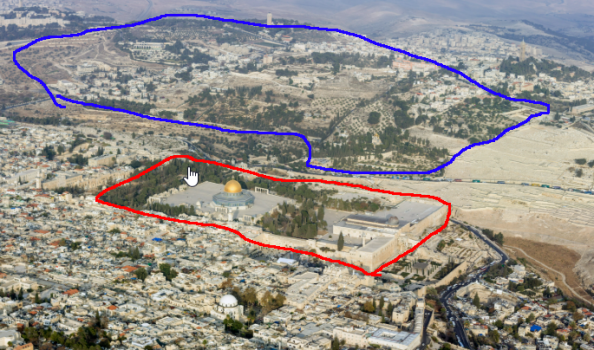
Temple Mount in RED. Mount of Olives in BLUE.
View attachment 83199

What's the joke?

The joke is your misunderstanding of the title of this thread. The OP is not saying that the temple is on the mount of Olives. The OP is saying, that while Jesus was on the mount of Olives after having left the temple grounds, He was not then still speaking of the temple of stone when He began answering the disciples questions in private. Apparently, you haven't read the OP nor any posts in this thread, otherwise you would already clearly know what the OP is meaning via the title of the thread. Not one person in this entire thread that has been participating in it even remotely thinks the OP is saying the temple is on the mount of Olives where Jesus began answering the disciples questions in private.
 

Spiritual Israelite

Well-Known Member
Apr 13, 2022
16,943
6,865
113
Midwest
Faith
Christian
Country
United States
Gender
Male
Out of curiosity, did you write all these things up yourself, or did you maybe get Chatgpt to help you write this? Nothing wrong with it if you did. The point being, even if one doesn't fully agree with everything, it is still easy to follow, and that Chatgpt is great for rewriting things in such a manner that pretty much anyone can follow, as opposed to my writing style, for instance. Mine literally sucks. And I admit it.
So, with that admission in mind, why do you get offended whenever I say that what you said is hard to follow?
 

CTK

Well-Known Member
Aug 13, 2024
1,515
315
83
72
Albuquerque
Faith
Christian
Country
United States
That’s a fair way of looking at it, but it might create another problem. If the prophecy can’t stop until it’s been fulfilled in full, then what about time itself? If we place a gap in between the weeks, we have essentially stopped (sealed) the prophecy, then unsealed it to start again for a future fulfillment of the final week or half week depending on your view.


Well, I tend to agree there should be only one time of trouble that is the greatest trouble ever. An issue happens when we consider Revelation 12 where Michael fights the dragon. It seems that this should be the time that Michael stands up in Daniel 12:1. However if that’s the case then the greatest trouble ever happened when Satan is cast out of heaven, and now is come salvation, and the kingdom of our God, and the power of his Christ.

So perhaps there is a greatest trouble ever in heaven and another on earth, or Michael takes a stand more than once, or maybe something else, IDK.

Something else to consider, who’s keeping track of the greatest trouble ever? So far there has to be a trouble that is the greatest ever, and when an even greater trouble happens we’ll replace the previous greatest trouble with the new one. Is there any kind of agreement among Christians what the greatest trouble so far is? If we can’t quantify that then we’re never going to know whether or not we’re in the greatest trouble ever if it is still future to us.
If you guys do not mind, please let me make a comment or two that may reveal another way to view chapter 9 and specifically the 70 years of weeks prophecy. And as with any analogy they all fail in one way or the other but I hope this makes some sense.


A Different Way to Understand the Seventy Weeks​

If you don’t mind, I’d like to suggest another way of looking at the seventy weeks prophecy in Daniel 9. Rather than working through every detail line by line, this is simply an attempt to step back and consider how the prophecy may be functioning as a whole.

The seventy weeks begin in 457 BC and unfold in a clear sequence. The first forty-nine years lead to the rebuilding of Jerusalem—its streets, walls, and Temple. This is followed by a longer period of four hundred thirty-four years, during which the people live in that restored city, studying the Scriptures and anticipating the coming of the Messiah. By the end of those 483 years, only seven years remain. Everything is moving toward completion.

Then, at that moment, the Messiah appears. Within three and a half years, He is rejected and crucified—“cut off,” as Daniel describes it. This becomes the turning point of the prophecy.

At first glance, this seems to interrupt what should have been a complete and unified fulfillment. But when we look more closely, we begin to see that two things are happening at the same time. On the one hand, the Messiah fulfills everything that was required of Him. The six purposes described in Daniel 9:24—dealing with sin, bringing reconciliation, establishing righteousness, and fulfilling prophecy—are accomplished through Him. From that perspective, nothing is lacking in His mission.

On the other hand, the prophecy is also given “for your people and your holy city.” And this is where the tension remains. The people do not receive Him. They reject the very One who fulfills the prophecy on their behalf. As a result, while the physical work to restore the Temple, the wall, etc., were completed, they still fell short of their requirements. This helps explain why the prophecy can appear both complete and yet unfinished at the same time.

This is where a broader framework may help bring clarity.

The seventy weeks can also be understood as aligning with what could be called the fourth and final Great Jubilee cycle—a 490-year period that likewise begins in 457 BC. In that sense, the timeline is not only about the Messiah’s mission, but also about the completion of a covenant cycle involving His people. But because the Messiah is rejected and crucified in the middle of the final week, this cycle does not reach its intended conclusion from the perspective of the people. The timeline reaches the midpoint of the final seven years, but the last three and a half years remain unresolved—not because the Messiah failed, but because His people did..

From this perspective, those remaining three and a half years are not assigned to the Messiah, nor to the broader Church, but to the people to whom the prophecy was originally given. His people, the Jews are the only ones capable of completing the 4th and final Great Jubilee cycle that began in 457 BC and was supposed to be completed the 70 weeks of years prophecy in 33/34 AD. This tells us there will / must come a time when that unfinished portion is finally completed.

Drawing from passages such as Epistle to the Romans 11, where a temporary blindness over Israel is described, and from Book of Revelation, where a defined period of testimony is given, it is possible to see a future moment when that blindness is removed. In that moment:
  • The people recognize the Messiah they once rejected
  • Their relationship with Him is restored
  • They take up a final role as witnesses
This period is often associated with the 1,260 days (or 3.5 years) described in Revelation, during which a faithful group—commonly identified as the 144,000—proclaims both the Word of God and the testimony of Jesus. Those final 3.5 years represent not a continuation of Christ’s unfinished work, but the completion of Israel’s unfinished response within the same prophetic framework.
Through that process:
  • The covenant relationship is restored
  • The final Jubilee cycle is completed
  • The prophetic structure reaches its intended conclusion
And only then does the narrative move to its final resolution—the return of the Messiah. God was crucified 3.5 years prior to the end of the final 7 years (last week of the prophecy), however, He fulfilled His God given mission (9:24) completely. His people, the Jews, as a result of their rejection and crucifixion of their Messiah would not. Immediately, the counting of the 4th Great Jubilee clock stopped, and God would "make desolate" His relationship with them for the next 2000 years (times of the Gentiles). Thus, the most "abominable" act in the history of mankind would cause God to turn away from His people. This is what is meant by the term AOD.

But Scripture tells us that God will never abandone His people ... He will restore His relationship with His people and after preaching the Good News with clarity and sincerity for the final 3.5 years, no different than what Paul had done, the Messiah will come.
 

Spiritual Israelite

Well-Known Member
Apr 13, 2022
16,943
6,865
113
Midwest
Faith
Christian
Country
United States
Gender
Male
That’s a fair way of looking at it, but it might create another problem. If the prophecy can’t stop until it’s been fulfilled in full, then what about time itself? If we place a gap in between the weeks, we have essentially stopped (sealed) the prophecy, then unsealed it to start again for a future fulfillment of the final week or half week depending on your view.


Well, I tend to agree there should be only one time of trouble that is the greatest trouble ever. An issue happens when we consider Revelation 12 where Michael fights the dragon. It seems that this should be the time that Michael stands up in Daniel 12:1. However if that’s the case then the greatest trouble ever happened when Satan is cast out of heaven, and now is come salvation, and the kingdom of our God, and the power of his Christ.

So perhaps there is a greatest trouble ever in heaven and another on earth, or Michael takes a stand more than once, or maybe something else, IDK.

Something else to consider, who’s keeping track of the greatest trouble ever? So far there has to be a trouble that is the greatest ever, and when an even greater trouble happens we’ll replace the previous greatest trouble with the new one. Is there any kind of agreement among Christians what the greatest trouble so far is? If we can’t quantify that then we’re never going to know whether or not we’re in the greatest trouble ever if it is still future to us.
When you look at what the text actually says, you can see that neither Daniel 12:1 nor Matthew 24:21 refer to a time of tribulation greater in scope than any time of tribulation before or after it. How can that even be possible in light of the flood in Noah's day? How can any tribulation be greater in scope than that, right?

Daniel 12:1 “At that time Michael shall stand up, The great prince who stands watch over the sons of your people; And there shall be a time of trouble, Such as never was since there was a nation, Even to that time. And at that time your people shall be delivered, Every one who is found written in the book.

Matthew 24:21 For then there will be great tribulation, such as has not been since the beginning of the world until this time, no, nor ever shall be.

I fully understand why people assume that these two verses are speaking of the same tribulation. But, I think it was a common figure of speech back then to say that a significant event was "such as has not been since the beginning of the world until this time, no, nor ever shall be.". That doesn't mean every time that figure of speech was used in relation to an event then it meant that it had to always refer to the same event.

And, again, neither verse refers to tribulation greater in scope than any tribulation before or after it. That's what people like @Davidpt think, but that is not the case. They both refer to tribulation that would be unlike any tribulation before or after it. So, a local great tribulation can be unlike any other tribulation that ever occurred anywhere before or since. The great tribulation in 70 AD can be described that way. There has never been a great tribulation like what happened in Judea and Jerusalem in 70 AD anywhere else before or since. So, I believe that is what Jesus was talking about in Matthew 24:21 and I know you agree.

But, I believe Daniel 12:1 has a different context. Based on what is written in Daniel 12:2, that tribulation will occur in conjunction with the resurrection of the dead and the resurrection of the dead has not yet occurred and will occur when Jesus returns in the future (1 Cor 15:22-23, 1 Thess 4:14-17, etc.). I know you disagree and you think Daniel 12:1 and Matthew 24:21 refer to the same tribulation that occurred in 70 AD, but what are your thoughts on what I'm saying about the verses not referring to the scope of great tribulation, but rather referring to tribulation unlike any other before or after?
 
  • Like
Reactions: grafted branch

CTK

Well-Known Member
Aug 13, 2024
1,515
315
83
72
Albuquerque
Faith
Christian
Country
United States
I appreciate the time it took to create your post, but I don't understand why you think the question, as recorded in Mark 13:4, has a different emphasis than the question, as recorded in Luke 21:7, when they are saying the same thing. There is no real difference between the question "What will be the sign when all these things are about to be fulfilled" and the question "What sign will there be when these things are about to take place". That is virtually the same question. And it's only one question. That's why I don't believe they asked three questions.
That’s a fair correction. I should clarify what I meant. I agree that Mark 13:4 and Luke 21:7 record essentially the same question. Both ask when “these things” will happen and what sign will indicate they are about to take place. So I am not saying Mark and Luke ask different questions. What I meant is that Mark and Luke record the question in a more compressed form, while Matthew preserves the broader wording by including “Your coming” and “the end of the age.”

The difference I was pointing to is not so much in the wording of Mark’s and Luke’s question, but in how Luke’s account later develops the answer. Luke includes the very concrete language about Jerusalem being surrounded by armies, which strongly points to the historical destruction of Jerusalem. Matthew and Mark preserve the Daniel language of the abomination of desolation.

So yes, Mark and Luke ask essentially the same thing. My point is simply that the Gospel accounts do not all develop the answer with the same level of detail or the same emphasis. Matthew gives the broader question, Mark gives a compressed version, and Luke makes the physical Jerusalem element especially clear.
You have the question about the sign of His coming (parousia) as a separate question from them asking about the sign of the end of the age. Does this mean that you don't believe that His parousia occurs at the end of the age? If so, I'd be curious as to how you interpret 1 Thessalonians 4:14-17.

I'm not seeing that at all. Where are you getting the idea that they are questioning the "meaning of the Messiah's role" from exactly?
Their question about “Your coming” shows they are trying to understand how Jesus’ role fits into what He just said. This is so confusing to them.
Sure, they are. I don't see any basis for this conclusion.
I agree that the disciples do ask a clearly structured question in Matthew 24:3. They are not speaking randomly or without order. The question itself is straightforward. What I was trying to suggest is not that their question is unclear, but that they may not fully distinguish how the events they are asking about relate to one another in time. They have just heard that the Temple will be destroyed, and in the same question they also ask about Your coming and the end of the age. That suggests they are linking these things together in their thinking, even if those events are not necessarily identical or occurring at the same moment. So I’m not saying their question is disorganized. I’m saying it reflects multiple concerns that they are treating as closely connected, which is why Jesus’ answer unfolds across different time horizons rather than staying within a single moment. There is definitely a weakness in providing a short brief comment in a bullet format... should not have collapsed things for brevity.
For you to separate the question about the sign of His coming and and of the end of the age into two questions makes me think that you don't think His coming (parousia) occurs at the end of the age and I strongly disagree with that.
I’m not separating Christ’s coming from the end of the age. My point is just that in Matthew 24:3, the disciples use two different phrases—“Your coming” and “the end of the age.” That shows they’re asking about more than one aspect, even if those aspects ultimately come together. So the real issue isn’t whether those events are connected. It’s whether everything in the passage should be limited to that one final moment. Since parts of Jesus’ answer clearly refer to things like the Temple’s destruction, it seems He is addressing more than one time frame, not just the end of the age.


Certainly apoligize for the confusion, I can see the way it was presented could indeed raise questions. Thanks again.