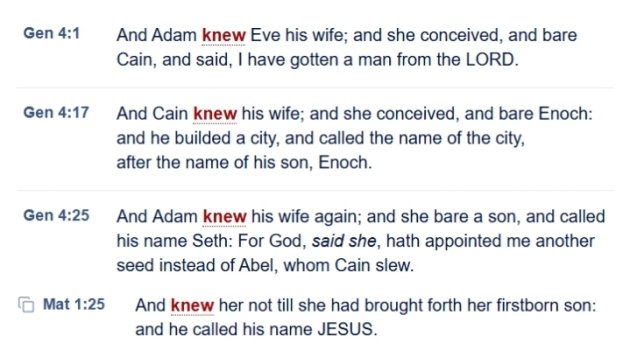
Quoting Matthew 1:25 repeatedly isn’t the same thing as showing that the text actually supports the conclusion you’re drawing from it. The New Testament wasn’t written in English, and ancient Greek terms don’t always map cleanly onto modern English words. That’s why simply repeating an English translation doesn’t resolve the question — anyone can quote a verse, but quoting alone doesn’t demonstrate what the verse
means.
It would be like quoting,
“Michal, the daughter of Saul, had no child until the day of her death,” and insisting the verse “clearly” means she started having children after she died. The English word
until doesn’t force a change afterward, and neither does the Greek
heos. That’s why I raised the linguistic and contextual issues — because those matter when interpreting an ancient text. Exegesis isn’t “twisting Scripture”; it’s simply paying attention to what the text actually says, in its own language, grammar, and narrative context. Ignoring those factors and relying only on an English gloss is not a method that can settle the question.
And Matthew’s narrative purpose in 1:18-25 is very specific: he is explaining the circumstances of Jesus’ conception and birth, why Joseph should not fear taking Mary as his wife, and how the virginal conception fulfills prophecy. In that context, Matthew uses
heos simply to mark the boundary that Joseph had no sexual involvement prior to the birth — so that the virginal conception he has just narrated remains theologically uncontested. The verse does not describe anything that happened afterward, which is why it cannot be used as proof of what did or didn’t occur later.
You’re free to hold your interpretation, but none of the points I raised about
heos, Matthew’s narrative purpose, or the fact that the verse doesn’t describe anything after the birth have been addressed. If your reading of the verse is sound, responding to those points should be straightforward.
Regarding your comment about Jesus’s “siblings”: that’s a different topic, which we’re currently discussing in the other thread. In that discussion, I already walked you through the Gospel evidence and the early Christian testimony about Jesus’s
adelphoi — including the fact that the Gospels explicitly identify Mary of Clopas/Cleophas as their mother, and that Koine Greek actually has distinct kinship terms (
anepsios for cousin,
syngenes/syngenis for relatives) even though Scripture often uses the broader term
adelphos the way the Septuagint does, to cover multiple kinds of kinship (see my post
#506 there). I'm still awaiting you to address those points, and if you decide to, please do so there so the conversation stays within forum rules.