So Joseph married Mary but didn’t have sex?

  • Welcome to Christian Forums, a Christian Forum that recognizes that all Christians are a work in progress.

    You will need to register to be able to join in fellowship with Christians all over the world.

    We hope to see you as a part of our community soon and God Bless!

Grailhunter

Well-Known Member
Jun 19, 2019
15,255
6,379
113
69
FARMINGTON
Faith
Christian
Country
United States
Gender
Male
Your comments on monogenes also do not address the point. The lexical definitions you quoted—“only one of its kind,” “unique,” “only legitimate child”—do not mean “sexually generated,” and you still have not produced a single instance where the New Testament uses monogenes to describe sexual reproduction. Matthew explicitly denies sexual conception in Jesus’ case, and appealing to “seed” language that Scripture never uses does not change the Greek or Matthew’s narrative.

Everything in the story line proves sexual reproduction. Again and again and again... The fact that it uses words like begotten, conceived ….impregnate….delivery of a baby that is defined as the Son of Yahweh, nails it. Don't make me repeat the obvious.
And Matthew does not deny sexual conception.
 

Moonwood

Member
Aug 24, 2026
134
42
28
Pacific Northwest
Faith
Christian
Country
United States
Gender
Female
I'm sorry. I thought you were claiming that Mary remained a virgin?

So then we are in agreement.
Mary did not remain a virgin.
Sorry for the misunderstanding.

God bless

Just to keep the discussion clear: you began by quoting Matthew 1:25 and saying, “Looks pretty clear to me,” as evidence that Joseph and Mary later had sexual relations. I addressed that specific claim directly — the semantics of heos, the narrative purpose of Matthew 1:18-25, and the fact that the verse does not describe anything after the birth. You dismissed those points as “excuses to protect the perpetual virginity dogma,” even though I haven’t made any claim about whether Mary remained a virgin. My only point has been that Matthew 1:25 doesn’t settle the question either way.

If you still believe Matthew 1:25 “clearly” teaches post‑birth intercourse, you’ll need to engage the linguistic and contextual evidence I raised. So far, that part of the conversation hasn’t been answered. And since your original statement was that Matthew 1:25 “looks pretty clear,” it’s reasonable to expect an actual textual argument showing that clarity — not just an assertion of it.
 

Grailhunter

Well-Known Member
Jun 19, 2019
15,255
6,379
113
69
FARMINGTON
Faith
Christian
Country
United States
Gender
Male
If you want to argue that Matthew 1:25 teaches post‑birth intercourse, you still need to show that from the text itself—Greek usage, narrative context, authorial intent. Simply asserting that the verse is “clear” or accusing me of defending a dogma doesn’t engage the linguistic or contextual evidence I presented. The meaning of heos is determined by how the term functions in Scripture and Koine Greek, not by what either of us believes about Mary’s later life.

Again and again and again and again, the scriptures are not going to go into sexual details. Yahweh produced a Son if it was not from His seed then Yeshua is not the Son of God. No scripture suggests that He was a created being. Yeshua calls Yahweh His Father over 50 times, not His creator. You are boring me now. I am going to start copying pasting or refer to previous posts.
 

Armour of God

Well-Known Member
Mar 6, 2026
1,712
1,122
113
47
Adelaide
Faith
Christian
Country
Australia
Gender
Male
Just to keep the discussion clear: you began by quoting Matthew 1:25 and saying, “Looks pretty clear to me,” as evidence that Joseph and Mary later had sexual relations. I addressed that specific claim directly — the semantics of heos, the narrative purpose of Matthew 1:18-25, and the fact that the verse does not describe anything after the birth. You dismissed those points as “excuses to protect the perpetual virginity dogma,” even though I haven’t made any claim about whether Mary remained a virgin. My only point has been that Matthew 1:25 doesn’t settle the question either way.

If you still believe Matthew 1:25 “clearly” teaches post‑birth intercourse, you’ll need to engage the linguistic and contextual evidence I raised. So far, that part of the conversation hasn’t been answered. And since your original statement was that Matthew 1:25 “looks pretty clear,” it’s reasonable to expect an actual textual argument showing that clarity — not just an assertion of it.
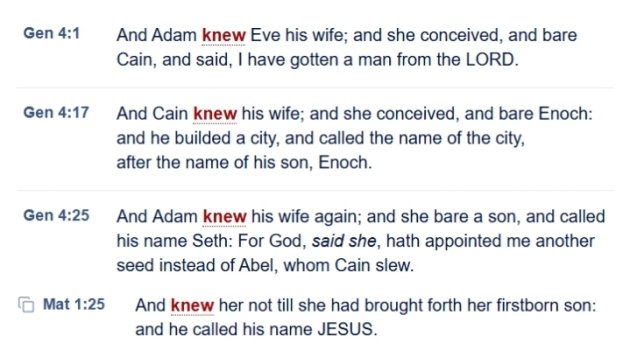
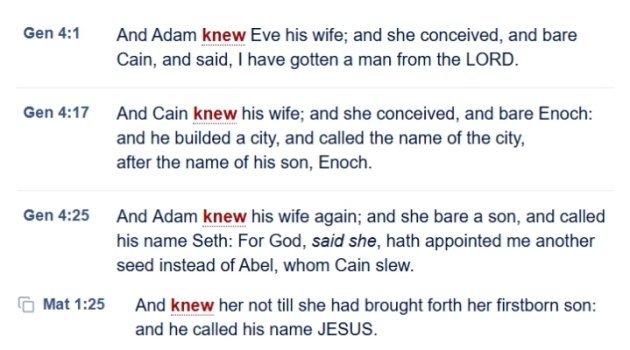
Screenshot_20260915-043857_Chrome.jpg
Your a confusing person to have a conversation with.

It seems that you don't believe that Matthew 1:25 is saying that that Mary and Joseph slept with eachother.

I believe it does.

But Joseph did not have sexual relations with her until her son was born. And he named him Jesus. - Matthew 1:25 ERV

Do you believe Mary remained a virgin her whole life?
 
Last edited:

Moonwood

Member
Aug 24, 2026
134
42
28
Pacific Northwest
Faith
Christian
Country
United States
Gender
Female
Don't expect for the scriptures to get into vivid detail on the sexual act. The fact that Yeshua is the Son of Yahweh pretty much tells it all. The fact that it uses words like begotten, conceived ….impregnate….delivery of a baby that is defined as the Son of Yahweh, nails it. Don't make me repeat the obvious.

Everything in the story line proves sexual reproduction. Again and again and again... The fact that it uses words like begotten, conceived ….impregnate….delivery of a baby that is defined as the Son of Yahweh, nails it. Don't make me repeat the obvious.
And Matthew does not deny sexual conception.

Again and again and again and again, the scriptures are not going to go into sexual details. Yahweh produced a Son if it was not from His seed then Yeshua is not the Son of God. No scripture suggests that He was a created being. Yeshua calls Yahweh His Father over 50 times, not His creator. You are boring me now. I am going to start copying pasting or refer to previous posts.

Your reply still doesn’t engage the actual wording of the passages. You keep asserting that “Son of God” must mean sexual reproduction, but Scripture never says that, and Matthew explicitly denies it. Matthew 1:18 states that Mary was found with child while She was still only betrothed to Joseph, and 1:20 says the child was conceived “of the Holy Spirit.” Those are direct statements about the origin of the conception, not “vivid sexual details,” and they contradict your claim that Matthew does not deny sexual conception. You have not explained how your view can stand alongside Matthew’s explicit wording.

Appealing to terms like “begotten,” “conceived,” or “impregnate” does not help your argument, because none of those words imply sexual reproduction when the text itself identifies the agent as the Holy Spirit. You still have not produced a single instance where monogenes means “sexually generated,” and repeating that it is “obvious” does not substitute for evidence. Likewise, your claim about “seed” is something you are importing into the text; Scripture never uses that language for Jesus’ conception.

Your argument also ignores the hermeneutics Matthew himself uses. Matthew identifies Isaiah 7:14 as finding its fulfillment in Christ, following standard Second‑Temple typology. That is Matthew’s own interpretive move, not “cherry picking.” And your attempt to equate the prophetess of Isaiah 8:3 with the ‘almah of Isaiah 7:14 has no textual support; the passages never identify them, and the Septuagint translators—long before Christianity—rendered ‘almah as parthenos, “virgin.”

Finally, repeating that “Scripture won’t go into sexual details” does not answer the linguistic point about heos. The phrase “he did not know Her until She had borne a Son” marks the boundary relevant to Matthew’s claim that Joseph had no role in the conception. It does not imply a change afterward, just as "Michal, the daughter of Saul, had no child until the day of her death" does not imply she began bearing children after she died. Matthew’s concern is the divine origin of Jesus, not the scenario you keep insisting on.

None of your replies have addressed these textual issues. You are asserting a mechanism Scripture never states and ignoring the passages that contradict your claim.
 
Last edited:

Moonwood

Member
Aug 24, 2026
134
42
28
Pacific Northwest
Faith
Christian
Country
United States
Gender
Female
View attachment 89960
Your a confusing person to have a conversation with.

It seems that you don't believe that Matthew 1:25 is saying that that Mary and Joseph slept with eachother.

I believe it does.

But Joseph did not have sexual relations with her until her son was born. And he named him Jesus. - Matthew 1:25 ERV

Do you believe Mary remained a virgin her whole life?

I’m not confused; I’m just keeping the discussion on the claim you started with. You quoted Matthew 1:25 and said, “Looks pretty clear to me,” as evidence that Joseph and Mary later had sexual relations. My responses have addressed that specific claim — the Greek heos, Matthew’s narrative purpose, and the fact that the verse does not describe anything after the birth.

Whether Mary remained a virgin Her whole life is a different theological question, and it’s outside the scope of this thread. I haven’t taken any position on that here; I’ve only pointed out that Matthew 1:25 doesn’t settle the question either way.

If you still believe Matthew 1:25 “clearly” teaches post‑birth intercourse, then the next step is to show that from the text itself. So far, the linguistic and contextual points I raised about heos and Matthew’s purpose haven’t been addressed.
 

Armour of God

Well-Known Member
Mar 6, 2026
1,712
1,122
113
47
Adelaide
Faith
Christian
Country
Australia
Gender
Male
I’m not confused; I’m just keeping the discussion on the claim you started with. You quoted Matthew 1:25 and said, “Looks pretty clear to me,” as evidence that Joseph and Mary later had sexual relations. My responses have addressed that specific claim — the Greek heos, Matthew’s narrative purpose, and the fact that the verse does not describe anything after the birth.

Whether Mary remained a virgin Her whole life is a different theological question, and it’s outside the scope of this thread. I haven’t taken any position on that here; I’ve only pointed out that Matthew 1:25 doesn’t settle the question either way.

If you still believe Matthew 1:25 “clearly” teaches post‑birth intercourse, then the next step is to show that from the text itself. So far, the linguistic and contextual points I raised about heos and Matthew’s purpose haven’t been addressed.

I've shown you what the texts say.
If you disagree that's fine.
I don't really care
 

Moonwood

Member
Aug 24, 2026
134
42
28
Pacific Northwest
Faith
Christian
Country
United States
Gender
Female
I've shown you what the texts say.
If you disagree that's fine.
I don't really care

Clearly we disagree — that’s why the discussion has continued. But you were the one who quoted Matthew 1:25 and said, “Looks pretty clear to me,” as evidence that Joseph and Mary later had sexual relations. I quoted the same verse and then explained why that conclusion doesn’t follow from the Greek heos, from Matthew’s narrative purpose, or from the fact that the verse doesn’t describe anything after the birth.

Simply repeating the verse isn’t an argument — anyone can quote a passage. What matters is showing that the text actually supports the conclusion you’re drawing from it. That’s the part I’ve been addressing.

If you’re satisfied with your interpretation, that’s fine — but the linguistic and contextual points I raised still haven’t been addressed. If your reading of the verse is sound, responding to those points should be straightforward.
 

Armour of God

Well-Known Member
Mar 6, 2026
1,712
1,122
113
47
Adelaide
Faith
Christian
Country
Australia
Gender
Male
Clearly we disagree — that’s why the discussion has continued. But you were the one who quoted Matthew 1:25 and said, “Looks pretty clear to me,” as evidence that Joseph and Mary later had sexual relations. I quoted the same verse and then explained why that conclusion doesn’t follow from the Greek heos, from Matthew’s narrative purpose, or from the fact that the verse doesn’t describe anything after the birth.

Simply repeating the verse isn’t an argument — anyone can quote a passage. What matters is showing that the text actually supports the conclusion you’re drawing from it. That’s the part I’ve been addressing.

If you’re satisfied with your interpretation, that’s fine — but the linguistic and contextual points I raised still haven’t been addressed. If your reading of the verse is sound, responding to those points should be straightforward.

Your just full of lame excuses to what is clearly stated.

But Joseph did not have sexual relations with her until her son was born. And he named him Jesus. - Matthew 1:25 ERV

That tells me that they had sexual relations after Jesus was born

Screenshot_20260915-043857_Chrome.jpg

This also tells me they had sexual relations after Jesus was born regardless of your twisting of scripture.

Maybe your right.
Maybe Mary was a bad wife and didn't submit to Joseph.
Maybe that's why we don't read about Joseph after Jesus age 12.
Maybe Joseph divorced her because of that.

I would be bitterly disappointed if i married a woman and she refused to have sex with me. I would divorce her.

But for me, it looks most probable that Mary and Joseph had children together.
Not only that Mat 1:25 but several other verses where Jesus is said to have siblings, not cousins as there is another Greek word for that that gets used in the NT.
 
Last edited:

Grailhunter

Well-Known Member
Jun 19, 2019
15,255
6,379
113
69
FARMINGTON
Faith
Christian
Country
United States
Gender
Male
Your reply still doesn’t engage the actual wording of the passages. You keep asserting that “Son of God” must mean sexual reproduction, but Scripture never says that, and Matthew explicitly denies it. Matthew 1:18 states that Mary was found with child while She was still only betrothed to Joseph, and 1:20 says the child was conceived “of the Holy Spirit.” Those are direct statements about the origin of the conception, not “vivid sexual details,” and they contradict your claim that Matthew does not deny sexual conception. You have not explained how your view can stand alongside Matthew’s explicit wording.

That is right. The scriptures are not going to say "Yahweh impregnated Miriam without having sex" Because He did have sex with Miriam.
And it does not use words like miraculously Impregnated or miraculously manifested or that He had Scotty beam Yeshua aboard Miriam.

What it does say are words like begotten, conceived ….impregnate….delivery of a baby that is defined as the Son of Yahweh. And Yeshua calls Him Father over 50 times in the Gospel. Yeshua does not call Yahweh His creator. Except for the fact that Yahweh was involved, Miriam's impregnation was normal.

And again and again and again and again. The scriptures say that the Holy Spirit was involved but they do not say that Yeshua is the Son of the Holy Spirit.

Matthew 1:18 states that Mary was found with child while She was still only betrothed to Joseph. So what?? So she was already pregnant from Yehweh. Nothing here to support that Yahweh did not have sex with Miriam.
 

Grailhunter

Well-Known Member
Jun 19, 2019
15,255
6,379
113
69
FARMINGTON
Faith
Christian
Country
United States
Gender
Male
Your argument also ignores the hermeneutics Matthew himself uses. Matthew identifies Isaiah 7:14 as finding its fulfillment in Christ, following standard Second‑Temple typology. That is Matthew’s own interpretive move, not “cherry picking.” And your attempt to equate the prophetess of Isaiah 8:3 with the ‘almah of Isaiah 7:14 has no textual support; the passages never identify them, and the Septuagint translators—long before Christianity—rendered ‘almah as parthenos, “virgin.”

I read the scriptures and the prophetess was Isaiah's wife and he had sex with her and she had a baby. No surprise. Whatever her condition was she had sex with her husband and she had a baby. Nothing to be called a prophecy. The only thing the storyline has a connection with Yeshua is that their names were similar. The prophetess' son was not a God.
 

Grailhunter

Well-Known Member
Jun 19, 2019
15,255
6,379
113
69
FARMINGTON
Faith
Christian
Country
United States
Gender
Male
Your reply still doesn’t engage the actual wording of the passages. You keep asserting that “Son of God” must mean sexual reproduction, but Scripture never says that, and Matthew explicitly denies it. Matthew 1:18 states that Mary was found with child while She was still only betrothed to Joseph, and 1:20 says the child was conceived “of the Holy Spirit.” Those are direct statements about the origin of the conception, not “vivid sexual details,” and they contradict your claim that Matthew does not deny sexual conception. You have not explained how your view can stand alongside Matthew’s explicit wording.

Appealing to terms like “begotten,” “conceived,” or “impregnate” does not help your argument, because none of those words imply sexual reproduction when the text itself identifies the agent as the Holy Spirit. You still have not produced a single instance where monogenes means “sexually generated,” and repeating that it is “obvious” does not substitute for evidence. Likewise, your claim about “seed” is something you are importing into the text; Scripture never uses that language for Jesus’ conception.

Your argument also ignores the hermeneutics Matthew himself uses. Matthew identifies Isaiah 7:14 as finding its fulfillment in Christ, following standard Second‑Temple typology. That is Matthew’s own interpretive move, not “cherry picking.” And your attempt to equate the prophetess of Isaiah 8:3 with the ‘almah of Isaiah 7:14 has no textual support; the passages never identify them, and the Septuagint translators—long before Christianity—rendered ‘almah as parthenos, “virgin.”

Finally, repeating that “Scripture won’t go into sexual details” does not answer the linguistic point about heos. The phrase “he did not know Her until She had borne a Son” marks the boundary relevant to Matthew’s claim that Joseph had no role in the conception. It does not imply a change afterward, just as "Michal, the daughter of Saul, had no child until the day of her death" does not imply she began bearing children after she died. Matthew’s concern is the divine origin of Jesus, not the scenario you keep insisting on.

None of your replies have addressed these textual issues. You are asserting a mechanism Scripture never states and ignoring the passages that contradict your claim.

I have addressed them several times.
 

Moonwood

Member
Aug 24, 2026
134
42
28
Pacific Northwest
Faith
Christian
Country
United States
Gender
Female
Your just full of lame excuses to what is clearly stated.

But Joseph did not have sexual relations with her until her son was born. And he named him Jesus. - Matthew 1:25 ERV

That tells me that they had sexual relations after Jesus was born

View attachment 89964

This also tells me they had sexual relations after Jesus was born regardless of your twisting of scripture.

Maybe your right.
Maybe Mary was a bad wife and didn't submit to Joseph.
Maybe that's why we don't read about Joseph after Jesus age 12.
Maybe Joseph divorced her because of that.

I would be bitterly disappointed if i married a woman and she refused to have sex with me. I would divorce her.

But for me, it looks most probable that Mary and Joseph had children together.
Not only that Mat 1:25 but several other verses where Jesus is said to have siblings, not cousins as there is another Greek word for that that gets used in the NT.

Quoting Matthew 1:25 repeatedly isn’t the same thing as showing that the text actually supports the conclusion you’re drawing from it. The New Testament wasn’t written in English, and ancient Greek terms don’t always map cleanly onto modern English words. That’s why simply repeating an English translation doesn’t resolve the question — anyone can quote a verse, but quoting alone doesn’t demonstrate what the verse means.

It would be like quoting, “Michal, the daughter of Saul, had no child until the day of her death,” and insisting the verse “clearly” means she started having children after she died. The English word until doesn’t force a change afterward, and neither does the Greek heos. That’s why I raised the linguistic and contextual issues — because those matter when interpreting an ancient text. Exegesis isn’t “twisting Scripture”; it’s simply paying attention to what the text actually says, in its own language, grammar, and narrative context. Ignoring those factors and relying only on an English gloss is not a method that can settle the question.

And Matthew’s narrative purpose in 1:18-25 is very specific: he is explaining the circumstances of Jesus’ conception and birth, why Joseph should not fear taking Mary as his wife, and how the virginal conception fulfills prophecy. In that context, Matthew uses heos simply to mark the boundary that Joseph had no sexual involvement prior to the birth — so that the virginal conception he has just narrated remains theologically uncontested. The verse does not describe anything that happened afterward, which is why it cannot be used as proof of what did or didn’t occur later.

You’re free to hold your interpretation, but none of the points I raised about heos, Matthew’s narrative purpose, or the fact that the verse doesn’t describe anything after the birth have been addressed. If your reading of the verse is sound, responding to those points should be straightforward.

Regarding your comment about Jesus’s “siblings”: that’s a different topic, which we’re currently discussing in the other thread. In that discussion, I already walked you through the Gospel evidence and the early Christian testimony about Jesus’s adelphoi — including the fact that the Gospels explicitly identify Mary of Clopas/Cleophas as their mother, and that Koine Greek actually has distinct kinship terms (anepsios for cousin, syngenes/syngenis for relatives) even though Scripture often uses the broader term adelphos the way the Septuagint does, to cover multiple kinds of kinship (see my post #506 there). I'm still awaiting you to address those points, and if you decide to, please do so in that thread so the conversation stays within forum rules.
 
Last edited:

Grailhunter

Well-Known Member
Jun 19, 2019
15,255
6,379
113
69
FARMINGTON
Faith
Christian
Country
United States
Gender
Male
Quoting Matthew 1:25 repeatedly isn’t the same thing as showing that the text actually supports the conclusion you’re drawing from it. The New Testament wasn’t written in English, and ancient Greek terms don’t always map cleanly onto modern English words. That’s why simply repeating an English translation doesn’t resolve the question — anyone can quote a verse, but quoting alone doesn’t demonstrate what the verse means.

It would be like quoting, “Michal, the daughter of Saul, had no child until the day of her death,” and insisting the verse “clearly” means she started having children after she died. The English word until doesn’t force a change afterward, and neither does the Greek heos. That’s why I raised the linguistic and contextual issues — because those matter when interpreting an ancient text. Exegesis isn’t “twisting Scripture”; it’s simply paying attention to what the text actually says, in its own language, grammar, and narrative context. Ignoring those factors and relying only on an English gloss is not a method that can settle the question.

And Matthew’s narrative purpose in 1:18-25 is very specific: he is explaining the circumstances of Jesus’ conception and birth, why Joseph should not fear taking Mary as his wife, and how the virginal conception fulfills prophecy. In that context, Matthew uses heos simply to mark the boundary that Joseph had no sexual involvement prior to the birth — so that the virginal conception he has just narrated remains theologically uncontested. The verse does not describe anything that happened afterward, which is why it cannot be used as proof of what did or didn’t occur later.

You’re free to hold your interpretation, but none of the points I raised about heos, Matthew’s narrative purpose, or the fact that the verse doesn’t describe anything after the birth have been addressed. If your reading of the verse is sound, responding to those points should be straightforward.

Regarding your comment about Jesus’s “siblings”: that’s a different topic, which we’re currently discussing in the other thread. In that discussion, I already walked you through the Gospel evidence and the early Christian testimony about Jesus’s adelphoi — including the fact that the Gospels explicitly identify Mary of Clopas/Cleophas as their mother, and that Koine Greek actually has distinct kinship terms (anepsios for cousin, syngenes/syngenis for relatives) even though Scripture often uses the broader term adelphos the way the Septuagint does, to cover multiple kinds of kinship (see my post #506 there). I'm still awaiting you to address those points, and if you decide to, please do so there so the conversation stays within forum rules.


I think he has addressed them and I have addressed them. The fact remains that after conceiving a baby from Yahweh, Miriam is not identified as a virgin. The only thing that Chapter 7 of Isaiah has in common with the New Testament is, that both women had sex and they both had a baby.
 

Moonwood

Member
Aug 24, 2026
134
42
28
Pacific Northwest
Faith
Christian
Country
United States
Gender
Female
That is right. The scriptures are not going to say "Yahweh impregnated Miriam without having sex" Because He did have sex with Miriam.
And it does not use words like miraculously Impregnated or miraculously manifested or that He had Scotty beam Yeshua aboard Miriam.

What it does say are words like begotten, conceived ….impregnate….delivery of a baby that is defined as the Son of Yahweh. And Yeshua calls Him Father over 50 times in the Gospel. Yeshua does not call Yahweh His creator. Except for the fact that Yahweh was involved, Miriam's impregnation was normal.

And again and again and again and again. The scriptures say that the Holy Spirit was involved but they do not say that Yeshua is the Son of the Holy Spirit.

Matthew 1:18 states that Mary was found with child while She was still only betrothed to Joseph. So what?? So she was already pregnant from Yehweh. Nothing here to support that Yahweh did not have sex with Miriam.

I read the scriptures and the prophetess was Isaiah's wife and he had sex with her and she had a baby. No surprise. Whatever her condition was she had sex with her husband and she had a baby. Nothing to be called a prophecy. The only thing the storyline has a connection with Yeshua is that their names were similar. The prophetess' son was not a God.

I have addressed them several times.

This phrase only means that Joseph did not have sex with her until after Yeshua was born.
But I am curious, what do you think it means?

Your reply still does not resolve the contradiction at the center of your argument. You are now claiming that Yahweh had literal sexual intercourse with Mary, while also claiming that Matthew 1:20 — “that which is conceived in Her is of the Holy Spirit” — does not deny sexual conception. But Matthew explicitly identifies the Holy Spirit as the agent of the conception. If the conception is “of the Holy Spirit,” then it is not the result of a sexual act involving a male. You have not explained how your claim that Yahweh physically impregnated Mary can stand alongside Matthew’s explicit statement that the conception was by the Spirit.

Repeating words like “begotten,” “conceived,” or “impregnate” does not help, because none of those terms imply sexual reproduction when the text itself gives the cause of the conception. You still have not produced a single instance where monogenes means “sexually generated,” and simply asserting that it is “obvious” is not evidence. Likewise, your appeal to “seed” is something you are importing into the text; Scripture never uses that language for Jesus’ conception.

Your comments on Isaiah also do not address Matthew’s hermeneutics. Matthew himself identifies Isaiah 7:14 as finding its fulfillment in Christ, following standard Second‑Temple typology. The prophetess of Isaiah 8:3 is never identified with the ‘almah of Isaiah 7:14, and the Septuagint translators — long before Christianity — rendered ‘almah as parthenos, “virgin.” Your argument does not engage the actual textual data.

Finally, your reply about heos does not address the linguistic point. The phrase “he did not know Her until She had borne a Son” marks the boundary relevant to Matthew’s claim that Joseph had no role in the conception. It does not imply a change afterward, just as “Michal, daughter of Saul, had no child until the day of her death” does not imply she began bearing children after she died. Simply repeating that “Scripture won’t go into sexual details” or saying you have “addressed this several times” does not engage that argument. Matthew’s concern is the divine origin of Jesus, not the scenario you keep insisting on.

None of your replies have addressed these textual issues. You are asserting a mechanism Scripture never states, denying the passages that contradict your claim, and replacing Matthew’s explanation with your own.
 

Grailhunter

Well-Known Member
Jun 19, 2019
15,255
6,379
113
69
FARMINGTON
Faith
Christian
Country
United States
Gender
Male
Your reply still does not resolve the contradiction at the center of your argument. You are now claiming that Yahweh had literal sexual intercourse with Mary, while also claiming that Matthew 1:20 — “that which is conceived in Her is of the Holy Spirit” — does not deny sexual conception. But Matthew explicitly identifies the Holy Spirit as the agent of the conception. If the conception is “of the Holy Spirit,” then it is not the result of a sexual act involving a male. You have not explained how your claim that Yahweh physically impregnated Mary can stand alongside Matthew’s explicit statement that the conception was by the Spirit.

LOL Do you believe that Yeshua is not the Son of Yahweh?
Does Yeshua ever identify Himself as the Son of the Holy Spirit?
I did show that Yahweh is the Father of Yeshua and all the associated words.
And you can call them all spirits.
 

Grailhunter

Well-Known Member
Jun 19, 2019
15,255
6,379
113
69
FARMINGTON
Faith
Christian
Country
United States
Gender
Male
Repeating words like “begotten,” “conceived,” or “impregnate” does not help, because none of those terms imply sexual reproduction when the text itself gives the cause of the conception.

Boy you have got to be kidding! Basic understanding of the word imply sexual intercourse. LOL
 

Grailhunter

Well-Known Member
Jun 19, 2019
15,255
6,379
113
69
FARMINGTON
Faith
Christian
Country
United States
Gender
Male
Your comments on Isaiah also do not address Matthew’s hermeneutics. Matthew himself identifies Isaiah 7:14 as finding its fulfillment in Christ, following standard Second‑Temple typology. The prophetess of Isaiah 8:3 is never identified with the ‘almah of Isaiah 7:14, and the Septuagint translators — long before Christianity — rendered ‘almah as parthenos, “virgin.” Your argument does not engage the actual textual data.

If you want to draw me into a discussion of the various words for virgin. That is quite the topic they have been debating the terms for virginity for a long time.....no one wins and the full topic is to explicit for this forum.
And here is a thought.....The Septuagint calls Danah a παρθένος (parthenos) after she was raped.
 

Grailhunter

Well-Known Member
Jun 19, 2019
15,255
6,379
113
69
FARMINGTON
Faith
Christian
Country
United States
Gender
Male
Finally, your reply about heos does not address the linguistic point. The phrase “he did not know Her until She had borne a Son” marks the boundary relevant to Matthew’s claim that Joseph had no role in the conception. It does not imply a change afterward, just as “Michal, daughter of Saul, had no child until the day of her death” does not imply she began bearing children after she died. Simply repeating that “Scripture won’t go into sexual details” or saying you have “addressed this several times” does not engage that argument. Matthew’s concern is the divine origin of Jesus, not the scenario you keep insisting on.

I am not sure what you are trying to imply? Joseph had no part in Yeshua's conception and Michal died before she could have children. Scriptures won't go into sexual details is just stating the facts. Every word connected to procreation is used. That is good enough for me.