
A Vatican John 1:1 Hebrew Text

  • Welcome to Christian Forums, a Christian Forum that recognizes that all Christians are a work in progress.

    You will need to register to be able to join in fellowship with Christians all over the world.

    We hope to see you as a part of our community soon and God Bless!

dak

Well-Known Member
Feb 9, 2013
1,622
223
63
Chrestianos
sites.google.com
Faith
Other Faith
Country
United States
Gender
Male
This thread is an offshoot from another thread which I have decided to bring here to its own new thread because the OP of the original thread is now asking for his thread to be closed. As one may see, it is a running thread within a thread that I have not had the time and opportunity to complete there in that other thread. So I started last night moving the information from there into this new thread before I lost the ability to quote the posts because that thread might be closed. That process is done now, as of reply #7 below in this page, and all of the quotes that were in this OP are now cohesively meshed into this thread.

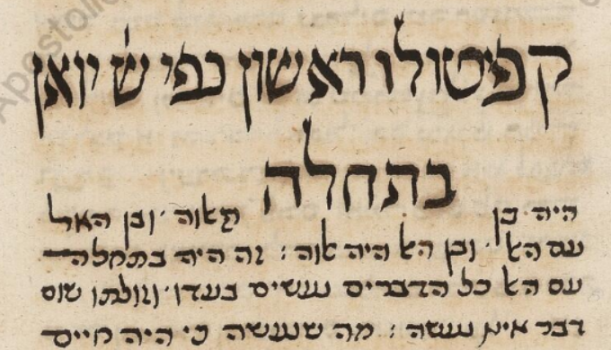
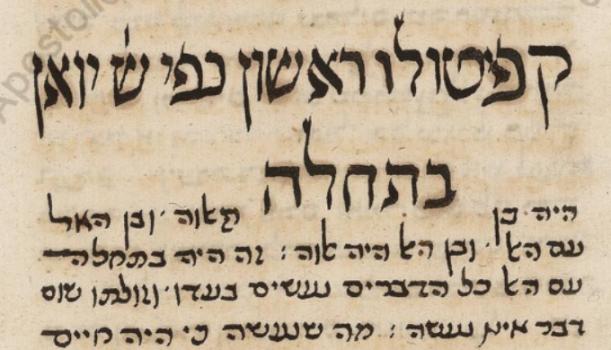
An image file of the Hebrew text in question:
000000_mss_vat_ebr_100_238.png

In this text the scribe is sometimes, (but not always), using a ligature for both El and Eloah: it looks like a C with a partial Lamed attached to it, something like this, lc, (but connected at the bottom). He is also using an unconventional, (non-Masoretic), upper accent as punctuation, either a comma, a semi-colon, or a colon. The lower accent beneath the letter hei in haEloah is called a tipḥa. The tipḥa is a disjunctive cantillation accent, so it can mark a phrase boundary and help show how the words group: it marks a break at its position, and the surrounding accents or punctuation help determine the larger grouping. There is a break signified with the first hei in the first occurrence of haEloah, and there is a comma immediately following that same word. It is singled out like so: "In the commencement was the Son, the Eloah,"... It does not say the Son of Eloah but calls the Son the Eloah, (which is not emphatic), like as if it is mentioning a place where it is previously written in a well known text, (such as possibly Ruakh Eloah in Gen 1:2, if perhaps that is what was originally in that text).

The above Hebrew text of John 1:1 in the square Assuri (Assyrian) script:

בתחלה היה בן ה֖אלוה ´ ובן האל עם האל ´ ובן האל היה אלוה׃​

You may find much more information about this text online at the link below, including a full rendering of the whole Gospel account, which is free to download, and an introductory section with the owner of the site's reading of the first verse, John 1:1 on video, (which I will also post below). However, be aware that his rendering appears to be that of a Oneness or Oneness Pentecostal believer, and that bias shows up even in this very first verse of the account, John 1:1. It also renders the statement illogical because he appears to entirely ignore the tipḥa accent mentioned above.

.
 
Last edited:

MonoBiblical

Well-Known Member
Apr 18, 2024
1,709
266
83
52
midwest
Faith
Christian
Country
United States
@dak You have 2 Hebrew versions of Matthew which are not even close to the original. I think you should improve your Koine Greek skill, if you have any.
 

dak

Well-Known Member
Feb 9, 2013
1,622
223
63
Chrestianos
sites.google.com
Faith
Other Faith
Country
United States
Gender
Male
@dak You have 2 Hebrew versions of Matthew which are not even close to the original.

Matthew???

Clue #2 — G4314 πρὸς -vs- H5973 עם, (for example, study the 2Chr 24:4 Hebrew text).

Reply Part 1 — critical portions from the BDAG entry for G4314 πρός

The entry is too large to even fit in one full post, (over 10,000 characters).
The full entry may be seen at the link below.

BDAG πρός
πρός prep. expressing direction ‘on the side of’, ‘in the direction of’: w. gen. ‘from’, dat. ‘at’, or acc. (the most freq. usage in our lit.) ‘to’ (s. the lit. s.v. ἀνά. beg.) (Hom.+).
<snip>

In the accusative case or context πρός is to be understood as to/unto/toward.

ε. of saying, speaking; s. ἀποκρίνομαι 1, also δημηγορέω Ac 12:21, εἶπον 1a, λαλέω 2aγ and 2b, λέγω 1bγ et al. Hebraistically λαλεῖν στόμα πρὸς στόμα speak face to face (Jer 39:4; ApcEsdr 6:6 p. 31, 10 Tdf.) 2J 12b; 3J 14 (cp. PGM 1, 39 τὸ στόμα πρὸς τὸ στόμα). πρὸς ἀλλήλους to one another, with each other, among themselves: s. ἀντιβάλλω, διαλαλέω, also διαλέγομαι Mk 9:34, διαλογίζομαι 8:16; Lk 20:14, εἶπον 24:32; J 16:17; 19:24, λαλέω, λέγω et al. πρὸς ἑαυτούς to themselves, to each other: s. διαλογίζομαι 1; εἶπον Mk 12:7; J 7:35; λέγω (Ps.-Callisth. 2, 15, 7 πρὸς ἑαυτὸν ἔλεγεν; Just., D. 62, 2) Mk 10:26; 16:3. διαθήκην ὁ θεὸς διέθετο πρὸς τοὺς πατέρας ὑμῶν, λέγων πρὸς Ἀβραάμ God made a covenant with your fathers, when he said to Abraham Ac 3:25 (διατίθημι 1). ὅρκον ὀμνύναι πρ. τινα (ὀμνύω, end) Lk 1:73. ζ. of asking, praying δέομαι Ac 8:24. εὔχομαι (s. εὔχομαι 1; cp. 2 Macc 9:13) 2 Cor 13:7. προσεύχομαι (cp. 1 Km 12:19; 2 Esdr 12: 4; 2 Macc 2:10) Hv 1, 1, 9. γνωρίζεσθαι πρὸς τὸν θεόν Phil 4:6 (γνωρίζω 1).
<snip>

In the context of speaking πρός is to be understood as mouth to mouth, or more correctly, face to face.


ⓖ by, at, near πρός τινα εἶναι be (in company) with someone Mt 13:56; Mk 6:3; 9:19a; 14:49; Lk 9:41; J 1:1f; 1 Th 3:4; 2 Th 2:5; 3:10; 1J 1:2.
<snip>
Arndt, W., Danker, F. W., & Bauer, W. (2000). A Greek-English lexicon of the New Testament and other early Christian literature (3rd ed., pp. 873–875). Chicago: University of Chicago Press.

In John 1:1 πρός is therefore to be understood as "(in company) with". However the other things previously stated are also involved, for not even "in company with" allows for the subject, ho Logos, to be within or inside the object, ton Theon, (acc. case). So "in company with" means together but separate individuals, yet also, positionally, face to face: the subject, ho Logos, facing to/unto/toward the object, ton Theon, the one facing the one, as Thayer also states, but more correctly the one facing the other, or the two facing each other.

Part 2 — Thayer says the same as BDAG

Thayer's Greek Lexicon
STRONGS NT 4314: πρός

<snip>

2. it is used of close proximity — the idea of direction, though not entirely lost, being more or less weakened;

a. answering to our at or by (German an); after verbs of fastening, adhering, moving (to): δεδέσθαι πρός τήν θύραν, Mark 11:4; προσκολλᾶσθαι, Mark 10:7 R G Tr (in marginal reading brackets); Ephesians 5:31 R G WH text; προσκόπτειν, Matthew 4:6; Luke 4:11; κεῖσθαι, equivalent to to be brought near to, Matthew 3:10; Luke 3:9 ((cf. 2 Macc. 4:33)); τιθέναι, Acts 3:2; (Acts 4:37 Tdf. (others παρά)); add, βεβλησθαι, Luke 16:20; τά πρός τήν θύραν, the forecourt (see θύρα, a.), Mark 2:2; εἶναι πρός τήν θάλασσαν (properly, toward the sea (A. V. by the sea)), Mark 4:1; θερμαίνεσθαι πρός τό φῶς, turned to the light (R. V. in the light), Mark 14:54; καθῆσθαι πρός τό φῶς, Luke 22:56; πρός τό μνημεῖον, John 20:11 Rec.; cf. Fritzsche on Mark, p. 201f
b. equivalent to (Latinapud) with, with the accusative of a person, after verbs of remaining, dwelling, tarrying, etc. (which require one to be conceived of as always turned toward one), cf. Fritzsche as above: after εἶναι, Matthew 13:56; Mark 6:3; Mark 9:19; Mark 14:49; Luke 9:41; John 1:1; 1 John 1:2; 1 Thessalonians 3:4; 2 Thessalonians 2:5; 2 Thessalonians 3:10;

"which require one to be conceived of as always turned toward one", in other words, the subject, ho Logos, is to be conceived as always turned toward the object, ton Theon, (face to face). Movement is not mentioned in either of the lexicons pertaining to John 1:1.

Take heed:

Exodus 20:3

לא יהיה־לך אלהים אחרים על־פני׃
You shall have no other elohim to/against My face.

Moreover "to/against My face", (face to face), is an idiom meaning on the same level as Me or equal to Me. The Trinitarian version now found in the Greek text of John 1:1 was interpreted into an erroneous Greek translation from an original Hebrew text, and four of that Hebrew line of transmission have now been found. So to finish, where again did the translator or translators go wrong in John 1:1? It was their choice of G4314 πρὸς, which instead should have been something more like G3326 μετά, (properly, in the midst of, amid, with, within, denoting association, union, accompaniment), and if they had guessed correctly, (darn the luck), there would not be any problem with the opening statement, John 1:1. But why did they choose incorrectly? because of an unregenerated Greco-Roman natural mindset, which by nature and culture sees God, or a god, or gods, in extremely limited anthropomorphic imagery, which has nothing to do with the Almighty Elohim and Father of the Hebrews, whose Word in Exodus 20:3, which they utterly ignored, now refutes them to their own faces.

.
 
Last edited:

MonoBiblical

Well-Known Member
Apr 18, 2024
1,709
266
83
52
midwest
Faith
Christian
Country
United States
Matthew???

Reply Part 1 — critical portions from the BDAG entry for G4314 πρός

The entry is too large to even fit in one full post, (over 10,000 characters).
The full entry may be seen at the link below.

BDAG πρός
πρός prep. expressing direction ‘on the side of’, ‘in the direction of’: w. gen. ‘from’, dat. ‘at’, or acc. (the most freq. usage in our lit.) ‘to’ (s. the lit. s.v. ἀνά. beg.) (Hom.+).
<snip>

In the accusative case or context πρός is to be understood as to/unto/toward.

ε. of saying, speaking; s. ἀποκρίνομαι 1, also δημηγορέω Ac 12:21, εἶπον 1a, λαλέω 2aγ and 2b, λέγω 1bγ et al. Hebraistically λαλεῖν στόμα πρὸς στόμα speak face to face (Jer 39:4; ApcEsdr 6:6 p. 31, 10 Tdf.) 2J 12b; 3J 14 (cp. PGM 1, 39 τὸ στόμα πρὸς τὸ στόμα). πρὸς ἀλλήλους to one another, with each other, among themselves: s. ἀντιβάλλω, διαλαλέω, also διαλέγομαι Mk 9:34, διαλογίζομαι 8:16; Lk 20:14, εἶπον 24:32; J 16:17; 19:24, λαλέω, λέγω et al. πρὸς ἑαυτούς to themselves, to each other: s. διαλογίζομαι 1; εἶπον Mk 12:7; J 7:35; λέγω (Ps.-Callisth. 2, 15, 7 πρὸς ἑαυτὸν ἔλεγεν; Just., D. 62, 2) Mk 10:26; 16:3. διαθήκην ὁ θεὸς διέθετο πρὸς τοὺς πατέρας ὑμῶν, λέγων πρὸς Ἀβραάμ God made a covenant with your fathers, when he said to Abraham Ac 3:25 (διατίθημι 1). ὅρκον ὀμνύναι πρ. τινα (ὀμνύω, end) Lk 1:73. ζ. of asking, praying δέομαι Ac 8:24. εὔχομαι (s. εὔχομαι 1; cp. 2 Macc 9:13) 2 Cor 13:7. προσεύχομαι (cp. 1 Km 12:19; 2 Esdr 12: 4; 2 Macc 2:10) Hv 1, 1, 9. γνωρίζεσθαι πρὸς τὸν θεόν Phil 4:6 (γνωρίζω 1).
<snip>

In the context of speaking πρός is to be understood as mouth to mouth, or more correctly, face to face.


ⓖ by, at, near πρός τινα εἶναι be (in company) with someone Mt 13:56; Mk 6:3; 9:19a; 14:49; Lk 9:41; J 1:1f; 1 Th 3:4; 2 Th 2:5; 3:10; 1J 1:2.
<snip>
Arndt, W., Danker, F. W., & Bauer, W. (2000). A Greek-English lexicon of the New Testament and other early Christian literature (3rd ed., pp. 873–875). Chicago: University of Chicago Press.

In John 1:1 πρός is therefore to be understood as "(in company) with". However the other things previously stated are also involved, for not even "in company with" allows for the subject, ho Logos, to be within or inside the object, ton Theon, (acc. case). So "in company with" means together but separate individuals, yet also, positionally, face to face: the subject, ho Logos, facing to/unto/toward the object, ton Theon, the one facing the one, as Thayer also states, but more correctly the one facing the other, or the two facing each other.

Part 2 — Thayer says the same as BDAG

Thayer's Greek Lexicon
STRONGS NT 4314: πρός

<snip>

2. it is used of close proximity — the idea of direction, though not entirely lost, being more or less weakened;

a. answering to our at or by (German an); after verbs of fastening, adhering, moving (to): δεδέσθαι πρός τήν θύραν, Mark 11:4; προσκολλᾶσθαι, Mark 10:7 R G Tr (in marginal reading brackets); Ephesians 5:31 R G WH text; προσκόπτειν, Matthew 4:6; Luke 4:11; κεῖσθαι, equivalent to to be brought near to, Matthew 3:10; Luke 3:9 ((cf. 2 Macc. 4:33)); τιθέναι, Acts 3:2; (Acts 4:37 Tdf. (others παρά)); add, βεβλησθαι, Luke 16:20; τά πρός τήν θύραν, the forecourt (see θύρα, a.), Mark 2:2; εἶναι πρός τήν θάλασσαν (properly, toward the sea (A. V. by the sea)), Mark 4:1; θερμαίνεσθαι πρός τό φῶς, turned to the light (R. V. in the light), Mark 14:54; καθῆσθαι πρός τό φῶς, Luke 22:56; πρός τό μνημεῖον, John 20:11 Rec.; cf. Fritzsche on Mark, p. 201f
b. equivalent to (Latinapud) with, with the accusative of a person, after verbs of remaining, dwelling, tarrying, etc. (which require one to be conceived of as always turned toward one), cf. Fritzsche as above: after εἶναι, Matthew 13:56; Mark 6:3; Mark 9:19; Mark 14:49; Luke 9:41; John 1:1; 1 John 1:2; 1 Thessalonians 3:4; 2 Thessalonians 2:5; 2 Thessalonians 3:10;

"which require one to be conceived of as always turned toward one", in other words, the subject, ho Logos, is to be conceived as always turned toward the object, ton Theon, (face to face). Movement is not mentioned in either of the lexicons pertaining to John 1:1.

.
@dak In John 1:1-2 God creates the words, and pros is used to describe that action as a direction. Pros is unworthy of a one-page study IMHO. But it does indicate the cause of the words.

And I was talking about the lame Ebionite gospels, and the Hebrew New Testament, which is not in Aramaic.
 

dak

Well-Known Member
Feb 9, 2013
1,622
223
63
Chrestianos
sites.google.com
Faith
Other Faith
Country
United States
Gender
Male
Clue #2 — G4314 πρὸς -vs- H5973 עם, (for example, study the 2Chr 24:4 Hebrew text).

BDB entry for H5973 עם
<snip>
4 Idiomatic of a thought or purpose present with one: —
a. ׳עִם לְבַב פ, especially in Deuteronomy and the later Deuteronomic style, Deuteronomy 8:5 וְיָדַעְתָּ עִם לְבָבְךָ thou shalt know with thy heart, Deuteronomy 15:9 פן יהיה דבר עם לבבך בליעל a wicked thought with thy heart, Joshua 14:7 I brought back word כָאשׁר עם לבבי ׳היה עם לְבַב פ, especially of a purpose, 1 Kings 8:17 ויהי עם ׳לבב דוד לִבְנוֺת וגו i.e. it was David's purpose to build, etc., 1 Kings 8:18; 1 Kings 8:18; 1 Kings 10:2 (= 2 Chronicles 6:7,8 (twice in verse); 2Chronicles 9:1), 1 Chronicles 22:7; 1 Chronicles 28:2 (both based on 1 Kings 8:17, etc.), 2Chronicles 1:11; 24:4; 29:10; rather differently, to muse or talk with one's heart, Psalm 77:7; Ecclesiastes 1:16.

First line: not "with one" but "within one", and the contexts provided prove this.
Dt 8:5 "you shall know within your heart" ~ וידעת עם לבבך
Dt 15:9 "a wicked thought within your heart" ~ פן יהיה דבר עם לבבך בליעל
1Kngs 8:17 "And it was in the heart of David to build" ~ ויהי עם לבב דוד לבנות
Final line: not to muse or talk with one's heart, but rather within one's heart.

Thus, in an idiomatic sense such as in the above section of the BDB entry, H5973 עם, (`im), surely can and does often mean in or within, which is not possible with the Greek word πρὸς in the context of John 1:1. I question whether some of the above occurrences should even be considered idiomatic at all.

G4314 πρὸς is the word found in the Greek text in the place of H5973 עם in the Vatican Hebrew text. The one and only one-of-a-kind Son is ever in/within the bosom of the Father, John 1:18.

.
 
Last edited:

dak

Well-Known Member
Feb 9, 2013
1,622
223
63
Chrestianos
sites.google.com
Faith
Other Faith
Country
United States
Gender
Male
And I was talking about the lame Ebionite gospels, and the Hebrew New Testament, which is not in Aramaic.

I never said anything about the Ebionite Gospel: you apparently suffer from a reading comprehension problem. I posted a link that happens to be discussing the writings of Epiphanius against the Ebionites wherein it is noted that he then goes on to mention that there were Hebrew versions of the Gospel of John and the book of Acts at the Geniza in Tiberias. That was the quote you were supposed to concentrate on rather than accusing me of promoting the Gospel of the Ebionites.

Clue #3 — "Epiphanius goes on to say that he had heard of Hebrew versions of John and Acts kept privately in the treasuries (Geniza?) at Tiberias".......

The actual location in the text is Epiphanius Panarion, Book 1, 30, 3:7-9. If you care to look it up for yourself I have attached the PDF below. However, if you would prefer to read the Greek text, you can find it at the link below:


Just scroll down to the heading "Κατὰ Ἐβιωναίων <ι>, τῆς δὲ ἀκολουθίας <λ>" and read the short second paragraph under number 3. chuckle.gif
.
 

Attachments

  • Panarion Epiphanius.pdf
    5.3 MB · Views: 1
Last edited:

dak

Well-Known Member
Feb 9, 2013
1,622
223
63
Chrestianos
sites.google.com
Faith
Other Faith
Country
United States
Gender
Male
I think you should improve your Koine Greek skill, if you have any.

You have room to talk? This is where this whole discussion started:

Here we are on page three of your thread and you have still not yet begun your argument(s). Why not just start with John 1:1? Surely you have some sort of argument with the common Trinitarian interpretation and understanding of that passage, correct? Below is the Greek text with links to the lexicons provided at biblehub,com. Show us all why the following Greek text is theologically incorrect.

John 1:1 Greek Study Bible (Apostolic / Interlinear)
Ἐν ἀρχῇ ἦν ὁ λόγος, καὶ ὁ λόγος ἦν πρὸς τὸν θεόν, καὶ θεὸς ἦν ὁ λόγος.

You had the Greek study Bible with links to lexicons for every word in John 1:1, and two interlinear Bibles right in front of you, and you completely ignored those things and posted the following ridiculous answer:

John 1:1 "In the beginning, it became a word, and a word it became with a God, and the God it became. A word ...."
The problem is the English not the Greek. Since you are Jew who knows only Hebrew, I suspect you will have some lame rebuttal.
Also notice the article or determiner is indefinite in all ancient languages. Greek, Hebrew, Aramaic, Latin.

To which I responded here:

Ridiculous. In Biblical Greek the definite article is the only way to make a word emphatic, (and there is no indefinite article). Hebrew is essentially the opposite: proper nouns are already emphatic and therefore do not tolerate the definite article.

"ho logos" (ὁ λόγος) = the Logos, the Word, etc., etc.

The rest of your reinterpretation is mind-boggling: how on earth did you come up with "it became a word"??? You arbitrarily inserted "it" into the statement three times without any textual reason for doing so.

You changed τὸν θεόν into "a God", replacing the definite article, (the), with an indefinite article, (a), that does not exist anywhere in the Greek texts of either the LXX or the N/T, (again, there is no indefinite article in Biblical Greek).

Then you took an anarthous form of θεὸς, (Theos without the article), and inserted the article, (the God it became)!!!

Unbelievable! You have subverted the entire statement in order to make it say nearly the exact opposite of what it actually says!!! And you say that my contributions here in this thread have been worthless??? :funlaugh2
(Post#41 at the top of this page).

And now I must say: thank you for helping me get through all those quotes from the other thread, and getting them meshed into this thread. :clmSmlx
.
 

MonoBiblical

Well-Known Member
Apr 18, 2024
1,709
266
83
52
midwest
Faith
Christian
Country
United States
That was the quote you were supposed to concentrate on rather than accusing me of promoting the Gospel of the Ebionites.
And you give the link later. How convenient for you!
You have room to talk? This is where this whole discussion started:


You had the Greek study Bible with links to lexicons for every word in John 1:1, and two interlinear Bibles right in front of you, and you completely ignored those things and posted the following ridiculous answer:


To which I responded here:


And now I must say: thank you for helping me get through all those quotes from the other thread, and getting them meshed into this thread. :clmSmlx
.
You really do not understand how articles and articular constructs a not definite in old languages such as Latin, Aramaic, Hebrew, or Greek. Latin, BTW, has many ways to introduce a noun into the dative case which is the case indefinite articulation. I have never seen any language other than Coptic which has a definite article, and scholarship has it backward. Why does are all other words in Latin definite without a definite article.

You also seem to not understand. The be verb of English is mostly unnecessarily in Hebrew, Aramaic, Latin, and Greek. EIMI means become, and egeneto (an inflected form) means to begin something.

"Thou art my son/progeny. Today, I have begun thee." eh?
 
Last edited:

dak

Well-Known Member
Feb 9, 2013
1,622
223
63
Chrestianos
sites.google.com
Faith
Other Faith
Country
United States
Gender
Male
The following is therefore why I said that the Vatican Hebrew text is theologically correct.

000000_mss_vat_ebr_100_238.png

בתחלה היה בן ה֖אלוה ´ ובן האל עם האל ´ ובן האל היה אלוה׃
In the commencement was the Son, the Eloah, and the Son of El was within the El, and the Son of El was Eloah:

Proverbs 30:4-5
4 Who has ascended the heavens and descended? Who has gathered the wind in His fists? Who has bound the waters in a garment? Who established all the ends of the earth? What is His Name, And what is the name of His Son, If you know?
5 Every Word of Eloah is tried; He is a shield to those who take refuge in Him.

Eloah is a shield to those who take refuge in Him:

Genesis 15:1
1 After these things came the Word of
יהוה to Abram in a vision, saying, “Fear not, Abram: I am your shield, your exceedingly great reward.
.
 
Last edited: