

- Feb 9, 2013
- 1,622
- 223
- 63
- Faith
- Other Faith
- Country
- United States
- Gender
- Male
This thread is an offshoot from another thread which I have decided to bring here to its own new thread because the OP of the original thread is now asking for his thread to be closed. As one may see, it is a running thread within a thread that I have not had the time and opportunity to complete there in that other thread. So I started last night moving the information from there into this new thread before I lost the ability to quote the posts because that thread might be closed. That process is done now, as of reply #7 below in this page, and all of the quotes that were in this OP are now cohesively meshed into this thread.
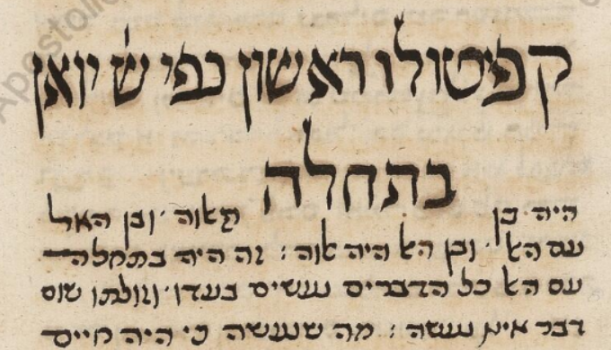
An image file of the Hebrew text in question:
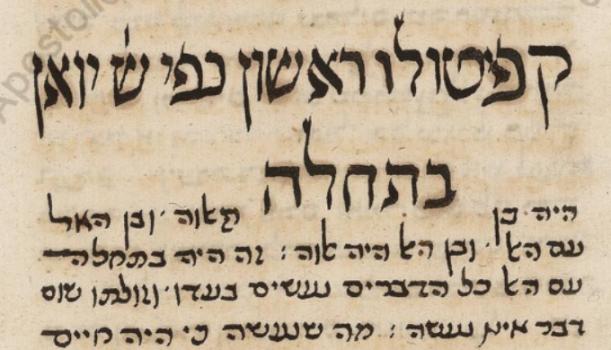
In this text the scribe is sometimes, (but not always), using a ligature for both El and Eloah: it looks like a C with a partial Lamed attached to it, something like this, lc, (but connected at the bottom). He is also using an unconventional, (non-Masoretic), upper accent as punctuation, either a comma, a semi-colon, or a colon. The lower accent beneath the letter hei in haEloah is called a tipḥa. The tipḥa is a disjunctive cantillation accent, so it can mark a phrase boundary and help show how the words group: it marks a break at its position, and the surrounding accents or punctuation help determine the larger grouping. There is a break signified with the first hei in the first occurrence of haEloah, and there is a comma immediately following that same word. It is singled out like so: "In the commencement was the Son, the Eloah,"... It does not say the Son of Eloah but calls the Son the Eloah, (which is not emphatic), like as if it is mentioning a place where it is previously written in a well known text, (such as possibly Ruakh Eloah in Gen 1:2, if perhaps that is what was originally in that text).
The above Hebrew text of John 1:1 in the square Assuri (Assyrian) script:
You may find much more information about this text online at the link below, including a full rendering of the whole Gospel account, which is free to download, and an introductory section with the owner of the site's reading of the first verse, John 1:1 on video, (which I will also post below). However, be aware that his rendering appears to be that of a Oneness or Oneness Pentecostal believer, and that bias shows up even in this very first verse of the account, John 1:1. It also renders the statement illogical because he appears to entirely ignore the tipḥa accent mentioned above.

 www.hebrewgospels.com
.
An image file of the Hebrew text in question:
In this text the scribe is sometimes, (but not always), using a ligature for both El and Eloah: it looks like a C with a partial Lamed attached to it, something like this, lc, (but connected at the bottom). He is also using an unconventional, (non-Masoretic), upper accent as punctuation, either a comma, a semi-colon, or a colon. The lower accent beneath the letter hei in haEloah is called a tipḥa. The tipḥa is a disjunctive cantillation accent, so it can mark a phrase boundary and help show how the words group: it marks a break at its position, and the surrounding accents or punctuation help determine the larger grouping. There is a break signified with the first hei in the first occurrence of haEloah, and there is a comma immediately following that same word. It is singled out like so: "In the commencement was the Son, the Eloah,"... It does not say the Son of Eloah but calls the Son the Eloah, (which is not emphatic), like as if it is mentioning a place where it is previously written in a well known text, (such as possibly Ruakh Eloah in Gen 1:2, if perhaps that is what was originally in that text).
The above Hebrew text of John 1:1 in the square Assuri (Assyrian) script:
בתחלה היה בן ה֖אלוה ´ ובן האל עם האל ´ ובן האל היה אלוה׃
You may find much more information about this text online at the link below, including a full rendering of the whole Gospel account, which is free to download, and an introductory section with the owner of the site's reading of the first verse, John 1:1 on video, (which I will also post below). However, be aware that his rendering appears to be that of a Oneness or Oneness Pentecostal believer, and that bias shows up even in this very first verse of the account, John 1:1. It also renders the statement illogical because he appears to entirely ignore the tipḥa accent mentioned above.
Hebrew Gospel of John | HebrewGospels.com
The first ever English translation of an authentic Hebrew manuscript of John! Can we learn anything from this Hebrew Gospel of John? Absolutely! In the introduction to the translation, we discuss the following topics: John 1:1 – Does the Gospel of John describe Yeshua as the Word or the Son...
www.hebrewgospels.com
Last edited: