Matthew 13:51-52 SV
51 Have ye understood all these things? They say unto him, Yea.
52 And he said unto them,
Therefore every scribe who hath been made a disciple to the kingdom of heaven is like unto a man that is a householder,
who bringeth forth out of his treasure things new and old.
Luke 5:37-39
37 And no man putteth
new [G3501 neos] wine into old wine-skins; else the
new [G3501 neos] wine will burst the skins and itself will be spilled, and the skins will perish.
38 But
new [G3501 neos] wine must be put into
fresh [G2537 kainos] wine-skins.
39 And no man having drunk old wine desireth
new; [G3501 neos] for he saith,
The old is chrestos!
It isn't even a
neos-new covenant: it is a
kainos-renewed covenant, (Also
ברית חדשה, Briyth Hadashah, Renewed Covenant, Jer 31:31). And this therefore is not simply my own opinion: it is the Testimony of the Master, showing that in Greek
neos is new while
kainos is renewed, refreshed, fresh, and so on. Which word is used for the so-called
new covenant in the LXX Greek version of Jer 31:31 and all over the Apostolic writings?
That would be
kainos, renewed, and this completely changes the focus from something
totally brand new to something
having been renewed, and therefore it is no wonder to me why biased translators, (antinomian bias against the Torah), render such passages the way they do when it comes to the renewed covenant. There is only one place where
neos is employed in the context of the renewed covenant and that is likely a small corruption in the text because it was probably originally speaking of the
neos-new Mediator of the Covenant, (Heb 12:24). All other places in the N/T where you read "new covenant" contain the word
kainos, (renewed). Some of the more Messianic oriented translators have recognized this fact and render such texts they way they actually should be understood.
Jeremiah 31:31 TS2009 W/Footnotes
31 “See, the days are coming,” declares
יהוה, “when I shall make
a renewed covenant with the house of Yisra’ĕl and with the house of Yehuḏah,
a Footnote: aHeb 8:8-12, Heb 10:16-17.
Luke 22:20 TS2009 W/Footnotes
20 Likewise the cup also, after supper, saying, “This cup is
the renewed covenant in My blood which is shed for you.
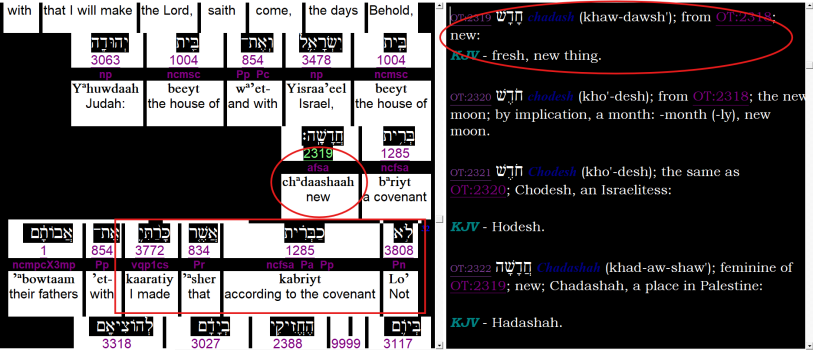
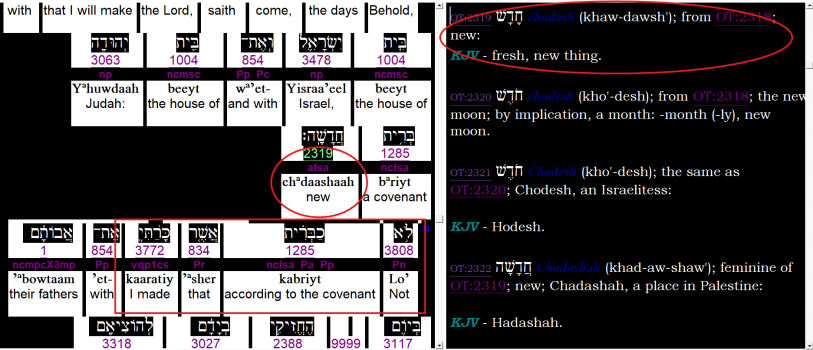
In Jeremiah 31:31 James Strong classified
hadash as H2319
hadash, but he divided the original single word
hadash into two different words, giving them two separate Strong's number classifications, H2318
hadash and H2319
hadash, and in doing so he created an antinomian lie which other Christian lexicons have followed for obvious reasons and purposes.
Here is the difference:
H2318 חָדַשׁ (chadash), to renew, to repair, to restore
Lexical Summary
chadash: To renew, to repair, to restore
Original Word:
Part of Speech: Verb
Transliteration: chadash
Pronunciation: khaw-dash'
Phonetic Spelling: (khaw-dash')
KJV: renew, repair
NASB: renew, restore, renewed, repair, restored
Word Origin: [a primitive root]
1. to be new
2. causatively, to rebuild
H2319 חָדָשׁ (chadash), new, fresh
As anyone may easily see, both words are the same exact three letter Hebrew spelling, the only difference is a single point in the Masoretic text that did not even exist until a thousand years after the N/T was written: there was no pointing system in the Hebrew texts of the first century. And again, what do we find in the LXX-Septuagint version of Jer 31:31? We find the Greek word
kainos, which means fresh, refreshed, renewed etc., etc.
James Strong helped to change the course of modern Christian antinomian exegesis by dividing a single Hebrew word into two separate words because of a single point that didn't even exist in the Hebrew texts of the first century. H2318 and H2319 are the same exact word with all the meanings of both combined into the one original word
hadash: those who understand the Torah understand how that word is to be read and understood in the passage concerned because the answer is already in the Torah.
.