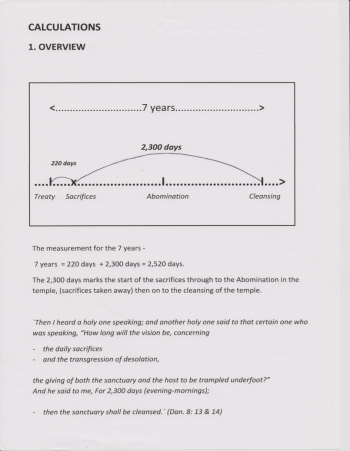
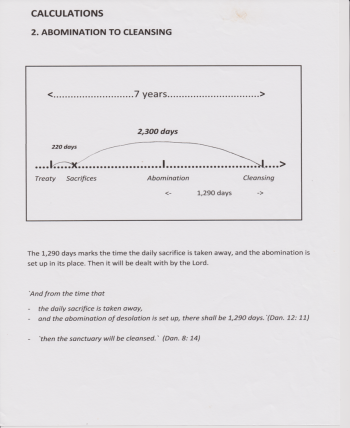
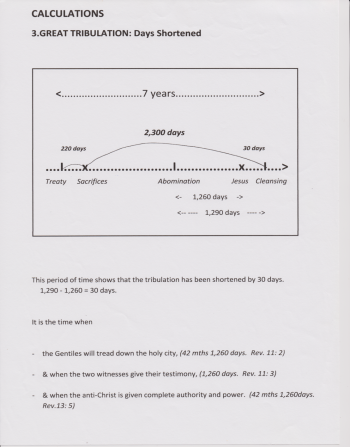
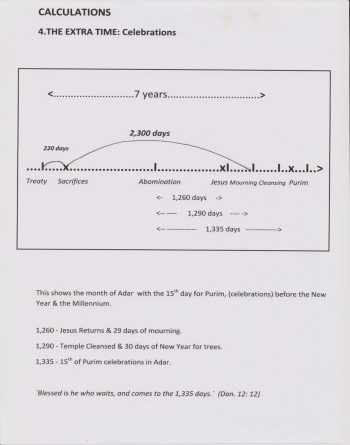
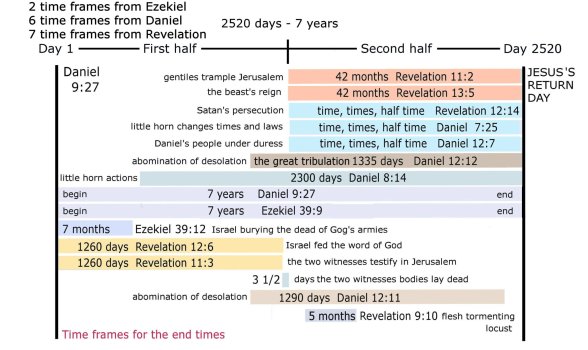
The 2300 days involving the little horn's action - ends the day of Jesus's return. The 2300 days is shown on this chart. The daily temple sacrifice of two lambs a day, one in the morning, one in the evening - will begin again on day 220 of the 7 years. i.e. 2520 days - 2300 days = 220
As usual Dougggg you grab an answer and will never give way to the truth, no matter what proof you are given. Changing this would mean your whole 70th week chart is off kilter, and you can't have that. Now, let me show what the the ORIGNAL TEXT in Hebrew/Chaldean says not in the KJV translation.
This is END TIME EVENTS, not Antiochus Epiphanes 4, and I can prove that too.
Daniel 8:12 And an host was given him against the daily sacrifice by reason of transgression, and it cast down the truth to the ground; and it practised, and prospered. 13 Then I heard one saint speaking, and another saint said unto that certain saint which spake, How long shall be the vision concerning the daily sacrifice, and the transgression of desolation, to give both the sanctuary and the host to be trodden under foot?
14 And he said unto me, Unto two thousand and three hundred days; then shall the sanctuary be cleansed.
15 And it came to pass, when I, even I Daniel, had seen the vision, and sought for the meaning, then, behold, there stood before me as the appearance of a man. 16 And I heard a man's voice between the banks of Ulai, which called, and said,
Gabriel, make this man to understand the vision. 17 So he came near where I stood: and when he came, I was afraid, and fell upon my face: but he said unto me,
Understand, O son of man: for at the time of the end shall be the vision.
(So, at the END TIME shall the VISION BE, its not about Antiochus)
18 Now as he was speaking with me, I was in a deep sleep on my face toward the ground: but he touched me, and set me upright. 19 And he said, Behold, I will make thee know what shall be
in the last end of the indignation: for at the time appointed the end shall be.
(At the time of God's Wrath/END.)
20 The ram which thou sawest having two horns are the kings of Media and Persia. 21 And the rough goat is the king of Grecia: and the great horn that is between his eyes is the first king. 22 Now that being broken, whereas four stood up for it, four kingdoms shall stand up out of the nation, but not in his power. 23 And in the
latter time of their kingdom(Greece is still a Kingdom), when the transgressors are come to the full, a king of fierce countenance, and understanding dark sentences, shall stand up.
24 And his power shall be mighty, but not by his own power: and he shall destroy wonderfully, and shall prosper, and practise, and shall destroy the mighty and the holy people. 25 And through his policy also he shall cause craft to prosper in his hand; and he shall magnify himself in his heart, and by peace shall destroy many:
he shall also stand up against the Prince of princes(Jesus); but he shall be broken without hand.
26 And
the vision of the evening and the morning which was told is true: wherefore shut thou up the vision; for it shall be for many days.
So, we can prove the 2300 "DAYS" was a TRANSLATION ERROR Dougg, by looking at how they translated the exact same words in verses 14 and 26
(IN RED) because they translated the same words in two different ways in the sane chapter. Lets look at my link to the original Hebrew.
Daniyel 8:14 And he said 559 z8799 unto x413 me, Unto x5704 two thousand 505 and three 7969 hundred 3967
days; 6153 1242 then shall the sanctuary 6944 be cleansed. 6663 z8738
Daniyel 8:26 And the vision 4758
of the evening 6153 and the morning 1242 which x834 was told 559 z8738 [is] true: 571 wherefore shut thou up 5640 z8798 x859 the vision; 2377 for x3588 it [shall be] for many 7227 days. 3117
So, is it DAYS as in vs. 14 or EVNING & MORNING as in vs. 26? Well it is TWO WORDS, 6153 and 1242. And we can link to each one to see what the Strong's Concord. says.
#6153 עֶרֶב `ereb {eh'-reb}
from H6150; TWOT - 1689a; n m
—Hebrew Word Study (Transliteration-Pronunciation Etymology & Grammar)
1)
evening, night, sunset
1a) evening, sunset
1b) night
—Brown-Driver-Briggs (Old Testament Hebrew-English Lexicon)
From H6150;
dusk:— + day, even (-ing, tide), night.
—Strong's (Hebrew & Chaldee Dictionary of the Old Testament)
#1242 בֹּקֶר boqer {bo'-ker}
from H1239; TWOT - 274c; n m
—Hebrew Word Study (Transliteration-Pronunciation Etymology & Grammar)
1) morning, break of day
1a) morning
1a1) of end of night
1a2) of coming of daylight
1a3) of coming of sunrise
1a4) of beginning of day
1a5) of bright joy after night of distress (fig.)
1b) morrow, next day, next morning
—Brown-Driver-Briggs (Old Testament Hebrew-English Lexicon)
From H1239;
properly dawn (as the break of day); generally morning:— (+) day, early, morning, morrow.
—Strong's (Hebrew & Chaldee Dictionary of the Old Testament)
So, this seams really clear to me, and if you would listen to an argument, it would to you also. Let go f those Charts Brother !! (Smile)
NOW, lets put the proper translation in vs. 14
Daniel 8:14 And he said unto me, Unto two thousand and three hundred
EVENNING and MORNINGS; then shall the sanctuary be cleansed.
In Daniel 9 we see this via Daniel EVENING PRAYER/Oblation.
Dan. 9:20 And
whiles I was speaking, and praying, and confessing my sin and the sin of my people Israel, and presenting my supplication before the Lord my God for the holy mountain of my God;
21 Yea, whiles I was speaking in prayer,
even the man Gabriel, whom I had seen in the vision at the beginning, being caused to fly swiftly, touched me about the time of the evening oblation.
So, these are 2300 Evening and Mornings SACRIFICES being TAKEN AWAY, not 2300 days.