


I am listening to the recording....it's awesome.The livestream just ended...it was really beautiful, Bible readings for Good Friday, tranquil Christian songs and a spirit of prayer.
Welcome to Christian Forums, a Christian Forum that recognizes that all Christians are a work in progress.
You will need to register to be able to join in fellowship with Christians all over the world.
We hope to see you as a part of our community soon and God Bless!
I am listening to the recording....it's awesome.The livestream just ended...it was really beautiful, Bible readings for Good Friday, tranquil Christian songs and a spirit of prayer.

I am listening to the recording....it's awesome.

Whatever AI he's using, he should put it on payroll.Yes it really was...I sensed the Holy Spirit's presence.
About the tranquil songs, Richard Inman who leads the fellowship and chat does the songs by using AI. He uses a lot of Scripture and some of the Creeds.

Because a third person is never implied or explicitly stated.Thanks. So you see two persons, not three persons, in the prologue. Who are the two persons? Why don’t you see three persons?
No. I see one.If you would, take a look now at the Geneva Bible I quoted (in post #105). Do you still see two persons?

Yes, I was noting in Geneva that the pronoun used was "it" instead of "he". Both are supported by the rules of Greek grammar. The choice of pronouns reflects the theology of the translator.No. I see one.

…. and briefly commented.
Since Riven is now trusting Christ as his Savior, we should be glad of that. Matthias you don't believe in the Trinity but we Christians do.
My advice: Leave room for awe and wonder, and it's okay to say "I don't know".Y'know, Riven, I was hoping you wouldn't get dragged into a theological controversy about the nature of Jesus Christ so soon, but you're a grown-up and you don't need to be mollycoddled.
Because a third person is never implied or explicitly stated.
No. I see one.
Yes, I was noting in Geneva that the pronoun used was "it" instead of "he". Both are supported by the rules of Greek grammar.
The choice of pronouns reflects the theology of the translator.
"It" just doesn't fit in with the context too well. "αὐτοῦ" can be translated as "it" or "him" or as "one" or "other" for that matter. In my opinion the context demands "him". However, the KJV does a similar thing when it translates "that holy thing that shall be born of thee" in reference to Jesus in Lk 1:35Yes, I was noting in Geneva that the pronoun used was "it" instead of "he". Both are supported by the rules of Greek grammar. The choice of pronouns reflects the theology of the translator.
There is a big difference between laying down your opinion and declaring victory and actually proving your point. I have posted this to you once and I do it again. The Shema that monotheists use to prove their point actually proves the TrinityThat was a kind and commendable thing for you to do.
That is where you went beyond letting him read and think it through for himself.
You’re overlooking an import fact: I’m a primitive Christian. Primitive Christians aren’t Nicene Christians (i.e. trinitarians). As church history documents, primitive Christianity existed several centuries before Nicene Christianity.
As is my custom when speaking with Nicene Christians, I’ve used the concessions of trinitarian scholars to make these points in other threads. I’m not interested in repeating that exercise in this thread.
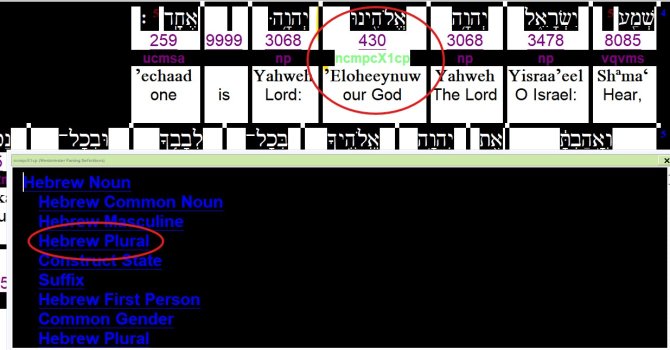
There is a big difference between laying down your opinion and declaring victory and actually proving your point. I have posted this to you once and I do it again. The Shema that monotheists use to prove their point actually proves the Trinity
Our God (plural) is. One (Echad) Echad being a unity out of plurality. A notable example is " A man shall cleave to his wife and they shall be one(echad) flesh
View attachment 82546
No. I see one.
By recognizing that there's differences in translations. Or... I could flip a coin.How are you going to reconcile the differences in the two translations? Both were done by reputable trinitarian scholars. One group saw something in the prologue of John’s Gospel which the other group didn’t.

Genesis 1:26-27 NKJV "Let us" shows the plurality of God.That’s right. “It” fits perfectly with the Jewish / Hebrew Bible background of John. John is intentionally taking his readers back to Genesis 1.

Because a third person is never implied or explicitly stated.
No. I see one.


