Talks with Iran have failed. Trump says Iran will not be allowed to sell any oil, if they block Strait for other countries, US will block their ships

  • Welcome to Christian Forums, a Christian Forum that recognizes that all Christians are a work in progress.

    You will need to register to be able to join in fellowship with Christians all over the world.

    We hope to see you as a part of our community soon and God Bless!

Scott Downey

Well-Known Member
Dec 19, 2021
11,457
6,981
113
66
St. Thomas
Faith
Christian
Country
Virgin Islands, U.S.
Gender
Male
I had a sense the talks would fail, Iran is not acting like they are defeated. Similar things happened in WW2, and many other wars.
I think Trump should follow through with his earlier plans, wipe out Iranian infrastructure, send them back to primitive times, and force open the gulf. Iran wont ever stop being Iran unless the current government is wiped out completely. Venezuela is a successful intervention story. Countries VP has become president, and development money is flowing back in, the people will have a better life.
One reason is they are not Shia Islamic, who if you notice have many issues with about everyone including Sunni Islam, Iran is a fascist theocratic dictatorship ruled by Mullahs, but now the IRGC have taken over and they most certainly are of the same dictator like ideas.
US took out dictator Maduro and things naturally got better, but that country was a different situation.


President Donald Trump detailed a sweeping "all-or-nothing" U.S. blockade of the Strait of Hormuz in a "Sunday Morning Futures" exclusive interview, vowing to choke off Iran’s oil profits and warning that no country — ally or adversary — will be allowed to bypass the crackdown.

"We're not going to let Iran make money on selling oil to people that they like and not people that they don't like... It's going to be all or none and that's the way it is," Trump said.

"You saw what we did with Venezuela. It'll be something very similar to that but at a higher level."

The president told Fox News’ Maria Bartiromo that the policy would be strictly "all or nothing," meaning every country would either be allowed full access through the waterway or none at all, with no exceptions for allies.

TRUMP REVEALS IRAN MADE 'SIGNIFICANT PROPOSAL' AFTER ULTIMATUM, BUT 'NOT GOOD ENOUGH'
 
Last edited:
  • Like
Reactions: Truth7t7

Truth7t7

Well-Known Member
Jan 2, 2014
12,819
4,033
113
Faith
Christian
Country
United States
Gender
Male
I had a sense the talks would fail, Iran is not acting like they are defeated. Similar things happened in WW2, and many other wars.
I think Trump should follow through with his earlier plans, wipe out Iranian infrastructure, send them back to primitive times, and force open the gulf. Iran wont ever stop being Iran unless the current government is wiped out completely. Venezuela is a successful intervention story. Countries VP has become president, and development money is flowing back in, the people will have a better life.
One reason is they are not Shia Islamic, who if you notice have many issues with about everyone including Sunni Islam, Iran is a fascist theocratic dictatorship ruled by Mullahs, but now the IRGC have taken over and they most certainly are of the same dictator like ideas.
US took out dictator Maduro and things naturally got better, but that country was a different situation.


President Donald Trump detailed a sweeping "all-or-nothing" U.S. blockade of the Strait of Hormuz in a "Sunday Morning Futures" exclusive interview, vowing to choke off Iran’s oil profits and warning that no country — ally or adversary — will be allowed to bypass the crackdown.

"We're not going to let Iran make money on selling oil to people that they like and not people that they don't like... It's going to be all or none and that's the way it is," Trump said.

"You saw what we did with Venezuela. It'll be something very similar to that but at a higher level."

The president told Fox News’ Maria Bartiromo that the policy would be strictly "all or nothing," meaning every country would either be allowed full access through the waterway or none at all, with no exceptions for allies.

TRUMP REVEALS IRAN MADE 'SIGNIFICANT PROPOSAL' AFTER ULTIMATUM, BUT 'NOT GOOD ENOUGH'
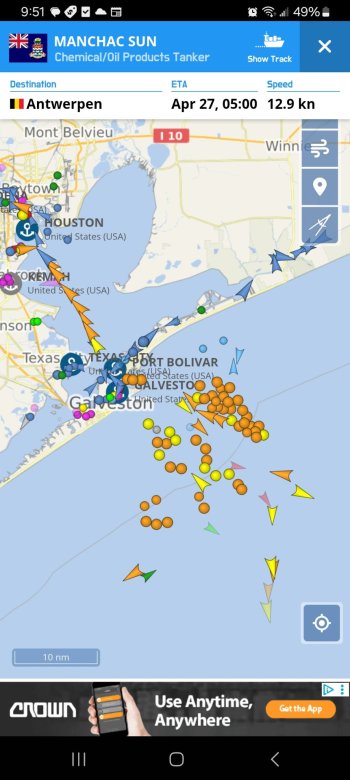
The orange dots are oil tanker ships from around the world, they're backing up waiting in line at the gas pump in Houston Texas?

The longer the straight of Hormuz is closed, the longer the line in Texas will get $$$

President Trump has closed the straight of Hormuz, Iran has been shut down and China is the biggest loser, where they received 50% of their oil at a big 50% discount from Iran , 20% of China's oil "Was" obtained from Venezuela that the USA is now in control of

Conclusion: China the world enemy #1 has been cut off by the USA with 70% of their oil supply being removed "Gone"!
 

Attachments

  • Screenshot_20260411_215120_VesselFinder.jpg
    Screenshot_20260411_215120_VesselFinder.jpg
    211.8 KB · Views: 1
Last edited:
  • Like
Reactions: Scott Downey

soberxp

Well-Known Member
Mar 6, 2025
2,631
907
113
43
Xi'an
m.youtube.com
Faith
Christian
Country
China
Gender
Male
The last world was destroyed in a great flood.
The second world will be destroyed in the hands of human beings.
If the war continues, famine will come to many countries.
Some predict that at least one third of humanity will be affected.
Mark 13:8
For nation shall rise against nation, and kingdom against kingdom: and there shall be earthquakes in divers places, and there shall be famines and troubles: these are the beginnings of sorrows.
The gathering is of elect.not a state.

Screenshot_2026-04-10-20-54-58-029_com.android.browser.jpgScreenshot_2026-04-10-20-55-07-282_com.android.browser.jpg
 

Jesussaves150

Member
Nov 11, 2025
109
88
28
59
Toronto
Faith
Christian
Country
Canada
The outcome of this will definitely show up in gas prices this week get ready for a big jump - it has yet to hit food price which will be coming soon.The war is costing a billion dollars a day to the American tax payer.Hope it been worth what is to come.The stock market will crash tomorrow due to this news.
 
  • Like
Reactions: TLHKAJ

soberxp

Well-Known Member
Mar 6, 2025
2,631
907
113
43
Xi'an
m.youtube.com
Faith
Christian
Country
China
Gender
Male
I. Strait of Hormuz Blockade: The Lifeline of Global Fertilizer Supply Is Cut

The most direct and severe impact of a U.S.-Israel-Iran conflict on global agriculture begins with disrupted passage through the Strait of Hormuz. The Persian Gulf region accounts for nearly half of global urea production, and about one-third of global seaborne fertilizer trade (approximately 16 million tons annually) must pass through this strategic chokepoint. Following the outbreak of conflict, several Gulf state fertilizer producers suspended deliveries, and more than 20 vessels carrying nearly 1 million tons of fertilizer are already stranded in the strait.

Iran’s position in the global fertilizer supply chain is particularly critical. 2024 data shows that Iran is the world’s second-largest urea exporter, with annual exports of about 9.4 million tons, accounting for more than 10% of global urea trade. It is also the world’s largest sulfur exporter (over 30% market share); sulfur is a key raw material for phosphate fertilizer production. After the conflict broke out, Iran announced a comprehensive ban on food and agricultural product exports on March 3, further tightening supply.

Sharp increases in fertilizer prices are already a fact. According to the World Bank, urea prices surged 54% month-on-month in March, hitting a new high since April 2022. The UN Food and Agriculture Organization (FAO) predicts that if instability continues, global fertilizer prices in the first half of this year could be 15% to 20% higher than normal levels. In some regions, urea and ammonia prices have soared about 50% and 20% respectively since the conflict began.

> **Key Data**: The Persian Gulf region accounts for approximately 46% of global seaborne urea trade and 30% of global seaborne ammonia trade; about one-third of global fertilizer trade depends on the Strait of Hormuz.

---

## II. Soaring Oil Prices: Comprehensive Cost Inflation in Agriculture

The fertilizer supply crisis overlaps with surging oil prices, creating a double squeeze on global agriculture. Brent crude briefly reached $112 per barrel after the conflict broke out, up more than 40% from pre-war levels. The surge in energy prices transmits to agricultural production costs through multiple channels:

**First, diesel costs skyrocket.** In Brazil, the world’s largest agricultural exporter, diesel prices rose 16.23% cumulatively in March, with some regions seeing actual increases near 40% and rationed fuel supply. Energy and freight costs typically account for 25% to 30% of total production costs on Brazilian soybean farms. During the peak soybean export season, diesel price hikes have already led some traders to suspend quotations, causing short-term disruptions in export chains.

**Second, agrochemicals such as pesticides rise in tandem.** Domestic mainstream glyphosate prices in China have risen from 24,000 yuan/ton before the conflict to 28,500 yuan/ton, an increase of 4,500 yuan per ton. Natural gas accounts for 60% to 80% of nitrogen fertilizer costs, and soaring energy prices have pushed up costs across the entire agricultural input chain, including fertilizers, pesticides, and agricultural film.

**Third, shipping and insurance costs surge.** War risk insurance premiums in Gulf waters have jumped from 0.25% to as high as 10%, with rates reassessed every seven days. The oil price rise triggered by the conflict has increased global food transport costs by 18%.

---

## III. Global Agriculture and Food Security: Differentiated Impacts

### (A) Africa: The Hardest‑Hit and Most Vulnerable Region

Over 90% of Africa’s fertilizer is imported, with the Gulf region supplying about 20% of that share — and as much as 50% in countries like Sudan. The World Food Programme (WFP) reports that 12 countries in West and Central Africa could see an additional 10.4 million food‑insecure people (a 21% increase), and North African countries an additional 5.2 million (a 14% increase). Africa is becoming the heaviest casualty of this conflict.

### (B) Brazil: Pressure from Harvest to Export

Brazil relies on imports for more than 80% of its fertilizer, with nitrogen fertilizer particularly dependent on Middle East supply. Brazilian urea prices have risen from $475 to $600 per ton. In southern soybean‑producing regions, many farmers have been forced to slow harvests due to diesel shortages. Several rice‑producing areas in Rio Grande do Sul have declared states of emergency due to diesel scarcity.

### (C) India: Import‑Dependent Edible Oil Sector Suffers

India is the world’s largest edible oil importer, relying on imports for nearly 60% of its demand. Higher fuel costs and shipping delays have already pushed palm oil and soybean oil prices up 4% to 5%. In India, Bangladesh, and other countries, natural gas shortages have forced some urea plants to cut production or shut down.

### (D) United States: Boomerang Effect

The disruption to fertilizer supply chains also hurts the United States itself. With nearly half of global fertilizer trade disrupted, urea prices have jumped nearly 30%, inflicting significant losses on U.S. agriculture. The average national gasoline price has risen 35% over the past month, reaching its highest level in nearly four years. The president of the American Farm Bureau has sent a “warning letter” to the president, stating that American farmers preparing for spring planting are facing the most severe conditions in history.

### (E) China: Relative Resilience

In stark contrast to the global fertilizer surge, China’s fertilizer prices remain largely stable. About 80% of China’s nitrogen fertilizer is produced from coal using domestically developed technology and equipment, enabling self‑sufficiency in supply. The main domestic urea futures contract is priced at only 1,829 yuan/ton, roughly one‑third of Middle Eastern prices. Together with the national commercial fertilizer reserve system that helps stabilize prices, China has demonstrated considerable resilience to this shock.

---

## IV. Global Food Security: Alarm Bells Ringing

The combined effects of fertilizer shortages and price increases will directly constrain the planting of major grain crops that heavily depend on nitrogen fertilizer, such as corn, wheat, and rice. The latest report from the UN World Food Programme shows that if the conflict continues into June and international oil prices remain above $100 per barrel, rising global food and fuel costs could push an additional estimated 45 million people into severe hunger, potentially raising global food insecurity to “alarmingly high levels.”

A senior global economist at JPMorgan Chase estimates that higher fertilizer prices could temporarily push global food inflation to 4%–5%, but the impact will show significant lags. More worrisome, the International Food Policy Research Institute (IFPRI) warns that if the conflict persists, global food prices could rise by 10% to 30%, exceeding the shock of the 2022 Russia‑Ukraine war, and the global hungry population could increase by 120 million to 250 million net.

UN Secretary‑General António Guterres has pointed out that the energy and fertilizer supply crises triggered by the U.S.-Israel-Iran conflict are impacting global food security in a chain reaction. The best way to reduce these disastrous consequences is to immediately end the war and resolve disputes through diplomacy.

---

**Summary**: The impact of a U.S.-Israel-Iran conflict on world agriculture follows a transmission chain: “Strait of Hormuz blockade → fertilizer and energy price spikes → comprehensive increase in agricultural production costs → reduced harvests and higher food prices,” ultimately threatening the food security of hundreds of millions of people around the globe. This crisis also exposes the extreme fragility of global fertilizer supply chains — a single chokepoint can reshape the world’s food map.
 

Rockerduck

Well-Known Member
Nov 7, 2022
4,246
3,389
113
71
Marietta, Georgia.
Faith
Christian
Country
United States
Gender
Male
I. Strait of Hormuz Blockade: The Lifeline of Global Fertilizer Supply Is Cut

The most direct and severe impact of a U.S.-Israel-Iran conflict on global agriculture begins with disrupted passage through the Strait of Hormuz. The Persian Gulf region accounts for nearly half of global urea production, and about one-third of global seaborne fertilizer trade (approximately 16 million tons annually) must pass through this strategic chokepoint. Following the outbreak of conflict, several Gulf state fertilizer producers suspended deliveries, and more than 20 vessels carrying nearly 1 million tons of fertilizer are already stranded in the strait.

Iran’s position in the global fertilizer supply chain is particularly critical. 2024 data shows that Iran is the world’s second-largest urea exporter, with annual exports of about 9.4 million tons, accounting for more than 10% of global urea trade. It is also the world’s largest sulfur exporter (over 30% market share); sulfur is a key raw material for phosphate fertilizer production. After the conflict broke out, Iran announced a comprehensive ban on food and agricultural product exports on March 3, further tightening supply.

Sharp increases in fertilizer prices are already a fact. According to the World Bank, urea prices surged 54% month-on-month in March, hitting a new high since April 2022. The UN Food and Agriculture Organization (FAO) predicts that if instability continues, global fertilizer prices in the first half of this year could be 15% to 20% higher than normal levels. In some regions, urea and ammonia prices have soared about 50% and 20% respectively since the conflict began.

> **Key Data**: The Persian Gulf region accounts for approximately 46% of global seaborne urea trade and 30% of global seaborne ammonia trade; about one-third of global fertilizer trade depends on the Strait of Hormuz.

---

## II. Soaring Oil Prices: Comprehensive Cost Inflation in Agriculture

The fertilizer supply crisis overlaps with surging oil prices, creating a double squeeze on global agriculture. Brent crude briefly reached $112 per barrel after the conflict broke out, up more than 40% from pre-war levels. The surge in energy prices transmits to agricultural production costs through multiple channels:

**First, diesel costs skyrocket.** In Brazil, the world’s largest agricultural exporter, diesel prices rose 16.23% cumulatively in March, with some regions seeing actual increases near 40% and rationed fuel supply. Energy and freight costs typically account for 25% to 30% of total production costs on Brazilian soybean farms. During the peak soybean export season, diesel price hikes have already led some traders to suspend quotations, causing short-term disruptions in export chains.

**Second, agrochemicals such as pesticides rise in tandem.** Domestic mainstream glyphosate prices in China have risen from 24,000 yuan/ton before the conflict to 28,500 yuan/ton, an increase of 4,500 yuan per ton. Natural gas accounts for 60% to 80% of nitrogen fertilizer costs, and soaring energy prices have pushed up costs across the entire agricultural input chain, including fertilizers, pesticides, and agricultural film.

**Third, shipping and insurance costs surge.** War risk insurance premiums in Gulf waters have jumped from 0.25% to as high as 10%, with rates reassessed every seven days. The oil price rise triggered by the conflict has increased global food transport costs by 18%.

---

## III. Global Agriculture and Food Security: Differentiated Impacts

### (A) Africa: The Hardest‑Hit and Most Vulnerable Region

Over 90% of Africa’s fertilizer is imported, with the Gulf region supplying about 20% of that share — and as much as 50% in countries like Sudan. The World Food Programme (WFP) reports that 12 countries in West and Central Africa could see an additional 10.4 million food‑insecure people (a 21% increase), and North African countries an additional 5.2 million (a 14% increase). Africa is becoming the heaviest casualty of this conflict.

### (B) Brazil: Pressure from Harvest to Export

Brazil relies on imports for more than 80% of its fertilizer, with nitrogen fertilizer particularly dependent on Middle East supply. Brazilian urea prices have risen from $475 to $600 per ton. In southern soybean‑producing regions, many farmers have been forced to slow harvests due to diesel shortages. Several rice‑producing areas in Rio Grande do Sul have declared states of emergency due to diesel scarcity.

### (C) India: Import‑Dependent Edible Oil Sector Suffers

India is the world’s largest edible oil importer, relying on imports for nearly 60% of its demand. Higher fuel costs and shipping delays have already pushed palm oil and soybean oil prices up 4% to 5%. In India, Bangladesh, and other countries, natural gas shortages have forced some urea plants to cut production or shut down.

### (D) United States: Boomerang Effect

The disruption to fertilizer supply chains also hurts the United States itself. With nearly half of global fertilizer trade disrupted, urea prices have jumped nearly 30%, inflicting significant losses on U.S. agriculture. The average national gasoline price has risen 35% over the past month, reaching its highest level in nearly four years. The president of the American Farm Bureau has sent a “warning letter” to the president, stating that American farmers preparing for spring planting are facing the most severe conditions in history.

### (E) China: Relative Resilience

In stark contrast to the global fertilizer surge, China’s fertilizer prices remain largely stable. About 80% of China’s nitrogen fertilizer is produced from coal using domestically developed technology and equipment, enabling self‑sufficiency in supply. The main domestic urea futures contract is priced at only 1,829 yuan/ton, roughly one‑third of Middle Eastern prices. Together with the national commercial fertilizer reserve system that helps stabilize prices, China has demonstrated considerable resilience to this shock.

---

## IV. Global Food Security: Alarm Bells Ringing

The combined effects of fertilizer shortages and price increases will directly constrain the planting of major grain crops that heavily depend on nitrogen fertilizer, such as corn, wheat, and rice. The latest report from the UN World Food Programme shows that if the conflict continues into June and international oil prices remain above $100 per barrel, rising global food and fuel costs could push an additional estimated 45 million people into severe hunger, potentially raising global food insecurity to “alarmingly high levels.”

A senior global economist at JPMorgan Chase estimates that higher fertilizer prices could temporarily push global food inflation to 4%–5%, but the impact will show significant lags. More worrisome, the International Food Policy Research Institute (IFPRI) warns that if the conflict persists, global food prices could rise by 10% to 30%, exceeding the shock of the 2022 Russia‑Ukraine war, and the global hungry population could increase by 120 million to 250 million net.

UN Secretary‑General António Guterres has pointed out that the energy and fertilizer supply crises triggered by the U.S.-Israel-Iran conflict are impacting global food security in a chain reaction. The best way to reduce these disastrous consequences is to immediately end the war and resolve disputes through diplomacy.

---

**Summary**: The impact of a U.S.-Israel-Iran conflict on world agriculture follows a transmission chain: “Strait of Hormuz blockade → fertilizer and energy price spikes → comprehensive increase in agricultural production costs → reduced harvests and higher food prices,” ultimately threatening the food security of hundreds of millions of people around the globe. This crisis also exposes the extreme fragility of global fertilizer supply chains — a single chokepoint can reshape the world’s food map.
Any good farmer don't need to import fertilizer. It's a natural process.
 

Jesussaves150

Member
Nov 11, 2025
109
88
28
59
Toronto
Faith
Christian
Country
Canada
Canada has lots of Potash unfortunately the USA has very little yet there is a 10% tariff on it which American farmers pay for - why - when farmers get 90% of the potash needed from Canada.The Tariff makes no sense and just increases the price of food from farms.
 
  • Like
Reactions: TLHKAJ

Triumph1300

Well-Known Member
Jan 11, 2018
5,942
5,613
113
North America
Faith
Christian
Country
Canada
Gender
Male
Any good farmer don't need to import fertilizer. It's a natural process.
.
Good luck with that one.
Lol
-------------
As the global population expands, so does the demand for food.

Fertilizers enable farmers to produce more crops on the same amount of land, helping meet the rising food requirements.
Countries with low crop yields per hectare, if provided with the right tools, could play a significant role in securing global food supplies.

In many low-income, smallholder farming communities, access to fertilizers can be transformative.

With better productivity, smallholder farmers can increase their resilience, break the cycle of poverty, and contribute to the global food system in a sustainable way.
 

ProDeo

Well-Known Member
Nov 20, 2024
1,813
1,503
113
51
Deventer
Faith
Christian
Country
Netherlands
The last world was destroyed in a great flood.
The second world will be destroyed in the hands of human beings.
If the war continues, famine will come to many countries.
Some predict that at least one third of humanity will be affected.
Mark 13:8
For nation shall rise against nation, and kingdom against kingdom: and there shall be earthquakes in divers places, and there shall be famines and troubles: these are the beginnings of sorrows.
The gathering is of elect.not a state.

Civilization started in the Middle East, it will also end in the Middle East.
 
  • Like
Reactions: Triumph1300

Rockerduck

Well-Known Member
Nov 7, 2022
4,246
3,389
113
71
Marietta, Georgia.
Faith
Christian
Country
United States
Gender
Male
Canada has lots of Potash unfortunately the USA has very little yet there is a 10% tariff on it which American farmers pay for - why - when farmers get 90% of the potash needed from Canada.The Tariff makes no sense and just increases the price of food from farms.
Canada always had a tariff on the USA. I believe in no tariff's between Canada and Mexico, and South America for that matter. Only Corporate farmers need fertilizer. You can grow a garden in a 1/4 acre back yard and stock a grocery store with vegetables, in warm climates.
 

Riven

Well-Known Member
Jul 6, 2024
1,419
1,086
113
38
Florida
Faith
Christian
Country
United States
Gender
Male
This blockade is an attempt to starve the regime of it's money supply. I still don't believe it'll have the intended effect. The war began with the goal of regime change. That has obviously failed to materialize.

The only way to achieve that objective is with a significant ground invasion. Since ground forces are off the table, with the exception of maybe Kharg Island, the only thing the US can do is bomb any remaining military targets to degrade the Iranian military further, or begin attacking civilian targets like power plants, desalination plants, etc.

The latter is going up the escalation ladder, and Iran can match that by targeting civilian infrastructure in the other gulf states. So no matter which way you slice it, the United States has really stepped in it once again.

Israel is the only country that has met it's military objectives in this war; the complete destruction of the Iranian navy and it's ability to project force outside of it's proxies. So Israel comes out on top, and once again, the US is left in a worse position than it was before the war began.

This is why do many people on the political right are questioning our relationship with Israel. Our political leaders are always putting the interests of a foreign power above our own, often at our own expense.

Secretary of State Marco Rubio, admitted on camera, that Israel is dictating US foreign policy. The question that should have been asked immediately after by reporters is, why didn't the President tell Netanyahu that if he attacks Iran, he will have no US support? People are rightly asking, why is a foreign country dictating whether or not we go to war?


TLHKAJ

Well-Known Member
Sep 12, 2020
10,365
11,670
113
US
youtu.be
Faith
Christian
Country
United States
Gender
Female
Canada has lots of Potash unfortunately the USA has very little yet there is a 10% tariff on it which American farmers pay for - why - when farmers get 90% of the potash needed from Canada.The Tariff makes no sense and just increases the price of food from farms.
People better learn some regenerative farming, organic gardening ...food storage and prepping... buy seeds, get chickens!
 

ProDeo

Well-Known Member
Nov 20, 2024
1,813
1,503
113
51
Deventer
Faith
Christian
Country
Netherlands
Meanwhile.........

The US Navy has at least 15 ships — including an aircraft carrier and 11 destroyers — in the Middle East region, according to a US official, as the Navy begins a maritime blockade on traffic to and from Iran’s ports at President Donald Trump’s direction.

It’s unclear where exactly each ship is or which could be participating in the blockade; previous accountings of the vessels by CNN have shown them dispersed among the US Central Command area of operations.

The ships include:

Aircraft carrier:
  • USS Abraham Lincoln
Destroyers:
  • USS Bainbridge
  • USS Thomas Hudner
  • USS Frank E. Petersen Jr.
  • USS Delbert D. Black
  • USS John Finn
  • USS Michael Murphy
  • USS Mitscher
  • USS Pinckney
  • USS Rafael Peralta
  • USS Spruance
  • USS Milius

Tripoli Amphibious Ready Group
  • USS Tripoli
  • USS New Orleans
  • USS Rushmore
~~~~~~

Prayers for those people who are risking their lives in the Strait-of-Death.

OTOH, if Iran dares to torpedo one of them all bets are off.
 

Scott Downey

Well-Known Member
Dec 19, 2021
11,457
6,981
113
66
St. Thomas
Faith
Christian
Country
Virgin Islands, U.S.
Gender
Male
US says wont be blocking anything except Iranian ships or ships going to or from Iranian ports.
 

Scott Downey

Well-Known Member
Dec 19, 2021
11,457
6,981
113
66
St. Thomas
Faith
Christian
Country
Virgin Islands, U.S.
Gender
Male
If Canada could get is oil to BC, then Canadian oil could be sold worldwide. That has been blocked by BC
Canada's own internal politics regarding oil and gas stopped it's economic development.

BC’s Oil Tanker Ban and the Push for a Pacific Pipeline​

British Columbia’s oil tanker moratorium — enshrined in the 2019 Oil Tanker Moratorium Act — prohibits oil tankers carrying more than 12,500 metric tonnes of crude or persistent oil products from docking in northern B.C. waters, from the northern tip of Vancouver Island to the B.C.–Alaska border CBC. The ban is designed to protect environmentally sensitive coastlines from the risk of catastrophic oil spills, and it applies to vessels carrying bitumen, Bunker C fuel, and other heavy oils. Penalties for violations can be up to $5 million per incident CBC.

For years, this ban has effectively blocked direct tanker exports of Canadian crude from the Pacific coast, forcing most oil to be shipped via the U.S. Gulf Coast. Alberta and the federal government argue that lifting or adjusting the ban would allow a pipeline to the Pacific to carry oil from Alberta to deep-water ports in B.C., enabling exports to Asian markets and reducing reliance on the U.S. US News+1.

In November 2025, Prime Minister Mark Carney and Alberta Premier Danielle Smith signed a memorandum of understanding (MOU) to work toward building such a pipeline. The MOU commits Ottawa to “enable the export of bitumen from a strategic deep-water port to Asian markets, including if necessary through an appropriate adjustment to the Oil Tanker Moratorium Act” Global News. Alberta plans to act as the proponent of the pipeline, seeking fast-tracking through a new federal infrastructure agency and private investment Bloomberg.

However, B.C. and Coastal First Nations oppose any changes to the tanker ban, warning of the environmental risks of a spill in the Great Bear Rainforest and other sensitive areas US News+1. They argue that the ban is a necessary safeguard and that pipeline construction would be too risky.

The debate is central to Canada’s energy strategy:

  • Proponents (federal and Alberta) see the pipeline as a way to diversify exports, secure new markets, and reduce U.S. dependence US News+1.
  • Opponents (B.C. government, First Nations) see it as a threat to environmental protection and Indigenous rights CBC+1.
While the MOU opens the door to legal changes, it does not guarantee them, and no route to northern B.C. is currently planned Global News. The outcome will depend on negotiations between Ottawa, B.C., First Nations, and the oil industry, as well as political will to amend the moratorium.
 

Scott Downey

Well-Known Member
Dec 19, 2021
11,457
6,981
113
66
St. Thomas
Faith
Christian
Country
Virgin Islands, U.S.
Gender
Male
Oil Oil Oil
Was it ever really about anything else
I doubt it
US would rather not get involved in wars. Iran should not be allowed to control the region, as in prevent other countries from selling their own oil. Iran should not be allowed to export its terror, such as Houthis and Hezbollah, surrounding middle east countries have also been happy the US took military action against Iran. Those countries want US to finish the Iranian regime as so do many Iranians. It is not just oil, it is also Iranian control of middle east, and nuclear weapons and Israel.
 

Scott Downey

Well-Known Member
Dec 19, 2021
11,457
6,981
113
66
St. Thomas
Faith
Christian
Country
Virgin Islands, U.S.
Gender
Male

Bita Hemmati is set to become the first female protester to be hanged by Iran

Bita Hemmati is set to become the first female protester to be hanged by Iran

Her husband Mohammadreza Majidi-Asl is also set to be executed alongside his wife

Her husband Mohammadreza Majidi-Asl is also set to be executed alongside his wife


Iran is set to execute its first female protester and her husband as the nation's crackdown over anti-regime protests in January continues.

The country has already hanged seven people in connection with the protests, which were ruthlessly stamped out in a crackdown that left thousands dead and tens of thousands arrested.


Four more people were sentenced to death today by a Tehran Revolutionary Court presided over by the notorious judge Imam Afshari.

They were named as Bita Hemmati and her husband Mohammadreza Majidi-Asl, along with two other men, Behrouz Zamaninejad and Kourosh Zamaninejad, who lived in the same Tehran building as the married couple.

Hemmati is believed to be the first woman to be sentenced to death over the protests.

The four were convicted of carrying out actions on behalf of the United States, the US-based Human Rights Activists News Agency (HRANA), and the Abdorrahman Boroumand Center said in separate statements.

They had been accused of throwing concrete blocks from a residential building onto security forces in the capital. It was not immediately clear when the verdict was issued.

The Abdorrahman Boroumand Center said it also believed that Hemmati was the woman who appeared in a video broadcast on state television in January, being personally interrogated by judiciary chief Gholamhossein Mohseni Ejei.

'The recording and broadcasting of forced confessions from defendants in an opaque process... constitutes a blatant violation of the defendant's rights,' it said.

Rights groups accuse the Islamic Republic of using the death penalty as a tool of repression to instil fear in society, and fear it will ramp up capital punishment in the wake of the war against Israel and the United States.


Norway-based Iran Human Rights (IHR) and Paris-based Together Against the Death Penalty (ECPM) said on Monday in their joint annual report on the death penalty in Iran that at least 1,639 people have been executed in 2025, including 48 women.

Of these, 21 women were executed for the murder of their husbands or fiancés, the report said. Rights groups have said women executed for killing spouses or relatives were often in abusive relationships.

The number of executions represented an increase of 68 per cent on the 975 people Iranian authorities put to death in 2024.

The figure amounted to an average of more than four executions per day.

The report said the number of executions was by far the highest since IHR began tracking it in 2008, and was the most reported since 1989, in the earlier years of the Islamic revolution.

Earlier this month, Iran hanged a teenage musician in the notorious Ghezel Hesar prison outside the capital, despite hopes he would be spared because of his age.


Amirhossein Hatami, 18, was arrested on January 8 and accused of committing arson against the feared Basij paramilitary's base in Tehran during anti-regime protests.

Amirhossein was convicted of 'Moharebeh' ('Enmity Against God') and sentenced to death on February 7.

On April 2, the judiciary announced he had been 'hanged at dawn'.


Earlier this month, Iran hanged a teenage musician in the notorious Ghezel Hesar prison outside the capital, despite hopes he would be spared because of his age

Earlier this month, Iran hanged a teenage musician in the notorious Ghezel Hesar prison outside the capital, despite hopes he would be spared because of his age

Biglari and Kalour’s family were not granted final visits or allowed to say goodbye before they were put to death (pictured is Mohammadamin Biglari, 19)

Biglari and Kalour’s family were not granted final visits or allowed to say goodbye before they were put to death (pictured is Mohammadamin Biglari, 19)

Both were convicted of ‘Moharaebeh’, or ‘enmity against God’, and sentenced to death by ‘Death Judge’ Abolghassem Salavati (pictured is Shahin Vahedparast Kalour, 30)

Both were convicted of ‘Moharaebeh’, or ‘enmity against God’, and sentenced to death by ‘Death Judge’ Abolghassem Salavati (pictured is Shahin Vahedparast Kalour, 30)
Two days later, Mohammadamin Biglari, 19, and Shahin Vahedparast Kalour, 30, were executed at Ghezel Hesar Prison.

Biglari and Kalour’s family were not granted final visits or allowed to say goodbye before they were put to death.

The young men had been seized during the protests on January 8 and accused of arson over a fire at the base of the feared Basij paramilitary base.


They ‘confessed’ after weeks held in prison, where there are extensive reports of torture, before being brought before the feared Revolutionary Court in Tehran on February 6.

Both were also convicted of ‘Moharaebeh’ and sentenced to death by ‘Death Judge’ Abolghassem Salavati.

Also convicted of the capital charge by Salavati that day were Abolfazl Siavashani, 51, Shahab Zohdi, 38, Ali Fahim, 23, Yaser Rajaifar, and Hatami.

As well as the seven already executed, death sentences have been issued against at least 26 other people arrested over the January protests, and several hundred more are facing charges that could see them executed, IHR warned.

'Dozens of individuals arrested during the January 2026 protests have been sentenced to death following grossly unfair, fast-tracked trials conducted without due process, access to independent counsel and reliance on torture-tainted forced 'confessions' as evidence,' said the New York-based Center for Human Rights in Iran.
 
Last edited: