The Coherent Causality Argument

  • Welcome to Christian Forums, a Christian Forum that recognizes that all Christians are a work in progress.

    You will need to register to be able to join in fellowship with Christians all over the world.

    We hope to see you as a part of our community soon and God Bless!

Eternal Entity

New Member
Jun 12, 2026
74
10
8
63
Timaru
Faith
Agnostic
Country
New Zealand
Gender
Male

How can there be life after death?​

How is such a thing possible? In order for the soul to leave the body upon death, it must break the laws of the universe. It is a supernatural event. But supernatural events do not happen in this universe precisely because they would break the laws of physics, and that's not possible.

My view is, once the brain dies, the person creases to exist because we are our brains. A great example of this is people who have suffered an extensive brain injury. They often experience significant changes in their personality because of the physical changes to their brains.

We still don't understand consciousness, it's true. It's possible that conciuousness is something that happens outside our brains and its interpreted in real time by the brain. However, I think that's unlikely given that it would require an insane amount of compute power from an outside source, and that the brain acting as a receiver would require an immense amount of power from the brain itself to interpret and render 3D reality in real time.

Therefore I conclude that it is very likely that there is nothing beyond the physical death of the brain. We return to the state we were in before we were born.
{SOURCE}
Here is the analysis of that post through the CCA framework:


Through the CCA Lens

1. The Argument Summarized


The soul cannot leave the body at death because that would violate the laws of physics.
Therefore, death is the end of consciousness - we are our brains.
Brain injury changes personality, supporting the claim that consciousness is brain-dependent.
Consciousness outside the brain is unlikely due to the immense computing power required.

2. Coherence Assessment

The argument is internally coherent: it assumes physicalism, rejects supernatural events, and concludes that consciousness ends at death.
However, it relies on an unstated assumption: that the laws of physics are complete and closed to mindful influence. This is an assumption, not a demonstrated fact.

3. Lawfulness

The argument appeals to the laws of physics. The CCA does not deny physics - it includes physics as part of formation.
But the CCA does not assume that physics is the only lawful framework. The Source's expression is lawful, and that lawfulness may extend beyond current physics.

4. Understandability in Principle

The argument presents a clear, testable hypothesis (consciousness = brain function).
It is understandable in principle - we can investigate brain states and consciousness.
However, the CCA would ask: what grounds the physical laws themselves? The argument does not address that.

5. Strong vs. Weak Supernaturalism/Strong Naturalism

The argument rejects strong supernaturalism - the idea that a soul (as a separate, non-physical substance) leaves the body at death, violating physical law. The CCA agrees: strong supernaturalism is incoherent.

But the CCA does not require physicalism as the only alternative. In the CCA, consciousness is not a separate substance that "leaves." Consciousness is what the Source is. The body is a formation of the Source. When the body dies, the formation changes. The Source does not "leave" - the Source is, and remains, expressed as whatever formation occurs.

The physicalist's assumption — that physical law is closed and that consciousness must be brain-generated - is a metaphysical stance, not a demonstrated fact. The CCA offers a third option: the Source expressing as both brain and consciousness, without violation of physical law, and without dualism.

6. Relation to the CCA’s Source

The CCA’s Source is not a supernatural soul. The Source is wilful matter - consciousness intrinsic to formation.
Consciousness is not an emergent property of the brain. It is the Source expressing as the brain’s formation. When the brain dies, the formation changes, but the Source does not cease. The personality grown, as that particular formation, is no longer expressed through the human experience.

7. The Kingdom Lens

The Kingdom is not about escaping death or proving an afterlife.
It is about recognizing that you are an expression of The Source, appearing as this formation - and that the Source does not begin or end with the formation.

Conclusion
The argument is coherent within its own physicalist assumptions, but it does not account for the grounding of physics itself, nor does it address the possibility of a broader natural reality (strong naturalism) beyond current physics. The CCA accepts the lawful nature of physics but does not reduce consciousness to brain function. The Kingdom is not just about surviving death - it is about recognizing what you are before, during and after any formation.
 

PeterAndroz

Active Member
May 15, 2026
573
141
43
42
Mt Compass Adelaide
Faith
Christian
Country
Australia
Gender
Male
Here is the analysis of that post through the CCA framework:


Through the CCA Lens

1. The Argument Summarized


The soul cannot leave the body at death because that would violate the laws of physics.
Therefore, death is the end of consciousness - we are our brains.
Brain injury changes personality, supporting the claim that consciousness is brain-dependent.
Consciousness outside the brain is unlikely due to the immense computing power required.

2. Coherence Assessment

The argument is internally coherent: it assumes physicalism, rejects supernatural events, and concludes that consciousness ends at death.
However, it relies on an unstated assumption: that the laws of physics are complete and closed to mindful influence. This is an assumption, not a demonstrated fact.

3. Lawfulness

The argument appeals to the laws of physics. The CCA does not deny physics - it includes physics as part of formation.
But the CCA does not assume that physics is the only lawful framework. The Source's expression is lawful, and that lawfulness may extend beyond current physics.

4. Understandability in Principle

The argument presents a clear, testable hypothesis (consciousness = brain function).
It is understandable in principle - we can investigate brain states and consciousness.
However, the CCA would ask: what grounds the physical laws themselves? The argument does not address that.

5. Strong vs. Weak Supernaturalism/Strong Naturalism

The argument rejects strong supernaturalism - the idea that a soul (as a separate, non-physical substance) leaves the body at death, violating physical law. The CCA agrees: strong supernaturalism is incoherent.

But the CCA does not require physicalism as the only alternative. In the CCA, consciousness is not a separate substance that "leaves." Consciousness is what the Source is. The body is a formation of the Source. When the body dies, the formation changes. The Source does not "leave" - the Source is, and remains, expressed as whatever formation occurs.

The physicalist's assumption — that physical law is closed and that consciousness must be brain-generated - is a metaphysical stance, not a demonstrated fact. The CCA offers a third option: the Source expressing as both brain and consciousness, without violation of physical law, and without dualism.

6. Relation to the CCA’s Source

The CCA’s Source is not a supernatural soul. The Source is wilful matter - consciousness intrinsic to formation.
Consciousness is not an emergent property of the brain. It is the Source expressing as the brain’s formation. When the brain dies, the formation changes, but the Source does not cease. The personality grown, as that particular formation, is no longer expressed through the human experience.

7. The Kingdom Lens

The Kingdom is not about escaping death or proving an afterlife.
It is about recognizing that you are an expression of The Source, appearing as this formation - and that the Source does not begin or end with the formation.

Conclusion
The argument is coherent within its own physicalist assumptions, but it does not account for the grounding of physics itself, nor does it address the possibility of a broader natural reality (strong naturalism) beyond current physics. The CCA accepts the lawful nature of physics but does not reduce consciousness to brain function. The Kingdom is not just about surviving death - it is about recognizing what you are before, during and after any formation.
Are you desperately trying to disprove what science is unable to do ?
That is disprove the existence of GOD ?
 

Eternal Entity

New Member
Jun 12, 2026
74
10
8
63
Timaru
Faith
Agnostic
Country
New Zealand
Gender
Male
PeterAndroz, the CCA does not try to disprove God. It argues for a conscious, physical Source -GOD, if you prefer that word - that is coherent with physical law and does not rely on supernatural gaps. I am not trying to disprove anything. Desperately or otherwise. I am offering a coherent explanation. If for any reason you think the CCA is wrong, please point to a specific premise you reject and explain why.
Also, science is not about disproving we exist within a created thing.
 

PeterAndroz

Active Member
May 15, 2026
573
141
43
42
Mt Compass Adelaide
Faith
Christian
Country
Australia
Gender
Male
PeterAndroz, the CCA does not try to disprove God. It argues for a conscious, physical Source -GOD, if you prefer that word - that is coherent with physical law and does not rely on supernatural gaps. I am not trying to disprove anything. Desperately or otherwise. I am offering a coherent explanation. If for any reason you think the CCA is wrong, please point to a specific premise you reject and explain why.
Also, science is not about disproving we exist within a created thing.
"""It argues for a conscious, physical Source -GOD
The GOD that through His Holy men wrote the Bible that we have today that teaches how anyone today enters Heaven tomorrow
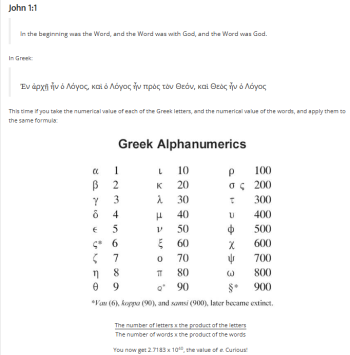
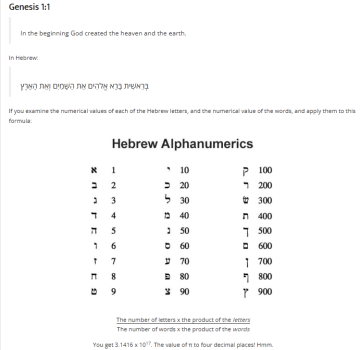
That same GOD through His Bible embedded Maths Pi RATIO into Gen 1:1, & Maths e RATIO into John 1:1
Do you know of an equivalent like for like occurence anywhere else ?
If so, please list it.
.

1781666560628.png

1781666593304.png