The Rich Young Ruler

  • Welcome to Christian Forums, a Christian Forum that recognizes that all Christians are a work in progress.

    You will need to register to be able to join in fellowship with Christians all over the world.

    We hope to see you as a part of our community soon and God Bless!

Hiddenthings

Well-Known Member
May 19, 2025
3,777
415
83
Leeton NSW
Faith
Christian
Country
Australia
Matthew 19:16–30, Mark 10:17–31, and Luke 18:18–30

“Behold!” Matthew begins (KJV), as if to say, “Now here is a story truly worth telling!”

The man who approaches Jesus is described as young (Matthew), yet already a ruler (Luke), which, in light of John 3:1, likely means he was a member of the Jewish Sanhedrin, not merely a ruler of a synagogue (which would likely have been specified if so). This detail speaks volumes about him: for someone so young to be appointed to such a respected body of wise and experienced leaders, he must have been a man of outstanding ability and exceptional character.

And indeed, his character was remarkable. He was willing to humble himself and seek guidance from Jesus of Nazareth, a controversial figure, and even ran to catch up with Jesus as he was about to continue on his journey (Mark). His eagerness is unmistakable.

Upon reaching Jesus, he knelt before Him (Mark) and asked with deep sincerity:

"Good Teacher" (Mark, Luke), "what good thing" (Matthew) "must I do to inherit eternal life?" (Luke 10:25).

This question reveals his earnestness, and his worldview.

Here stands an example of the finest kind of devout Jew (@dak), one who genuinely sought to attain righteousness through the works of the law (Romans 9:31–32).

Romans 9:31–32 but that Israel who pursued a law that would lead to righteousness did not succeed in reaching that law. 32 Why? Because they did not pursue it by faith (Abraham!), but as if it were based on works. They have stumbled over the stumbling stone,

It's unlikely he had heard Jesus’ words: “Blessed are the meek, for they shall inherit the earth” (Matthew 5:5), and almost certainly he wasn’t present a short time later when Jesus declared at the prospect of judgment: “Come, you who are blessed by my Father, inherit the kingdom prepared for you from the foundation of the world” (Matthew 25:34).

Neither of these blessings, however, applied to this rich ruler. The first referred to the meek, a term drawn from the Old Testament to describe the lowly, humble, and often overlooked, yet devout individuals within Israel. The second commendation was for those who had lived righteously without even realizing they had done so, people not conscious of their good deeds, but who had acted out of genuine compassion and faith (by promise).

TBC...
 

Hiddenthings

Well-Known Member
May 19, 2025
3,777
415
83
Leeton NSW
Faith
Christian
Country
Australia
A Mistaken Approach

There was little encouragement, then, for this earnest seeker of righteousness in Jesus’ reply: “Why do you call me good? There is none good but one, God.” At first glance, the words might seem harsh, but they were necessary. A man inherits what naturally comes to him, his fallen nature from Adam. With this brief but pointed comment on the word “good,” Jesus shifted the entire conversation into proper perspective. True, essential goodness isn't attainable by human effort. Only God is inherently good (Psalm 22:3), and only He can impart that goodness. If someone sets out to earn eternal life by their own merit, they are chasing an impossible goal.

Jesus exemplified one who sought...

Romans 2:7 "to those who by patience in well-doing seek for glory and honor and immortality, he will give eternal life;"


This response from Jesus also carries a profound and unsettling implication about himself. He, who once asked, “Which of you convicts me of sin?”, now appears to deny possessing the absolute goodness that belongs solely to God. The man had assumed that, through committed effort, one could achieve moral perfection. Jesus challenged that assumption head-on: “Not even I, bound by the same human inheritance from Adam, claim that kind of goodness.” This was a striking statement. It's understandable why some in the early Church, moving increasingly toward a Trinitarian understanding of Christ, might have been tempted to revise the manuscripts here.

There is, however, a very different interpretation that some have suggested: “Do you realize what you're saying? Only God is good, yet you’re calling me good!” But the context and the direction of the conversation rule out this interpretation. It doesn’t address the man’s question, nor does it align with the way Jesus continued the discussion.

Further complicating the issue is a different reading found in Matthew: “Why do you ask me about what is good?” (Revised Version). This variation should be dismissed, if only because it creates contradiction between the Gospels. The textual evidence against this reading is overwhelming. Not only do all known manuscripts of Mark and Luke omit it, but in Matthew itself, twenty early church Fathers and Versions (from the 2nd to 6th centuries), along with nearly all manuscripts, support the more familiar reading. The preference for this variant in modern versions seems driven more by adherence to a textual theory than by solid evidence.

TBC
 

JohnDB

Well-Known Member
Feb 7, 2010
5,879
3,759
113
TN
Faith
Christian
Country
United States
Gender
Male
There was little encouragement, then, for this earnest seeker of righteousness in Jesus’ reply: “Why do you call me good? There is none good but one, God.” At first glance, the words might seem harsh, but they were necessary. A man inherits what naturally comes to him, his fallen nature from Adam. With this brief but pointed comment on the word “good,” Jesus shifted the entire conversation into proper perspective. True, essential goodness isn't attainable by human effort. Only God is inherently good (Psalm 22:3), and only He can impart that goodness. If someone sets out to earn eternal life by their own merit, they are chasing an impossible goal.
Jesus was asking the wealthy man if he was indeed calling him the Messiah/God.

Because EVERYONE who did received a blessing that only God could give.

And he blew it....
Because he was not one of the "Born from Above". He was devout. He kept the Law. It was possible for him to do so because he was wealthy....but then came the hook.
He trusted his wealth to continue to be righteous before God....not Jesus....who he did not see as God. And because of that....he blew his chance at eternal life. The poor ALWAYS had a very difficult time following the Law.
 

JohnDB

Well-Known Member
Feb 7, 2010
5,879
3,759
113
TN
Faith
Christian
Country
United States
Gender
Male
There was little encouragement, then, for this earnest seeker of righteousness in Jesus’ reply: “Why do you call me good? There is none good but one, God.” At first glance, the words might seem harsh, but they were necessary. A man inherits what naturally comes to him, his fallen nature from Adam. With this brief but pointed comment on the word “good,” Jesus shifted the entire conversation into proper perspective. True, essential goodness isn't attainable by human effort. Only God is inherently good (Psalm 22:3), and only He can impart that goodness. If someone sets out to earn eternal life by their own merit, they are chasing an impossible goal.
Jesus was asking the wealthy man if he was indeed calling him the Messiah/God.

Because EVERYONE who did received a blessing that only God could give.

And he blew it....
Because he was not one of the "Born from Above". He was devout. He kept the Law. It was possible for him to do so because he was wealthy....but then came the hook.
He trusted his wealth to continue to be righteous before God....not Jesus....who he did not see as God. And because of that....he blew his chance at eternal life. The poor ALWAYS had a very difficult time following the Law.
 

Hiddenthings

Well-Known Member
May 19, 2025
3,777
415
83
Leeton NSW
Faith
Christian
Country
Australia

Christ’s First Answer​

Jesus first responded by pointing back to the commandments: “You know the commandments” (Mark, Luke). “If you want to enter into life, keep the commandments” (Matthew).

The questioner pressed further: “Which commandments?” (Matthew).

Jesus then repeated the final six commandments of the Decalogue, with the tenth expressed as “Do not defraud” (Mark) meaning, “Do not withhold what belongs to another.” This may have been a subtle rebuke of wealth gained at the expense of the poor or exploited workers. As later studies will show, the phrase has a special significance beyond this immediate setting.

Luke’s account intriguingly reverses the order of commandments six and seven, and Jesus’ answer at first seems to encourage the ruler’s assumption that law-keeping was the path to eternal life. But any misunderstanding was quickly corrected by what followed.

The young man may have felt a moment of relief: “Is that all? I have always lived this way.” Yet Jesus added more: “Love your neighbor as yourself” (Matthew). Luke’s phrase “these things” (Luke 18:22) suggests a two-part response.

Still confident, the man replied: “All these I have kept from my youth” (Mark, Matthew). His wording implied strict diligence, though perhaps more for his own righteousness (@dak) than for God’s glory. His phrase “from my youth” referred to his Bar-Mitzvah, when he became responsible for the commandments. To him, Jesus’ requirements so far seemed basic. Surely there must be something greater, some higher act of devotion, yet to attempt?

So he asked: “What do I still lack?” (Matthew). His words echo Psalm 39:4 in the Greek: “Let me know my end, and the measure of my days.” In the Hebrew it reads: “Let me know how frail I am.” Perhaps this was intentional, since the psalm continues: “Behold, you have made my days a handbreadth… surely every man is a mere breath before you” reflecting his search for eternal life.

Remarkably, the psalm also speaks of one chastened for sin, fading like a moth, and confessing: “I am a stranger with you, a sojourner, as all my fathers were” (Psalm 39:11–12). The encounter of this earnest seeker with Jesus seems almost foreshadowed there.

What was it about this young man that drew Jesus’ heart? “Jesus looked at him and loved him” (Mark). This expression of deep affection is rare, elsewhere it describes Jesus’ special bond with John and with the beloved family in Bethany.

TBC
 

Hiddenthings

Well-Known Member
May 19, 2025
3,777
415
83
Leeton NSW
Faith
Christian
Country
Australia

A Second Answer​

With evident reluctance, Jesus now placed before the young man a far sterner demand: “One thing you lack” (Mark). “If you would be perfect, mature, truly complete” (Matthew), “go, sell all you have and give to the poor, and you will have treasure in heaven. Then come, follow me” (Luke).

This was a challenge that went far beyond keeping the negative commands of the Law. The young man had asked, “What must I do?” Now the answer stood before him: he must act, or fall short. It was a call to discipleship of the highest order, perhaps even preparation for filling the place soon to be vacated by Judas, a self-denying rich man to replace one enslaved by money.

The demand was staggering, at least equal to what had been required of the twelve (Matthew 19:27), and it strongly reinforced the call to love one’s neighbor. It echoed one of Jesus’ least-quoted and most neglected commands, the uncompromising ideal: “Sell what you have and give alms; provide yourselves purses that do not grow old, a treasure in heaven that does not fail” (Luke 12:33).

Yet not all wealthy disciples were given such a command, and Zacchaeus, for instance, was commended for pledging half his wealth to the poor (Luke 19:8). Why then did Jesus ask so much more of this eager seeker than of others close to him? The common explanation, that he loved wealth too much, does not fully suffice, for that is true of most people.

A fuller explanation belongs to another study, but here it is important to note: Jesus was not content to stress love for one’s neighbor alone. He also required love for God, summed up in the call: “Come, follow me.”

This was the heart of his demand. In saying, “One thing you lack,” Jesus was alluding to Psalm 23, though with a telling difference: “The Lord is my shepherd; I lack nothing” (LXX). For this young man, the one thing truly lacking was precisely that, “The Lord is my shepherd.” Hence the invitation: “Come, follow me!”

@dak

The Rich Young Ruler, remaining within the camp under Torah, could never find salvation. That is a sobering reality! If you were raised under Torah and couldn't grasp the implications of stepping outside the camp, the realization should leave you utterly astonished.

So Jesus also suffered outside the gate in order to sanctify the people through his own blood. Therefore let us go to him outside the camp and bear the reproach he endured. Hebrews 13:12–13

Jesus was crucified outside the city walls of Jerusalem. The rabbis regarded Jerusalem as “the camp of God,” patterned after the encampment of the twelve tribes in the wilderness. Their symbolism went further still: the city as a whole was seen as the camp of Israel; the temple represented the tabernacle of Moses; and the Most Holy Place in the temple corresponded to the Most Holy Place in the tabernacle.

Thus, Jesus’ suffering “outside the camp” carried profound significance. It may well have been in mind when he told the Samaritan woman: “Believe me, woman, the hour is coming when you will worship the Father neither on this mountain nor in Jerusalem… But the hour is coming, and is now here, when the true worshipers will worship the Father in spirit and truth, for the Father is seeking such people to worship him” (John 4:21, 23).

I am unable to show you the city Abraham sought by faith (Heb 13:14) as this subject is not in the Torah, but when you are ready it's a wonderful vision!
 

Hiddenthings

Well-Known Member
May 19, 2025
3,777
415
83
Leeton NSW
Faith
Christian
Country
Australia
The Great Refusal

The Lord’s challenge was more than the young ruler could bear. His expression darkened (Mk.cf. Mt. 16:3) as he quickly weighed the cost of what Jesus demanded. In effect, his heart cried out, “No, Jesus, no! That is too much to ask.” With sorrow etched on his face, he turned away, burdened and unwilling. Wycliffe’s rendering “he was full sorry” captures it well, for this man was not merely comfortable; he was exceedingly wealthy.

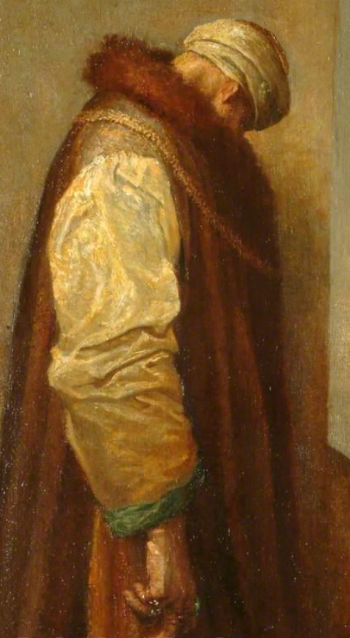
Watt’s famous painting in the Tate Gallery captures the scene perfectly:

1756267105221.png

the ruler clothed in costly garments, his robe tailored to perfection, a jeweled turban upon his head, rings adorning his fingers. With one hand covering his face, he turns away before him, nothing but a blank wall.

If only he had invited Jesus and the twelve to his home for the Sabbath meal, how much easier it might have been to embrace the Lord’s call. But he did not. Instead, Jesus would later dine with Zacchaeus and hear from him a joyful renunciation of wealth.

This refusal grieved the Lord deeply. His eyes lingered for a moment on this earnest seeker, bound by worldly possessions. Then he turned deliberately to his disciples with a penetrating gaze: “How hard it is for those who have riches to enter the kingdom of God”, and Judas was among those who heard.

Jesus did not need personal wealth to recognize the destructive power of riches. He had seen again and again how “the deceitfulness of riches” could choke spiritual life (Mt. 13:22). Later, Paul would echo the same concern, instructing Timothy: “Charge those who are rich in this present world not to be arrogant nor to put their hope in uncertain riches, but in the living God, who richly provides us with everything to enjoy.” Instead, they were to live “rich in good works,” marked by generosity and fellowship with those in need. In this way the wealthy could “lay up treasure for themselves as a firm foundation for the coming age,” exchanging uncertain wealth for the certainty of eternal life (1 Tim. 6:9-10, 17-19).
 

Hiddenthings

Well-Known Member
May 19, 2025
3,777
415
83
Leeton NSW
Faith
Christian
Country
Australia
Startled Disciples

Though accustomed to the revolutionary character of their Master’s teaching, the disciples were nonetheless staggered (Mark) at this pronouncement. To ensure they understood it was no mere parable, no hyperbolic flourish, Jesus repeated it with unmistakable clarity: “Children”, a word of affectionate regard, not rebuke, acknowledging the sacrifices they had already made “how hard it is for those who trust in riches to enter the kingdom of God!” (Mark).

This principle is sweeping, almost uncomfortably so, for the number of those who place their trust in wealth mirrors almost exactly the number who possess it. Centuries before, a man of God had glimpsed this truth in perspective: “Those who trust in their wealth and boast in the multitude of their riches, none of them can redeem his brother, nor give a ransom to God for him… for the redemption of life is costly, and must be left for another age, until the Redeemer comes” (Psalm 49:6–8).

The reality is sobering: wealth, in its allure and security, can so easily ensnare the heart, obscuring the path to that kingdom which is freely offered to all who surrender and follow.