THE RADIO
As far as I can remember, the radio was always on top of grandfather's oak cabinet downstairs in the basement. The basement in our house in Chappaqua, N.Y., was a lonely, quiet place of boxed up memories of the past. A place of boxed up stuff, this-and-thats, decorations, furniture pieces, whatnots that somehow did not make it upstairs to the living room. Things that found a place in our house in Elmhurst, N.Y.C., now slumber in silent solitude within 4 concrete walls.
I had gone up and down the wooden steps that led to the basement many times during my childhood there in Chappaqua. At the bottom of the steps to the left stood about 5 metal shelves where my parents stacked all kinds of canned goods, right next to those shelves were the washer, dryer, and sink where mom would do the wash.
A fuse box that held the old type circular screw on-and-off fuses found its place against the concrete wall next to the sink. Quite a few times I remember my dad changing a fuse or two that had given up their ghosts.
Across from the washer and dryer were the oil burner and hot water heater. In between those two downstairs residents stood Grandma's two-wheeled shopping basket, no longer in use. It just stood there as a reminder of the many trips she must have taken back and forth from the local food markets in New York City so many years ago.
On the other side of the basement, there were boxes and boxes of things like old Good Housekeeping magazines, Field and Stream magazines, piano sheet music that belonged to my mom, Eskimo garb, and Grandma and Grandpa's “1906” trunk. This was the trunk that they used when they came to America from the “Old Country. I say “1906” because stuck to the bottom of the trunk was a piece of newspaper with that date under the headline.
The basement was divided in half by a center concrete wall. On the other side of it, Dad had built me a “train table” where his Lionel trains lay, lined up on the train track. I used to turn on the power and run them for a while, putting “smoke pills” in the chimney of the locomotive and watching the engine belch out puffs of white smoke. These trains were one of those “hand-me-downs” that fathers sometimes give to their sons. I saw some more trains in other boxes that somehow never left their cardboard housing. Those were the ones Dad bought back in the 1930s.
At the other end of the basement was the wall that divided our house from the great outdoors.
Right next to the back-yard door was my wooden toy-chest with outgrown toys, some broken, some still in good shape. Once outside there was a steep hill that ended at an oak tree and my swing set. This was especially good during winter when there was icy snow. I would “belly-flop” and slide down the hill on my belly until I stopped at the swing-set.
On the other side of the back-yard door was grandpa's oak cabinet with 4 pull-out drawers. The bottom two would open vertically, the top two would open horizontally. The bottom two had
a piece of cardboard wedged between to keep them close since the key was lost long ago. I don't recall much of the contents of that oak cabinet, only that the bottom part had a shoe box with some silverware with the monogram “P” and the date “November 1914” engraved on the knives, forks, and spoons. This was the date of Grandma and Grandpa's wedding.
In the top-left drawer was a folded-up ship's flag with the stars and stripes and an anchor amidst the stars. This belonged to the Texaco Tanker “Ohio” when grandpa was captain back in the 1930s. Guess he took it as a keepsake.
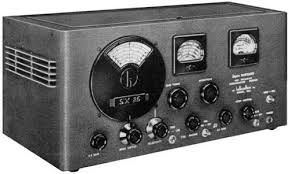
On top of the cabinet sat “The Radio”. It was unlike our small yellow plastic kitchen counter radio, which had a clock-face and a swivel dial that was permanently set to WFAS-1230 AM. The radio in the basement came in two parts. There were two black, metal boxes, one on top of the other. The larger one was full of knobs and switches with three half-moon windows with lines and numbers on their faces. Below the windows were two large dials with the markings “main tuning” and “band-spread”. On the main tuning dial was the letter “h” and the letters and numbers SX-25.
The other knobs and switches had other letters on them like BFO, AF Gain, and RF Gain. The speaker lay inside of the smaller black box on top of the radio. The back was hollow with just some folded-up wires hanging out. The radio just sat there with the three half-moon yellow eyes staring lifelessly at the iron food shelf which stood across the room.
I imagine that in the years past, these dials must have lit up many times with the speaker vibrating with music from the Benny Goodman band, the Andrew Sisters, the Amos and Andy show, and news from different announcers. I can imagine the famous speech made by President Roosevelt coming through the speaker of that radio so many years ago; “Yesterday, December 7th, 1941, is a day that will live in infamy.......”. My dad told me about that day, which was the day he was recalled into the army for extended service.
Now it was still, a quiet sentinel of the past, now a home for spiders and dust. I had passed by that radio many times on my way out the basement door to the back yard. I often wondered what it would sound like with the switch turned to “on”. I tried it once, but the radio remained silent, dead to the world, a quiet ghost of past melodies, songs, and news broadcasts.
Then came the day when I found myself looking at the radio when my dad came downstairs. He came behind me and put his hands on my shoulders and said;
“That's a Hallicrafters SX-25 Communications receiver, a short-wave radio. It can pick up radio stations from all over the world. I bought it way back in 1937.”
He continued to tell me how he used to tune in stations from different parts of the world. He especially listened to “HAMS” (amateur radio operators). He told me how once he heard a “HAM” transmitting from “Little America” (The South Pole).
“I hope I can do that too someday, dad, hear stations from other parts of the world,” I told him. I was really interested in this now. I can't really recall, but this was around 1966 when we had that short conversation.
“Maybe someday, Jimmy” he responded with a smile, “Maybe someday.”
Moving day came early in June 1966. School had let out, and I was a 6th-grade graduate, ready to go into Jr. High. The Santini brothers ‘moving van came and packed up all of our stuff, all the odds and ends, furniture, etc., including Dad's radio. All went into new boxes, they went on the truck, and we said our final “goodbye” to Chappaqua, N.Y.
We moved to Yorktown Heights, N.Y. My parents enrolled me in Yorktown Jr. High School, and after that, I sat back to enjoy the rest of the summer. Our new house in Yorktown Heights didn't exactly have a basement; it had what one could call a “downstairs den”. All our stuff was offloaded, and Grandpa's oak cabinet ended up next to the house-entrance door in the back of our two-car garage. Beside the cabinet was his “1906 trunk”, but there was no sign of the radio.
As far as I can remember, the radio was always on top of grandfather's oak cabinet downstairs in the basement. The basement in our house in Chappaqua, N.Y., was a lonely, quiet place of boxed up memories of the past. A place of boxed up stuff, this-and-thats, decorations, furniture pieces, whatnots that somehow did not make it upstairs to the living room. Things that found a place in our house in Elmhurst, N.Y.C., now slumber in silent solitude within 4 concrete walls.
I had gone up and down the wooden steps that led to the basement many times during my childhood there in Chappaqua. At the bottom of the steps to the left stood about 5 metal shelves where my parents stacked all kinds of canned goods, right next to those shelves were the washer, dryer, and sink where mom would do the wash.
A fuse box that held the old type circular screw on-and-off fuses found its place against the concrete wall next to the sink. Quite a few times I remember my dad changing a fuse or two that had given up their ghosts.
Across from the washer and dryer were the oil burner and hot water heater. In between those two downstairs residents stood Grandma's two-wheeled shopping basket, no longer in use. It just stood there as a reminder of the many trips she must have taken back and forth from the local food markets in New York City so many years ago.
On the other side of the basement, there were boxes and boxes of things like old Good Housekeeping magazines, Field and Stream magazines, piano sheet music that belonged to my mom, Eskimo garb, and Grandma and Grandpa's “1906” trunk. This was the trunk that they used when they came to America from the “Old Country. I say “1906” because stuck to the bottom of the trunk was a piece of newspaper with that date under the headline.
The basement was divided in half by a center concrete wall. On the other side of it, Dad had built me a “train table” where his Lionel trains lay, lined up on the train track. I used to turn on the power and run them for a while, putting “smoke pills” in the chimney of the locomotive and watching the engine belch out puffs of white smoke. These trains were one of those “hand-me-downs” that fathers sometimes give to their sons. I saw some more trains in other boxes that somehow never left their cardboard housing. Those were the ones Dad bought back in the 1930s.
At the other end of the basement was the wall that divided our house from the great outdoors.
Right next to the back-yard door was my wooden toy-chest with outgrown toys, some broken, some still in good shape. Once outside there was a steep hill that ended at an oak tree and my swing set. This was especially good during winter when there was icy snow. I would “belly-flop” and slide down the hill on my belly until I stopped at the swing-set.
On the other side of the back-yard door was grandpa's oak cabinet with 4 pull-out drawers. The bottom two would open vertically, the top two would open horizontally. The bottom two had
a piece of cardboard wedged between to keep them close since the key was lost long ago. I don't recall much of the contents of that oak cabinet, only that the bottom part had a shoe box with some silverware with the monogram “P” and the date “November 1914” engraved on the knives, forks, and spoons. This was the date of Grandma and Grandpa's wedding.
In the top-left drawer was a folded-up ship's flag with the stars and stripes and an anchor amidst the stars. This belonged to the Texaco Tanker “Ohio” when grandpa was captain back in the 1930s. Guess he took it as a keepsake.
On top of the cabinet sat “The Radio”. It was unlike our small yellow plastic kitchen counter radio, which had a clock-face and a swivel dial that was permanently set to WFAS-1230 AM. The radio in the basement came in two parts. There were two black, metal boxes, one on top of the other. The larger one was full of knobs and switches with three half-moon windows with lines and numbers on their faces. Below the windows were two large dials with the markings “main tuning” and “band-spread”. On the main tuning dial was the letter “h” and the letters and numbers SX-25.
The other knobs and switches had other letters on them like BFO, AF Gain, and RF Gain. The speaker lay inside of the smaller black box on top of the radio. The back was hollow with just some folded-up wires hanging out. The radio just sat there with the three half-moon yellow eyes staring lifelessly at the iron food shelf which stood across the room.
I imagine that in the years past, these dials must have lit up many times with the speaker vibrating with music from the Benny Goodman band, the Andrew Sisters, the Amos and Andy show, and news from different announcers. I can imagine the famous speech made by President Roosevelt coming through the speaker of that radio so many years ago; “Yesterday, December 7th, 1941, is a day that will live in infamy.......”. My dad told me about that day, which was the day he was recalled into the army for extended service.
Now it was still, a quiet sentinel of the past, now a home for spiders and dust. I had passed by that radio many times on my way out the basement door to the back yard. I often wondered what it would sound like with the switch turned to “on”. I tried it once, but the radio remained silent, dead to the world, a quiet ghost of past melodies, songs, and news broadcasts.
Then came the day when I found myself looking at the radio when my dad came downstairs. He came behind me and put his hands on my shoulders and said;
“That's a Hallicrafters SX-25 Communications receiver, a short-wave radio. It can pick up radio stations from all over the world. I bought it way back in 1937.”
He continued to tell me how he used to tune in stations from different parts of the world. He especially listened to “HAMS” (amateur radio operators). He told me how once he heard a “HAM” transmitting from “Little America” (The South Pole).
“I hope I can do that too someday, dad, hear stations from other parts of the world,” I told him. I was really interested in this now. I can't really recall, but this was around 1966 when we had that short conversation.
“Maybe someday, Jimmy” he responded with a smile, “Maybe someday.”
Moving day came early in June 1966. School had let out, and I was a 6th-grade graduate, ready to go into Jr. High. The Santini brothers ‘moving van came and packed up all of our stuff, all the odds and ends, furniture, etc., including Dad's radio. All went into new boxes, they went on the truck, and we said our final “goodbye” to Chappaqua, N.Y.
We moved to Yorktown Heights, N.Y. My parents enrolled me in Yorktown Jr. High School, and after that, I sat back to enjoy the rest of the summer. Our new house in Yorktown Heights didn't exactly have a basement; it had what one could call a “downstairs den”. All our stuff was offloaded, and Grandpa's oak cabinet ended up next to the house-entrance door in the back of our two-car garage. Beside the cabinet was his “1906 trunk”, but there was no sign of the radio.
Last edited: