DEUTERONOMY 1:1-3:22 "Devarim" (Words)
We start the final book of the original 5 books of the Torah, in which Moshe wrote down all the statutes, commandments, precepts, details, etc. that Adonai dictated to him. We must remember that the Children of Israel received the first 10 commandments directly from the mouth of Adonai, written down in stone, and given to the people, as a form of “Ketubah” or “marriage contract. Later, Adonai called Moshe back up to the mountain and there, dictated the rest of Torah, the rest of the 603 commandments, which were written on the scrolls. The Last book, "Devarim" or "Deuteronomy," was begun by Moses, and Joshua or another elder finished it because it speaks of Moses' death. Even in the beginning of the book, the speaker uses 3rd person "Moses," so it might be possible that the introduction was written after Moses' death.
The Greek word is "Deutero" (two, or second) and "Nomos' (Law), which is used in the Septuagint, indicates a "Repetition" of the Law or Torah. The emphasis is on reminding the 2nd generation of what God gave their forefathers upon leaving Egypt. The second generation's oldest would have been 59 years old at this time, since all 20 years and older would have died in the desert, so, 40 years later, 19 + 40 = 59. They have to be reminded of the errors of their fathers, so as not to commit the same mistakes. At least, this was the purpose (we know otherwise)
We should always read and re-read, study and study God's Holy Writ, because we always learn new things. We are reminded of things we forget. We must always remember 2 Tim 3:16:
All Scripture is God-breathed and is useful for teaching, rebuking, correcting, and training in righteousness.
Rabbi Shammai wrote in Mishnah 15 in "Ethics of the Fathers" (A part of the Talmud) the following: Make the study of Torah (The Bible) a fixed habit, say little and do much." Another writer of "Ethics of the Fathers" wrote: "Turn it (The Torah/Bible) over and over again, for everything is in it, and contemplate it, and grow old and gray over it, and stir not from it, for you can have no better rule than this." (Ben Bag Bag)
Just as we have Bible commentaries written by Christians, there is also the Talmud, which is a compilation of Jewish thought and commentary on God's Word. Yet we always need to trust in the Holy Scriptures as our teacher; commentaries are just thoughts by their writers.
The book relates the travels and experiences that “Am Yisrael” took and went through in 40 years. Moshe retells the experience somewhat as a father would relate to his son. Let’s say that father and son travel across the USA for 6 months; then, perhaps 10 years later, the father would remind the son of their trip by remembering their “experiences.” “Remember, son, the time when we were traveling through Texas and, well, you insisted on exploring that abandoned house, even when I said it would NOT be a good idea…….”
The father tells both the good experiences and the bad experiences, the times when the son obeyed and the times when the son disobeyed. Moshe is doing the same thing. This is similar to last week’s parashah “Masei” (journeys) in which Moshe relates the journeys of Israel.
An interesting midrash is the difference and similarity between two words; “D’varim” (words) and “D’vorim” (bees) One could say that the words that Moshe spoke to the Israelites were like the “stings of bees” and after giving this message, a little later on, Moshe went up Mt. Pisgah a died, just like when a bee stings, it leaves the stinger in the victim and dies.
What can we learn from the beginning of D’varim? Are we mature enough to receive rebuke? From elders? From others who are in authority? When a believer or even a non-believer is rebuked, it is for his or her own good, either to bring that person to the knowledge of Messiah Yeshua, or to turn that person from error to walk in harmony with the Torah. Moshe tells the people the words of Adonai:
“YHVH your Elohim spoke to us in Horeb saying, 'You have dwelt long enough in this mountain…turn you and take your journey…. (1:6)
It seems that the Children of Yisrael were in their “comfort zone”. They were at Mt. Horeb. Perhaps they wanted to stay right there, yet it was NOT the promised land. It was where they received the Torah; it was where they received instruction, but now they have to go to where Adonai wanted them to go.
It is like being in college and studying a career; sooner or later, you will have to graduate and put your knowledge to work, leave your college, and get a job. You might be studying to be a rabbi or pastor, and you get your Bible degree; now, you need to teach and practice what you have learned in some congregation.
Now here is something interesting. The word "Horeb" is written (in the Hebrew language) with just three letters (H +R +B) the vowels are not written as letters, but as "dots" and "dashes." The same letters (H + R + B) are used to write the word "Cherev," which means "Sword," yet the vowels are different. The relationship between "Horeb" and "Cherev" (the "b" and "v") is the same letter, is that; "If you (Israel) will follow my Torah and commandments you received at "Horeb" when you get to the Promised land, then blessings will follow; if not, then the "Sword" (Cherev) will follow YOU!
We could say that even today, when we follow God's Word, blessings will follow, yet if we walk in disobedience, what can we expect? only disaster, curses, jail, illness, etc...(The "Sword of the LORD" will catch up to us)
Now, the Israelites were right at the border of Moab and Canaan; the Jordan River separated the two nations. It was time to leave their “comfort zone” and “cross over” and conquer the pagan peoples, and lay claim to the land! They had fought giants before, you know; the bigger they are, the harder they fall, especially if Adonai “falls” them.
Remember that it all starts in Egypt (Mitzraim) the land of “restriction”, Moshe leads them out, symbolizing a sort of Messiah, leading them to Mt Sinai, they receive the Torah, for 40 years they undergo instruction, go through both “good times” and “bad times” sometimes, “very bad times” when YHVH chastised and killed many of them for disobedience and rebellion. Yet now, it is time for the promise to be fulfilled, the “Promised Land”
We go through the same thing in our lives. We start out being liberated from our “Egypt”; we are liberated from the “lost world and the ways of the lost” by accepting Yeshua as our Messiah and LORD. We grow in faith, in spiritual maturity, or…perhaps fail in our relationship with YHVH, going through valleys and dark places, yet always emerging into the light of Torah again. Sometimes we get comfortable in one place, or doing one thing. Yet, God is saying…” turn now and take your journey” or “continue your journey and continue to grow in faith, expose yourself to different “stuff,” “situations, ' yet always trusting in HaShem.
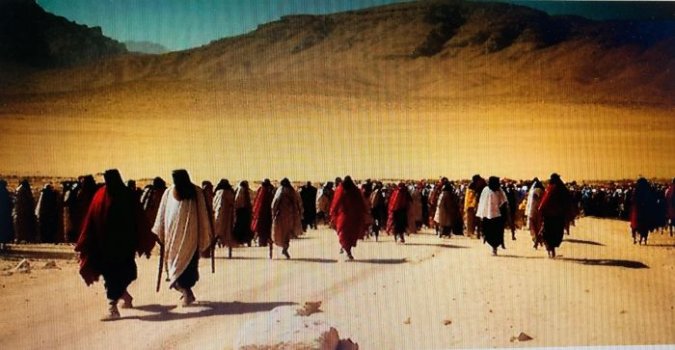
As the Israelites traveled in the desert, moving from place to place for 40 years, they were always maintained by God. They never lacked anything.
Remember that we, as believers, will travel in our lives, perhaps from place to place, or from transition to transition, from babyhood to childhood, to adolescence, to teen years, to adulthood, to seniorhood, from school to job, to marriage and family, and finally, to death. These are our life's transitions. The LORD will always guide us and will greet us at the "homecoming" to our "Canaan" in HIS Heavenly realm.
Walking our life's journeys
We start the final book of the original 5 books of the Torah, in which Moshe wrote down all the statutes, commandments, precepts, details, etc. that Adonai dictated to him. We must remember that the Children of Israel received the first 10 commandments directly from the mouth of Adonai, written down in stone, and given to the people, as a form of “Ketubah” or “marriage contract. Later, Adonai called Moshe back up to the mountain and there, dictated the rest of Torah, the rest of the 603 commandments, which were written on the scrolls. The Last book, "Devarim" or "Deuteronomy," was begun by Moses, and Joshua or another elder finished it because it speaks of Moses' death. Even in the beginning of the book, the speaker uses 3rd person "Moses," so it might be possible that the introduction was written after Moses' death.
The Greek word is "Deutero" (two, or second) and "Nomos' (Law), which is used in the Septuagint, indicates a "Repetition" of the Law or Torah. The emphasis is on reminding the 2nd generation of what God gave their forefathers upon leaving Egypt. The second generation's oldest would have been 59 years old at this time, since all 20 years and older would have died in the desert, so, 40 years later, 19 + 40 = 59. They have to be reminded of the errors of their fathers, so as not to commit the same mistakes. At least, this was the purpose (we know otherwise)
We should always read and re-read, study and study God's Holy Writ, because we always learn new things. We are reminded of things we forget. We must always remember 2 Tim 3:16:
All Scripture is God-breathed and is useful for teaching, rebuking, correcting, and training in righteousness.
Rabbi Shammai wrote in Mishnah 15 in "Ethics of the Fathers" (A part of the Talmud) the following: Make the study of Torah (The Bible) a fixed habit, say little and do much." Another writer of "Ethics of the Fathers" wrote: "Turn it (The Torah/Bible) over and over again, for everything is in it, and contemplate it, and grow old and gray over it, and stir not from it, for you can have no better rule than this." (Ben Bag Bag)
Just as we have Bible commentaries written by Christians, there is also the Talmud, which is a compilation of Jewish thought and commentary on God's Word. Yet we always need to trust in the Holy Scriptures as our teacher; commentaries are just thoughts by their writers.
The book relates the travels and experiences that “Am Yisrael” took and went through in 40 years. Moshe retells the experience somewhat as a father would relate to his son. Let’s say that father and son travel across the USA for 6 months; then, perhaps 10 years later, the father would remind the son of their trip by remembering their “experiences.” “Remember, son, the time when we were traveling through Texas and, well, you insisted on exploring that abandoned house, even when I said it would NOT be a good idea…….”
The father tells both the good experiences and the bad experiences, the times when the son obeyed and the times when the son disobeyed. Moshe is doing the same thing. This is similar to last week’s parashah “Masei” (journeys) in which Moshe relates the journeys of Israel.
An interesting midrash is the difference and similarity between two words; “D’varim” (words) and “D’vorim” (bees) One could say that the words that Moshe spoke to the Israelites were like the “stings of bees” and after giving this message, a little later on, Moshe went up Mt. Pisgah a died, just like when a bee stings, it leaves the stinger in the victim and dies.
What can we learn from the beginning of D’varim? Are we mature enough to receive rebuke? From elders? From others who are in authority? When a believer or even a non-believer is rebuked, it is for his or her own good, either to bring that person to the knowledge of Messiah Yeshua, or to turn that person from error to walk in harmony with the Torah. Moshe tells the people the words of Adonai:
“YHVH your Elohim spoke to us in Horeb saying, 'You have dwelt long enough in this mountain…turn you and take your journey…. (1:6)
It seems that the Children of Yisrael were in their “comfort zone”. They were at Mt. Horeb. Perhaps they wanted to stay right there, yet it was NOT the promised land. It was where they received the Torah; it was where they received instruction, but now they have to go to where Adonai wanted them to go.
It is like being in college and studying a career; sooner or later, you will have to graduate and put your knowledge to work, leave your college, and get a job. You might be studying to be a rabbi or pastor, and you get your Bible degree; now, you need to teach and practice what you have learned in some congregation.
Now here is something interesting. The word "Horeb" is written (in the Hebrew language) with just three letters (H +R +B) the vowels are not written as letters, but as "dots" and "dashes." The same letters (H + R + B) are used to write the word "Cherev," which means "Sword," yet the vowels are different. The relationship between "Horeb" and "Cherev" (the "b" and "v") is the same letter, is that; "If you (Israel) will follow my Torah and commandments you received at "Horeb" when you get to the Promised land, then blessings will follow; if not, then the "Sword" (Cherev) will follow YOU!
We could say that even today, when we follow God's Word, blessings will follow, yet if we walk in disobedience, what can we expect? only disaster, curses, jail, illness, etc...(The "Sword of the LORD" will catch up to us)
Now, the Israelites were right at the border of Moab and Canaan; the Jordan River separated the two nations. It was time to leave their “comfort zone” and “cross over” and conquer the pagan peoples, and lay claim to the land! They had fought giants before, you know; the bigger they are, the harder they fall, especially if Adonai “falls” them.
Remember that it all starts in Egypt (Mitzraim) the land of “restriction”, Moshe leads them out, symbolizing a sort of Messiah, leading them to Mt Sinai, they receive the Torah, for 40 years they undergo instruction, go through both “good times” and “bad times” sometimes, “very bad times” when YHVH chastised and killed many of them for disobedience and rebellion. Yet now, it is time for the promise to be fulfilled, the “Promised Land”
We go through the same thing in our lives. We start out being liberated from our “Egypt”; we are liberated from the “lost world and the ways of the lost” by accepting Yeshua as our Messiah and LORD. We grow in faith, in spiritual maturity, or…perhaps fail in our relationship with YHVH, going through valleys and dark places, yet always emerging into the light of Torah again. Sometimes we get comfortable in one place, or doing one thing. Yet, God is saying…” turn now and take your journey” or “continue your journey and continue to grow in faith, expose yourself to different “stuff,” “situations, ' yet always trusting in HaShem.
As the Israelites traveled in the desert, moving from place to place for 40 years, they were always maintained by God. They never lacked anything.
Remember that we, as believers, will travel in our lives, perhaps from place to place, or from transition to transition, from babyhood to childhood, to adolescence, to teen years, to adulthood, to seniorhood, from school to job, to marriage and family, and finally, to death. These are our life's transitions. The LORD will always guide us and will greet us at the "homecoming" to our "Canaan" in HIS Heavenly realm.
Walking our life's journeys