I believe Paul greatly influenced the writer so much I'd give Paul the majority credit. However, the Greek it was written in was of a higher degree of education, which matches Dr. Luke's writings in Luke and Acts. So, likely it was a sermon of Paul's that was written down by Dr. Luke. I believe the "Faith Chapter" was not Paul's but one of his companions, like Apollos, who could argue eloquently. So without naming anyone as a writer, the Hebrews letter was powerful on its own to be added to the bible. So, yes, I think the Apostle Paul's name should be on the letter if only because of the Pauline doctrine contained in it.
Your final statement is most important: for what if "Luke", (a.k.a. "the Physician"), is actually one of Paul's scribes? (or, as they say, amanuensis), like Tertius for the book of Romans? There is also strong evidence that the Gospel now called Luke may actually be the written Gospel account of Paul, (written through Luke, his scribe?), which he quotes from essentially verbatim to the Corinthians, (1Cor 11:23-25). I have touched on this in the thread
Paul's Gospel, but even if this high probability is incorrect we still have the fact that the Gospel of Luke is still, for all intents and purposes, the Gospel of Paul.
So we have the Gospel of Luke and the Epistle to the Hebrews reflecting the same Gospel as Paul's Gospel, and we have also the book of Acts which is in the same category as the Gospel of Luke, then we have the Gospel of Paul preached in the remainder of his Epistles. Thus we have not three but four mentions of the Psalm 2:7 decree in writings either from Paul or directly related to him.
The first account is the Codex Bezae version of the Luke immersion account:
Luke 3:22 Codex Bezae (D) Uncial Text
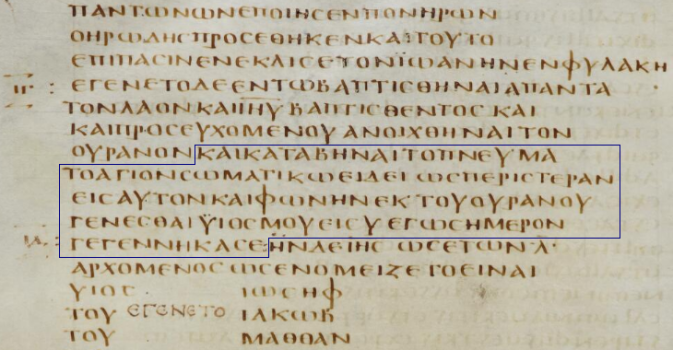
Luke 3:22 Codex Bezae (D) Uncial Text
22
ΚΑΙ ΚΑΤΑΒΗΝΑΙ ΤΟ ΠΝΕΥΜΑ ΤΟ ΑΓΙΟΝ ϹΩΜΑΤΙΚΩ ΕΙΔΕΙ ΩϹ ΠΕΡΙϹΤΕΡΑΝ ΕΙϹ ΑΥΤΟΝ ΚΑΙ ΦΩΝΗΝ ΕΚ ΤΟΥ ΟΥΡΑΝΟΥ ΓΕΝΕϹΘΑΙ ΫΙΟϹ ΜΟΥ ΕΙ ϹΥ ΕΓΩ ϹΗΜΕΡΟΝ ΓΕΓΕΝΝΗΚΑ ϹΕ
ΫΙΟϹ ΜΟΥ ΕΙ ϹΥ ΕΓΩ ϹΗΜΕΡΟΝ ΓΕΓΕΝΝΗΚΑ ϹΕ
You are My Son: this day I have begotten you
Luke 3:22 Codex Bezae (D) Minuscule Transcript
22
και καταβηναι το πνευμα το αγιον σωματικω ειδει ως περιστεραν εις αυτον και φωνην εκ του ουρανου γενεσθαι ϋιος μου ει συ εγω σημερον γεγεννηκα σε
ϋιος μου ει συ εγω σημερον γεγεννηκα σε
You are My Son: this day I have begotten you
Moreover what follows in the Luke account is that the Meshiah, being full of the holy Spirit, immediately goes into the wilderness for forty days to fast and pray and be tested/tempted by the Devil. Then, when the Devil left him, we read the following, again, for all intents and purposes, the Gospel of Paul.
Luke 4:14-21 KJV
14 And Jesus returned in the power of the Spirit into Galilee: and there went out a fame of him through all the region round about.
15 And he taught in their synagogues, being glorified of all.
16 And he came to Nazareth, where he had been brought up: and, as his custom was, he went into the synagogue on the sabbath day, and stood up for to read.
17 And there was delivered unto him the book of the prophet Esaias. And when he had opened the book, he found the place where it was written,
18
The Spirit of the Lord [Adonai YHWH, Isa 61:1] is upon me,
because he hath anointed me to preach the gospel to the poor; he hath sent me to heal the brokenhearted, to preach deliverance to the captives, and recovering of sight to the blind, to set at liberty them that are bruised,
19 To preach the acceptable year of the Lord.
20 And he closed the book, and he gave it again to the minister, and sat down. And the eyes of all them that were in the synagogue were fastened on him.
21
And he began to say unto them, This day is this scripture fulfilled in your ears.
The above no doubt speaks of the Meshiah, the Christos or Christ, the Anointed One: a man born of the seed of David according to the flesh, according to Paul's Gospel. Then we have also the Psalm 2:7 decree mentioned three more times: Acts 13:33, and the two instances from Heb 1:5 and 5:5.
The Codez Bezae version of Luke 3:22 is also found in a few of the older Latin texts which remain: the evidence for the timing of the decree spoken by the Father to the Anointed One, (which was at the immersion according to Bezae), is still there but getting harder and harder to find as time goes on.




