

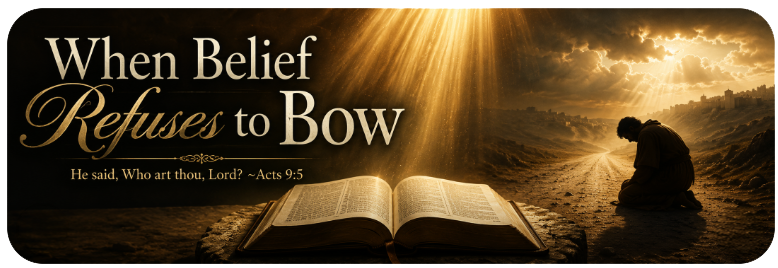
“He said, Who art thou, Lord?” ~Acts 9:5
Saul of Tarsus was not an unbelieving pagan who knew nothing about God. He was deeply religious, highly educated, confident, and convinced he was defending the truth. Yet he was wrong.
When Jesus Christ confronted him, Saul did not argue his position. He did not quote his teachers. He did not appeal to the religious system he had spent his life defending. He fell to the ground and asked, “Who art thou, Lord?”
That is where real belief begins.
The issue is not how strongly we believe something. A person can be completely sincere and completely wrong. Saul proved that. The issue is whether we are willing to bow when the Lord shows us from His Word that what we believe is wrong.
That is what this entire discussion about creeds and confessions comes down to.
There is nothing automatically wrong with writing down what we believe. A creed or confession may contain many true statements. It may even be a useful summary of what someone believes Scripture teaches. But it is still written by fallible men. It is not inspired. It is not God-breathed. It has no authority over the Word of God.
“All scripture is given by inspiration of God, and is profitable for doctrine, for reproof, for correction, for instruction in righteousness.” ~2 Timothy 3:16
Creeds are not given by inspiration of God. Confessions are not given by inspiration of God. Theological systems are not given by inspiration of God. Scripture alone has that authority.
The problem begins when a creed stops being a summary of what someone believes and becomes the filter through which Scripture must be interpreted. Instead of allowing the Bible to speak for itself, the meaning of Scripture is forced to fit conclusions that have already been decided.
At that point, the creed may still be called subordinate, but it is not subordinate in practice. It is controlling the interpretation.
We naturally want everything explained, organized, and settled. Once we place a teaching inside a theological system, we feel like we have control over it. We know where every verse belongs and what every passage is allowed to mean.
But God’s Word was not given to bow before our systems.
Our systems must bow before God’s Word.
Many people will say that Scripture is their final authority. But the real test comes when Scripture challenges something they have believed, defended, or taught for years. Will they admit that they may be wrong, or will they twist the passage to protect their position?
That is where pride is exposed.
A person may speak highly of Scripture while refusing to let Scripture correct him. He may claim Sola Scriptura while treating a creed, confession, denomination, or favorite teacher as the final word. He may accuse others, assign labels, mock their understanding, and declare that he has won the argument, yet never plainly answer the Scriptures placed before him.
None of that proves anything.
The question is still, “What saith the scripture?” ~Romans 4:3
The Bereans were called noble because they “searched the scriptures daily, whether those things were so.” ~Acts 17:11
They did not search a creed to see whether Paul agreed with it. They searched the Scriptures to see whether Paul was teaching the truth. Even an apostle’s preaching was tested by the written Word of God.
How much more should the writings of uninspired men be tested?
“Prove all things; hold fast that which is good.” ~1 Thessalonians 5:21
We are not commanded to hold fast to everything that has been handed down to us. We are commanded to prove everything and hold fast only to what is good.
That means a creed must be tested. A confession must be tested. A theological system must be tested. My beliefs must be tested. Your beliefs must be tested.
And the test is Scripture.
The greatest danger is not simply being wrong. All of us can misunderstand something. The real danger is being shown the truth and refusing to bow because our pride, reputation, group, or theological system matters more to us than what God has said.
Jesus said: “And this is the condemnation, that light is come into the world, and men loved darkness rather than light.” ~John 3:19
When the light of Scripture exposes something false in us, we have a choice. We can step into the light and admit we were wrong, or we can back away and keep defending ourselves.
Saul bowed.
He went from asking, “Who art thou, Lord?” to asking, “Lord, what wilt thou have me to do?” ~Acts 9:6
That is real submission.
It does not matter how old a creed is, how respected a confession may be, how many scholars defend a system, or how many people agree with us. If Scripture says one thing and all of them say another, Scripture is right and every one of them is wrong.
The mystery of believing is not merely understanding the truth.
It is being willing to bow when the truth proves us wrong.
“Woe is me” if the light of God’s Word is placed directly before me and I still refuse to bow.

