Idioms used in the Bible

  • Welcome to Christian Forums, a Christian Forum that recognizes that all Christians are a work in progress.

    You will need to register to be able to join in fellowship with Christians all over the world.

    We hope to see you as a part of our community soon and God Bless!

JustMe

Well-Known Member
May 6, 2025
1,172
1,333
113
US
Faith
Christian
Country
United States
Gender
Male
Idioms are expressions that have meanings other than what the words themselves communicate at face value. For example, you can “have your hands full” even with empty hands. If an idea is “over one’s head,” you don’t look toward the ceiling to find it. If someone has “let the cat out of the bag,” you don’t have to call animal control. These idioms are understood by experienced users of the English language to mean “busy,” “beyond comprehension,” and “revealed a secret,” respectively.

Idioms in the Bible can also significantly alter the context and interpretation of scripture, as they often carry meanings beyond their literal sense. For instance, the phrase "to bite the dust" in Psalms 72 is used metaphorically to mean failure or ceasing to exist, rather than a literal act of biting dust.

The English Bible has had a profound effect on the development of the English language. The phrasing, vocabulary, and cadences of the King James Version left a lasting impact on our culture. In fact, some of the Bible’s idioms have been adopted as idioms in English. Idioms that come straight from the Bible include the following:

Let me catch my breath. Meaning: “give me some time.” As Job is questioning the purposes of his suffering, he says of God, “He would not let me catch my breath but would overwhelm me with misery” (Job 9:18).

A drop in the bucket. Meaning: “a very small, insignificant amount.” In lifting up God as sovereign, Isaiah writes, “Surely the nations are like a drop in a bucket; they are regarded as dust on the scales; he weighs the islands as though they were fine dust” (Isaiah 40:15).

It's amazing how many times we have misunderstood scripture and even fought 'tooth and nail' to defend our cherished interpretation only to find out later we were ignorant and wrong, because we ignored the use and meanings of idioms in them.

So, if you are interested in getting scripture right, having the best interpretation, be on the look out for its idioms that can completely spin your head around, facing the opposite direction.
 
  • Like
Reactions: Matthias

JustMe

Well-Known Member
May 6, 2025
1,172
1,333
113
US
Faith
Christian
Country
United States
Gender
Male
Here are two complex hidden idioms, especially the first one introduced, that most will brush off and do not want to touch (in faith); pun intended as you will see. They are used to describe a fulfillment of prophecy by Jesus.

(Mal 4:2) But for you that honor my name, victory will shine like the sun with healing in its rays, and you will jump around like calves at play.
(CEV)

(KJV) But unto you that fear my name shall the Sun of righteousness arise with healing in his wings; and ye shall go forth, and grow up as calves of the stall.

(NEV) But to you who fear My name shall the sun of righteousness arise with healing in his rays. You will go out, and leap like calves of the stall.

In Luke, a woman was healed by touching the tassels of Jesus' priestly robe. She had been suffering from a hemorrhage for twelve years, and dying, and believed that if she could just touch Jesus' clothes, she would be healed. When she touched the tassels, her bleeding stopped immediately, and Jesus recognized that power (from his Father) had gone out from Him, affirming her faith and declaring her healed.

All three translations above are appropriate and correct. For those who honor or have reverence for the Father, in faith, he gives victory of healing through his Son who also have faith in him.

'In his wings' or 'the rays' means the priestly wings or edges or the hem part of the robe or garment of Jesus. In fact found on his wings, or outer edges or hem would be found tassels shaped as RAYS of the SUN. And the Sun being the Son of God. The one with the given power to heal and restore life.

The girl was healed for a blood from a hemorrhage by placing her faith by physically touching the tassels of the wings/edges/rays of Jesus' garment.

(Luk 8:41) And there came a man named Jairus, a ruler of the synagogue; and he fell down at Jesus' feet and begged him to come into his house.
(Luk 8:42) For he had an only daughter, about twelve years of age; and she was dying. But as he went, the crowds crushed him.
(Luk 8:43) And a woman who had suffered from chronic bleeding for twelve years, who had spent all her livelihood upon doctors and could not be healed by any,
(Luk 8:44) came behind him and touched the border of his garment; and immediately her bleeding stopped.
(Luk 8:45) And Jesus said: Who is it that touched me? And when all denied, Peter and they that were with him said: Master, the crowds press upon you and crush you.
(Luk 8:46) But Jesus said: Someone did touch me. For I perceived power going out from me.
(Luk 8:47) And when the woman saw that she was not hidden, she came trembling, and falling down before him, declared in the presence of all the people for what reason she touched him, and how she was healed immediately.
(Luk 8:48) And he said to her: Daughter, your faith has made you whole. Go in peace.

The woman/daughter from that point on, by the healing of Jesus, was as a lively calf in the stall, once again. Heathy and healed.

Complex as it might get : Again the rays of the sun or the wings of the righteous sun are regarded as sheer miraculous power, energy, bringing life and warmth upon the earth, and to mankind. It infers the tasseled rays of the righteous sun - Son, on the edges or wings of his garment is found miraculous power of healing, given to and through the Son of God, by his Father; who created both the physical Son from and of heaven, and the physical sun for the earth. Both given by the Father, for the benefit of mankind The first was the physical and earthly case, then the invisible and spiritual case.

Might need more time for all this to sink in...
 
Last edited:
  • Like
Reactions: Matthias

JustMe

Well-Known Member
May 6, 2025
1,172
1,333
113
US
Faith
Christian
Country
United States
Gender
Male
Another important family of idioms involve Jesus' words regarding himself and heaven.

These are the main scripture passages involved: Luke 20:4; John 3:12-13, 31-34; John 6:33, 38, 62-63; John 8:23, 26-29; John 13: 12-13, 31-32; John 16:27-28; and James 1:17

There are embedded idioms in all these passages. Again, they are not to be taken at face-value, or literally. They have deeper meaning that indicated who is/was Jesus, or where he came from, or really the source of Jesus' existence. And it's not speaking of a pre-existing past of Jesus either.

If you have not noticed it already, John loves to speak/write of idioms. He's the real deep thinker of the bunch. He loves symbolism, metaphorical, and imagery language, and idioms.

Luk 20:4 the baptism of John, was it from heaven, or from men? So, our baptism was not created for and by the needs of certain men or of self. That would be foolish and an empty act of displaying our commitment to God through his Son's death and resurrection.

The idiom here of 'baptism from heaven' was not that we were in a physical state in heaven while participating in the act of baptism. Yes, we were in spirit, in the heavenlies, in the domain of God. We communicated by spirit of faith in the Son of God to those in heaven. They received it, even though we were still earth bound. The source of this act was guided by the Spirit of God, the source of it, who is from heaven, Baptism is a holy act from heaven and not an act of the religious, fallen men of the earth.

Joh 3:12 If I told you earthly things and you do not believe, how shall you believe if I tell you heavenly things?
Joh 3:13 No one has ascended into heaven, but he that descended from heaven, the Son of Man, who is in heaven.

Now this may become a major surprise to many. Jesus never ascended into heaven literally, before his ascension. And that was the first time.

Jesus is saying he was born of God, and the Spirit of God descended to earth and conceive him, the man, with Mary. And that since that time, Jesus is 'in' heaven, in God's domain in the Spirit of his God. Thus he is figuratively in heaven and was in heaven since his conception, and not before that time. We as believers are also in heaven because of our conversion. Actually not just in heaven, in the Kingdom of God.

(Joh 3:31) He that comes from above is above all. He that is of the earth is of the earth, and of the earth he speaks. He that comes from heaven is above all.
(Joh 3:32) What he has seen and heard, of that he testifies; and no one receives his witness.
(Joh 3:33) He that has received his witness has certified that God is true.
(Joh 3:34) For he whom God has sent speaks the words of God; for He does not give him the Spirit by measure.

And John the Baptist confirms that Jesus was born from God, who is in heaven, and even Jesus was/is in heaven as he saw him physically on the earth, with the Spirit of God, the source of his life. And what Jesus speaks, his words, is of heaven, of the Father, the truth, of the Spirit of his Father, and that the Father is the real article.

Let me pick up in John 6 in the next post...later
 

JustMe

Well-Known Member
May 6, 2025
1,172
1,333
113
US
Faith
Christian
Country
United States
Gender
Male
(Joh 6:33) For the bread of God is that which comes down out of heaven and gives life to the world.
(Joh 6:34) They replied to him: Lord, always give us this bread.
(Joh 6:35) Jesus said to them: I am the bread of life. He that comes to me shall not hunger, and he that believes on me shall never thirst.
(Joh 6:36) But I say to you: That you have seen me, and still you do not believe.
(Joh 6:37) All that the Father gives me shall come to me, and him that comes to me I will in no way reject.
(Joh 6:38) For I came down from Heaven, not to do my own will, but the will of Him that sent me.
(Joh 6:39) And this is the will of Him that sent me, that of all which He has given me I should lose nothing, but should raise it up at the last day.

Jesus speaks of the physical food, the manna send from heaven. It fed and sustained those in the desert. Their lives at one point depended upon this food they found in the mornings, on the ground. God is the source of this manna food although this food did not literally come form heaven where God resides.

Jesus is saying he is a type of manna, food of the Spirit, not for a limited physical life, for a eternal, invisible future life, not in this physical realm. He was born of God to to be this manna or the bread of eternal life. Jesus is the only one born of the Spirit of God, although he is not God himself. He comes in his Father's stead. He is his glorious and holy messenger of the gospel and his sacrificial lamb.

So, in verse 38, Jesus is saying once again, he was born of God, with his Spirit, not that he actually physically descended from heaven. It is another same type idiom. He became, as result of his conception and birth, first the Father's and then our, live human instrument of his Father's offer and his grace for our eternal life. That was the deal. Take it or leave it!

Those who accept God's offer will live.

Note that in Matthew 26:26-28: similar to the physical manna, a type of Jesus, that Jesus said that the bread he gave as the pre-Passover meal was his body and blood. This was not his literal body and blood of course. He brought them/us life through the spiritual interaction of the Father's Spirit upon his Son's spirit when he resurrected him from the dead. Jesus was reborn to a quickening spirit, alive of immortality. We fed on him through our faith in this glorious and miraculous act..

Joh 6:62 What then if you should see the Son of Man ascending where he was before?
Joh 6:63 It is the spirit that gives life. The flesh profits nothing. The words that I have spoken to you are spirit, and are life.

Note verse 62, well - Jesus related or connected himself with the bread from heaven as the man, the son of man, the human being NOT as God as many want to still believe he is one. The source of life of this bread is always from his Father who is God, not his Son. His Son became this bread of life.


Pick up with John 8 later....
 

JustMe

Well-Known Member
May 6, 2025
1,172
1,333
113
US
Faith
Christian
Country
United States
Gender
Male
Jesus taught with authority, and more importantly with the authority of and from his God, and not from himself. He considered himself as a humble servant, in the service and using the authority of his Father.

Mat 7:29 For he taught them as one having authority and not as their scribes.

(Joh 8:26) I have many things to speak and to judge concerning you. However, He that sent me is true, and the things which I heard from Him, these I speak to the world.
(Joh 8:27) They did not understand that he spoke to them of the Father.
(Joh 8:28) Jesus continued: When you have lifted up the Son of Man, then you will know that I am he, and that I do nothing on my own authority, but speak just as the Father taught me.
(Joh 8:29) And He that sent me is with me. He has not left me alone. For I always do the things that are pleasing to Him.

Luke 20:1-8 speaks to the same subject here.

The Father send his Son to speak his words and not is own. And people then, as today, still do not understand that Jesus is the finest and purest expression of God, and his words and actions. Even today Jesus mediated and brings life to us within his spirit, with the 'new' and appropriate words of God, if we can hear then and listen to them. And it may take some time to sink in.

So, Jesus expressed, with power the word of God, that also meant that God was with Jesus, as he spoke and performed miracles. Jesus was always learning for his Father. He was once healing a blind man, and it took more that attempt to get it right.

Now the words 'He that sent me' is most likely another idiom for Jesus, being born by his Father, to be in the service of his Father, to speak and do for his, not that Jesus came out of some previous state of another previous existence.
 

Matthias

Well-Known Member
May 3, 2022
32,249
24,121
113
Kentucky
Faith
Other Faith
Country
United States
Gender
Male
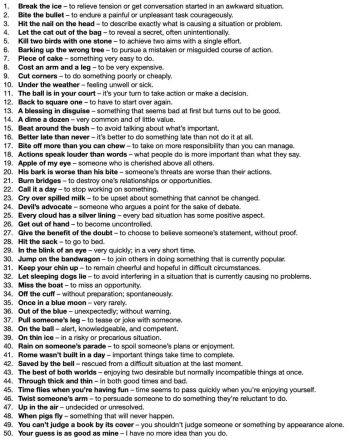
All languages have idioms. Examples of idioms in the English language:

1752521510711.png

Taking an idiom literally (in any language) will produce a wild understanding which the author never intended.
 
  • Like
Reactions: JustMe and talons

Wick Stick

Well-Known Member
Sep 21, 2023
2,424
1,486
113
46
Phoenix
Faith
Christian
Country
United States
Here's a funny one...

"Cover(ed) your feet" - this means to go to the bathroom

1Sa 24:3 And he came to the sheepcotes by the way, where was a cave; and Saul went in to cover his feet: and David and his men remained in the sides of the cave.

If you cover your feet with your pants, it's because you uncovered your privates in order to make water, or take a dump
 
  • Like
Reactions: JustMe and Lambano

Lambano

Well-Known Member
Jul 13, 2021
10,015
12,792
113
Island of Misfit Toys
Faith
Christian
Country
United States
Gender
Male
Genesis 4:1

And Adam knew Eve his wife; and she conceived, and bare Cain, and said, I have gotten a man from the Lord.

Comedian Allan Sherman of Hello Muddah, Hello Faddah fame notes that if we take the biblical writers' use of yada (Hebrew, "to know") as a euphemism for sexual intercourse literally, it turns the sweet love song Getting to Know You into an obscene ditty, turns Plato's maxim "Know thyself" into "Go f*** yourself", and makes the expression "God knows" unutterably blasphemous.

Yada, yada, yada.
 
Last edited:

Jericho

Well-Known Member
Aug 10, 2023
905
983
93
51
Texas
Faith
Christian
Country
United States
Sure, but do we know all the idioms from the 1st century Judea? It seems doubtful to me.
 
  • Like
Reactions: talons

Matthias

Well-Known Member
May 3, 2022
32,249
24,121
113
Kentucky
Faith
Other Faith
Country
United States
Gender
Male
Could you post a few?

Here are a dozen, selected at random, for your consideration.

1. A pillar of salt. Genesis 19:26. Lifeless; stricken dead. (p. 4)

2. When I washed my steps with butter. Job 29:6. When I was very wealthy. (p. 16)

3. Set me as a seal upon thine heart and arm. Song of Solomon. Keep me in your mind and love me with your strength. (p. 27)

4. I am a child. Jeremiah 1:6. I am unlearned, inexperienced. (p. 34)

5. Corrupt tree. Matthew 7:17. An evil man. (p. 51)

6. Mortify your members. Colossians 3:5. Bring your members under control. (p. 65)

7. Washed my hands in innocency. Psalm 26:6. Absolved from guilt. (p. 18)

8. A smoke from the north. Isaiah 14:31. A disaster from the north; an invasion. (p. 30)

9. Thou whited wall. Acts 23:3. You hypocrite. (p. 62)

10. Spirit of jealousy. Numbers 5:14. An evil inclination which causes jealousy. (p. 8)

11. Take the little book and eat it. Revelation 10:9. Remember it by heart; make it a part of you. (p. 70)

12. Have salt in yourselves. Mark 9:50. Have good manners; good conduct. (p. 56)

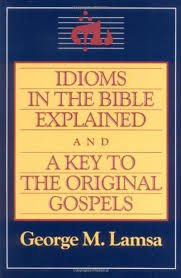
(George M. Lamsa, Idioms in the Bible Explained and A Key to the Original Gospel)

As with everything you read, read this thoughtfully and critically.
 

JustMe

Well-Known Member
May 6, 2025
1,172
1,333
113
US
Faith
Christian
Country
United States
Gender
Male
Here are a dozen, selected at random, for your consideration.

1. A pillar of salt. Genesis 19:26. Lifeless; stricken dead. (p. 4)

2. When I washed my steps with butter. Job 29:6. When I was very wealthy. (p. 16)

3. Set me as a seal upon thine heart and arm. Song of Solomon. Keep me in your mind and love me with your strength. (p. 27)

4. I am a child. Jeremiah 1:6. I am unlearned, inexperienced. (p. 34)

5. Corrupt tree. Matthew 7:17. An evil man. (p. 51)

6. Mortify your members. Colossians 3:5. Bring your members under control. (p. 65)

7. Washed my hands in innocency. Psalm 26:6. Absolved from guilt. (p. 18)

8. A smoke from the north. Isaiah 14:31. A disaster from the north; an invasion. (p. 30)

9. Thou whited wall. Acts 23:3. You hypocrite. (p. 62)

10. Spirit of jealousy. Numbers 5:14. An evil inclination which causes jealousy. (p. 8)

11. Take the little book and eat it. Revelation 10:9. Remember it by heart; make it a part of you. (p. 70)

12. Have salt in yourselves. Mark 9:50. Have good manners; good conduct. (p. 56)

(George M. Lamsa, Idioms in the Bible Explained and A Key to the Original Gospel)

As with everything you read, read this thoughtfully and critically.
Very good list....and yes what you read, read it critically for purpose, context and intended meaning.
 
  • Like
Reactions: Matthias

rebuilder 454

Well-Known Member
Jul 15, 2023
5,055
1,301
113
70
robstown
Faith
Christian
Country
United States
Here are a dozen, selected at random, for your consideration.

1. A pillar of salt. Genesis 19:26. Lifeless; stricken dead. (p. 4)

2. When I washed my steps with butter. Job 29:6. When I was very wealthy. (p. 16)

3. Set me as a seal upon thine heart and arm. Song of Solomon. Keep me in your mind and love me with your strength. (p. 27)

4. I am a child. Jeremiah 1:6. I am unlearned, inexperienced. (p. 34)

5. Corrupt tree. Matthew 7:17. An evil man. (p. 51)

6. Mortify your members. Colossians 3:5. Bring your members under control. (p. 65)

7. Washed my hands in innocency. Psalm 26:6. Absolved from guilt. (p. 18)

8. A smoke from the north. Isaiah 14:31. A disaster from the north; an invasion. (p. 30)

9. Thou whited wall. Acts 23:3. You hypocrite. (p. 62)

10. Spirit of jealousy. Numbers 5:14. An evil inclination which causes jealousy. (p. 8)

11. Take the little book and eat it. Revelation 10:9. Remember it by heart; make it a part of you. (p. 70)

12. Have salt in yourselves. Mark 9:50. Have good manners; good conduct. (p. 56)

(George M. Lamsa, Idioms in the Bible Explained and A Key to the Original Gospel)

As with everything you read, read this thoughtfully and critically.
Thanks!!!
Keep them coming!
Good thread.
 
  • Like
Reactions: Matthias

Matthias

Well-Known Member
May 3, 2022
32,249
24,121
113
Kentucky
Faith
Other Faith
Country
United States
Gender
Male
From my X / Twitter feed this evening -

“I’m often asked, ‘Do you take the Bible literally.’ My answer is, ‘Yes, where it is meant to be taken literally. Everything in the Bible is literally true but not all of it is expressed in a literal way.’”

(Frank Turek)


Figures of speech is an important topic for discussion and study.