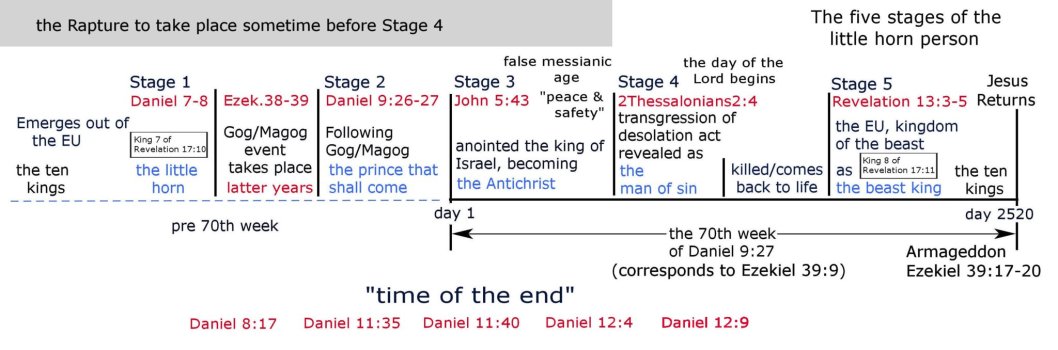
It is best not to conflate the vision in Daniel 2 with other visions.
(Dan 2:43) And as you saw iron mixed with miry clay, they shall mix themselves with the seed of men.
But they shall not cling to one another, even as iron is not mixed with clay.
Daniel 2:43 can be explained in terms of tribes conquered by the Roman Empire being difficult to integrate with Roman governance due to racial, cultural, and religious differences making them brittle like clay that will not mix with iron. This issue is still a factor in the affairs of Europe and Asia.
Daniel 2:43 is a rich vein for symbolic interpretation, especially when viewed through the lens of cultural integration and imperial fragility. Here's a breakdown of how this verse can be understood in terms of the Roman Empire's struggle to unify its diverse conquests:
️ Daniel 2:43 — Iron and Clay: A Symbol of Imperial Fragility
Verse (Daniel 2:43):
"And as you saw the iron mixed with soft clay, so they will mix with one another in marriage, but they will not hold together, just as iron does not mix with clay."
Historical Context: The Roman Empire's Expansion
- Iron = Roman military and administrative strength
Rome was unmatched in its ability to conquer and enforce order. Its legions, laws, and infrastructure were the iron backbone of the empire.
- Clay = Conquered tribes and cultures
The clay represents the peoples Rome absorbed—Celts, Gauls, Germans, Jews, Berbers, and others—each with distinct languages, customs, and spiritual traditions.
Symbolic Interpretation: Why Clay and Iron Don’t Mix
- Cultural incompatibility
Many tribes resisted Romanization. Their native customs, tribal loyalties, and spiritual beliefs clashed with Roman ideals of citizenship, law, and centralized governance.
- Religious divergence
Rome’s pantheon and later imperial cults were often at odds with monotheistic or animistic traditions of conquered peoples. This spiritual dissonance created unrest and rebellion.
- Ethnic and racial tensions
Rome’s elite remained largely Italic, while the provinces were ethnically diverse. Integration through intermarriage or citizenship often failed to produce true unity.
- Political fragmentation
The later empire became a patchwork of semi-autonomous regions. Local leaders, federated tribes, and client kings diluted Roman authority, especially in the West.
Allegorical Insight: The Empire’s Brittle Foundation
- The feet of iron and clay in Nebuchadnezzar’s dream symbolize a kingdom that appears strong but is internally divided.
- Rome’s external strength masked its internal weakness—a brittle structure prone to fracture under pressure.
- The "mingling with the seed of men" suggests attempts at integration (e.g., granting citizenship, intermarriage, federated alliances) that ultimately failed to produce cohesion.
Prophetic Implication
- Daniel’s vision foretells that such a divided empire cannot endure.
Just as iron and clay cannot truly bond, Rome’s attempt to unify disparate peoples was doomed to crumble.
- This sets the stage for the stone “cut without hands”—a divine kingdom that will replace all human empires with one that is unified and eternal (Daniel 2:44).
If the book of Daniel was a history book, I just may find your comments interesting, but it is not. The book of Daniel is about the restoration of His people back from Babylon in 606 BC. God is recording their travel back to Jerusalem through the 4 kingdoms and where it comes all together in the earlier part of the 4th kingdom in pagan Rome. The 70 weeks of years prophecy began in 457 BC and it would end exactly 490 years later. The purpose of this prophecy is to ensure we understand how / when His people will come back and restore Jerusalem. And by the 69th week of the 70th week they (Jews) had completely restored the Temple, the walls and streets, all the physical elements that were either destroyed or taken away by the Babylonians.
In addition to the physical elements, they also reinstated all of their animal sacrifices, all their ceremonies found in Leviticus, as well as the 7 Feast days. And finally, they also restored all of theri sabbatical cylces. In essence, Daniel is His plan to restore His people and His city back to exactly what they were prior to the Babylonian destruction.
But of course, God also had a bigger plan for this "restoration." The only piece of furniture the Jews could not restore was the Ark of the Covenant - the Presence of God in the sanctuary. And this is where God's prophecies are so amazing - the only One capable of restoring the presence of God in the sanctuary was God Himeslf. And this would be accomplished by the coming of the Messiah. Jesus would represent the Ark or the restoration fo t he Presene of God and complete the full restoration. He would arrive on the first day of the 70rh week of the prohecy, He would minister for 3.5 years and then be crucified.
This is what the book of Daniel is all about - it is not a history lesson - it is all about the coming Messiah and His fulfilment of His God given mission in 9:24.
Jesus would establish His church at the cross and His followers and Apostles would go out into the Romean Empire to preach the Good News. Then, the Temple would be physically destroyed in 70 AD, and the church would grow throughout the empire. Constantine would legalize Chrisitanity in 312 AD, and it would become the official religion of pagan Rome. But in 476 AD, (Daniel 7:11) pagan Rome would be slain - see its demise. Then, within 100 - 125 or so years, the Christian church would replace pagan Rome and soon become known as Papal Rome (this is your divided kingdom).
Thios means the entire book of Daniel covers the period from 606 BC to approximately 500 AD - when the little horn sits atop the 4th beast of papal Rome. This is your timeline and the purpose of the book of Daniel - it is about the Messiah.
FYI, the "mingling of the seed of men" means that the "seed of men" - the Jews who originally started the church and preached the Word of God and the Testimony of Jesus would certainly be successful in growing the church. However, as the sheer number of Gentiles joined the church, even before Constantine, this church no longer looked or acted like the church that began in the first century. Noe, bishops and priest, etc., ruled this Christian institution and began bringing in pagan practices and changing the teachings of Jesus. Consequently, this would not be accepted by the "Jews" - they would "mingle" with this changing church but not would no go along with this soon to be Gentile Christian church... They would no longer be welcomed and this church would lose its Jewish roots....
The "Strength of iron shall be in it (2:41) represents the time when pagan Rome was no longer and was replaced by papal Rome, but the military might of pagan Rome certainly did not go away over night .This is where the RCC would utilize the "iron" of pagan Rome within its own Christian church to ensure its policies, practices and total control over both civil and religious matters were obeyed.
This is just some of the elements found in 2:41-45.