Contending with the devil

  • Welcome to Christian Forums, a Christian Forum that recognizes that all Christians are a work in progress.

    You will need to register to be able to join in fellowship with Christians all over the world.

    We hope to see you as a part of our community soon and God Bless!

Hiddenthings

Well-Known Member
May 19, 2025
3,777
415
83
Leeton NSW
Faith
Christian
Country
Australia
The statement attributes to the context something that is not there, that is, a bias against "the Israelite" as a whole.
I love Israel and I firmly hold to their hope, but no one is righteous by nature (Romans 1:18–32). And section refers to converted Gentiles those whose minds have been transformed by the teaching of God. These individuals obey God's law not through outward ritual or formalism, but through a new life, formed by the gospel that has enlightened their consciences.

While Israel rejected that Gospel, we know the first will be last!
 

dak

Well-Known Member
Feb 9, 2013
1,457
188
63
Messianica
sites.google.com
Faith
Other Faith
Country
United States
Gender
Male
Only someone unfamiliar with the meaning and proper use of these terms could make such a statement. It's also possible that the person holds incorrect beliefs on the subject, which may be influencing their reasoning.

You examine your motives, I'll examine mine, and let the Lord be the one to judge between us
I love Israel and I firmly hold to their hope, but no one is righteous by nature (Romans 1:18–32). And section refers to converted Gentiles those whose minds have been transformed by the teaching of God. These individuals obey God's law not through outward ritual or formalism, but through a new life, formed by the gospel that has enlightened their consciences.

While Israel rejected that Gospel, we know the first will be last!

Only someone ignorant of the Torah teachings of the Master would say such things.
 

Hiddenthings

Well-Known Member
May 19, 2025
3,777
415
83
Leeton NSW
Faith
Christian
Country
Australia
Only someone ignorant of the Torah teachings of the Master would say such things.
You appear vague at times, so its left to me to try and read your mind. Do you understand what the Lord meant when he said the first would be last? Matthew 19:30
 

Matthias

Well-Known Member
May 3, 2022
32,133
24,090
113
Kentucky
Faith
Other Faith
Country
United States
Gender
Male
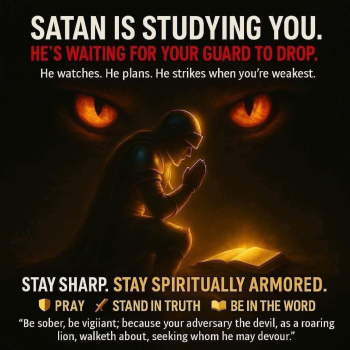
1754738792034.jpeg

Mr. Wilson added to the “devil isn’t real” roll call. It’s unwise to align yourselves with them.
 

Matthias

Well-Known Member
May 3, 2022
32,133
24,090
113
Kentucky
Faith
Other Faith
Country
United States
Gender
Male
How did the “devil and the demons aren’t real” crowd wind up in their error? In part, by not recognizing that the Bible itself, while not ignoring them - as if that were even possible - doesn’t dwell on them. They’re real, they’re active, and their time is short. Don’t focus on them. Focus on God and the Messiah.

“We have talked on this podcast about Satan. Not a lot - we don’t fixate on him. But we do talk about him and his designs, usually to look at what Satan cannot do to us. There’s a lot he cannot do to us as Christians because Christ has disarmed him in two very important ways. … today we flip the question and ask, What can Satan do to Christians?”


Hiddenthings

Well-Known Member
May 19, 2025
3,777
415
83
Leeton NSW
Faith
Christian
Country
Australia
“We have talked on this podcast about Satan. Not a lot - we don’t fixate on him. But we do talk about him and his designs, usually to look at what Satan cannot do to us. There’s a lot he cannot do to us as Christians because Christ has disarmed him in two very important ways. … today we flip the question and ask, What can Satan do to Christians?”

Quote "First, Satan is behind much, though not all, sickness"

How does a person know if their sickness is possession?
 

Jay Ross

Well-Known Member
Jun 20, 2011
9,365
3,484
113
QLD
Faith
Christian
Country
Australia
Gender
Male
It is not our responsibility to contend with the Devil, that is God's responsibility.

What is mankind's responsibility is to respond to God's Salvation Covenant to ensure that we become acceptable to Him in how we live our lives for Him.

Shalom
 

Matthias

Well-Known Member
May 3, 2022
32,133
24,090
113
Kentucky
Faith
Other Faith
Country
United States
Gender
Male
It is not our responsibility to contend with the Devil, that is God's responsibility.

Haven’t you heard? The “devil isn’t real” members are busy teaching us that the devil isn’t real. Who do you think is behind that?

What is mankind's responsibility is to respond to God's Salvation Covenant to ensure that we become acceptable to Him in how we live our lives for Him.

Shalom
 

Jay Ross

Well-Known Member
Jun 20, 2011
9,365
3,484
113
QLD
Faith
Christian
Country
Australia
Gender
Male
Haven’t you heard? The “devil isn’t real” members are busy teaching us that the devil isn’t real. Who do you think is behind that?

Yes, but with discernment our focus should only be on establishing our connection with God and not Satan/the devil.
 
  • Like
Reactions: Matthias

Hiddenthings

Well-Known Member
May 19, 2025
3,777
415
83
Leeton NSW
Faith
Christian
Country
Australia
Quote "First, Satan is behind much, though not all, sickness"

How does a person know if their sickness is possession?
 

Matthias

Well-Known Member
May 3, 2022
32,133
24,090
113
Kentucky
Faith
Other Faith
Country
United States
Gender
Male
“But Michael, the archangel, when contending with the devil and arguing about the body of Moses, dared not bring against him an abusive condemnation, but said, ‘May the Lord rebuke you!’”

(Jude 9, WEB)

The archangel wasn’t contending with human nature.
 

Matthias

Well-Known Member
May 3, 2022
32,133
24,090
113
Kentucky
Faith
Other Faith
Country
United States
Gender
Male
“No evidence!“

That must be dealt with, and the linked article does just that.

”To many men, less mature in their theological thinking than the readers of this Journal are likely to be, the foregoing question presents subject full of puzzling difficulties. Rarely, if ever, does the ordinary Sunday-school lesson or pastor’s sermon throw a ray of clear light upon it. The gospel accounts of demon possession are commonly taken at their face value, and the interpreter gravely explains that during the lifetime of Jesus there was a special activity on the part of the hellish hosts, Satan rallying all his organization in opposition to Jesus. On the other hand, when discussion arises, a number of opinions emerge. Some allegorize the demons, making them the evil inclinations and habits of men, and refer to demons of anger, lust, alcohol, and the like. Others suppose the demons to have been bodily ailments, such as epilepsy or insanity, arising from physical causes. Others, again, think they were evil personalities, devoid of physical bodies, which housed inside victims and caused them to be deaf, dumb, insane, and the like. Thus in common lay thinking there are at least three suppositions: (1) that the demons referred to in the Gospel were merely bad habits; (2) that they were diseases, having physical causes; (3) that they were evil personalities, subject to Satan, and stirred into unwonted activity by the presence of Jesus on earth in his incarnate form.

Such a close-up acquaintance with these views of Christian laymen suggests two reasons for careful consideration of the question raised above by all whose task it is to stimulate and guide religious thinking. In the first place, the Gospels refer to demons so frequently that any thorough or consecutive study is sure to raise questions concerning them. In the second place, the topic of demons in the Gospels furnishes an approach to the whole thought-world of Jesus and the normative value of his opinions which to many men has proved not to be a matter of antiquarian interest, but one of freeing value. …

More cogent is Jesus’ acceptance of the reality of demons as shown in the Gospel narratives of exorcism. He speaks to the demons, rebukes them, asks them for information. …

We have amassed the Gospel evidence in answer to the question whether or not Jesus shared the beliefs of his people and his time as to the existence of demons, their housing in living human bodies, their causing certain afflictions, their differentiation into classes, their fondness for water, their ability to colonize in a single human being, their having a chieftain, Satan, or Beelzebub.”

(A. Wakefield Slaten, “DID JESUS BELIEVE IN DEMONS?”)


No evidence? Dr. Slaten demonstrated in his article that’s certainly not the case.

What does he conclude after examining the evidence?

“It might appear that to a normal mind, faced with such an array of evidence collected from the Gospels themselves, but a single conclusion would be possible, viz., that Jesus did believe in demons. But experience with successive groups of men shows that this is not the case. The following are the reactions that will be obtained in every group:

1. Some will say that Jesus did not believe in demons, but accommodated himself to the ignorance and credulity of the people about him. He spoke and acted therefore as though demons were real to him, although they were not.

2. Some will say that Jesus did not believe in demons and made no pretense of believing in them. The statements in the Gospels that would make us think he did all came from the evangelists themselves. To them, demons were real, and they read into Jesus’ action and teaching their own beliefs.

3. Some will say that Jesus did believe in demons, that is, that the Gospels are correct in their representations of him in this matter. Those who take this view divide into two parties, (a) the one affirming that Jesus’ belief in demons commits us as his followers to the same belief, (b) the other denying that loyalty to Jesus demands this copying of his thought.

In any ordinary Protestant group the largest number will hold opinions (1) and (3a). Opinions (2) and (3b) will occur to a much smaller number. Probably the largest number of all will incline to opinion (3a) and hold that as Jesus believed in demons we must also.”

Dr. Slaten was a Protestant. I’m not, but I would be located in group (3a) if I were.

 

Hiddenthings

Well-Known Member
May 19, 2025
3,777
415
83
Leeton NSW
Faith
Christian
Country
Australia
That must be dealt with, and the linked article does just that.

”To many men, less mature in their theological thinking than the readers of this Journal are likely to be, the foregoing question presents subject full of puzzling difficulties. Rarely, if ever, does the ordinary Sunday-school lesson or pastor’s sermon throw a ray of clear light upon it. The gospel accounts of demon possession are commonly taken at their face value, and the interpreter gravely explains that during the lifetime of Jesus there was a special activity on the part of the hellish hosts, Satan rallying all his organization in opposition to Jesus. On the other hand, when discussion arises, a number of opinions emerge. Some allegorize the demons, making them the evil inclinations and habits of men, and refer to demons of anger, lust, alcohol, and the like. Others suppose the demons to have been bodily ailments, such as epilepsy or insanity, arising from physical causes. Others, again, think they were evil personalities, devoid of physical bodies, which housed inside victims and caused them to be deaf, dumb, insane, and the like. Thus in common lay thinking there are at least three suppositions: (1) that the demons referred to in the Gospel were merely bad habits; (2) that they were diseases, having physical causes; (3) that they were evil personalities, subject to Satan, and stirred into unwonted activity by the presence of Jesus on earth in his incarnate form.

Such a close-up acquaintance with these views of Christian laymen suggests two reasons for careful consideration of the question raised above by all whose task it is to stimulate and guide religious thinking. In the first place, the Gospels refer to demons so frequently that any thorough or consecutive study is sure to raise questions concerning them. In the second place, the topic of demons in the Gospels furnishes an approach to the whole thought-world of Jesus and the normative value of his opinions which to many men has proved not to be a matter of antiquarian interest, but one of freeing value. …

More cogent is Jesus’ acceptance of the reality of demons as shown in the Gospel narratives of exorcism. He speaks to the demons, rebukes them, asks them for information. …

We have amassed the Gospel evidence in answer to the question whether or not Jesus shared the beliefs of his people and his time as to the existence of demons, their housing in living human bodies, their causing certain afflictions, their differentiation into classes, their fondness for water, their ability to colonize in a single human being, their having a chieftain, Satan, or Beelzebub.”

(A. Wakefield Slaten, “DID JESUS BELIEVE IN DEMONS?”)


No evidence? Dr. Slaten demonstrated in his article that’s certainly not the case.

What does he conclude after examining the evidence?

“It might appear that to a normal mind, faced with such an array of evidence collected from the Gospels themselves, but a single conclusion would be possible, viz., that Jesus did believe in demons. But experience with successive groups of men shows that this is not the case. The following are the reactions that will be obtained in every group:

1. Some will say that Jesus did not believe in demons, but accommodated himself to the ignorance and credulity of the people about him. He spoke and acted therefore as though demons were real to him, although they were not.

2. Some will say that Jesus did not believe in demons and made no pretense of believing in them. The statements in the Gospels that would make us think he did all came from the evangelists themselves. To them, demons were real, and they read into Jesus’ action and teaching their own beliefs.

3. Some will say that Jesus did believe in demons, that is, that the Gospels are correct in their representations of him in this matter. Those who take this view divide into two parties, (a) the one affirming that Jesus’ belief in demons commits us as his followers to the same belief, (b) the other denying that loyalty to Jesus demands this copying of his thought.

In any ordinary Protestant group the largest number will hold opinions (1) and (3a). Opinions (2) and (3b) will occur to a much smaller number. Probably the largest number of all will incline to opinion (3a) and hold that as Jesus believed in demons we must also.”

Dr. Slaten was a Protestant. I’m not, but I would be located in group (3a) if I were.

Have you read what you have posted here Matthias?
 

Matthias

Well-Known Member
May 3, 2022
32,133
24,090
113
Kentucky
Faith
Other Faith
Country
United States
Gender
Male
“… did Jesus believe in demon-possession? … all the likelihood is that Jesus did so believe.”

(William Barclay, The Mind of Jesus, p. 74)

A conclusion based on the evidence found in scripture and the Jewish culture he was born, raised, and lived in.
 

Hiddenthings

Well-Known Member
May 19, 2025
3,777
415
83
Leeton NSW
Faith
Christian
Country
Australia
“… did Jesus believe in demon-possession? … all the likelihood is that Jesus did so believe.”

(William Barclay, The Mind of Jesus, p. 74)

A conclusion based on the evidence found in scripture and the Jewish culture he was born, raised, and lived in.
These do nothing to provide the evidence which you are lacking.