Is the New World Translation a valid version of the Bible?

  • Welcome to Christian Forums, a Christian Forum that recognizes that all Christians are a work in progress.

    You will need to register to be able to join in fellowship with Christians all over the world.

    We hope to see you as a part of our community soon and God Bless!

MonoBiblical

Well-Known Member
Apr 18, 2024
1,560
257
83
52
midwest
Faith
Christian
Country
United States
The claim that “ho logos” is an indefinite article is simply false. In Koine Greek the article ho (ὁ) is the definite article, equivalent to “the.” It never functions as an indefinite marker; indefiniteness is expressed by the lack of an article.
At a beginning? Why the lack of consistency?
 

HealthyShape

Well-Known Member
Aug 29, 2025
1,827
673
113
Northeast
Faith
Christian
Country
United States
At a beginning? Why the lack of consistency?
Because it is grammatically incorrect to say "at a beginning was the Word", in English. It is not about inconsistency, it is about a proper translation to English.

If some language had the definite article before personal names, like "the Peter", it would be also incorrect to say it in English, so a good translation would correctly leave that out.

No two languages have their grammatical rules matching perfectly 1:1.
 
Last edited:
  • Like
Reactions: David Lamb

MonoBiblical

Well-Known Member
Apr 18, 2024
1,560
257
83
52
midwest
Faith
Christian
Country
United States
Because it is grammatically incorrect to say "at a beginning was the Word", in English. It is not about inconsistency, it is about a proper translation to English.
At a "beginning" is not what you want theologically; and the beginning is not being introduced because it does not have the article. But the LOGOS is not introduced and so is God; so thusly, there is need to indicate to this. Few things are introduced in the English NT, because of the myths about the Greek article being like Latin.

If some language had the definite article before names, like "the Peter", it would be also incorrect to say it in English, so a good translation would correctly leave that out.
The point is names are definite without article, and so is every other ονομα. Every ονομα which has the article is indefinite. Since translators don't understand this; the epistles are as clear as mud in English.
 

HealthyShape

Well-Known Member
Aug 29, 2025
1,827
673
113
Northeast
Faith
Christian
Country
United States
At a "beginning" is not what you want theologically; and the beginning is not being introduced because it does not have the article. But the LOGOS is not introduced and so is God; so thusly, there is need to indicate to this. Few things are introduced in the English NT, because of the myths about the Greek article being like Latin.
You're wrong. Koine Greek has the definite article (ho, hé, to). Bare nouns like "en arché" often express a definite temporal idea without an article, so English naturally supplies “the.” John 1:1 does use the article with logos (ho logos) marking a particular, identified subject. The grammar and context support reading the Logos as the definite divine agent, not an indefinite “a Logos.”

The point is names are definite without article
And so is "the" beginning, in English. Saying "at a beginning was the Word" is at least unnatural in English, if not incorrect.

 
  • Like
Reactions: David Lamb

shepherdsword

Encounter Team - Eagle
Staff member
Encounter Team
Feb 12, 2009
2,034
1,632
113
Millington
Faith
Christian
Country
United States
Gender
Male
Because it is grammatically incorrect to say "at a beginning was the Word", in English. It is not about inconsistency, it is about a proper translation to English.

If some language had the definite article before personal names, like "the Peter", it would be also incorrect to say it in English, so a good translation would correctly leave that out.

No two languages have their grammatical rules matching perfectly 1:1.
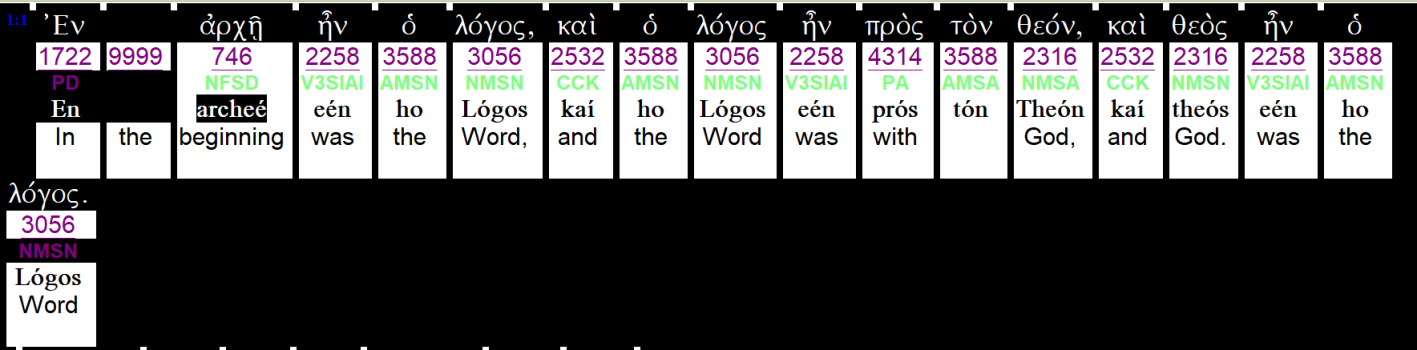
We know this by John 1:1 and the precise language that he used:
(A.T. Robinson)

1758131838326.png
 

MonoBiblical

Well-Known Member
Apr 18, 2024
1,560
257
83
52
midwest
Faith
Christian
Country
United States
You're wrong. Koine Greek has the definite article (ho, hé, to). Bare nouns like "en arché" often express a definite temporal idea without an article, so English naturally supplies “the.” John 1:1 does use the article with logos (ho logos) marking a particular, identified subject. The grammar and context support reading the Logos as the definite divine agent, not an indefinite “a Logos.”


And so is "the" beginning, in English. Saying "at a beginning was the Word" is at least unnatural in English, if not incorrect.

"At the start it was a word," since I believe αρχη is the start of anything. It is all natural except the phrase, " and a word was with a God,". This phrase means the worder originated with God, and implies his OT name.
 

MonoBiblical

Well-Known Member
Apr 18, 2024
1,560
257
83
52
midwest
Faith
Christian
Country
United States
I can imagine somebody twisting the other examples, but would somebody try to say that "the love is God"? I hope not.
ὅτι ὁ θεὸς ἀγάπη ἐστίν, how a God the consideration, he or it is. I guess it is a good example. "how God is the consideration."?
 

HealthyShape

Well-Known Member
Aug 29, 2025
1,827
673
113
Northeast
Faith
Christian
Country
United States
"At the start it was a word," since I believe αρχη is the start of anything. It is all natural except the phrase, " and a word was with a God,". This phrase means the worder originated with God, and implies his OT name.
This is breaking major Greek grammar rules. The correct English translation is "In the beginning was the Word and the Word was with God and the Word was God".

Yes, "in a beginning" would be more literal translation from Greek, but it would not reflect the original contextual meaning in Greek.
 
Last edited:

MonoBiblical

Well-Known Member
Apr 18, 2024
1,560
257
83
52
midwest
Faith
Christian
Country
United States
This is breaking major Greek grammar rules. The correct English translation is "In the beginning was the Word and the Word was with God and the Word was God".

Yes, "in a beginning" would be more literal translation from Greek, but it would not reflect the original contextual meaning in Greek.
The text clearly and plainly states that the Word IS God.

View attachment 70087
It is plainly wrong. Ho logos is nominative starting the next sentence. Similar things happen with the neuter case, but the neuter case is both object then subject.
 

MonoBiblical

Well-Known Member
Apr 18, 2024
1,560
257
83
52
midwest
Faith
Christian
Country
United States
Your post is largely unintelligible. I have no idea what you are saying.
ὅτι ὁ θεὸς ἀγάπη ἐστίν, because how a God the consideration, he or it is. I guess it is a good example. "because God is the consideration."?
 

shepherdsword

Encounter Team - Eagle
Staff member
Encounter Team
Feb 12, 2009
2,034
1,632
113
Millington
Faith
Christian
Country
United States
Gender
Male
It is plainly wrong. Ho logos is nominative starting the next sentence. Similar things happen with the neuter case, but the neuter case is both object then subject.
LOL...you don't know what you are talking about. A.T. Robertson was a Greek master scholar both in the classical and koine. Stop pretending you know Greek. You will not find any scholars that agree with you.
 
  • Like
Reactions: David Lamb

MonoBiblical

Well-Known Member
Apr 18, 2024
1,560
257
83
52
midwest
Faith
Christian
Country
United States
LOL...you don't know what you are talking about. A.T. Robertson was a Greek master scholar both in the classical and koine. Stop pretending you know Greek. You will not find any scholars that agree with you.
Stop pretending that they and Tyndale knew enough. I care not if the scholars, I care if they are correct; and it is amazing how wrong they are.
 

HealthyShape

Well-Known Member
Aug 29, 2025
1,827
673
113
Northeast
Faith
Christian
Country
United States
ὅτι ὁ θεὸς ἀγάπη ἐστίν, because how a God the consideration, he or it is. I guess it is a good example. "because God is the consideration."?
Again, your post is unintelligible. Why do you insert the word "how" and then strike it through, why do you say "a God", what do you mean by "the consideration" or "he or it is".

hoti ho theos agapé estin = because (the) God is love.
 
  • Like
Reactions: David Lamb

HealthyShape

Well-Known Member
Aug 29, 2025
1,827
673
113
Northeast
Faith
Christian
Country
United States
It is plainly wrong. Ho logos is nominative starting the next sentence.
Ho logos is nominative and is the subject of the verb én, not “starting the next sentence".

Similar things happen with the neuter case, but the neuter case is both object then subject.
This is a confused statement.

1. The neuter is a grammatical gender, not inherently a semantic role. A neuter noun can be subject, object, predicate nominative, etc., depending on syntax.

2. Greek syntax does not permit a single noun form to be simultaneously object and subject; role is determined by case and position/verb agreement. If a noun appears neuter and is in the accusative, it functions as object; if it’s nominative, it functions as subject. Context and agreement decide, not a mysterious “both” property.
 
  • Like
Reactions: David Lamb