John 1:14-17 LITV
14) And the Word became flesh and tabernacled among us. And we beheld His glory, glory as of an only begotten from the Father, full of grace and of truth.
15) John witnesses concerning Him, and has cried out, saying, This One was He of whom I said, He coming after me has been before me, for He was preceding me.
16) And out of His fullness we all received, and grace on top of grace.
17) For the Law was given through Moses, but grace and truth came through Jesus Christ.
No, based on the above, and other passages, the Word Who tabernacles among us, this is Jesus.
The passage you posted does not say what you say. There is no statement in John 1 saying that "Jesus is the Word", it's rather all presumption on the part of those who wish to force their preconceived doctrine into the text.
I thought so. You have a POV that requires you to insert a word that changes the text. I don't think we will have much more to discuss. Yes, I am aware of the doctrinal aspect, and you've introduced a significant change to the text based on your reasoning, but not on the actual text.
Please prove your accusation with actual evidence. What Greek word did I add to the text? You yourself just did exactly what you accuse me of doing: you added
but into John 1:17 when there is absolutely no equivalent in the Greek text, it simply isn't there, your favorite translator-interpreters added it there to help you read their interpretation of the text, rather than what it actually says. Moreover your types use this text against the Torah and against Mosheh, which the Almighty warns against in the Torah, and the Torah is spiritual, (Rom 7:14a), and thus, so is the leprosy. If you are going to post verses reinterpreted by lying scribes I hold you accountable for passing them off as true on the board. In fact John 1:17 has already been addressed in this thread.
Misreading οτι, inserting "but" when it is not there, and misinterpreting δια twice:
For the law was given by Moses, but grace and truth came by Jesus Christ.
17 οτι ο νομος δια μωυσεως εδοθη η χαρις και η αληθεια δια Ι̅Η Χ̅Ρ εγενετο
Because the Torah was given through Mosheh; the grace and the truth came to be through Ι̅Η Χ̅Ρ
I understand that translators do such things due to an antinomian bias: do you understand that?
Jesus (the Word) did however seal a portion for due season well beyond His theology as presented during that time of His first appearing. In Jewish monotheism, the Messiah consistently acts within the constraints of his theology at all times.

www.christianityboard.com
I do not need your antinomian lying scribes: I can read the text for myself.
Moreover, please remember what you yourself posted concerning John 12:48 in reply #299, (did you post another rendering somewhere? I did not see it if you did). You merely posted an image file from an interlinear:
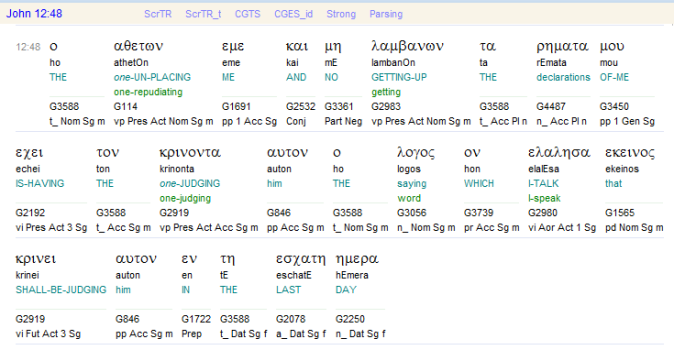
So that everyone may fully understand, this is what the interlinear says:
The one-un-placing me and no getting-up the declarations of-me is-having the
one-judging him the saying which I-talk that shall-be-judging him in the last day
Are you serious? And you have not provided an actual translation of this text anywhere else? And you accuse me of changing a word to suit my own point of view? I have not changed anything which appears in the Greek text: what I did was to render
ekeinos literally for what it actually means, so as to wake people up as to what Trinitarian scholarship is doing to hide the truth in texts such as this which refute your doctrine. And the more literal we get in our readings of the Greek scriptures the more the Trinity doctrine becomes indefensible.
Some translations render
ekeinos here as "He" or "he". That rendering is the same as "that One" because either way it refers back to the statement, "the Logos which I have spoken" and "he" is of course third person, so it cannot be the Meshiah himself because it is the Logos which he has spoken, ("that One", "He"). Others render
ekeinos as "the same", and still yet it refers back to "the Logos that I have spoken", and therefore cannot mean the Meshiah himself. Others entirely omit
ekeinos, and why would they feel the need to omit this word from the text? obviously they must realize how damaging it is to the Trinity doctrine, and apparently therefore they avoid it all together.
The most egregious tampering with the text is the fact that so many English translations pervert the text in order to make the Logos in this passage into an inanimate object, rather than the Living Logos, whom we know is the one and only one-of-a-kind Son who is ever in the bosom of the Father, (John 1:18), and that One, (He), is the only Judge. They are indeed playing the logical fallacy game called
special pleading, where in their minds LOGOS is a super duper GOD-WORD in John 1:1, but merely some simple inanimate logos-word spoken by THE SUPER LOGOS in John 12:48, (even though in John 12:48 Logos has the article attached, the Logos), and no doubt they do this because otherwise John 12:48 destroys their doctrine.
There is a judge for the one who rejects Me and does not receive My words: The word that I have spoken will judge him on the last day.
biblehub.com
@Matthias was right when he said you are a hypocrite.