Yet modern archaeologists insist on shrinking Antonia down to a footnote, cramming it into a corner of the Temple Mount like an unwanted in-law. Why? Because tradition dies harder than a gladiator in the Colosseum.

Hat tip to Bob Ellsworth for the diagram.
The Wailing Wall: A Roman Retaining Wall?
Here’s the kicker: the Wailing Wall’s masonry matches
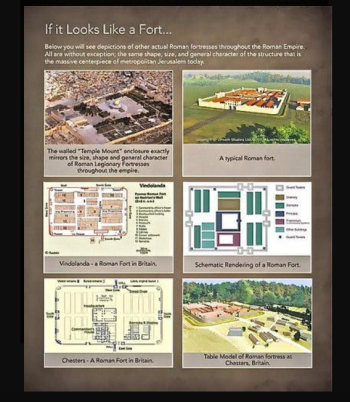
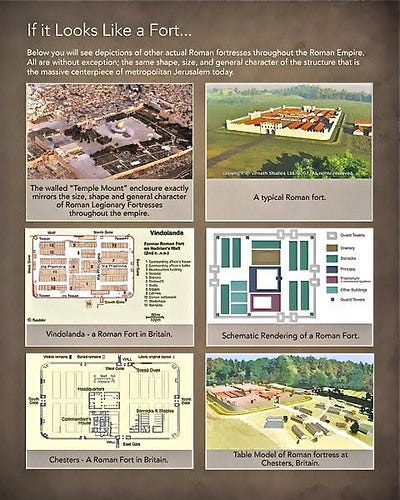
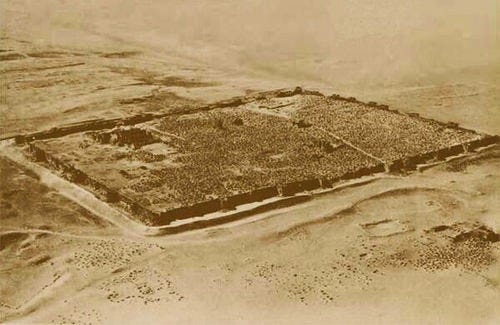
Roman construction, not Jewish. The massive ashlars, the precision cuts, the sheer scale, it’s textbook Roman military engineering. Even the layout of the Haram es-Sharif (the “Temple Mount”) mirrors standard Roman fortresses, like the one still standing in Sergiopolis, Syria. Coincidence? Or proof that Jerusalem’s holiest site was actually Rome’s local bad ass base?
And let’s talk about those aerial bridges. Josephus mentions two 600-foot walkways connecting Antonia to the Temple, convenient for quick troop deployments during Passover riots. But where are they now? Gone, like Pilate’s patience. Traditionalists claim the Jews destroyed Antonia during the siege of 70 CE, but Josephus hints it was just the bridges. The fortress itself? Probably repurposed by Titus’s boys as a victory lap.

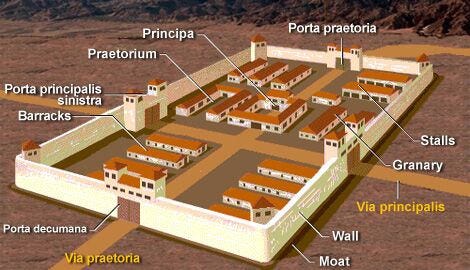
Rome's cookie-cutter fortress blueprint - because when you're conquering the world, efficiency matters.

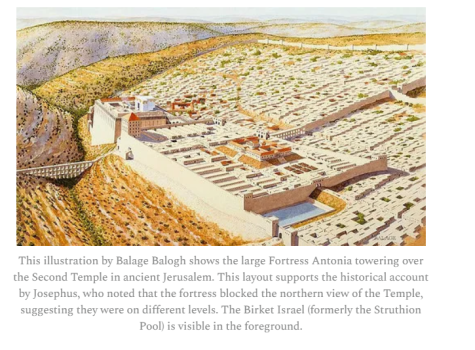
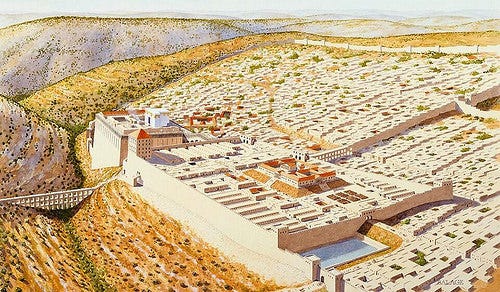
This illustration by Balage Balogh shows the large Fortress Antonia towering over the Second Temple in ancient Jerusalem. This layout supports the historical account by Josephus, who noted that the fortress blocked the northern view of the Temple, suggesting they were on different levels. The Birket Israel (formerly the Struthion Pool) is visible in the foreground.
The Case of the Missing Temple Stones
Jesus supposedly prophesied the Temple’s destruction, saying “not one stone [would] be left upon another.” Yet the Wailing Wall’s stones are
very much stacked. Meanwhile, in the City of David, where alternative theorists place the real Temple, archaeologists haven’t found a single surviving temple stone. Curious. Unless, of course, the “Temple Mount” was always Antonia, and the real Temple was elsewhere, reduced to rubble as foretold.
Even the “place of trumpeting” stone, found near the Wailing Wall, doesn’t prove much. Romans loved repurposing local artifacts, ever seen a menorah on the Arch of Titus?

Above: Rome slapped down forts like this everywhere, Spain, Germany, even the Middle East. Sergiopolis in Syria? Still standing. Meanwhile, Jerusalem’s 'Temple Mount' looks suspiciously similar. Just saying.
History’s Best-Kept Secret (or Worst-Kept)
The Wailing Wall as Fort Antonia’s remnant isn’t just a fringe theory, it’s a middle finger to centuries of dogma. If true, it means Jerusalem’s most contested real estate isn’t a temple wall at all. It’s a Roman barracks.
So next time you see pilgrims weeping at the Wall, remember: they might be mourning the wrong ruin. And if you’re a Roman history buff, pour one out for Fort Antonia, the fortress Jerusalem forgot, but archaeology might just resurrect.
Primary References:
- Josephus, Flavius – The Jewish War (Book 5, Chapter 5) – Describes Fort Antonia’s size, structure, and connection to the Temple.
- Josephus, Flavius – Antiquities of the Jews (Book 15, Chapter 11) – Details Herod’s construction projects, including Antonia.
Archaeological & Scholarly Sources:
- Popular Archaeology (2023) – Antonia: The Fortress Jerusalem Forgot – Argues for Fort Antonia’s dominance over the Temple Mount.
- Leen Ritmeyer (1992) – The Temple and the Rock – Challenges traditional Temple Mount placement; suggests Antonia’s remains are misidentified.
- Ernest L. Martin (2000) – The Temples That Jerusalem Forgot – Controversial thesis claiming the Temple was south of the Dome of the Rock, with the Haram es-Sharif being Antonia.
- Benjamin Mazar (1975) – The Mountain of the Lord – Excavations near the Southern Wall; notes Roman engineering in Herodian structures.
Supporting Evidence:
- Roman Military Architecture – Comparisons to forts like Castra Praetoria (Rome) and Sergiopolis (Syria).
- The "Place of Trumpeting" Stone – Discovered near the Wailing Wall, possibly repurposed.
- Titus’s Arch (Rome) – Depicts Temple artifacts, but no clear depiction of Antonia’s destruction.