Do you believe this statement: "Jesus is YHWH", Yes or No?

  • Welcome to Christian Forums, a Christian Forum that recognizes that all Christians are a work in progress.

    You will need to register to be able to join in fellowship with Christians all over the world.

    We hope to see you as a part of our community soon and God Bless!

Do you believe and agree with the following statement: "Jesus is YHWH." Yes or No?


  • Total voters
    20
  • Poll closed .

David in NJ

Well-Known Member
Jul 20, 2021
16,392
8,947
113
50
Denville
Faith
Christian
Country
United States
Gender
Male
Nope, the Gospel is to each in his or her own appointed times, the times appointed of the Father, which no one knows except for the Father, the day when a child becomes an adult, a tried, true, fully tested son of the Father. No intelligent father puts his own untested babe or child in charge of all his goods.

Understand? Your time will not be your brother's time, nor your sister's time, nor your neighbor's time, nor was it my time: each one in his or her own appointed times appointed of the Father.

Walking according to the eyes and mind of the flesh, seeing all things as outward and physical concerning Biblical Prophecy, has landed you where you are. The Gospel is private, individual, and to each in his or her own appointed times. You are watching according to the world, and the news of the world, and the Master is not going to be revealing himself to the outside world who hates him.

John 14:15-23 KJV
15 If ye love me, keep my commandments.
16 And I will pray the Father, and he shall give you another Comforter, that he may abide with you for ever;
17 Even the Spirit of truth; whom the world cannot receive, because it seeth him not, neither knoweth him: but ye know him; for he dwelleth with you, and shall be in you.
18 I will not leave you comfortless: I will come to you.
19 Yet a little while, and the world seeth me no more; but ye see me: because I live, ye shall live also.
20 At that day ye shall know that I am in my Father, and ye in me, and I in you.
21 He that hath my commandments, and keepeth them, he it is that loveth me: and he that loveth me shall be loved of my Father, and I will love him, and will manifest myself to him.
22 Judas saith unto him, not Iscariot, Lord, how is it that thou wilt manifest thyself unto us, and not unto the world?
23 Jesus answered and said unto him, If a man love me, he will keep my words: and my Father will love him, and we will come unto him, and make our abode with him.

And here is what you yourself missed:

Revelation 19:10 YLT
10 and I fell before his feet, to bow before him, and he saith to me, 'See--not! fellow servant of thee am I, and of thy brethren, those having the testimony of Jesus; bow before God, for the testimony of Jesus is the spirit of the prophecy.'

Understand? the Testimony of the Meshiah is the Spirit of the Prophecy.
And that holy Testimony is Spirit according to John 6:63.
OK

FULLY AGREE with all the Scripture you posted and the First Half of Truth you are speaking of.

But you left out that the Word that was God became flesh and dwelt among us.

God made man from a physical earth/dust and on a physical earth where we currently are in our physical bodies.

God made man 3 dimensional = body soul spirit

God's words are Spirit and they are Life

God's words are Truth = BOTH, in this physical realm and in the Eternal Realm of the Spirit


The Word that was God became flesh and dwelt among us

His suffering was physical as well as DEEP within His Soul

His Death was physical = on a physical Cross

His Resurrection was physical

His Kingdom is Spiritual and from Above

His Return/Second Coming is PHYSICAL

ALWAYS embrace the Whole of TRUTH = "Thy word is Truth"
 
  • Like
Reactions: Nancy

rockytopva

Mod
Staff member
Dec 31, 2010
6,525
3,390
113
Faith
Christian
Country
United States
Gender
Male
Saducee (Noting... Sad... You..See)... That was not from original Greek or Hebrew. It was interpreted by the countenance.
 
Last edited:

Hazelelponi

Well-Known Member
Jan 12, 2024
264
385
63
57
Raven
Faith
Christian
Country
United States
If today's generation continues to complicate the simplicity that is in Christ the end result will be that God will not be able to get a blessing in there edgewise because of it. People will cease coming to Christ for the looks of the Saducee (noting... sad... you..see)

Its about the Truth being communicated, not about complications, over simplification is detrimental to the truth. Have you read older confessions, creeds, and catechisms that Reformed believer's taught their children? Now people act as though there's something to fear in communicating truth from Scripture as it's written.

Both the WCF and LBCF first define Yahweh using Old Testament divine attributes and names (self-existence, immutability, eternality, etc.), then immediately confess that this one Yahweh exists eternally as Father, Son, and Spirit.

In other words:
  • Yahweh ≠ the Father alone
  • Yahweh = the one divine essence
  • Father, Son, and Spirit each fully possess that one Yahwistic essence

This is classic Nicene, Chalcedonian, Reformed orthodoxy. God is Triune. .
 
Last edited:

dak

Well-Known Member
Feb 9, 2013
1,457
188
63
Messianica
sites.google.com
Faith
Other Faith
Country
United States
Gender
Male
Yes, as he in the Incarnation was God in Human flesh

This being your answer to the Poll question, I can only assume that you are saying that YHWH was incarnated in the flesh, as Jesus, (and therefore died on the cross). Please correct me if I have misunderstood your answer.
 

David in NJ

Well-Known Member
Jul 20, 2021
16,392
8,947
113
50
Denville
Faith
Christian
Country
United States
Gender
Male
This being your answer to the Poll question, I can only assume that you are saying that YHWH was incarnated in the flesh, as Jesus, (and therefore died on the cross). Please correct me if I have misunderstood your answer.
You are My witnesses,” says YHWH
“And My servant whom I have chosen,
That you may know and believe Me,
And understand that
I am He.
Before Me there was no God formed,
Nor shall there be after
Me.

JESUS = "IAM HE" = You are witnesses unto Me=
Acts 1:8

Elohim of Genesis
One Spirit, even as ye are called in one hope of your calling;
One Lord, one faith, one baptism,
One God and Father of all, who is above all, and through all, and in you all.
 

dak

Well-Known Member
Feb 9, 2013
1,457
188
63
Messianica
sites.google.com
Faith
Other Faith
Country
United States
Gender
Male
You are My witnesses,” says YHWH
“And My servant whom I have chosen,
That you may know and believe Me,
And understand that
I am He.
Before Me there was no God formed,
Nor shall there be after
Me.

JESUS = "IAM HE" = You are witnesses unto Me=
Acts 1:8

Elohim of Genesis
One Spirit, even as ye are called in one hope of your calling;
One Lord, one faith, one baptism,
One God and Father of all, who is above all, and through all, and in you all.

1) Why do you feel a need to answer for @JesusFan?
2) If you are going to answer for JesusFan then why did you not answer the question which I asked JesusFan? Did I correctly understand what was said in the post I responded to from JesusFan, or was I mistaken in my short summary of what I thought JesusFan meant by that response in that post?
3) Do you yourself believe that YHWH was incarnated in the flesh, as Jesus, (and therefore died on the cross)? Is that why you felt the need to answer too? If so, why not just say so and post scriptures that actually support that belief to prove your point. None of the passages you quoted above say anything about an "incarnation of YHWH".
 

David in NJ

Well-Known Member
Jul 20, 2021
16,392
8,947
113
50
Denville
Faith
Christian
Country
United States
Gender
Male
1) Why do you feel a need to answer for @JesusFan?
2) If you are going to answer for JesusFan then why did you not answer the question which I asked JesusFan? Did I correctly understand what was said in the post I responded to from JesusFan, or was I mistaken in my short summary of what I thought JesusFan meant by that response in that post?
3) Do you yourself believe that YHWH was incarnated in the flesh, as Jesus, (and therefore died on the cross)? Is that why you felt the need to answer too? If so, why not just say so and post scriptures that actually support that belief to prove your point. None of the passages you quoted above say anything about an "incarnation of YHWH".
i responded to you as i promised i would to YOU in my post #154

YES, they irrevocably do declare YHWH came to earth - and below is just a few

You are My witnesses,” says YHWH
“And My servant whom I have chosen,
That you may know and believe Me,
And understand that I am He. = Revelation 1:18
Before Me there was no God formed, = John 1:1
Nor shall there be after Me. = John 1:1
 

TrevorHL

Active Member
Jul 17, 2024
617
174
43
82
New South Wales / Lake Macquarie
Faith
Christian
Country
Australia
Gender
Male
Greetings again dak,
Do you honestly believe that Christian members on this board believe that staunch anti-Trinitarian Christadelphians such as yourself are Christians? Who decides what is a Christian here?
I object to the misuse of the word "Christian", mainly because the true meaning of this word is defined in Acts 11:25-26. I consider it important to simply state the truth of God's word whenever relevant and when given the opportunity. I appreciate this facility and those who who have made this available. I have been banned from a number of sites because I do not accept the Trinity. I also have respect for the principles outlined in Acts 4:17-20.

Kind regards
Trevor
 

shepherdsword

Encounter Team - Eagle
Staff member
Encounter Team
Feb 12, 2009
2,034
1,631
113
Millington
Faith
Christian
Country
United States
Gender
Male
Sorry but neither statement is true.
Please explain where my position is different that the classic Trinitarian
1) YHWH is the Father and Trinitarianism does not teach that "Jesus is the Father", in fact, the exact opposite, and it is written on the Trinity Shield.
2) The Shema absolutely does not say "they are one".
3) The name of the Father absolutely is the Tetragrammaton, according to HE HIMSELF, (Exodus 6:3, "And I appeared to Abraham, to Yitzhak, and to Yaakob as El Shaddai: but by My name, YHWH, I was not known to them").
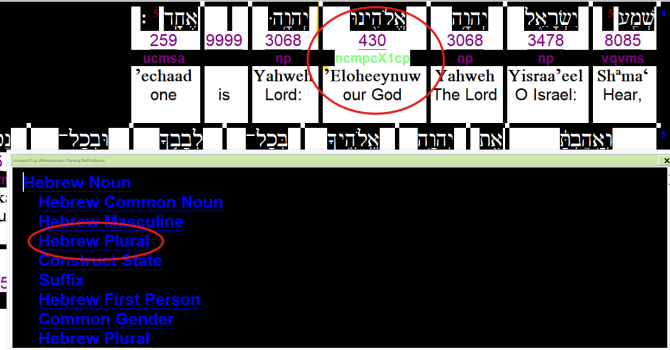
Let's look closely. as we can see, "Eloheeynuw" is plural, this denotes that Yahweh has plurality. Don't ignore this with a casual "this is wrong". Present a valid justification explaining why you think it is wrong.

1765518622586.png
 
  • Love
Reactions: David in NJ

Hazelelponi

Well-Known Member
Jan 12, 2024
264
385
63
57
Raven
Faith
Christian
Country
United States
1) Why do you feel a need to answer for @JesusFan?
2) If you are going to answer for JesusFan then why did you not answer the question which I asked JesusFan? Did I correctly understand what was said in the post I responded to from JesusFan, or was I mistaken in my short summary of what I thought JesusFan meant by that response in that post?
3) Do you yourself believe that YHWH was incarnated in the flesh, as Jesus, (and therefore died on the cross)? Is that why you felt the need to answer too? If so, why not just say so and post scriptures that actually support that belief to prove your point. None of the passages you quoted above say anything about an "incarnation of YHWH".

Hello. I think I have a clearer grasp of your position now, so I want to respond directly to the assumption that keeps driving your conclusions. I’m not objecting to Scripture; I’m objecting to a category you keep importing into it.

You keep assuming that if Jesus is YHWH, then the Father must have become flesh and died. That conclusion isn’t required by any biblical text. It’s only required if personal distinction within the one divine essence is ruled out from the start. Scripture itself never makes that move.

John is actually very careful here. He says, In the beginning was the Word, and the Word was with God, and the Word was God. Then he adds, And the Word became flesh. The text does not say God in general became flesh, and it does not say the Father became flesh. The subject is the Word—the Son. He is fully God, yet personally distinct from the Father, and He is the one who becomes incarnate.

That same distinction shows up everywhere else. The Father sends; the Son is sent. God sent forth His Son, born of woman. The Father sent the Son to be the Savior of the world. Sending only makes sense if the Father and the Son are not the same Person. At the same time, nothing in these texts suggests inequality of being—only distinction of Persons.

When Scripture speaks of Christ taking on humanity, it doesn’t describe a loss of deity or a change in God’s nature. Paul says that though He was in the form of God, He took the form of a servant. The subject remains the same—the Son—but He assumes a true human nature. Nothing divine is subtracted; something human is added.

That’s why Scripture can say things that would otherwise sound impossible. Paul says, They crucified the Lord of glory. Luke says God purchased the church with His own blood. The one who suffers and dies is the divine Son—but He suffers and dies according to the human nature He assumed. The Father does not bleed. The divine nature does not die. And yet the Person who dies really is God. There’s no contradiction here unless person and nature are collapsed into the same category.

What really forces the issue, though, is how the New Testament handles YHWH texts.

Joel 2:32


“Everyone who calls on the name of YHWH shall be saved.”

Paul applies that passage directly to calling on the name of Jesus. Romans 10:9, 13

“If you confess Jesus as Lord…

"Everyone who calls on the name of the Lord shall be saved.”

Paul does not explain this away.
He's identifing Jesus as YHWH.

Isaiah (45:23) says that every knee will bow to YHWH; Paul says that every knee will bow at the name of Jesus (Philippians 2:10–11). Paul doesn’t explain this away, and he doesn’t apologize for it. Either he’s committing blasphemy, or Jesus is YHWH, Scripture doesn’t leave room for a third option.

So when you say, “If Jesus is YHWH, then YHWH died,” you’re only right if person equals nature. Scripture never confuses those categories. The Son is YHWH. The Son became incarnate. The Son died according to His human nature. The Father remained unincarnate, and the divine nature remained impassible. That’s not later philosophy—it’s the only way to speak the way Scripture speaks without contradiction.

I wouldn’t describe YHWH as anything other than the Triune God Himself. YHWH names the one divine essence, which eternally subsists as Father, Son, and Holy Spirit. Each Person is fully and truly God, not by division or containment, but by fully possessing the one undivided divine essence.

And this isn’t just an abstract debate. The gospel itself is at stake. If the one who died on the cross is not Himself the one true God, then God did not personally redeem us. The cross becomes a creature’s sacrifice that cannot save, not God’s self-giving act of redeeming a people unto Himself. Paul says, God was in Christ reconciling the world to Himself,” and he also says that the Lord of glory" was crucified.

That’s why the church has always confessed what Scripture forces us to confess: one God, eternally Father, Son, and Spirit; the Son alone incarnate; the Son alone dying in the flesh; and yet the one who dies is undiminished YHWH.

Thomas understood this immediately. He fell at Jesus’ feet and said, “My Lord and my God.” Jesus didn’t correct him. He blessed him.

YHWH does not name the Father in isolation. It names the one divine essence fully possessed by the Father, the Son, and the Holy Spirit. Because the fullness of deity dwells bodily in Christ, bowing to Christ is bowing to YHWH, worshiping Christ is worshiping YHWH, and calling on the name of Jesus is calling on the name of YHWH.

That’s why the apostles worshiped Him. That’s why heaven worships Him. And that’s why refusing Christ is refusing YHWH Himself.
 
  • Love
Reactions: marks

dak

Well-Known Member
Feb 9, 2013
1,457
188
63
Messianica
sites.google.com
Faith
Other Faith
Country
United States
Gender
Male
Part One: (I had to break this reply into two posts)

Hello. I think I have a clearer grasp of your position now, so I want to respond directly to the assumption that keeps driving your conclusions. I’m not objecting to Scripture; I’m objecting to a category you keep importing into it.

Are you sure you understand my position? I am an Adoptionist, (but not of the Arian type), in my view there are not "three persons" to begin with, so I am surely not conflating or confusing "three persons" with essence.

You keep assuming that if Jesus is YHWH, then the Father must have become flesh and died. That conclusion isn’t required by any biblical text. It’s only required if personal distinction within the one divine essence is ruled out from the start. Scripture itself never makes that move.

Yes, it does, YHWH is the Father, as stated multiple times in the scripture including even the Torah, (see #135 and #142.

John is actually very careful here. He says, In the beginning was the Word, and the Word was with God, and the Word was God. Then he adds, And the Word became flesh. The text does not say God in general became flesh, and it does not say the Father became flesh. The subject is the Word—the Son. He is fully God, yet personally distinct from the Father, and He is the one who becomes incarnate.

I believe John 1:1 contains a Trinitarian error because it was translated from a Hebrew text. The way I am quite sure of this is because the Trinity Shield way of thinking is inserted into the text by using pros. Sounds good to the Trinitarian mind, but this makes the Father into an anthropomorphic entity, just as does the Trinity Shield imagery.

Do you believe the Father is an anthropomorphic spirit-body or that rather He is omnipresent? The Hebrew Tanak, (Torah, Prophets, and Writings), teaches only one way, and that is the the Father, YHWH, is omipresent: the heavens and the heaven of the heavens cannot contain Him. Greek pros however places the Son face to face with the Father, outside the Father, and almost no doubt they did this to support their theory of the "three persons".

This would have been utterly heretical to the author of the Gospel of John, and he makes his position clear where he states that the Son is in the bosom of the Father, John 1:18, and thus John 1:1 now contradicts John 1:18. Moreover John 1:1 would have likely employed Memra, which was then rendered as Logos in the Greek translation by early Trinitarians: and that changes everything, for at that point the door swung wide open for the Hellenization of the entire account.

That same distinction shows up everywhere else. The Father sends; the Son is sent. God sent forth His Son, born of woman. The Father sent the Son to be the Savior of the world. Sending only makes sense if the Father and the Son are not the same Person. At the same time, nothing in these texts suggests inequality of being—only distinction of Persons.

That is not true if the Son is in the bosom of the Father. People do not realize what omnipresence truly means and the consequences/results thereof.

When Scripture speaks of Christ taking on humanity, it doesn’t describe a loss of deity or a change in God’s nature.

"Christ" is the Anointed One, the Meshiah, the Chosen One, a man: and that one is not the one and only kind Son of the Father. Rather, the one and only Son is the very Anointing upon the Anointed One: for the Son is the Word or Memra, not the Anointed One, and even according to Paul the Son is Yah Elohim. All that is necessary is for people to recheck Paul's quotes of the Tanak and not assume that he is just cherry picking like they themselves are doing. Paul is not cherry-picking, he is like a wise Rabbi pointing the hearer and reader to a section of scripture that is familiar to the hearer/reader. Perhaps start with his quote of Psalm 68:18 where he expounds from it in Ephesians 4:7-13. Another way in which the RCC has deceived people is by interpreting the nomina sacra.

All the places you see "Jesus", "Christ", "God", "Lord" are actually nomina sacra, (the Latin name for sacred names), in the oldest Uncial Greek texts. If you follow their interpretations, which all modern scholars do without question, you have been taught by men and not by Elohim. Every nomen sacrum has the possibility of multiple meanings. CHI-RHO, the nomen sacrum for Christ, (in English XR), can be understood as Christos, (Christ, Meshiah, the Anointed One), or Chrestos, (Gracious when spoken of the Father or the Son), or Chrisma, (the Anointing). Keep that in mind in passages like Ephesians 4:7-13

Paul says that though He was in the form of God, He took the form of a servant. The subject remains the same—the Son—but He assumes a true human nature. Nothing divine is subtracted; something human is added.

That’s why Scripture can say things that would otherwise sound impossible. Paul says, They crucified the Lord of glory. Luke says God purchased the church with His own blood. The one who suffers and dies is the divine Son—but He suffers and dies according to the human nature He assumed. The Father does not bleed. The divine nature does not die. And yet the Person who dies really is God. There’s no contradiction here unless person and nature are collapsed into the same category.

What really forces the issue, though, is how the New Testament handles YHWH texts.

None of this is a problem in my understanding.

Joel 2:32

Paul applies that passage directly to calling on the name of Jesus. Romans 10:9, 13
“If you confess Jesus as Lord…
"Everyone who calls on the name of the Lord shall be saved.”
Paul does not explain this away.
He's identifing Jesus as YHWH.

No, he isn't, that is again a tragic situation introduced by the RCC interpretations of the nomina sacra.
 

dak

Well-Known Member
Feb 9, 2013
1,457
188
63
Messianica
sites.google.com
Faith
Other Faith
Country
United States
Gender
Male
Part Two:

Isaiah (45:23) says that every knee will bow to YHWH; Paul says that every knee will bow at the name of Jesus (Philippians 2:10–11). Paul doesn’t explain this away, and he doesn’t apologize for it. Either he’s committing blasphemy, or Jesus is YHWH, Scripture doesn’t leave room for a third option.

Most all of your responses have been answered on this board in various threads listed in my signature.

So when you say, “If Jesus is YHWH, then YHWH died,” you’re only right if person equals nature. Scripture never confuses those categories. The Son is YHWH. The Son became incarnate. The Son died according to His human nature. The Father remained unincarnate, and the divine nature remained impassible. That’s not later philosophy—it’s the only way to speak the way Scripture speaks without contradiction.

I see that as only being due to a person's misunderstanding of the scripture and what it actually says and teaches. It neither teaches a Trinity nor the Trinity doctrine.

I wouldn’t describe YHWH as anything other than the Triune God Himself. YHWH names the one divine essence, which eternally subsists as Father, Son, and Holy Spirit. Each Person is fully and truly God, not by division or containment, but by fully possessing the one undivided divine essence.

That's only if you believe there are three persons: I do not.

And this isn’t just an abstract debate. The gospel itself is at stake. If the one who died on the cross is not Himself the one true God, then God did not personally redeem us. The cross becomes a creature’s sacrifice that cannot save, not God’s self-giving act of redeeming a people unto Himself. Paul says, God was in Christ reconciling the world to Himself,” and he also says that the Lord of glory" was crucified.

That’s why the church has always confessed what Scripture forces us to confess: one God, eternally Father, Son, and Spirit; the Son alone incarnate; the Son alone dying in the flesh; and yet the one who dies is undiminished YHWH.

This is why atonement doctrine is so messed up in MS Christianity that it has never been fully agreed upon by all: everyone has their own variant beliefs concerning atonement. The Testimony of the Meshiah is tantamount to his blood because he indeed payed for that Testimony with his own blood. However that Testimony was not his own, and was given to him from above, from the Father, to be freely gifted unto all who believe on/into him, and as he says, his Testimony is Spirit and Life. Testimony therefore is indeed spirit, even the Renewed Covenant Spirit of Grace foretold in the Prophets.

Thomas understood this immediately. He fell at Jesus’ feet and said, “My Lord and my God.” Jesus didn’t correct him. He blessed him.

YHWH does not name the Father in isolation.

We disagree, and I have already quoted plenty of scripture where that is indeed the case.

It names the one divine essence fully possessed by the Father, the Son, and the Holy Spirit. Because the fullness of deity dwells bodily in Christ, bowing to Christ is bowing to YHWH, worshiping Christ is worshiping YHWH, and calling on the name of Jesus is calling on the name of YHWH.

How do you know whether or not the fullness of deity bodily, (σωματικως, adverb, bodily, corporeally) is or isn't the same as the Holy Spirit descending in a bodily (σωματικως, adjective, corporeal) form, as a dove, upon the Meshiah-Anointed One in Luke 3:22?

They claim that Luke 3:22 contains σωματικός, (the adjective), but in the text we read σωματικω.
They claim Colossians 2:9 contains σωματικως, (the adverb), and that is what we read, σωματικως.

That’s why the apostles worshiped Him. That’s why heaven worships Him. And that’s why refusing Christ is refusing YHWH Himself.

That would just be another debate over the meaning of προσκυνέω. I understand it according to its counterpart(s) in the Hebrew scriptures. As for "Christ" I am not refusing the Meshiah, or Anointed One, or Chosen One: but it is possible that by your doctrine you may be unintentionally rejecting both the Chrisma and-or the Chrestos for lack of understanding the nomina sacra: taste and see that both YHWH and YAH His Son are Gracious, (Tob as Chrestos in the LXX, 1Pet 2:3, and Chrestos concerning the yoke upon the Meshiah as stated in Mat 11:30).
 
Last edited:

JesusFan

Member
May 15, 2025
116
36
28
65
Macomb mi
Faith
Christian
Country
United States
This being your answer to the Poll question, I can only assume that you are saying that YHWH was incarnated in the flesh, as Jesus, (and therefore died on the cross). Please correct me if I have misunderstood your answer.
Hold that the Second person of the Godhead was incarnated in human flesh as Jesus
 

JesusFan

Member
May 15, 2025
116
36
28
65
Macomb mi
Faith
Christian
Country
United States
Part Two:


Most all of your responses have been answered on this board in various threads listed in my signature.


I see that as only being due to a person's misunderstanding of the scripture and what it actually says and teaches. It neither teaches a Trinity nor the Trinity doctrine.


That's only if you believe there are three persons: I do not.


This is why atonement doctrine is so messed up in MS Christianity that it has never been fully agreed upon by all: everyone has their own variant beliefs concerning atonement. The Testimony of the Meshiah is tantamount to his blood because he indeed payed for that Testimony with his own blood. However that Testimony was not his own, and was given to him from above, from the Father, to be freely gifted unto all who believe on/into him, and as he says, his Testimony is Spirit and Life. Testimony therefore is indeed spirit, even the Renewed Covenant Spirit of Grace foretold in the Prophets.


We disagree, and I have already quoted plenty of scripture where that is indeed the case.


How do you know whether or not the fullness of deity bodily, (σωματικως, adverb, bodily, corporeally) is or isn't the same as the Holy Spirit descending in a bodily (σωματικως, adjective, corporeal) form, as a dove, upon the Meshiah-Anointed One in Luke 3:22?

They claim that Luke 3:22 contains σωματικός, (the adjective), but in the text we read σωματικω.
They claim Colossians 2:9 contains σωματικως, (the adverb), and that is what we read, σωματικως.


That would just be another debate over the meaning of προσκυνέω. I understand it according to its counterpart(s) in the Hebrew scriptures. As for "Christ" I am not refusing the Meshiah, or Anointed One, or Chosen One: but it is possible that by your doctrine you may be unintentionally rejecting both the Chrisma and-or the Chrestos for lack of understanding the nomina sacra: taste and see that both YHWH and YAH His Son are Gracious, (Tob as Chrestos in the LXX, 1Pet 2:3, and Chrestos concerning the yoke upon the Meshiah as stated in Mat 11:30).
Angel of the Lord in OT was a messenger from Yahweh who spoke for Yahweh and also as Yahweh, also Abraham saw God appear as a man with 2 angels, we just hold He came in the human flesh as Jesus
 

dak

Well-Known Member
Feb 9, 2013
1,457
188
63
Messianica
sites.google.com
Faith
Other Faith
Country
United States
Gender
Male
Hold that the Second person of the Godhead was incarnated in human flesh as Jesus
Angel of the Lord in OT was a messenger from Yahweh who spoke for Yahweh and also as Yahweh, also Abraham saw God appear as a man with 2 angels, we just hold He came in the human flesh as Jesus

One word answer: Agency.

YHWH is neither a man nor any type of physical being.
 
  • Like
Reactions: JustMe

Hazelelponi

Well-Known Member
Jan 12, 2024
264
385
63
57
Raven
Faith
Christian
Country
United States
Most all of your responses have been answered on this board in various threads listed in my signature.

Just a heads up, but I'm not in various threads, I'm in this one responding to your posts here.
 

Hazelelponi

Well-Known Member
Jan 12, 2024
264
385
63
57
Raven
Faith
Christian
Country
United States
believe John 1:1 contains a Trinitarian error because it was translated from a Hebrew text. The way I am quite sure of this is because the Trinity Shield way of thinking is inserted into the text by using pros. Sounds good to the Trinitarian mind,


At this point, I think it’s important to clarify where our disagreement lies.

We aren't arguing merely for a different interpretation of the same text. You’ve explicitly stated that John 1:1 is in error, that key New Testament identifications are the result of later theological corruption, and that the Greek text itself cannot be trusted where it conflicts with your reconstruction of Hebrew categories.

Once the apostolic text is treated as suspect because it teaches something uncomfortable, we are no longer doing exegesis together. We’re operating from different authorities.

Likewise, appealing to nomina sacra as if they introduce semantic uncertainty does not reflect how they function historically. They are scribal abbreviations, not theological variables, and they do not dissolve Paul’s deliberate application of YHWH texts to Jesus.

Scripture does not merely say Jesus acts for YHWH. It places Him within YHWH’s unique divine identity — receiving the worship reserved for God alone, bearing the divine name, and fulfilling passages that explicitly exclude all created agents.

If those identifications must be explained away by rejecting the text, redefining worship as agency, or denying personal distinction from the outset, then the disagreement is not about what Scripture says, but about whether it is allowed to say it.

I’m content to let that difference stand plainly for the reader.
 
  • Like
Reactions: ProDeo and marks

dak

Well-Known Member
Feb 9, 2013
1,457
188
63
Messianica
sites.google.com
Faith
Other Faith
Country
United States
Gender
Male
Just a heads up, but I'm not in various threads, I'm in this one responding to your posts here.

I understand, but certain points you have brought up are just too lengthy to answer when combined with everything else in your previous post, (which I was already forced to divide into two posts because the first attempt was more than ten thousand characters). So then, I will at least use the place where I made the statement, which you have quoted, as a single example of why it was and is relative and important.

Isaiah (45:23) says that every knee will bow to YHWH; Paul says that every knee will bow at the name of Jesus (Philippians 2:10–11). Paul doesn’t explain this away, and he doesn’t apologize for it. Either he’s committing blasphemy, or Jesus is YHWH, Scripture doesn’t leave room for a third option.

Most all of your responses have been answered on this board in various threads listed in my signature.

In Isaiah 45:23 Paul is quoting from the LXX which says no such thing: for the LXX rightly divides the text at the waw in the supposed Tetragrammaton in that situation. The original Ashuri text was not separated except by the waw, and it read very similarly to the ancient Greek Uncial texts in a form of scriptio continua. Those who rendered the Hebrew text of that time into Greek, (circa 285BC), did not have a Hebrew text with spaces in it for separation: the beginning of that type of separation came afterwards, and the beginnings thereof may be seen in texts and fragments from the DSS, (the Pharisee separation of the text). In other words there is yet another critical reason why the N/T authors quoted the LXX most often, and that is because they knew all too well what the Pharisee separation of the text was all about and did not agree with it.

From Logos Logic Reply #18

In the two quotes to follow, Paul is quoting not from the Hebrew text but from the OG-LXX, (Old Greek Septuagint). There are many places in the OG LXX where the Tetragrammaton is actually divided at the waw, producing Yah, which would have appeared that way in the Paleo Hebrew text but do not now appear that way in the M/T, which is not likely due to anything nefarious, but because of the problem of separating the Ashuri text, (having a waw separator and written in a semi-scriptio continua form like the older Paleo text), if perhaps you no longer had the Paleo text to guide you in that separation process. Another thing which is critical to understand is that Yah may be rendered as either Kurios or Theos in the LXX, and here Yah is rendered as Theos, and this is really only evident because we have now both the LXX and the Hebrew texts to investigate and compare, to get an idea of what has happened.

Philippians 2:9-11
9 Wherefore also Elohim highly exalted him, and gave unto him the name which is above every name: [that is named, Eph 1:21]
10 that in the name of Ι̅Η every knee should bow, of things in heaven and things on earth and things under the earth,
11 and that every tongue should confess that Κ̅Ϲ Ι̅Η Χ̅Ρ, to the glory of Elohim the Father.

The above contains two portions from Yeshayah 45:23, (LXX), but they are not the larger precise quote: for he also quotes from this passage almost verbatim in Romans 14:11, where he likewise quotes from the OG LXX. Why is he not quoting from the Hebrew since he clearly knew Hebrew like the back of his hand, having formerly been a Pharisee the son of Pharisees? (moreover the Master spoke to him in Hebrew during the conversion vision near Damascus). After the Hebrew text was rendered into Greek, (beginning about circa 285BC), the Pharisees, about a hundred years later, began to separate the Hebrew text their own way, according to their understandings and doctrines regarding the scripture text.

This was a process that was not completely finalized until about 1000AD, and the beginning of this process can first be seen in scrolls and fragments discovered at Damascus-Qumran, (Qumran by the modern Arabic name Khirbet Qumran). It appears to me that Paul had realized that even in his day the Perushim were already beginning to subvert the Hebrew text: for they went against the precedent set by those who separated the text before them in order to render it into the Greek OG LXX. And we know that at the very least those who rendered the Torah portions of the LXX would have been Tzadokim, the order of the highest priestly line through the sons of Tzadok the Kohen, for no one but the Kohanim were allowed to copy Torah scrolls besides the Kohanim and Levim, (Priests and Levites), even down to the days wherein the LXX began to be translated. Howbeit, aside from all the arguments pertaining to such things, Paul quotes from the OG LXX, knowing Hebrew, which is significant in this much more critical instance than other passage quotes.

Romans 14:11
11 For it is written, As I live, says the LORD, (YHWH), every knee shall bow to Me, and every tongue shall confess by God.

Romans 14:11 (N/A, T/R, BYZ, W/H, all the same)
11 γεγραπται γαρ ζω εγω λεγει κυριος οτι εμοι καμψει παν γονυ και πασα γλωσσα εξομολογησεται τω θεω

In the above, which is quoted from the OG LXX, the Tetragrammaton is divided in the middle, exactly where we read τω θεω, thus we see that the Kohen who rendered this text into the Greek OG LXX separated the text radically different than the Masoretes who came along much later: and herein Paul approves the separation of the text found in the OG LXX. And because we know that the Tetragrammaton is in the Hebrew text; one should therefore know and understand that Theo in this case cannot be Elohim, (God), and is surely therefore YH, (Yah).

Isaiah 45:23-25 OG LXX
23 κατ εμαυτου ομνυω η μην εξελευσεται εκ του στοματος μου δικαιοσυνη οι λογοι μου ουκ αποστραφησονται οτι εμοι καμψει παν γονυ και εξομολογησεται πασα γλωσσα τω θεω
24 λεγων δικαιοσυνη και δοξα προς αυτον ηξουσιν και αισχυνθησονται παντες οι αφοριζοντες εαυτους
25 απο κυριου δικαιωθησονται και εν τω θεω ενδοξασθησονται [Hebrew reads hallu] παν το σπερμα των υιων ισραηλ

The answer using both the Hebrew and the OG LXX:

Yeshayah 45:23-25
[23] By Myself have I sworn, the righteous Word has gone forth from My mouth and shall not be turned back, that unto Me every knee shall bow: and every tongue shall surely confess by Yah unto Me, saying, He is my righteousness and strength!
[24] All those incensed against Him shall come and be ashamed: [25] by YHWH shall they be justified, and all the seed of Yisrael shall hallu-in-Yah!


dak

Well-Known Member
Feb 9, 2013
1,457
188
63
Messianica
sites.google.com
Faith
Other Faith
Country
United States
Gender
Male
At this point, I think it’s important to clarify where our disagreement lies.

We aren't arguing merely for a different interpretation of the same text. You’ve explicitly stated that John 1:1 is in error, that key New Testament identifications are the result of later theological corruption, and that the Greek text itself cannot be trusted where it conflicts with your reconstruction of Hebrew categories.

Once the apostolic text is treated as suspect because it teaches something uncomfortable, we are no longer doing exegesis together. We’re operating from different authorities.

Likewise, appealing to nomina sacra as if they introduce semantic uncertainty does not reflect how they function historically. They are scribal abbreviations, not theological variables, and they do not dissolve Paul’s deliberate application of YHWH texts to Jesus.

Scripture does not merely say Jesus acts for YHWH. It places Him within YHWH’s unique divine identity — receiving the worship reserved for God alone, bearing the divine name, and fulfilling passages that explicitly exclude all created agents.

If those identifications must be explained away by rejecting the text, redefining worship as agency, or denying personal distinction from the outset, then the disagreement is not about what Scripture says, but about whether it is allowed to say it.

I’m content to let that difference stand plainly for the reader.

That's basically saying that you put your trust in the RCC who delivered your canon to you after they had their corrupt hands all over it for more than 1700 years now.

That's your prerogative, but I have already done enough investigation into these things, for quite some years now, to know whereof I speak, and that they indeed tinkered monstrously with the Word of YHWH delivered through His Meshiah, the Anointed One, whom He placed His Son upon in the Gospel accounts. And that surely occurred in the immersion narratives, and at that time also He spoke the decree from Psalm 2:7 to His chosen Meshiah, which still remains in Luke 3:22, in Codex Bezae, and other less significant texts including some Latin texts, (which thankfully escaped RCC censorship).
 

dak

Well-Known Member
Feb 9, 2013
1,457
188
63
Messianica
sites.google.com
Faith
Other Faith
Country
United States
Gender
Male
The poll has closed.

The sought after numbers were those of professed Trinitarians. There are 12 "YES" votes registered in the poll but there were also 3 who voted "YES" by thread posts and made their view extremely clear in thread: those are included as "voice votes" not reflected in the actual poll, and all 15 votes are professed Trinitarians. Only one professed Trinitarian voted "NO" and is reflected in the poll at the top of the page.

Professed Trinitarians who voted "YES" = 15 (3 by "voice vote" in thread)
Professed Trinitarians who voted "NO" = 01

Professed Trinitarians: "YES" = 15 = 93.75%
Professed Trinitarians: "NO" = 01 = 6.25%

Percentages were calculated at the following link: Vote Percentage Calculator.

This poll was not about names but about the numbers, (despite the false accusations leveled at me in thread). As for any interpretation(s) for the meaning(s) of these results, I will not be offering any of my own: I have already taken enough shrapnel just for posting this poll.

Reminder of the Survey posted once and mentioned several times in thread:


Thread/|<-