"Before Abraham Was, I AM"

  • Welcome to Christian Forums, a Christian Forum that recognizes that all Christians are a work in progress.

    You will need to register to be able to join in fellowship with Christians all over the world.

    We hope to see you as a part of our community soon and God Bless!

rvmb

Well-Known Member
Jul 3, 2025
1,252
329
83
Adelaide
Faith
Christian
Country
Australia
Gender
Male
You are quoting from your Creed playbook. There is no adopted spiritual playbook that I believe in, and I never will my friend.

Here's some key points that you can carry with you after this session, to maybe reflect upon, as to why some do not believe as you do.

1. Adherents of the Nicene Creed, as I'm not of them, make Scripture untenable to understand particularly from those that emphasize sola scriptura and reject creedal authority.

2. Some argue as I do, that the Nicene Creed introduces philosophical concepts—such as "homoousios" (consubstantial)—that are not explicitly or even inferred in Scripture and thus obscure or distort biblical teaching.

3. They also contend, as I do, that the creed's use of Greek philosophical categories, like ousia (essence) and hypostasis (person), creates a metaphysical framework that is foreign to the biblical narrative and can lead to a misunderstanding of God's nature.

4. That the creed's formulation of the Trinity—defining the Father, Son, and Holy Spirit as one being in substance—can undermine the biblical portrayal of the true Father and Son.

5. That the original creed's emphasis on divine unity, while intended to combat heresies like Arianism, has led to a loss of clarity about the nature of God, the Father and his Son.

6. The creed's language, particularly in its later formulations, can be unintelligible or alienating to modern believers, leading to a mechanical recitation without genuine comprehension.

7. From the previous point, this can result in a disconnect between the creed's words and the lived faith of individuals, making it difficult to see how the creed supports or clarifies Scripture. In this view, the creed becomes a barrier rather than a bridge to understanding the Bible.

And on this last point, we are seeing this scripture block or filtering action present now, as I write on these forums today.

It will never subside, until this creed is reevaluated truly alongside scripture. The two are far apart and never complimentary in thought for true belief.

Thus, the response to your question is clearly no. The Father possessing His own (holy) Spirit is the origin of all life beyond time and space, and His Son was first established in his Father's word/logos, to be created through the same Father's word/logos at the right moment in time, for our salvation.

The Son, as a man, was baptized as a symbol of his readiness to offer his pure spirit as an unblemished lamb, demonstrating true humility and obedience to his Father's will, marking the start of his divine mission toward the Cross. Immediately after, He was anointed by equipping the Son with His Father's word and Spirit.

I hope this gives you a clearer picture as to why I cannot agree with you on your affirmation statement.
""Well my friend"" you obviously reject that The Father, The Word, The HS existed before creation
Next will you try and convince me that Christ is Michael ? :)
 

JustMe

Well-Known Member
May 6, 2025
1,172
1,333
113
US
Faith
Christian
Country
United States
Gender
Male
""Well my friend"" you obviously reject that The Father, The Word, The HS existed before creation
Next will you try and convince me that Christ is Michael ? :)
Well, I'm glad we now understand each other on this point you made, even if our views are quite different. And as you said I reject it, your view. I was being candid with you. I just wanted you to know right upfront, all at once, without taking many winding and drawn-out posts to come to the same conclusion.

And my reply was not to primarily convince you or anyone else of my view. It was a list of topic points I've come to realize over the years. That's it.

About Christ being Michael, that's also a non-starter for me. Those who believe in this relationship however come closer to some of my other views that yours I expect, and I hope I'm not pre-judging, or being premature in my conclusion.

Anyway, thanks for allowing me to voice my view on this subject, on your thread, well someone else's then. I hope to inch in and add to other discussions whether I'm in agreement or not. How else can one test and know other perspectives that especially influence doctrine.

So, keep querying my other Theological views. I also learn from these Q&A interactions.

Later...
 
Last edited:

bdavidc

Well-Known Member
Mar 31, 2025
1,133
1,105
113
67
Charlestown, IN
know-the-bible.com
Faith
Christian
Country
United States
Gender
Male
Something that came to me that blew my socks off:

"Before Abraham Was, I AM" (Jn.8:58)

I had never understood this but suddenly tonight I believe the meaning came to me. Why did Jesus say I AM? Why didn't he just say I was? I think the answer is that God inhabits eternity. He cannot say I was, or I will be as God is the same yesterday, today, and forever. He never changes. God is outside time!
John 8 is not Jesus discussing philosophy. He is responding to a challenge as to who He is. When they quote Abraham, Jesus takes it farther back, saying, “Before Abraham was, I AM” ~John 8:58. Abraham had a beginning. Jesus did not say “I was.” He uses the divine name.

Why does that wording matter? Because God revealed to Moses the phrase “I AM THAT I AM” when he spoke to Him ~Exodus 3:14. Jesus is identifying Himself with the same God.

Notice their reaction. It clearly shows they understood Him, because they immediately took up stones to kill Him ~John 8:59. They recognized this as a claim to deity.

This is consistent with the rest of Scripture, where we read, “In the beginning was the Word, and the Word was God” ~John 1:1, and where Jesus plainly says, “I and my Father are one” ~John 10:30.

So John 8:58 is not about grammar or time. Jesus is declaring that He is God.
 
  • Love
  • Like
Reactions: rwb and mailmandan

Ronald David Bruno

Well-Known Member
Nov 7, 2020
5,304
2,592
113
Southern
Faith
Christian
Country
United States
Gender
Male
Something that came to me that blew my socks off:

"Before Abraham Was, I AM" (Jn.8:58)

I had never understood this but suddenly tonight I believe the meaning came to me. Why did Jesus say I AM? Why didn't he just say I was? I think the answer is that God inhabits eternity. He cannot say I was, or I will be as God is the same yesterday, today, and forever. He never changes. God is outside time!


Exodus 3:14 was God's introduction ( I Am) to Moses and the Israelites that would later be fully revealed in Christ.
I am the way, the Truth and the life ...
I am the Bread of life
I am the Good Shepherd ...
I am the resurrection...
I am the door ...
I am thr Vine ...
I am the Alpha and Omega
I am He ...
He is the Savior, the Messiah, God
 
  • Like
Reactions: TLHKAJ and rwb

keithr

Well-Known Member
Dec 4, 2020
2,003
541
113
Dorset
Faith
Christian
Country
United Kingdom
Gender
Male
John 8 is not Jesus discussing philosophy. He is responding to a challenge as to who He is. When they quote Abraham, Jesus takes it farther back, saying, “Before Abraham was, I AM” ~John 8:58. Abraham had a beginning. Jesus did not say “I was.” He uses the divine name.
Jesus spoke in Aramaic, which John translated into Greek when writing his Gospel, and others translated that into English. He did not speak God's name - that would have made no sense.

Why do so many people stop at Exodus 3:14 and not read the next verse, in which God tells us what is His name:

Exodus 3:15 LSV
(15) And God says again to Moses, “Thus you say to the sons of Israel: YHWH, God of your fathers, God of Abraham, God of Isaac, and God of Jacob, has sent me to you; this [is] My Name for all time, and this [is] My memorial, to generation [and] generation.​

This is confirmed in Isaiah 42:8 LSV
(8) I [am] YHWH, this [is] My Name, ...​

YHWH means 'self-existing father of love' - it does not mean 'I am' (or as the UASV notes says, "based on grammar and context, an alternative reading could be, I will be what I will be"). It would have made no sense for Jesus to say, "Before Abraham was born, self-existing father of love". Jesus answered saying that he had been in existence from before when Abraham was born (as the UASV notes say, "before Abraham came to be, I have been in existence").

It is stupid to assume that Jesus was claiming to be God whenever he used the words "I am", or "I have been". Nobody assumes the same thing whenever anybody else say "I am", e.g. Acts 10:21 WEB

(21) Peter went down to the men, and said, “Behold, I am he whom you seek. Why have you come?”​

(That's the exact same Greek words as is used in John 5:58 - ego eimi.)

Jesus never claimed to be God (YHVH), he claimed to be the Son of God. That is why the Jews wanted him crucified - John 19:7 WEB

(7) The Jews answered him, “We have a law, and by our law he ought to die, because he made himself the Son of God.”​

That is also what John believed - 1 John 5:19-20 WEB

(19) We know that we are of God, and the whole world lies in the power of the evil one.​
(20) We know that the Son of God has come, and has given us an understanding, that we know him who is true, and we are in him who is true, in his Son Jesus Christ. This is the true God, and eternal life.​

and 1 John 5:5 WEB

(5) Who is he who overcomes the world, but he who believes that Jesus is the Son of God?​
 
Last edited:

bdavidc

Well-Known Member
Mar 31, 2025
1,133
1,105
113
67
Charlestown, IN
know-the-bible.com
Faith
Christian
Country
United States
Gender
Male
Jesus spoke in Aramaic, which John translated into Greek when writing his Gospel, and others translated that into English. He did not speak God's name - that would have made no sense.
Your position doesn’t fail due to a language issue. It fails because it is contrary to the text and contrary to how Scripture interprets itself.

John 8 is not a semantic debate over grammar minutiae. It is a conflict over identity. Jesus isn’t stating an obvious fact that He existed before Abraham. Angels existed before Abraham. The Jews knew that. The issue is what kind of existence Jesus claimed.

Jesus said, “Before Abraham was, I AM” ~John 8:58.

Abraham “came into being.” Jesus did not say, “I was.” He claimed present, absolute existence. Notice the significance of that. Scripture reports the contrast deliberately.

If He meant “I existed before Abraham,” He could have said that unambiguously. He would not have risked this in an otherwise mundane sense. Jesus would not have made this claim if it meant “I was a created being and have existed since.” Yet that is precisely what your position requires.

The Jews’ reaction verifies your “explanation” is wrong.

“Then took they up stones to cast at him” ~John 8:59

This isn’t how they reacted when the prophets claimed preexistence. This isn’t how they would react to anyone claiming preexistence. They were incensed because they heard Him identify Himself as the eternal God. If it were a misunderstanding, Jesus would have clarified. He did not. He “abode in that saying.”

Appealing to Acts 10:21 is a willful mishandling of Scripture. Peter added a predicate, “I am he whom you seek.” He used normal, descriptive grammar. John 8:58 has no predicate. The phrase is complete. Scripture itself draws the contrast.

Pulling Exodus 3: 14 away from John 8 collapses under the weight of the rest of Scripture.

“I am YHWH, and beside me there is no saviour” ~Isaiah 43:11
“I, even I, am YHWH” ~Isaiah 43:25

Now compare that with Christ.

“Neither is there salvation in any other” ~Acts 4:12
“I am the way, the truth, and the life” ~John 14:6

Scripture will not allow for two saviors. If Jesus saves and if YHWH alone saves then Jesus must share the identity of YHWH.

To say, “Jesus never claimed to be God” is not only false, it directly contradicts the testimony of John.

“In the beginning was the Word, and the Word was with God, and the Word was God” ~John 1:1
“All things were made by him; and without him was not any thing made that was made” ~John 1:3

If all created things were made by Him then He is not created.

Thomas understood.

“My Lord and my God” ~John 20:28

Jesus didn’t rebuke him. God doesn’t allow worship from a created creature.

John 19: 7 proves the opposite of what you want to claim. Calling Himself the Son of God was understood by the Jews to be a claim to equality with God.

“Therefore the Jews sought the more to kill him… because he said also that God was his Father, making himself equal with God” ~John 5:18

Scripture is plain on the issue. It is you that are attempting to water it down.

Your definition of YHWH is not based on Scripture. Scripture defines YHWH as the eternal, self-existent One.

“I am the first, and I am the last; and beside me there is no God” ~Isaiah 44:6

Jesus applies this title to Himself.

“I am Alpha and Omega, the beginning and the ending… the Almighty” ~Revelation 1:8
“I am the first and the last” ~Revelation 22:13

Scripture interprets Scripture. The divine names of YHWH are applied directly to Christ.

This is not a case of confusion. This is a case of denial.

Denying the deity of Christ is denying the Son as He is revealed in Scripture. Scripture is clear about the consequence.

“He that denieth the Son, the same hath not the Father” ~1 John 2:23

This is not an academic debate over minutiae. This is a false Christ. A false Christ cannot save.

Repent of perverting the Word of God. Submit to what Scripture actually says. The Jesus you are selling is not the Jesus that is revealed in the Bible.

“Whosoever transgresseth, and abideth not in the doctrine of Christ, hath not God” ~2 John 1:9
 
  • Love
  • Like
Reactions: rwb and mailmandan

TrevorHL

Active Member
Jul 17, 2024
617
174
43
82
New South Wales / Lake Macquarie
Faith
Christian
Country
Australia
Gender
Male
Greetings bdavidc and keithr,
God revealed to Moses the phrase “I AM THAT I AM” when he spoke to Him ~Exodus 3:14. Jesus is identifying Himself with the same God.
the UASV notes says, "based on grammar and context, an alternative reading could be, I will be what I will be"
I agree with the rendition "I will be what I will be". Jesus is not quoting Exodus 3:14, but is stating that he is the Christ "I am he", the same as in John 8:24,28.

Most translations and commentators accept the present tense “I am that I am”, but notice in the margin of the RV (or ASV) and RSV, an alternative is given “I will be that I will be” or “I will be what I will be”, showing that some modern scholars suggest this alternative reading. Although not popular it appears that this future tense is the correct translation. Not only modern scholars, Tyndale also translated this in the future tense, and I also like the interesting spelling of his time and the specific spelling “I wilbe”:
Exodus 3:12-14 (Tyndale): 12 And he sayde: I wilbe with the. And this shalbe a token vnto the that I haue sent the: after that thou hast broughte the people out of Egipte, ye shall serue God vppon this mountayne. 13 Than sayde Moses vnto God: when I come vnto the childern of Israell and saye vnto them, the God of youre fathers hath sent me vnto you, ad they saye vnto me, what ys his name, what answere shall I geuethem? 14 Then sayde God vnto Moses: I wilbe what I wilbe: ad he sayde, this shalt thou saye vnto the children of Israel: I wilbe dyd send me to you.

The word “ehyeh” that occurs in Exodus 3:14 is the same that occurs in the earlier statement in v12 rendered in the KJV “I will be”, and here most other translators also give the future tense:
Exodus 3:12 (KJV): And he said, Certainly I will be with thee; and this shall be a token unto thee, that I have sent thee: When thou hast brought forth the people out of Egypt, ye shall serve God upon this mountain.
Not only does this fix the tense in this context, but it also introduces the concept that the Name of God is associated with some future activity. This future tense and future activity was to be God acting to deliver Israel out of Egypt and to bring them into the Promised Land.

Kind regards
Trevor
 

JustMe

Well-Known Member
May 6, 2025
1,172
1,333
113
US
Faith
Christian
Country
United States
Gender
Male
Your position doesn’t fail due to a language issue. It fails because it is contrary to the text and contrary to how Scripture interprets itself.

John 8 is not a semantic debate over grammar minutiae. It is a conflict over identity. Jesus isn’t stating an obvious fact that He existed before Abraham. Angels existed before Abraham. The Jews knew that. The issue is what kind of existence Jesus claimed.

Jesus said, “Before Abraham was, I AM” ~John 8:58.

Abraham “came into being.” Jesus did not say, “I was.” He claimed present, absolute existence. Notice the significance of that. Scripture reports the contrast deliberately.

If He meant “I existed before Abraham,” He could have said that unambiguously. He would not have risked this in an otherwise mundane sense. Jesus would not have made this claim if it meant “I was a created being and have existed since.” Yet that is precisely what your position requires.

The Jews’ reaction verifies your “explanation” is wrong.

“Then took they up stones to cast at him” ~John 8:59

This isn’t how they reacted when the prophets claimed preexistence. This isn’t how they would react to anyone claiming preexistence. They were incensed because they heard Him identify Himself as the eternal God. If it were a misunderstanding, Jesus would have clarified. He did not. He “abode in that saying.”

Appealing to Acts 10:21 is a willful mishandling of Scripture. Peter added a predicate, “I am he whom you seek.” He used normal, descriptive grammar. John 8:58 has no predicate. The phrase is complete. Scripture itself draws the contrast.

Pulling Exodus 3: 14 away from John 8 collapses under the weight of the rest of Scripture.

“I am YHWH, and beside me there is no saviour” ~Isaiah 43:11
“I, even I, am YHWH” ~Isaiah 43:25

Now compare that with Christ.

“Neither is there salvation in any other” ~Acts 4:12
“I am the way, the truth, and the life” ~John 14:6

Scripture will not allow for two saviors. If Jesus saves and if YHWH alone saves then Jesus must share the identity of YHWH.

To say, “Jesus never claimed to be God” is not only false, it directly contradicts the testimony of John.

“In the beginning was the Word, and the Word was with God, and the Word was God” ~John 1:1
“All things were made by him; and without him was not any thing made that was made” ~John 1:3

If all created things were made by Him then He is not created.

Thomas understood.

“My Lord and my God” ~John 20:28

Jesus didn’t rebuke him. God doesn’t allow worship from a created creature.

John 19: 7 proves the opposite of what you want to claim. Calling Himself the Son of God was understood by the Jews to be a claim to equality with God.

“Therefore the Jews sought the more to kill him… because he said also that God was his Father, making himself equal with God” ~John 5:18

Scripture is plain on the issue. It is you that are attempting to water it down.

Your definition of YHWH is not based on Scripture. Scripture defines YHWH as the eternal, self-existent One.

“I am the first, and I am the last; and beside me there is no God” ~Isaiah 44:6

Jesus applies this title to Himself.

“I am Alpha and Omega, the beginning and the ending… the Almighty” ~Revelation 1:8
“I am the first and the last” ~Revelation 22:13

Scripture interprets Scripture. The divine names of YHWH are applied directly to Christ.

This is not a case of confusion. This is a case of denial.

Denying the deity of Christ is denying the Son as He is revealed in Scripture. Scripture is clear about the consequence.

“He that denieth the Son, the same hath not the Father” ~1 John 2:23

This is not an academic debate over minutiae. This is a false Christ. A false Christ cannot save.

Repent of perverting the Word of God. Submit to what Scripture actually says. The Jesus you are selling is not the Jesus that is revealed in the Bible.

“Whosoever transgresseth, and abideth not in the doctrine of Christ, hath not God” ~2 John 1:9
I believe you might have lost the plot of this one verse, John 8:58, a while back. Did you study the local and outer context for it? And if you did I'm very surprised you really did not use any of it as your support in your persuasive points of argument or what became a rant. Instead, you hung to dear life on one two-word expression in an attempt make your case. It failed badly in my estimation.

Let's look a little closer at your ace card you think you have, of the "I am."
I've uses much of my own research here with some outside sources not listed, and then combined them for better effect.

The statement "I am," along with the assertion that it relates to a supposed divinity of Yeshua, is evidently wrong for several reasons. Below are three key reasons that ought to challenge any firm and mistaken mindset.

1. It is often and commonly used in scripture as a strong expression by any individual. For instance, in Paul's writings. He evidently did not recognize or respect its unique significance for divinity since he applied it to himself without any obvious hesitation. He used it as a regular expression to stress a point or two.

(1Co 15:9) For I am the least of the apostles, who is unworthy to be called an apostle, because I persecuted the church of God.
(1Co 15:10) But by the grace of God I am what I am, and His grace which was bestowed upon me was not in vain; but I laboured more abundantly than all of them. Yet not I, but the grace of God which was with me. (NEV)

In verse 10 Paul is saying he became, twice, what God intended him to be. It is meant to reveal a dynamic Paul who labored, not to denote a static name given to him by God. This is similar as YHWH, who is not a static display of immortality and divinity. He is a being in motion, involved in his people and his creation. And so in Exodus 3:15 it states that YHWH is the God of his people's fathers....God is progressive in this sense, changing causing change in each generation that his Son is now at the helm of it all, as his Father still 'speaks' through him.

2. This forceful phrase found in modern translations of Exodus 3:14b is unreliable and misleading. It was absent from the earliest Greek manuscripts. Likewise, the phrase 'I am who I am' in verse 14a is also a recent and unnecessary error.

(Exo 3:13) Moses said to God, Behold, when I come to the children of Israel, and tell them, ‘The God of your fathers has sent me to you;’ and they ask me, ‘What is His name?’ What should I tell them?
(Exo 3:14) God said to Moses, I AM WHO I AM; and He said, You shall tell the children of Israel this: ‘I AM has sent me to you’.
(Exo 3:15) God said moreover to Moses, You shall tell the children of Israel this, ‘Yahweh, the God of your fathers, the God of Abraham, the God of Isaac, and the God of Jacob, has sent me to you’. This is My name forever, and this is My memorial to all generations.
(Exo 3:16) Go, and gather the elders of Israel together, and tell them, ‘Yahweh, the God of your fathers, the God of Abraham, of Isaac, and of Jacob, has appeared to me, saying, I have surely visited you, and seen that which is done to you in Egypt;(NEV)

A brief history of the verse Exodus 3:14....

From the Septuagint [the Greek translation of the old testament] 200-300 AD:

“And God spoke to Moses and said I am the being, and he said, thus shall you say to the children of Israel, the being has sent me to you.”

The Lamsa bible, translated from the Aramaic Peshitta text in the 5th century:

And God said to Moses, I am Ahiah Ashar High (i.e. The living God)..Ahiah has sent me to you….

The Armenian bible, translated from the Syriac text of 411A.D:

And God said to Moses, I am the God who is…thus you shall say to the Israelites, The God of your fathers, the God of Abraham, the God of Isaac, the God of Jacob has sent me to you..

The Hebrew interlinear parallel rendition:

…I am being which I shall be and to you he send me I shall be you will say to the sons of Israel…

Notice that these two words “I am,” when applied does not have any significance apart from connecting subject, of :“the being,” “the Ahiah Ashar High,” “Ahiah,” “the God who is,” “The God of your fathers, the God of Abraham, the God of Isaac, the God of Jacob .”

This “I am” is an introductory emphasis expression prefacing YHWH’s name. "I am" alone, means nothing without being connected to the main clause.

3. Here's a ton more detail and some of it repeated a few times from a linguistic standpoint to really say I am the one who is writing all this for everyone's benefit as a future reference on this vital subject of modern day deception. That tries to isolate and minimize who Yeshua really is: My lord, my savior, the Messiah of my God, the Blessed Son of the living God, and not forgetting he was a man and still is today, immortal today, a true perfect son of man as the perfect reflection of his God, the last and 2nd Adam. I don't think John would disagree with me as he based his gospel view and themes on Yeshua being the Son of God, the Messiah and the Son of Man.


------------more text added below-----------
 
Last edited:

JustMe

Well-Known Member
May 6, 2025
1,172
1,333
113
US
Faith
Christian
Country
United States
Gender
Male
On with it then... @bdavidc

The classic argument given by those who believe Yeshua is YHWH is their sole dependance on their misuse of the words ego eimi ho on. They equate these words as being the same as ego eimi only, and translated into English as “I am.” The Book of Exodus in 3:14 reveals YHWH’s name as "the one who is" and not the introduction of the word expression it is me or for me, as in, “I am.”

The Greek phrase "ho on" translates to "the one who is" in English. It is used in the Septuagint (LXX) to express the divine name, emphasizing eternal self-existence. In the LXX, "ho on" carries the idea of eternal self-existence, distinct from "ego eimi" (I am), which is not the primary term conveying this concept. The phrase "ho on" is capable of standing alone to denote the eternal being, as seen in Exodus 3:14 where it is used as a shortened form of the Divine Name.

Consider this, if ”ego eimi” was the Greek way of saying God's name YHWH, why did not Yeshua say, "Before Abraham was, YHWH." in John 8:58?

And again, similar to what I just said, and to make this point even clearer. The Greek Septuagint translation of Exodus 3:14 uses the phrase "ego eimi ho on," which translates to "I am the one who is". While "ego eimi" (I am) appears in the Greek text, it is part of a larger phrase, "ego eimi ho on," rather than standing alone. The full expression "ego eimi ho on" is used to convey God's self-identification as "the one who is". The term "ego eimi" alone is not the full divine title; instead, the Septuagint renders the second part of the Hebrew phrase "Ehyeh Asher Ehyeh" as "ho on" ("the one who is"). Therefore, while "ego eimi" is present in the Greek text of Exodus 3:14, it is not used in isolation but as part of a larger expression that identifies God as "the one who is".

And again: The interpretation of ehyeh as "I will be" rather than "I am" is supported by the Septuagint's use of "Ho On" (The Being) and by the consistent use of ehyeh in future contexts throughout Moses' writings. Therefore, "I am who I will be" may offer a more comprehensive understanding of God's nature as both eternal and actively involved in human history.

Hebrew Grammar: The Imperfect Verb Form אֶהְיֶה

The key lies in the verb אֶהְיֶה (ʾehyeh), the first-person singular imperfect of היה (hāyâ, “to be, to become”). The imperfect verb in Hebrew often conveys incomplete or future action—“I will be,” “I will become,” or “I shall prove to be.” It does not typically mean “I am” in a present, static sense. Thus, the most natural rendering of אֶהְיֶה is “I will be” rather than “I am.”

The phrase אֶהְיֶה אֲשֶׁר אֶהְיֶה (ʾehyeh ʾăšer ʾehyeh) can be literally translated:

• “I will be who I will be.”

• “I will become what I will become.”

• “I shall prove to be what I shall prove to be.”

Each rendering maintains the force of the imperfect verb, emphasizing God’s dynamic, purposeful action rather than a static ontological declaration.

Theological Imposition in Translation

Many modern versions render the phrase as “I AM WHO I AM” (NASB, ESV, NIV), and some even stylize it in capital letters (“I AM WHO I AM”) to emphasize supposed theological connections with John 8:58. This capitalization, however, is entirely interpretive (UNNECESSARY!) and foreign to the Hebrew text. The Hebrew does not present this statement as a divine title in itself but as an explanation of God’s Name revealed in the following verse:

Exodus 3:15 (UASV): “God also said to Moses, ‘Say this to the sons of Israel: Jehovah/YHWH, the God of your fathers, the God of Abraham, the God of Isaac, and the God of Jacob, has sent me to you. This is my name forever, and this is how I am to be remembered throughout all generations.’”

Verse 15 explicitly links the explanation of אֶהְיֶה with the covenant name יְהוָה (Jehovah/YHWH). Thus, אֶהְיֶה אֲשֶׁר אֶהְיֶה is not introducing a new divine name; rather, it clarifies the meaning of Jehovah/YHWH—He will become or prove to be all that His people need Him to be.

The Distinction Between אֶהְיֶה and יְהוָה

The Tetragrammaton (יהוה, YHWH, vocalized as Jehovah) derives from a related root of the verb “to be.” Yet there is a difference:

• אֶהְיֶה is first person: “I will be.”

• יְהוָה is third person: “He will be.”

Thus, God tells Moses, in effect: “Tell them, ‘I will be who I will be’ has sent you.” Then He immediately connects this with His covenant name Jehovah: “Jehovah has sent me to you.” In this way, God defines His Name by His activity, not by abstract metaphysical categories.

Contrast with Greek and Latin Renderings

The Septuagint renders the phrase as ἐγώ εἰμι ὁ ὤν (egō eimi ho ōn), literally, “I am the One who is” or “I am The Being.” This is already a shift away from the Hebrew’s verbal dynamism toward a philosophical abstraction. Philo of Alexandria and later Christian theologians, influenced by Platonic and Aristotelian categories, read Exodus 3:14 as God’s declaration of pure Being or self-existence.

The Latin Vulgate followed the Greek: ego sum qui sum (“I am who I am”). From there, traditional theology cemented this as a metaphysical proof text of God’s aseity, immutability, and timeless existence. While these doctrines are biblical in other respects, this passage does not articulate them.

John 8:58 and the Misapplied Connection

John 8:58 (UASV): “Jesus said to them, ‘Truly, truly, I say to you, before Abraham was born, I am.’”

The Greek phrase is ἐγώ εἰμι (egō eimi, “I am”). Many theologians and translators link this with Exodus 3:14, suggesting Jesus was claiming to be the “I AM” of the burning bush. Yet several points undermine this connection:

1. Verb Tense: Jesus contrasts His existence with Abraham’s beginning. Abraham “came into being” (γενέσθαι, genesthai), but Jesus “is” (ἐγώ εἰμι). The sense may well be “I have been in existence” rather than “I am the I AM.”

2. No Article or Title: In Exodus 3:14 LXX, God identifies Himself as ὁ ὤν (“the Being”). Jesus does not use this title; He simply uses egō eimi in a predicative contrast.

3. Contextual Meaning: In John’s Gospel, egō eimi occurs frequently without divine overtones (John 6:20; 9:9). The uniqueness of John 8:58 is its temporal contrast, not a direct allusion to Exodus 3:14.

Thus, linking Exodus 3:14’s “I will be” with John 8:58’s “I am” is a theological imposition rather than a linguistic or contextual necessity.

“I Will Prove to Be” – The Covenant Implications

When YHWH says, “I will be who I will be,” He assures Moses and Israel that His Name guarantees active fulfillment of His promises. He will prove to be whatever is necessary to deliver His people, guide them, protect them, and bring them into covenant blessing.

This dynamic interpretation is supported by later Scripture:

• Exodus 6:6-7 – Jehovah declares He will “bring out,” “deliver,” “redeem,” and “take” Israel as His people.

• Isaiah 43:10-13 – Jehovah identifies Himself as the One who acts in history: “I am He. Before me no god was formed, nor shall there be any after me.”

• Revelation 1:8 – YHWH is “the One who is, who was, and who is coming,” again emphasizing His action across time.

Thus, Exodus 3:14 should not be abstracted into Greek philosophical ontology. It is a declaration of God’s covenant faithfulness, His willingness to become what His people need Him to be in order to accomplish His saving purpose.
Conclusion on Translation Philosophy

Exodus 3:14 is not a static declaration of being (“I am”), but a dynamic declaration of becoming: “I will be who I will be.” This emphasizes Jehovah’s freedom, sovereignty, and covenantal faithfulness. The Tetragrammaton (Jehovah) is then explained in light of this self-revelation: He is the God who will always prove to be exactly what His people need in order to fulfill His purposes.

Rendering the phrase as “I AM WHO I AM” not only distorts the Hebrew grammar but also imposes later Greek metaphysical categories upon the text. A truly literal, contextually faithful translation must preserve the imperfect tense: “I will be who I will be” or “I shall prove to be what I shall prove to be.”

The names for my God and his Son are very precious to me and Yeshua speaks in Gospels, of especially in John, and in Paul as the Father's Messiah, his true Son, the first of human immortals, of the new creation, the first fruits of his Fathers' restoration plan for mankind.. Amen.

 

bdavidc

Well-Known Member
Mar 31, 2025
1,133
1,105
113
67
Charlestown, IN
know-the-bible.com
Faith
Christian
Country
United States
Gender
Male
Greetings bdavidc and keithr,


I agree with the rendition "I will be what I will be". Jesus is not quoting Exodus 3:14, but is stating that he is the Christ "I am he", the same as in John 8:24,28.

Most translations and commentators accept the present tense “I am that I am”, but notice in the margin of the RV (or ASV) and RSV, an alternative is given “I will be that I will be” or “I will be what I will be”, showing that some modern scholars suggest this alternative reading. Although not popular it appears that this future tense is the correct translation. Not only modern scholars, Tyndale also translated this in the future tense, and I also like the interesting spelling of his time and the specific spelling “I wilbe”:
Exodus 3:12-14 (Tyndale): 12 And he sayde: I wilbe with the. And this shalbe a token vnto the that I haue sent the: after that thou hast broughte the people out of Egipte, ye shall serue God vppon this mountayne. 13 Than sayde Moses vnto God: when I come vnto the childern of Israell and saye vnto them, the God of youre fathers hath sent me vnto you, ad they saye vnto me, what ys his name, what answere shall I geuethem? 14 Then sayde God vnto Moses: I wilbe what I wilbe: ad he sayde, this shalt thou saye vnto the children of Israel: I wilbe dyd send me to you.

The word “ehyeh” that occurs in Exodus 3:14 is the same that occurs in the earlier statement in v12 rendered in the KJV “I will be”, and here most other translators also give the future tense:
Exodus 3:12 (KJV): And he said, Certainly I will be with thee; and this shall be a token unto thee, that I have sent thee: When thou hast brought forth the people out of Egypt, ye shall serve God upon this mountain.
Not only does this fix the tense in this context, but it also introduces the concept that the Name of God is associated with some future activity. This future tense and future activity was to be God acting to deliver Israel out of Egypt and to bring them into the Promised Land.

Kind regards
Trevor
Scripture settles this, without citing scholars, translation notes, or later tradition.

God is not naming a future role in Exodus 3, He is revealing His identity. God immediately tells Moses to tell Israel, “I AM hath sent me unto you” ~Exodus 3:14. God then tells Moses that this name is His memorial “for ever” ~Exodus 3:15. This name is about who God is, not what He will do in the future.

The verb ehyeh is a form of hayah, “to be.” It is used to express continuing existence. The exact English expression depends on the context. “I will be with thee” ~Exodus 3: 12 is a promise of God’s presence during Moses’ mission. “I AM THAT I AM” ~Exodus 3: 14 has the context of a response to the question of His name, not His help. Scripture itself explains the difference.

The rest of Scripture never once uses God’s name to speak of temporary future activity. God says, “I am the LORD, I change not” ~Malachi 3:6. He is said to be “from everlasting to everlasting” ~Psalm 90:2. God declares, “Before me there was no God formed, neither shall there be after me” ~Isaiah 43:10. All of these verses point to the idea that God is defined as eternally present, not something that He later becomes.

Jesus directly applies this divine name to Himself. He does not use the past tense. He says, “Before Abraham was, I AM” ~John 8:58. The hearers’ reaction confirms the meaning, because they attempted to stone Him ~John 8:59. They knew that He was claiming the divine name.

Jesus reiterates this earlier in the same chapter. “If ye believe not that I AM, ye shall die in your sins” ~John 8:24. Again, “When ye have lifted up the Son of man, then shall ye know that I AM” ~John 8:28. These are equally as stark as the Exodus 3:14 statement. The clause is left without any predicate added on.

John’s Gospel testifies in agreement with this. “In the beginning was the Word, and the Word was with God, and the Word was God” ~John 1:1. Jesus Himself also says, “I and my Father are one” ~John 10:30. Scripture testifies again and again to the Son’s identification with that same eternal divine being that was revealed to Moses.

The Bible never portrays God’s name as being based on some temporary future activity. The Bible portrays God as eternally existent, unchanging, self-sufficient. Jesus directly and clearly identifies Himself with that same divine identity.

Scripture is clear, and Scripture is sufficient.
 
  • Love
Reactions: rwb and mailmandan

bdavidc

Well-Known Member
Mar 31, 2025
1,133
1,105
113
67
Charlestown, IN
know-the-bible.com
Faith
Christian
Country
United States
Gender
Male
I believe you might have lost the plot of this one verse, John 8:58, a while back. Did you study the local and outer context for it? And if you did I'm very surprised you really did not use any of it as your support in your persuasive points of argument or what became a rant. Instead, you hung to dear life on one two-word expression in an attempt make your case. It failed badly in my estimation.
Your response fails for one reason. It places selective language arguments over the authority of Scripture and then forces the text to submit to them. Jesus did not teach that way, and neither did the apostles.

This is not about isolating two words. It is about letting the passage speak in its own context and allowing the rest of Scripture to define its meaning. In John 8, the context is clear. Jesus contrasts origin with being. He says that Abraham rejoiced to see His day and saw it, then the Jews respond that Jesus is not yet fifty years old and ask how He could have seen Abraham. Jesus answers, “Before Abraham was, I AM” in John 8:56–58. Abraham came into existence. Jesus does not say He existed before Abraham. He contrasts Abraham’s beginning with His own timeless existence. Scripture records that contrast deliberately.

If Jesus merely meant preexistence, the dispute would have ended there. It did not. The text immediately says they took up stones to cast at Him in John 8:59. That reaction did not follow claims of being a prophet, the Messiah, or a preexistent being. It followed blasphemy. Jesus did not correct them or soften the claim. He allowed it to stand.

Appealing to Paul’s use of “I am” fails because Paul always supplies a predicate. He says what he is. In John 8:58, Jesus does not. The statement is complete in itself, and Scripture itself draws the distinction.

In Exodus, God does not give Moses a mission description. He gives him His name. God says, “I AM THAT I AM,” and then instructs Moses to tell Israel, “I AM hath sent me unto you,” and immediately adds, “This is my name for ever, and this is my memorial unto all generations” in Exodus 3:14–15. Scripture defines this name as eternal, not situational, not progressive, and not changing. The claim that God is a being who evolves contradicts God’s own words when He says, “I am the LORD, I change not” in Malachi 3:6. God acts in history, but His being does not change.

Scripture itself unites Exodus 3 with the identity of Christ. YHWH declares, “I, even I, am the LORD; and beside me there is no saviour” in Isaiah 43:11. Yet Scripture also declares that salvation is found only in Jesus Christ, as Acts 4:12 states, and Jesus Himself says He is the only way to the Father in John 14:6. Scripture does not allow two saviors. If YHWH alone saves and Jesus saves, then Jesus shares the identity of YHWH.

Appealing to Jesus as merely the Son of God does not weaken this conclusion. Scripture explains that when Jesus called God His Father, the Jews understood that He was making Himself equal with God, as John 5:18 plainly states. John opens his Gospel by declaring that in the beginning the Word was with God and was God, and that all things were made by Him, and without Him nothing was made that was made in John 1:1–3. If all created things were made by Him, then He Himself is not created.

Thomas understood this when he addressed Jesus directly as “My Lord and my God” in John 20:28, and Jesus did not rebuke him. God does not accept worship from a created being.

Scripture also applies the unique titles of YHWH directly to Christ. YHWH says He is the first and the last and that besides Him there is no God in Isaiah 44:6. Jesus applies the same titles to Himself when He says He is the Alpha and Omega, the beginning and the ending, the Almighty in Revelation 1:8, and again that He is the first and the last in Revelation 22:13. Scripture interprets Scripture, and the divine identity of YHWH is applied directly to Jesus.

This is not confusion or misunderstanding. It is denial. To deny the deity of Christ is to deny the Son as He is revealed in Scripture. God’s Word is explicit that whoever denies the Son does not have the Father, as stated in 1 John 2:23, and that whoever does not abide in the doctrine of Christ does not have God, as stated in 2 John 1:9.

This is not an academic debate over wording. A diminished Christ is a false Christ, and a false Christ cannot save. Repent of redefining Him and submit to the testimony God has given concerning His Son.
 
  • Love
Reactions: rwb and mailmandan

bdavidc

Well-Known Member
Mar 31, 2025
1,133
1,105
113
67
Charlestown, IN
know-the-bible.com
Faith
Christian
Country
United States
Gender
Male
The classic argument given by those who believe Yeshua is YHWH is their sole dependance on their misuse of the words ego eimi ho on. They equate these words as being the same as ego eimi only, and translated into English as “I am.” The Book of Exodus in 3:14 reveals YHWH’s name as "the one who is" and not the introduction of the word expression it is me or for me, as in, “I am.”
Your argument sounds technical, but it collapses because it asks Scripture to bow to a linguistic framework instead of letting Scripture define its own theology. Jesus never grounded truth in grammar charts. He grounded truth in what God has revealed about Himself across the whole of Scripture.

First, the claim that belief in Christ’s deity depends on a misuse of egō eimi ho ōn is false. Scripture never teaches that God’s identity is locked to a single grammatical form. In Exodus 3, God reveals Himself to Moses and then immediately anchors that revelation to His covenant name. God says that Moses is to tell Israel, “I AM has sent me to you,” and then declares, “This is my name for ever, and this is my memorial unto all generations” in Exodus 3:14–15. Scripture itself treats this revelation as eternal, not situational or temporary.

You repeatedly insist that ehyeh must mean “I will be” and therefore denies present, eternal being. That conclusion ignores how Scripture itself describes God. God later declares plainly, “I am the LORD, I change not” in Malachi 3:6. He is called “from everlasting to everlasting” in Psalm 90:2. Scripture does not present YHWH as a being who becomes something new. His actions unfold in history, but His being does not evolve.

The imperfect form ehyeh does not restrict God to future action. It expresses continuing existence. Scripture uses the same verb form in different contexts, and the context determines its force. In Exodus 3:12, God promises presence with Moses in a mission. In Exodus 3:14, God answers a question about His name. Scripture itself draws the distinction. To insist the name only means future activity contradicts how God Himself defines it as His memorial forever.

Your argument about the Septuagint also fails because Scripture does not grant interpretive authority to one translation philosophy over another. The Greek phrase ho ōn means “the one who is,” which affirms ongoing being. That does not deny present existence. It affirms it. Revelation later applies this same concept to God when it says He is “the one who is, and who was, and who is to come” in Revelation 1:8, showing continuity of being across time, not becoming something new.

You ask why Jesus did not say “Before Abraham was, YHWH.” Scripture answers that by showing how divine identity is revealed, not by phonetic repetition of names. Jesus says, “Before Abraham was, I am” in John 8:58. Abraham came into being. The verb used of Abraham indicates origin. Jesus contrasts that with His own timeless existence. He does not say, “Before Abraham was, I was.” He uses present existence deliberately.

The reaction of the Jews proves how the statement was understood. The text immediately says they took up stones to stone Him in John 8:59. Scripture shows repeatedly that claims of messiahship or preexistence did not provoke stoning. Claims of equality with God did. John explains earlier that when Jesus called God His Father, the Jews sought to kill Him because He was “making himself equal with God” in John 5:18. Jesus did not correct their understanding because it was correct.

Your appeal to other uses of egō eimi ignores context. Scripture often uses common phrases in common ways. But Scripture also shows that context determines meaning. In John 8, Jesus is not identifying Himself to a crowd, nor answering a question of recognition. He is making a claim about existence prior to Abraham. The statement stands complete and unqualified. Scripture records it that way intentionally.

You claim Scripture presents God as dynamic rather than static, yet Scripture defines God as both active and unchanging. God says He works salvation, delivers His people, and judges nations, yet also declares that He does not change, that He alone is God, and that besides Him there is no Savior, as stated in Isaiah 43:11. Scripture then applies salvation exclusively to Jesus, declaring there is no salvation in any other in Acts 4:12 and that Jesus alone is the way to the Father in John 14:6. Scripture does not allow two saviors. If YHWH alone saves and Jesus saves, then Jesus shares the identity of YHWH.

John’s Gospel does not reduce Jesus to a merely exalted human. It opens by declaring that the Word was with God and was God, and that all things were made by Him, and without Him nothing was made that was made in John 1:1–3. If all created things were made by Him, He Himself is not created. Scripture does not leave room for Jesus as the first of created immortals.

Thomas understood this plainly when he addressed Jesus as “My Lord and my God” in John 20:28. Jesus did not rebuke him. God does not accept worship from a creature. Scripture repeatedly forbids it.

Finally, Scripture applies the unique titles of YHWH directly to Christ. YHWH says He is the first and the last and that besides Him there is no God in Isaiah 44:6. Jesus applies that same title to Himself when He says He is the Alpha and Omega and the Almighty in Revelation 1:8, and again that He is the first and the last in Revelation 22:13. Scripture interprets Scripture. Divine identity is not inferred by philosophy. It is stated by God.

This is not about mistranslation or imposed metaphysics. It is about whether Scripture is allowed to speak with its own unified voice. Scripture presents one God, eternal, unchanging, and saving, and it identifies Jesus Christ fully within that divine identity.

To deny that is not clarification. It is contradiction.

Scripture warns plainly that whoever denies the Son does not have the Father in 1 John 2:23, and that whoever does not abide in the doctrine of Christ does not have God in 2 John 1:9. A Christ reduced to something less than what Scripture reveals is not the Christ who saves.
 
  • Love
  • Like
Reactions: rwb and mailmandan

TrevorHL

Active Member
Jul 17, 2024
617
174
43
82
New South Wales / Lake Macquarie
Faith
Christian
Country
Australia
Gender
Male
Greetings again bdavidc,
God is not naming a future role in Exodus 3, He is revealing His identity. God immediately tells Moses to tell Israel, “I AM hath sent me unto you” ~Exodus 3:14. God then tells Moses that this name is His memorial “for ever” ~Exodus 3:15. This name is about who God is, not what He will do in the future.
In my earlier post I mentioned that the margin of the Revised Version has "I will be" for Exodus 3:14, and one of the supporters of this rendition could have been AB Davidson as he was one of the Hebrew scholars engaged in the production of the RV. Please note that I do not endorse all of his theology, as he was most probably a Trinitarian and also had other wrong ideas, but his Hebrew abilities have been respected and some of his Hebrew books were published in new editions until recently.

The article by AB Davidson is in the Hastings Bible Dictionary Volume 2 page 199:
"The name is connected with the Hebrew ‘hayah’, ‘to be’, in the imperfect. Now with regard to this verb, first, it does not mean ‘to be’ essentially or ontologically, but phenomenally; and secondly the imperfect has not the sense of a present (‘am’) but of a future (‘will be’). In Exodus 3:10ff, when Moses demurred to go to Egypt, God assured him saying, ‘I will be with thee’. When he asked how he should name the God of their fathers to the people, he was told Ehyeh asher Ehyeh. Again he was bidden say, ‘Ehyeh hath sent me unto you’. From all this it seems evident that in the view of the writer Ehyeh and Yahweh are the same: that God is Ehyeh, ‘I will be’, when speaking of Himself and ‘Yahweh’, ‘he will be’, when spoken of by others. What He will be is left unexpressed - He will be with them, helper, strengthener, deliverer."
Now this last comment by AB Davidson ties in with what I suggested that what God would do or be was that Yahweh would be their salvation, He would deliver Israel out of Egypt and bring them into the Promised Land..

The following passage emphasises this work of delivering Israel with the future aspect of the Name:
Exodus 6:1-8 (KJV): 1 Then the LORD said unto Moses, Now shalt thou see what I will do to Pharaoh: for with a strong hand shall he let them go, and with a strong hand shall he drive them out of his land. 2 And God spake unto Moses, and said unto him, I am the LORD: 3 And I appeared unto Abraham, unto Isaac, and unto Jacob, by the name of God Almighty, but by my name JEHOVAH (or Yahweh) was I not known to them. 4 And I have also established my covenant with them, to give them the land of Canaan, the land of their pilgrimage, wherein they were strangers. 5 And I have also heard the groaning of the children of Israel, whom the Egyptians keep in bondage; and I have remembered my covenant. 6 Wherefore say unto the children of Israel, I am the LORD, and I will bring you out from under the burdens of the Egyptians, and I will rid you out of their bondage, and I will redeem you with a stretched out arm, and with great judgments: 7 And I will take you to me for a people, and I will be to you a God: and ye shall know that I am the LORD your God, which bringeth you out from under the burdens of the Egyptians. 8 And I will bring you in unto the land, concerning the which I did swear to give it to Abraham, to Isaac, and to Jacob; and I will give it you for an heritage: I am the LORD.

Kind regards
Trevor
 

JustMe

Well-Known Member
May 6, 2025
1,172
1,333
113
US
Faith
Christian
Country
United States
Gender
Male
Your argument sounds technical, but it collapses because it asks Scripture to bow to a linguistic framework instead of letting Scripture define its own theology. Jesus never grounded truth in grammar charts. He grounded truth in what God has revealed about Himself across the whole of Scripture.

First, the claim that belief in Christ’s deity depends on a misuse of egō eimi ho ōn is false. Scripture never teaches that God’s identity is locked to a single grammatical form. In Exodus 3, God reveals Himself to Moses and then immediately anchors that revelation to His covenant name. God says that Moses is to tell Israel, “I AM has sent me to you,” and then declares, “This is my name for ever, and this is my memorial unto all generations” in Exodus 3:14–15. Scripture itself treats this revelation as eternal, not situational or temporary.

You repeatedly insist that ehyeh must mean “I will be” and therefore denies present, eternal being. That conclusion ignores how Scripture itself describes God. God later declares plainly, “I am the LORD, I change not” in Malachi 3:6. He is called “from everlasting to everlasting” in Psalm 90:2. Scripture does not present YHWH as a being who becomes something new. His actions unfold in history, but His being does not evolve.

The imperfect form ehyeh does not restrict God to future action. It expresses continuing existence. Scripture uses the same verb form in different contexts, and the context determines its force. In Exodus 3:12, God promises presence with Moses in a mission. In Exodus 3:14, God answers a question about His name. Scripture itself draws the distinction. To insist the name only means future activity contradicts how God Himself defines it as His memorial forever.

Your argument about the Septuagint also fails because Scripture does not grant interpretive authority to one translation philosophy over another. The Greek phrase ho ōn means “the one who is,” which affirms ongoing being. That does not deny present existence. It affirms it. Revelation later applies this same concept to God when it says He is “the one who is, and who was, and who is to come” in Revelation 1:8, showing continuity of being across time, not becoming something new.

You ask why Jesus did not say “Before Abraham was, YHWH.” Scripture answers that by showing how divine identity is revealed, not by phonetic repetition of names. Jesus says, “Before Abraham was, I am” in John 8:58. Abraham came into being. The verb used of Abraham indicates origin. Jesus contrasts that with His own timeless existence. He does not say, “Before Abraham was, I was.” He uses present existence deliberately.

The reaction of the Jews proves how the statement was understood. The text immediately says they took up stones to stone Him in John 8:59. Scripture shows repeatedly that claims of messiahship or preexistence did not provoke stoning. Claims of equality with God did. John explains earlier that when Jesus called God His Father, the Jews sought to kill Him because He was “making himself equal with God” in John 5:18. Jesus did not correct their understanding because it was correct.

Your appeal to other uses of egō eimi ignores context. Scripture often uses common phrases in common ways. But Scripture also shows that context determines meaning. In John 8, Jesus is not identifying Himself to a crowd, nor answering a question of recognition. He is making a claim about existence prior to Abraham. The statement stands complete and unqualified. Scripture records it that way intentionally.

You claim Scripture presents God as dynamic rather than static, yet Scripture defines God as both active and unchanging. God says He works salvation, delivers His people, and judges nations, yet also declares that He does not change, that He alone is God, and that besides Him there is no Savior, as stated in Isaiah 43:11. Scripture then applies salvation exclusively to Jesus, declaring there is no salvation in any other in Acts 4:12 and that Jesus alone is the way to the Father in John 14:6. Scripture does not allow two saviors. If YHWH alone saves and Jesus saves, then Jesus shares the identity of YHWH.

John’s Gospel does not reduce Jesus to a merely exalted human. It opens by declaring that the Word was with God and was God, and that all things were made by Him, and without Him nothing was made that was made in John 1:1–3. If all created things were made by Him, He Himself is not created. Scripture does not leave room for Jesus as the first of created immortals.

Thomas understood this plainly when he addressed Jesus as “My Lord and my God” in John 20:28. Jesus did not rebuke him. God does not accept worship from a creature. Scripture repeatedly forbids it.

Finally, Scripture applies the unique titles of YHWH directly to Christ. YHWH says He is the first and the last and that besides Him there is no God in Isaiah 44:6. Jesus applies that same title to Himself when He says He is the Alpha and Omega and the Almighty in Revelation 1:8, and again that He is the first and the last in Revelation 22:13. Scripture interprets Scripture. Divine identity is not inferred by philosophy. It is stated by God.

This is not about mistranslation or imposed metaphysics. It is about whether Scripture is allowed to speak with its own unified voice. Scripture presents one God, eternal, unchanging, and saving, and it identifies Jesus Christ fully within that divine identity.

To deny that is not clarification. It is contradiction.

Scripture warns plainly that whoever denies the Son does not have the Father in 1 John 2:23, and that whoever does not abide in the doctrine of Christ does not have God in 2 John 1:9. A Christ reduced to something less than what Scripture reveals is not the Christ who saves.
Don't you get it yet, the 'I am' with a predicate or not, is a fake expression that does not produce a real name or title. It's a no-name expression and never can relate to Yeshua, ever.

And for the rest of your post, it's just another self-egotistical-soothing rant ending again with a school boy empty threat, "...if you do not repent..." look out. Get over yourself and learn something of the truth in scripture and not the same useless traditions that apparently have possessed you for years.

You said, "It is about whether Scripture is allowed to speak with its own unified voice." And that voice is your own voice and of men, not of the spirit of Christ. How dare you speak for the word of God when you corrupt it with your fables and philosophies.

You said: "John’s Gospel does not reduce Jesus to a merely exalted human." Who said such a thing! Yeshua is the Messiah and the true Son of God. You do not even know what the anointed one means do you? You think that Yeshua could have completed his mission without his Father's spirit and word within him, don't you? You think he is God like his Father don't you? How dare you suggest that Yeshua was a mere man. Have you no shame or tact because you lack the truth. You are crooked spirit and a danger to others.

You rant into thinking that if you amass more empty nonsensical accusatory words and statements you can then gain some public attention; that you seem to thrive off, a sign of a weak spirit. You just parrot what other men had said and written about and many are seriously wanting, absent of the Spirit.

Pride is a real issue to overcome for people like you. I've met many in my travels.

Do you want to really know what John 8:58 meant to Yeshua and his Father, who is the only God, YHWH? Or are you so much entrenched and thrilled in and with the idea that the Son of God is the imaginary God the Son, by a hook you think you have found in the Burning Bush of YHWH, not of his Son?
 

JustMe

Well-Known Member
May 6, 2025
1,172
1,333
113
US
Faith
Christian
Country
United States
Gender
Male
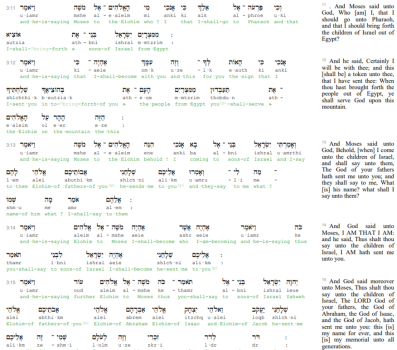
For information that can curb ones appetite from the quick and easy solution found on the right column... Review the Hebrew for accuracy.

I would think we all need to see the truth...look at verses 14 and 15 in particular.

On the translating of EGO EIMI at John 8:58 by Dr Jason BeDuhn “Truth in Translation”:

"John 8:58. The traditional translation "Before Abraham was, I am" is slavishly faithful to the literal meaning of the Greek ("Before Abraham came to be, I am"). The result is ungrammatical English. We cannot mix our tenses in such a way. The reason for this ugly rendering is the accident that, in English, the idiomatic "I am" sounds like what God says about himself in the Hebrew/Old Testament. This is sheer coincidence. Jesus is not employing a divine title here. He is merely claiming that he existed before Abraham and, of course, he still exists whereas Abraham is dead. There is nothing wrong with the Greek, but we need to take account of the Greek idiom being employed and render the meaning into proper English.

Also of interest, God didn't say his name is 'I am' in Exodus 3:14.

The tense denotes: "I shall' and not 'I am'.

Many translations mistranslate 2 verses to prove something not found in scripture.

1766145018335.png

1766145018335.png
 

JustMe

Well-Known Member
May 6, 2025
1,172
1,333
113
US
Faith
Christian
Country
United States
Gender
Male
The Expository Times, 1996, page 302 by Kenneth Mckay.

"in John 8:58: prin Abraam genesthai ego eimi, which would be most naturally translated - 'I have been in existence since before Abraham was born', if it were not for the obsession with the simple words 'I am'." . . . "If we take the Greek words in their natural meaning, as we surely should, the claim to have been in existence for so long is in itself a staggering one, quite enough to provoke the crowd's violent reaction."
 
  • Like
Reactions: TazzJazz

bdavidc

Well-Known Member
Mar 31, 2025
1,133
1,105
113
67
Charlestown, IN
know-the-bible.com
Faith
Christian
Country
United States
Gender
Male
In my earlier post I mentioned that the margin of the Revised Version has "I will be" for Exodus 3:14, and one of the supporters of this rendition could have been AB Davidson as he was one of the Hebrew scholars engaged in the production of the RV. Please note that I do not endorse all of his theology, as he was most probably a Trinitarian and also had other wrong ideas, but his Hebrew abilities have been respected and some of his Hebrew books were published in new editions until recently.
You are trusting scholars and dictionaries over God’s own words, and Scripture says that is trusting man rather than the LORD ~Jeremiah 17:5. That is the core problem here. Under Sola Scriptura, Davidson’s opinion carries zero weight. Scripture interprets Scripture, not footnotes, margins, or respected Hebrew professors.

Start with the text. God does not leave Moses guessing. He explicitly tells him what to say. “Thus shalt thou say unto the children of Israel, I AM hath sent me unto you” ~Exodus 3:14. That is not future tense speculation. That is a direct divine self-designation. Then God immediately anchors that name permanently when He says, “This is my name for ever, and this is my memorial unto all generations” ~Exodus 3:15. A memorial name is not a temporary description of what God will do in one historical moment. It is who He is.

Yes, the Hebrew word hayah can appear in different tenses, but the surrounding context determines what it means here, not every possible definition listed in a lexicon. Here the context is God revealing Himself, not promising future help. Moses did not ask, “What will God do for us?” He asked, “What is His name?” ~Exodus 3:13. God answers the question that was asked. He does not dodge it and give a vague mission statement.

Your argument also collapses when you read the broader testimony of Scripture
. God consistently uses present identity language when revealing Himself. “I am the LORD, I change not” ~Malachi 3:6. “Before me there was no God formed, neither shall there be after me” ~Isaiah 43:10. “I am the first, and I am the last; and beside me there is no God” ~Isaiah 44:6. That is identity language, not future role language.

Exodus 6 does not rescue your position. It actually confirms the opposite. God says, “I am the LORD” repeatedly ~Exodus 6:2, 6:6, 6:7, 6:8. His actions flow from who He already is. Deliverance does not define His name. His name grounds His deliverance. He does not say, “I will become the LORD when I rescue you.” He says, “I am the LORD, and I will bring you out.” Identity precedes action every time.

The attempt to turn Ehyeh into an undefined future role empties the passage of its force. If God meant “I will be whatever I turn out to be,” that tells Israel nothing about who sent Moses. That would defeat the purpose of the revelation entirely. Instead, God reveals Himself as the self-existent, ever-present One, the God who is, who was, and who is to come, as later Scripture openly affirms ~Revelation 1:8.

You admit in your own words. You said, “Please note that I do not endorse all of his theology, as he was most probably a Trinitarian and also had other wrong ideas.” Appealing to Davidson while disclaiming his theology does not solve the issue. Scripture never instructs us to resolve divine revelation by academic consensus. “Add thou not unto his words, lest he reprove thee, and thou be found a liar” ~Proverbs 30:6. When God explains His own name and says it is His memorial forever, shows you are wrong. You point people away from the plain meaning of Scripture because you refuse to submit to what God has said and instead defend your own doctrine or pride ~Romans 8:7, ~2 Thessalonians 2:10.

Exodus 3 is not God naming a future task. It is God revealing His eternal identity. The text says so plainly. Any reading that turns God’s self-revelation into a flexible future description is reading against the grain of Scripture, not with it.
 

bdavidc

Well-Known Member
Mar 31, 2025
1,133
1,105
113
67
Charlestown, IN
know-the-bible.com
Faith
Christian
Country
United States
Gender
Male
Don't you get it yet, the 'I am' with a predicate or not, is a fake expression that does not produce a real name or title. It's a no-name expression and never can relate to Yeshua, ever.
Yes, I understand exactly what John 8:58 means, because Scripture defines it and Scripture does not change to fit anyone’s theory. Jesus contrasts Abraham coming into being with His own continuing existence when He says, “Before Abraham was, I am” ~John 8:58, and that language is already defined by God Himself when He said, “I AM hath sent me unto you,” and called it His name and memorial forever ~Exodus 3:14–15. You can label “I am” a fake or no-name expression, but God does not, and the Bible does not bend because someone wants it to say something else.

You have to resort to insults and name-calling, because you do not have a strong biblical argument. You insist that “I am” is a fake, no-name expression, yet Scripture itself disagrees with you. God explicitly tells Moses what to say. “Thus shalt thou say unto the children of Israel, I AM hath sent me unto you” ~Exodus 3:14. God then immediately says, “This is my name for ever, and this is my memorial unto all generations” ~Exodus 3:15. Whatever philosophical objections you raise, God Himself calls it His name and memorial. Under Sola Scriptura, your claim cannot stand against God’s own words.

You accuse me of speaking for men while you are the one redefining God’s self-revelation to fit your theology. Scripture does not treat God’s name as a meaningless placeholder. Scripture treats it as revelation. “I am the LORD: that is my name” ~Isaiah 42:8. God does not say, “This is not really a name.” He says it is His name.

You say Yeshua cannot be God like His Father, yet Scripture directly attributes to Him what belongs to God alone. Creation belongs to God alone, yet “All things were made by him; and without him was not any thing made that was made” ~John 1:3. Eternal existence belongs to God alone, yet Jesus says, “Before Abraham was, I am” ~John 8:58. Worship belongs to God alone, yet Thomas addresses Jesus as “My Lord and my God” ~John 20:28, and Jesus accepts it without correction.

Your claim that Jesus needed the Father’s Spirit does not diminish His identity, it confirms the incarnation. Scripture says the Word became flesh ~John 1:14, not that the Word stopped being who He was. The Son humbles Himself, yet remains who He is. “Who, being in the form of God… took upon him the form of a servant” ~Philippians 2:6–7. That is Scripture, not tradition.

The charge of pride is empty when Scripture itself is being quoted and allowed to speak. This is not about threats or ego. Scripture itself draws the line. “Whosoever denieth the Son, the same hath not the Father” ~1 John 2:23. That is not my warning. That is God’s.

If you truly want to know what John 8:58 means, then you must let the whole of Scripture define it, not isolate it, redefine it, or dismiss it. Scripture presents one God, eternal and unchanging, and it places Jesus squarely within that divine identity. Rejecting that is not correction. It is contradiction.
 

bdavidc

Well-Known Member
Mar 31, 2025
1,133
1,105
113
67
Charlestown, IN
know-the-bible.com
Faith
Christian
Country
United States
Gender
Male
I would think we all need to see the truth...look at verses 14 and 15 in particular.

On the translating of EGO EIMI at John 8:58 by Dr Jason BeDuhn “Truth in Translation”:
You search grammar and scholars to avoid what God plainly said, but Scripture already settled this. God said, “I AM hath sent me unto you,” and declared it His name forever ~Exodus 3:14–15. Jesus used the same contrast of being when He said, “Before Abraham was, I am” ~John 8:58, and the Jews knew exactly what He claimed, which is why they tried to stone Him ~John 8:59. You are not correcting translation, you are denying revelation, and Jesus said plainly, “Ye do err, not knowing the scriptures” ~Matthew 22:29.
 

bdavidc

Well-Known Member
Mar 31, 2025
1,133
1,105
113
67
Charlestown, IN
know-the-bible.com
Faith
Christian
Country
United States
Gender
Male
The Expository Times, 1996, page 302 by Kenneth Mckay.

"in John 8:58: prin Abraam genesthai ego eimi, which would be most naturally translated - 'I have been in existence since before Abraham was born', if it were not for the obsession with the simple words 'I am'." . . . "If we take the Greek words in their natural meaning, as we surely should, the claim to have been in existence for so long is in itself a staggering one, quite enough to provoke the crowd's violent reaction."
You are trusting scholars instead of submitting to what God has said, and Scripture is clear that this is the broad path. Jesus warned that many choose that road because it lets them avoid truth and live as they please ~Matthew 7:13. God said, “I AM hath sent me unto you,” and called it His name forever ~Exodus 3:14–15, and Jesus said, “Before Abraham was, I am” ~John 8:58. You replace God’s words with men’s explanations to escape their meaning, and Scripture calls that idolatry, because you have exchanged the truth of God for something created by men ~Romans 1:25. Jesus’ verdict fits exactly: “Ye do err, not knowing the scriptures” ~Matthew 22:29.