On with it then...
@bdavidc
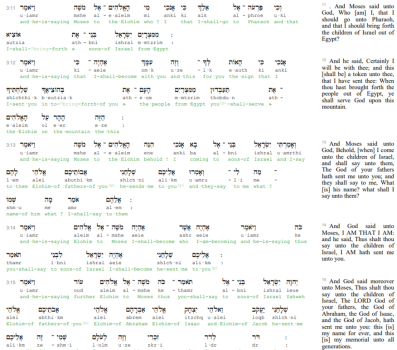
The classic argument given by those who believe Yeshua is YHWH is their sole dependance on their misuse of the words ego eimi ho on. They equate these words as being the same as ego eimi only, and translated into English as “I am.” The Book of Exodus in 3:14 reveals YHWH’s name as "the one who is" and not the introduction of the word expression it is me or for me, as in, “I am.”
The Greek phrase "ho on" translates to "the one who is" in English. It is used in the Septuagint (LXX) to express the divine name, emphasizing eternal self-existence. In the LXX, "ho on" carries the idea of eternal self-existence, distinct from "ego eimi" (I am), which is not the primary term conveying this concept. The phrase "ho on" is capable of standing alone to denote the eternal being, as seen in Exodus 3:14 where it is used as a shortened form of the Divine Name.
Consider this, if ”ego eimi” was the Greek way of saying God's name YHWH, why did not Yeshua say, "Before Abraham was, YHWH." in John 8:58?
And again, similar to what I just said, and to make this point even clearer. The Greek Septuagint translation of Exodus 3:14 uses the phrase "ego eimi ho on," which translates to "I am the one who is". While "ego eimi" (I am) appears in the Greek text, it is part of a larger phrase, "ego eimi ho on," rather than standing alone. The full expression "ego eimi ho on" is used to convey God's self-identification as "the one who is". The term "ego eimi" alone is not the full divine title; instead, the Septuagint renders the second part of the Hebrew phrase "Ehyeh Asher Ehyeh" as "ho on" ("the one who is"). Therefore, while "ego eimi" is present in the Greek text of Exodus 3:14, it is not used in isolation but as part of a larger expression that identifies God as "the one who is".
And again: The interpretation of ehyeh as "I will be" rather than "I am" is supported by the Septuagint's use of "Ho On" (The Being) and by the consistent use of ehyeh in future contexts throughout Moses' writings. Therefore, "I am who I will be" may offer a more comprehensive understanding of God's nature as both eternal and actively involved in human history.
Hebrew Grammar: The Imperfect Verb Form אֶהְיֶה
The key lies in the verb אֶהְיֶה (ʾehyeh), the first-person singular imperfect of היה (hāyâ, “to be, to become”). The imperfect verb in Hebrew often conveys incomplete or future action—“I will be,” “I will become,” or “I shall prove to be.” It does not typically mean “I am” in a present, static sense. Thus, the most natural rendering of אֶהְיֶה is “I will be” rather than “I am.”
The phrase אֶהְיֶה אֲשֶׁר אֶהְיֶה (ʾehyeh ʾăšer ʾehyeh) can be literally translated:
• “I will be who I will be.”
• “I will become what I will become.”
• “I shall prove to be what I shall prove to be.”
Each rendering maintains the force of the imperfect verb, emphasizing God’s dynamic, purposeful action rather than a static ontological declaration.
Theological Imposition in Translation
Many modern versions render the phrase as “I AM WHO I AM” (NASB, ESV, NIV), and some even stylize it in capital letters (“I AM WHO I AM”) to emphasize supposed theological connections with John 8:58. This capitalization, however, is entirely interpretive (UNNECESSARY!) and foreign to the Hebrew text. The Hebrew does not present this statement as a divine title in itself but as an explanation of God’s Name revealed in the following verse:
Exodus 3:15 (UASV): “God also said to Moses, ‘Say this to the sons of Israel: Jehovah/YHWH,
the God of your fathers, the God of Abraham, the God of Isaac, and the God of Jacob, has sent me to you. This is my name forever, and this is how I am to be remembered throughout all generations.’”
Verse 15 explicitly links the explanation of אֶהְיֶה with the covenant name יְהוָה (Jehovah/YHWH). Thus, אֶהְיֶה אֲשֶׁר אֶהְיֶה is not introducing a new divine name; rather, it clarifies the meaning of Jehovah/YHWH—He will become or prove to be all that His people need Him to be.
The Distinction Between אֶהְיֶה and יְהוָה
The Tetragrammaton (יהוה, YHWH, vocalized as Jehovah) derives from a related root of the verb “to be.” Yet there is a difference:
• אֶהְיֶה is first person: “I will be.”
• יְהוָה is third person: “He will be.”
Thus, God tells Moses, in effect: “Tell them, ‘I will be who I will be’ has sent you.” Then He immediately connects this with His covenant name Jehovah: “Jehovah has sent me to you.” In this way, God defines His Name by His activity,
not by abstract metaphysical categories.
Contrast with Greek and Latin Renderings
The Septuagint renders the phrase as ἐγώ εἰμι ὁ ὤν (egō eimi ho ōn), literally, “I am the One who is” or “I am The Being.” This is already a shift away from the Hebrew’s verbal dynamism
toward a philosophical abstraction. Philo of Alexandria and later Christian theologians, influenced by Platonic and Aristotelian categories, read Exodus 3:14 as God’s declaration of pure Being or self-existence.
The
Latin Vulgate followed the Greek: ego sum qui sum (“I am who I am”). From there,
traditional theology cemented this as a metaphysical proof text of God’s aseity, immutability, and timeless existence. While these doctrines are biblical in other respects,
this passage does not articulate them.
John 8:58 and the Misapplied Connection
John 8:58 (UASV): “Jesus said to them, ‘Truly, truly, I say to you, before Abraham was born, I am.’”
The Greek phrase is ἐγώ εἰμι (egō eimi, “I am”). Many theologians and translators link this with Exodus 3:14, suggesting Jesus was claiming to be the “I AM” of the burning bush. Yet several points undermine this connection:
1. Verb Tense: Jesus contrasts His existence with Abraham’s beginning. Abraham “came into being” (γενέσθαι, genesthai), but Jesus “is” (ἐγώ εἰμι). The sense may well be “I have been in existence” rather than “I am the I AM.”
2. No Article or Title: In Exodus 3:14 LXX, God identifies Himself as ὁ ὤν (“the Being”). Jesus does not use this title; He simply uses egō eimi in a predicative contrast.
3. Contextual Meaning: In John’s Gospel, egō eimi occurs frequently without divine overtones (John 6:20; 9:9). The uniqueness of John 8:58 is its temporal contrast, not a direct allusion to Exodus 3:14.
Thus, linking Exodus 3:14’s “I will be” with John 8:58’s “I am”
is a theological imposition rather than a linguistic or contextual necessity.
“I Will Prove to Be” – The Covenant Implications
When YHWH says, “I will be who I will be,” He assures Moses and Israel that His Name guarantees active fulfillment of His promises. He will prove to be whatever is necessary to deliver His people, guide them, protect them, and bring them into covenant blessing.
This dynamic interpretation is supported by later Scripture:
• Exodus 6:6-7 – Jehovah declares He will “bring out,” “deliver,” “redeem,” and “take” Israel as His people.
• Isaiah 43:10-13 – Jehovah identifies Himself as the One who acts in history: “I am He. Before me no god was formed, nor shall there be any after me.”
• Revelation 1:8 – YHWH is “
the One who is, who was, and who is coming,” again emphasizing His action across time.
Thus, Exodus 3:14
should not be abstracted into Greek philosophical ontology. It is a declaration of God’s covenant faithfulness, His willingness to become what His people need Him to be in order to accomplish His saving purpose.
Conclusion on Translation Philosophy
Exodus 3:14 is not a static declaration of being (“I am”), but a dynamic declaration of becoming: “I will be who I will be.” This emphasizes Jehovah’s freedom, sovereignty, and covenantal faithfulness. The Tetragrammaton (Jehovah) is then explained in light of this self-revelation: He is the God who will always prove to be exactly what His people need in order to fulfill His purposes.
Rendering the phrase as “I AM WHO I AM” not only
distorts the Hebrew grammar but also
imposes later Greek metaphysical categories upon the text. A truly literal, contextually faithful translation must preserve the imperfect tense: “I will be who I will be” or “I shall prove to be what I shall prove to be.”
The names for my God and his Son are very precious to me and Yeshua speaks in Gospels, of especially in John, and in Paul as the Father's Messiah, his true Son, the first of human immortals, of the new creation, the first fruits of his Fathers' restoration plan for mankind.. Amen.