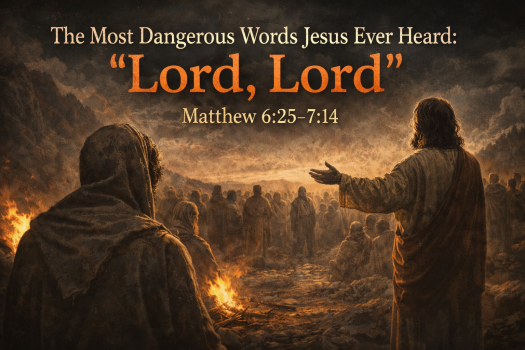
What Did Jesus Mean by “Lord, Lord”? (Matthew 7:21)

  • Welcome to Christian Forums, a Christian Forum that recognizes that all Christians are a work in progress.

    You will need to register to be able to join in fellowship with Christians all over the world.

    We hope to see you as a part of our community soon and God Bless!

bdavidc

Well-Known Member
Mar 31, 2025
1,133
1,105
113
67
Charlestown, IN
know-the-bible.com
Faith
Christian
Country
United States
Gender
Male
lord-lord.png
Jesus ends Matthew 6:25–7:14 with a warning aimed straight at religious people who assumed their words proved their faith. He exposes unbelief not as open rebellion but as divided loyalty. When Jesus asks, “O ye of little faith” ~Matthew 6:30, anxiety is revealed as mistrust. When He says no man can serve God and mammon ~Matthew 6:24, He draws a hard line that leaves no room for shared authority. God does not accept partial allegiance.

Jesus then exposes hypocrisy by condemning those who judge others while ignoring their own sin ~Matthew 7:3–5. He warns that fruit, not profession, reveals the tree. “A good tree bringeth forth good fruit” ~Matthew 7:17. Claims mean nothing if the direction of a life contradicts them. Religious activity does not equal submission.

Then comes the warning many try to soften. “Not every one that saith unto me, Lord, Lord, shall enter into the kingdom of heaven” ~Matthew 7:21. These words are not spoken to atheists but to people who thought they belonged. Jesus ends with two gates, one wide and popular, the other narrow and costly ~Matthew 7:13–14. Scripture is clear that faith without obedience is dead ~James 2:17.

Full study: Know the Bible

Question: What was Jesus warning about when He said many who call Him “Lord, Lord” will not enter the kingdom of heaven?
 

Mark51

Member
Nov 8, 2020
176
54
28
74
BROOKLYN
Faith
Christian
Country
United States
Gender
Male
View attachment 77282
Jesus ends Matthew 6:25–7:14 with a warning aimed straight at religious people who assumed their words proved their faith. He exposes unbelief not as open rebellion but as divided loyalty. When Jesus asks, “O ye of little faith” ~Matthew 6:30, anxiety is revealed as mistrust. When He says no man can serve God and mammon ~Matthew 6:24, He draws a hard line that leaves no room for shared authority. God does not accept partial allegiance.

Jesus then exposes hypocrisy by condemning those who judge others while ignoring their own sin ~Matthew 7:3–5. He warns that fruit, not profession, reveals the tree. “A good tree bringeth forth good fruit” ~Matthew 7:17. Claims mean nothing if the direction of a life contradicts them. Religious activity does not equal submission.

Then comes the warning many try to soften. “Not every one that saith unto me, Lord, Lord, shall enter into the kingdom of heaven” ~Matthew 7:21. These words are not spoken to atheists but to people who thought they belonged. Jesus ends with two gates, one wide and popular, the other narrow and costly ~Matthew 7:13–14. Scripture is clear that faith without obedience is dead ~James 2:17.

Full study: Know the Bible

Question: What was Jesus warning about when He said many who call Him “Lord, Lord” will not enter the kingdom of heaven?
 

Mark51

Member
Nov 8, 2020
176
54
28
74
BROOKLYN
Faith
Christian
Country
United States
Gender
Male
View attachment 77282
Jesus ends Matthew 6:25–7:14 with a warning aimed straight at religious people who assumed their words proved their faith. He exposes unbelief not as open rebellion but as divided loyalty. When Jesus asks, “O ye of little faith” ~Matthew 6:30, anxiety is revealed as mistrust. When He says no man can serve God and mammon ~Matthew 6:24, He draws a hard line that leaves no room for shared authority. God does not accept partial allegiance.

Jesus then exposes hypocrisy by condemning those who judge others while ignoring their own sin ~Matthew 7:3–5. He warns that fruit, not profession, reveals the tree. “A good tree bringeth forth good fruit” ~Matthew 7:17. Claims mean nothing if the direction of a life contradicts them. Religious activity does not equal submission.

Then comes the warning many try to soften. “Not every one that saith unto me, Lord, Lord, shall enter into the kingdom of heaven” ~Matthew 7:21. These words are not spoken to atheists but to people who thought they belonged. Jesus ends with two gates, one wide and popular, the other narrow and costly ~Matthew 7:13–14. Scripture is clear that faith without obedience is dead ~James 2:17.

Full study: Know the Bible

Question: What was Jesus warning about when He said many who call Him “Lord, Lord” will not enter the kingdom of heaven?
This suggests to me that using “Lord” twice is an emphasis of acknowledgment and respect that Jesus Christ has authority of judgment over the past, present and future people of the earth.
 

bdavidc

Well-Known Member
Mar 31, 2025
1,133
1,105
113
67
Charlestown, IN
know-the-bible.com
Faith
Christian
Country
United States
Gender
Male
This suggests to me that using “Lord” twice is an emphasis of acknowledgment and respect that Jesus Christ has authority of judgment over the past, present and future people of the earth.
Jesus was not warning about respect or acknowledgment of authority. He was warning about false profession.

The people saying “Lord, Lord” believed they belonged to Him, yet Jesus says plainly, “I never knew you” ~Matthew 7:23. Their words were correct. Their lives were not.

Jesus defines the issue Himself. “He that doeth the will of my Father which is in heaven” ~Matthew 7:21. Obedience is the evidence of genuine faith, not the repetition of titles.

This is a warning to religious people who substitute confession for submission.
 
  • Like
Reactions: Hillsage and FredG3

Soyeong

Active Member
Jan 29, 2024
619
140
43
43
Hudson
Faith
Christian
Country
United States
View attachment 77282
Jesus ends Matthew 6:25–7:14 with a warning aimed straight at religious people who assumed their words proved their faith. He exposes unbelief not as open rebellion but as divided loyalty. When Jesus asks, “O ye of little faith” ~Matthew 6:30, anxiety is revealed as mistrust. When He says no man can serve God and mammon ~Matthew 6:24, He draws a hard line that leaves no room for shared authority. God does not accept partial allegiance.

Jesus then exposes hypocrisy by condemning those who judge others while ignoring their own sin ~Matthew 7:3–5. He warns that fruit, not profession, reveals the tree. “A good tree bringeth forth good fruit” ~Matthew 7:17. Claims mean nothing if the direction of a life contradicts them. Religious activity does not equal submission.

Then comes the warning many try to soften. “Not every one that saith unto me, Lord, Lord, shall enter into the kingdom of heaven” ~Matthew 7:21. These words are not spoken to atheists but to people who thought they belonged. Jesus ends with two gates, one wide and popular, the other narrow and costly ~Matthew 7:13–14. Scripture is clear that faith without obedience is dead ~James 2:17.

Full study: Know the Bible

Question: What was Jesus warning about when He said many who call Him “Lord, Lord” will not enter the kingdom of heaven?
The Hebrew word “yada” refers to intimate knowledge gained by experience, such as with Genesis 4:1 where Adam knew (yada) Eve, she conceived, and gave birth to Cain. God’s way is the way to know (yada) Him and Jesus by experiencing being in His likeness through embodying His character traits, which is the narrow way to eternal life (John 17:3). For example, in Genesis 18:19, God knew (yada) Abraham that he would teach his children and those of His household to walk in His way by being doers of righteousness and justice that the Lord might bring to him all that He has promised. In Exodus 33:13, Moses wanted God to be gracious to him by teaching him to walk in His way that he and Israel might know (yada) Him, and in Matthew 7:23, Jesus said that he would tell those who are workers of lawlessness to depart from him because he never knew them, so the goal of the law is to graciously teach us how to know (yada) God and Jesus, which is His gift of eternal life.

The problem is that people can go through the motions of obeying the Law of God while neglecting to be a doer of the character traits of God that it was given in order to teach us to how to embody and thus neglect to know (yada) God and Jesus and still be counted as workers of lawlessness. For example, in Matthew 23:23, Jesus said that tithing was something that they ought to be doing while not neglecting weightier matters of the Law of justice, mercy, and faithfulness. In Philippians 3:8, Paul was in the same situation where he had been obeying the Law of God, but not while being focused on knowing Christ, so he had been missing the whole goal of the law and counted that as rubbish.
 

bdavidc

Well-Known Member
Mar 31, 2025
1,133
1,105
113
67
Charlestown, IN
know-the-bible.com
Faith
Christian
Country
United States
Gender
Male
The Hebrew word “yada” refers to intimate knowledge gained by experience, such as with Genesis 4:1 where Adam knew (yada) Eve, she conceived, and gave birth to Cain. God’s way is the way to know (yada) Him and Jesus by experiencing being in His likeness through embodying His character traits, which is the narrow way to eternal life (John 17:3). For example, in Genesis 18:19, God knew (yada) Abraham that he would teach his children and those of His household to walk in His way by being doers of righteousness and justice that the Lord might bring to him all that He has promised. In Exodus 33:13, Moses wanted God to be gracious to him by teaching him to walk in His way that he and Israel might know (yada) Him, and in Matthew 7:23, Jesus said that he would tell those who are workers of lawlessness to depart from him because he never knew them, so the goal of the law is to graciously teach us how to know (yada) God and Jesus, which is His gift of eternal life.

The problem is that people can go through the motions of obeying the Law of God while neglecting to be a doer of the character traits of God that it was given in order to teach us to how to embody and thus neglect to know (yada) God and Jesus and still be counted as workers of lawlessness. For example, in Matthew 23:23, Jesus said that tithing was something that they ought to be doing while not neglecting weightier matters of the Law of justice, mercy, and faithfulness. In Philippians 3:8, Paul was in the same situation where he had been obeying the Law of God, but not while being focused on knowing Christ, so he had been missing the whole goal of the law and counted that as rubbish.
You are right that Scripture uses the word “know” to describe real relationship. But your conclusion drifts away from what Jesus is actually warning about in Matthew 7.

Jesus is not teaching that eternal life comes from embodying God’s character traits through the Law. He is warning about people who claim allegiance to Him while rejecting submission to Him.

When Jesus says, “I never knew you: depart from me, ye that work iniquity” ~Matthew 7:23, the issue is not that they failed to achieve enough experiential likeness. The issue is lawlessness. The Greek word there is anomia, meaning living without submission to God’s authority. These people were religious, active, and impressive. They prophesied, cast out devils, and did many works. Yet they were never under Christ’s lordship.

Jesus already defined the problem earlier. “No man can serve two masters” ~Matthew 6:24. They said “Lord” with their mouths, but their lives were ruled by something else. That is why He says, “Why call ye me, Lord, Lord, and do not the things which I say?” ~Luke 6:46. The contradiction is between profession and obedience, not between Law-keeping and character formation.

John 17:3 does not redefine eternal life as experiential moral transformation. Jesus says eternal life is to know the Father and the Son whom He sent. That knowledge begins with faith. Scripture is explicit. “He that believeth on the Son hath everlasting life” ~John 3:36. “By grace are ye saved through faith… not of works” ~Ephesians 2:8–9. Obedience follows salvation. It does not produce it.

Paul did not say the Law’s goal was to teach us how to embody God so we could gain life. He said, “Christ is the end of the law for righteousness to every one that believeth” ~Romans 10:4. The Law exposes sin and shuts every mouth before God ~Romans 3:19–20. It never gives life ~Galatians 3:21.

Matthew 23:23 proves this point, not the opposite. Jesus rebukes them because they focused on visible obedience while their hearts were unchanged. That does not mean righteousness comes from better law-keeping. It means external religion without a transformed heart is dead.

So what was Jesus warning about with “Lord, Lord”?

He was warning about false assurance. About religious people who trust their works, their activity, or their identity instead of submitting to Christ in faith. Many will be shocked on that day because they replaced repentance and faith with religious performance.

The narrow way is not self-transformation through the Law. The narrow way is repentance and faith that produces obedience. Anything else is the wide road dressed up in religious clothing.
 

Soyeong

Active Member
Jan 29, 2024
619
140
43
43
Hudson
Faith
Christian
Country
United States
You are right that Scripture uses the word “know” to describe real relationship. But your conclusion drifts away from what Jesus is actually warning about in Matthew 7.

Jesus is not teaching that eternal life comes from embodying God’s character traits through the Law. He is warning about people who claim allegiance to Him while rejecting submission to Him.
The way to have allegiance to God and to submit to His authority is by embodying His character traits.

When Jesus says, “I never knew you: depart from me, ye that work iniquity” ~Matthew 7:23, the issue is not that they failed to achieve enough experiential likeness. The issue is lawlessness. The Greek word there is anomia, meaning living without submission to God’s authority. These people were religious, active, and impressive. They prophesied, cast out devils, and did many works. Yet they were never under Christ’s lordship.
Sin is what is contrary to God's character traits and sin is lawlessness because the Law of God was given for the purpose of teaching us how to know God through embodying His character traits.

Jesus already defined the problem earlier. “No man can serve two masters” ~Matthew 6:24. They said “Lord” with their mouths, but their lives were ruled by something else. That is why He says, “Why call ye me, Lord, Lord, and do not the things which I say?” ~Luke 6:46. The contradiction is between profession and obedience, not between Law-keeping and character formation.
The difference between profession and obedience is embodying God's character traits

John 17:3 does not redefine eternal life as experiential moral transformation. Jesus says eternal life is to know the Father and the Son whom He sent. That knowledge begins with faith. Scripture is explicit. “He that believeth on the Son hath everlasting life” ~John 3:36.
We embody what we believe to be true about God through or works such as with James 2:18 saying that he would show his faith through his works, so everyone who is a doer of the same works as James believes in the Son. In other words, the way to believe in God is by walking in His way. For example, by being a doer of good works in obedience to the Law of God we are embodying God's goodness, which is why our good works bring glory to Him (Matthew 5:16), and by embodying God's goodness we are also embodying the belief that God is good. Likewise, the way to believe that God is compassionate is by being compassionate (Luke 6:36), the way to believe that God is holy is by being a doer of His instructions for how to be holy as He holy (1 Peter 1:16), and so forth. This is exactly the same as the way to believe in the Son, who is the radiance of God's glory and the exact likeness of His character (Hebrews 1:3), which he embodied through his works by setting a sinless example for us to follow of how to walk in obedience to the Law of God. This is why there are many verses that connect our belief in God with our obedience to Him, such as wit Revelation 14:12 where those who kept faith in Christ are the same as those who kept God's commandments. Moreover, this is also why there are many verses like John 3:36 that say that the way to have eternal life is by believing in the Son and many verses like Luke 10:25-28 that say that the way to inherit eternal life is by obeying the greatest two commandments. In addition, John 3:16-21 connect believing in the Son with our obedience. It is by this faith alone that we attain righteousness and the other character traits of God.

“By grace are ye saved through faith… not of works” ~Ephesians 2:8–9. Obedience follows salvation. It does not produce it.
In Psalms 119:29-30, he wanted to put false ways far from him, for God to be gracious to him by teaching him to obey His law, and he chose the way of faith by setting it before him, so this has always been the one and only way of salvation by grace through faith. In Ephesians 2:8-10, we are new creations in Christ to do good works, so while Paul denied that we can earn our salvation as the result of our works lest we should boast, God graciously making us into doers of good works is nevertheless a central part of the content of His gift of salvation. In Titus 2:11-13, the content of our gift of salvation is described as being trained by grace to do what is godly, righteous, and good, and to renounce doing what is ungodly, so we are not required to have first done those works in order to earn our salvation as the result and we are not required to do those works as the result of having first been saved, but rather God graciously teaching us to experience embodying those traits is part of the content of His gift of salvation.

Paul did not say the Law’s goal was to teach us how to embody God so we could gain life. He said, “Christ is the end of the law for righteousness to every one that believeth” ~Romans 10:4. The Law exposes sin and shuts every mouth before God ~Romans 3:19–20.
In Romans 9:30-10:4, they had zeal for God, but it was not based on knowing Him, so they failed to attain righteousness because they misunderstood the goal of the law by pursuing it as through righteousness were earned as the result of their works in order to establish their own instead of pursing it as though righteousness were by faith, for knowing Christ is the goal of the law for righteousness for everyone who has faith.

It never gives life ~Galatians 3:21.
We can't earn eternal life even as the result of having perfect obedience to the Law of God because it was never given as a way to earn eternal life, but rather was given into order to teach us what is intrinsically required in order to experience the gift of eternal life. In Luke 10:25-28, Jesus affirmed that the way to inherit eternal life is by obeying the greatest two commandments and something that we inherit is a gift, so he was speaking about what is intrinsically required in order to experience the gift of eternal life, not about the way to be good enough to earn it as the result.

Matthew 23:23 proves this point, not the opposite. Jesus rebukes them because they focused on visible obedience while their hearts were unchanged. That does not mean righteousness comes from better law-keeping. It means external religion without a transformed heart is dead.
We can't earn our righteousness even as the result of perfect obedience to the Law of God because it was never given as a way of doing that (Romans 4:1-5), but rather it was given in order to teach us what is intrinsically required to experience the gift of righteousness. Jesus embodied the righteousness of God through his works by setting a sinless example for us to follow of how to walk in obedience to the Law of God, so us getting to experience being a doer of righteous works in accordance with his example is the content of his gift of the righteousness of God.

So what was Jesus warning about with “Lord, Lord”?

He was warning about false assurance. About religious people who trust their works, their activity, or their identity instead of submitting to Christ in faith. Many will be shocked on that day because they replaced repentance and faith with religious performance.
God is trustworthy, therefore His law is also trustworthy (Psalms 19:7), so the way to trust on God is by obediently trusting in His instructions and it is contradictory to think that we trust in God instead of trusting in His instructions or to think that we should trust in God's Word made flesh instead of in embodying Gods Word. In Luke 6:46, Jesus asked why people called him "Lord, Lord" but did not do as he said.

The narrow way is not self-transformation through the Law. The narrow way is repentance and faith that produces obedience. Anything else is the wide road dressed up in religious clothing.
The way to repent from our sins through faith is by obeying the Law of God.
 

bdavidc

Well-Known Member
Mar 31, 2025
1,133
1,105
113
67
Charlestown, IN
know-the-bible.com
Faith
Christian
Country
United States
Gender
Male
The way to have allegiance to God and to submit to His authority is by embodying His character traits.


Sin is what is contrary to God's character traits and sin is lawlessness because the Law of God was given for the purpose of teaching us how to know God through embodying His character traits.


The difference between profession and obedience is embodying God's character traits


We embody what we believe to be true about God through or works such as with James 2:18 saying that he would show his faith through his works, so everyone who is a doer of the same works as James believes in the Son. In other words, the way to believe in God is by walking in His way. For example, by being a doer of good works in obedience to the Law of God we are embodying God's goodness, which is why our good works bring glory to Him (Matthew 5:16), and by embodying God's goodness we are also embodying the belief that God is good. Likewise, the way to believe that God is compassionate is by being compassionate (Luke 6:36), the way to believe that God is holy is by being a doer of His instructions for how to be holy as He holy (1 Peter 1:16), and so forth. This is exactly the same as the way to believe in the Son, who is the radiance of God's glory and the exact likeness of His character (Hebrews 1:3), which he embodied through his works by setting a sinless example for us to follow of how to walk in obedience to the Law of God. This is why there are many verses that connect our belief in God with our obedience to Him, such as wit Revelation 14:12 where those who kept faith in Christ are the same as those who kept God's commandments. Moreover, this is also why there are many verses like John 3:36 that say that the way to have eternal life is by believing in the Son and many verses like Luke 10:25-28 that say that the way to inherit eternal life is by obeying the greatest two commandments. In addition, John 3:16-21 connect believing in the Son with our obedience. It is by this faith alone that we attain righteousness and the other character traits of God.


In Psalms 119:29-30, he wanted to put false ways far from him, for God to be gracious to him by teaching him to obey His law, and he chose the way of faith by setting it before him, so this has always been the one and only way of salvation by grace through faith. In Ephesians 2:8-10, we are new creations in Christ to do good works, so while Paul denied that we can earn our salvation as the result of our works lest we should boast, God graciously making us into doers of good works is nevertheless a central part of the content of His gift of salvation. In Titus 2:11-13, the content of our gift of salvation is described as being trained by grace to do what is godly, righteous, and good, and to renounce doing what is ungodly, so we are not required to have first done those works in order to earn our salvation as the result and we are not required to do those works as the result of having first been saved, but rather God graciously teaching us to experience embodying those traits is part of the content of His gift of salvation.


In Romans 9:30-10:4, they had zeal for God, but it was not based on knowing Him, so they failed to attain righteousness because they misunderstood the goal of the law by pursuing it as through righteousness were earned as the result of their works in order to establish their own instead of pursing it as though righteousness were by faith, for knowing Christ is the goal of the law for righteousness for everyone who has faith.


We can't earn eternal life even as the result of having perfect obedience to the Law of God because it was never given as a way to earn eternal life, but rather was given into order to teach us what is intrinsically required in order to experience the gift of eternal life. In Luke 10:25-28, Jesus affirmed that the way to inherit eternal life is by obeying the greatest two commandments and something that we inherit is a gift, so he was speaking about what is intrinsically required in order to experience the gift of eternal life, not about the way to be good enough to earn it as the result.


We can't earn our righteousness even as the result of perfect obedience to the Law of God because it was never given as a way of doing that (Romans 4:1-5), but rather it was given in order to teach us what is intrinsically required to experience the gift of righteousness. Jesus embodied the righteousness of God through his works by setting a sinless example for us to follow of how to walk in obedience to the Law of God, so us getting to experience being a doer of righteous works in accordance with his example is the content of his gift of the righteousness of God.


God is trustworthy, therefore His law is also trustworthy (Psalms 19:7), so the way to trust on God is by obediently trusting in His instructions and it is contradictory to think that we trust in God instead of trusting in His instructions or to think that we should trust in God's Word made flesh instead of in embodying Gods Word. In Luke 6:46, Jesus asked why people called him "Lord, Lord" but did not do as he said.


The way to repent from our sins through faith is by obeying the Law of God.
Here is where your reasoning crosses the line Scripture will not cross.

You keep redefining faith as obedience itself. The Bible never does that. Scripture consistently says obedience flows from faith, not that obedience is faith.

Paul states it plainly. “To him that worketh not, but believeth on him that justifieth the ungodly, his faith is counted for righteousness” ~Romans 4:5. That verse alone shuts the door on the idea that faith is embodied obedience. Faith trusts. Obedience follows.

James 2 does not say works create faith or define faith. James says works demonstrate faith before men. Abraham was justified by faith in Genesis 15, long before Isaac in Genesis 22 ~James 2:21–23. The faith already existed. The works proved it.

You keep appealing to Luke 10, but Jesus there is exposing the lawyer’s inability, not giving a method of salvation. That same Gospel later records Jesus saying, “That which is impossible with men is possible with God” ~Luke 18:27. If eternal life came through embodied obedience, Christ would not have needed the cross.

Scripture is explicit that the Law was never the means of life. “If there had been a law given which could have given life, verily righteousness should have been by the law” ~Galatians 3:21. The Law defines righteousness. It does not impart it.

You say repentance is obeying the Law. Scripture says repentance is a turning of the heart to God. “Repent ye therefore, and be converted, that your sins may be blotted out” ~Acts 3:19. Obedience follows conversion. It does not cause it.

Jesus did not reject the people in Matthew 7 because they failed to embody God’s traits well enough. He rejected them because they were workers of lawlessness who never knew Him. Knowledge of Christ comes through faith, not through moral imitation ~John 17:3, ~John 3:36.

The gospel order never changes. Faith saves. Grace justifies. The Spirit transforms. Obedience testifies.

Reverse that order and you end up with a religious system that sounds spiritual but quietly places confidence back in self. That is exactly what Jesus was warning about.
 

lforrest

Admin
Staff member
Admin
Aug 10, 2012
6,565
7,937
113
Faith
Christian
Gender
Male
View attachment 77282
Jesus ends Matthew 6:25–7:14 with a warning aimed straight at religious people who assumed their words proved their faith. He exposes unbelief not as open rebellion but as divided loyalty. When Jesus asks, “O ye of little faith” ~Matthew 6:30, anxiety is revealed as mistrust. When He says no man can serve God and mammon ~Matthew 6:24, He draws a hard line that leaves no room for shared authority. God does not accept partial allegiance.

Jesus then exposes hypocrisy by condemning those who judge others while ignoring their own sin ~Matthew 7:3–5. He warns that fruit, not profession, reveals the tree. “A good tree bringeth forth good fruit” ~Matthew 7:17. Claims mean nothing if the direction of a life contradicts them. Religious activity does not equal submission.

Then comes the warning many try to soften. “Not every one that saith unto me, Lord, Lord, shall enter into the kingdom of heaven” ~Matthew 7:21. These words are not spoken to atheists but to people who thought they belonged. Jesus ends with two gates, one wide and popular, the other narrow and costly ~Matthew 7:13–14. Scripture is clear that faith without obedience is dead ~James 2:17.

Full study: Know the Bible

Question: What was Jesus warning about when He said many who call Him “Lord, Lord” will not enter the kingdom of heaven?
He was predicting the clammer of the lost pleading to him for mercy. They will plead to him for acceptance. It will sound like "Lord, Lord, it's me." Being spoken by many trying to get his attention.

Guess they don't have the confidence to say Bro, Bro.
 

bdavidc

Well-Known Member
Mar 31, 2025
1,133
1,105
113
67
Charlestown, IN
know-the-bible.com
Faith
Christian
Country
United States
Gender
Male
He was predicting the clammer of the lost pleading to him for mercy. They will plead to him for acceptance. It will sound like "Lord, Lord, it's me." Being spoken by many trying to get his attention.

Guess they don't have the confidence to say Bro, Bro.
Jesus is not describing strangers knocking on heaven’s door. He is warning church folks who thought they already had the key. “Lord, Lord” is not a cry of panic. It is a claim of familiarity. These are people confident in their religious résumé. They preached. They served. They did things in His name. But Jesus cuts straight through the noise and says, “I never knew you” ~Matthew 7:23. Not “I knew you once.” Never.

Here is the line Jesus draws. Saying the right words is not the same as submitting to the Father’s will. Religious activity can look impressive and still hide rebellion. “Why call ye me, Lord, Lord, and do not the things which I say?” ~Luke 6:46. This is not about perfection. It is about direction. A living faith produces obedience. A dead faith produces excuses. “Faith, if it hath not works, is dead” ~James 2:17.

Jesus gave this warning because false assurance is deadly. The narrow gate costs everything. But it leads to life ~Matthew 7:13–14.
 
  • Like
Reactions: lforrest

Soyeong

Active Member
Jan 29, 2024
619
140
43
43
Hudson
Faith
Christian
Country
United States
You keep redefining faith as obedience itself. The Bible never does that. Scripture consistently says obedience flows from faith, not that obedience is faith.
Not all works are faith, but the way to experience having faith is through our works. Take a scenario where you are observing a guide who is leading a couple people through a jungle and they come to a rope bridge that he assures them is safe. One person (P1) responds just by just standing there and mentally affirming that it is true that it is safe while the second person (P2) responds by crossing the bridge. P2 is experiencing what it means to have faith in the guide in a way that P1 is not and biblical faith (pistis/emunah) is P2. For example, in Romans 1:8, Paul was thanking God that their faith was being reported all of the world and the way to report someone's faith is by speaking about the actions that they did that embodied their faith as is done in Hebrews 11. If you were looking at P1, then you couldn't tell whether or not they believed that the bridge was safe and you would have nothing to report, but if you were looking at P2, then you could see what it means to have faith that the bridge is safe and you would have something to report.

This is why the Bible repeatedly connects our faith in God with our obedience to Him. In Romans 1:6, we have receive grace in order to bring about the obedience of faith. In Romans 3:31, our faith upholds the Law of God. In Matthew 23:23, Jesus said that faith is one of the weightier matters of the Law of God. In Psalms 119:130, he chose the way of faith by setting the Law of God before him. In John 3:16-21, it connects believing in the Son with our works. In John 3:36, it equates believing in the Son with obeying him. In Hebrews 3:18-19, it equates disobedience with unbelief. In Numbers 5:6, it describes disobedience as breaking faith. And so forth.

Paul states it plainly. “To him that worketh not, but believeth on him that justifieth the ungodly, his faith is counted for righteousness” ~Romans 4:5. That verse alone shuts the door on the idea that faith is embodied obedience. Faith trusts. Obedience follows.
Works can be done for a variety of reasons, so it is important to recognize that the Bible can speak against being required to be doer of works for incorrects reason without speaking against being required to do them for correct reasons. While Paul denied in Romans 4:1-5 that we can earn our righteousness as the result of our works even as the result of perfect obedience, he also affirmed in Romans 2:13 that only the doers of the law will be declared righteous, so there is a reason why our righteousness requires us to choose to be doers of the law other than in order to earn it as a wage, namely faith insofar as the faith by which we are declared righteous apart from works also upholds the Law of God (Romans 3:28-31). We become someone who has faith, someone who will be declared righteous, and someone who is a doer of the Law of God all at the same time and anyone who is not one of those is also not the others, but we do not earn our righteousness as the result of our obedience.

James 2 does not say works create faith or define faith. James says works demonstrate faith before men. Abraham was justified by faith in Genesis 15, long before Isaac in Genesis 22 ~James 2:21–23. The faith already existed. The works proved it.
While it is true that Abraham was declared righteous because he believed God (Genesis 15:6), it is also true that he was a doer of righteous works because he believed God (Genesis 15:6), ad that he offered Isaac because he believed God (Hebrews 11:17), so the faith by which he was declared righteous was also embodied through his works, but he did not earn his righteousness as the result of his works (Romans 4:1-5). In James 2:21-24, it quotes Genesis 15:6 to support saying that Abraham was declared righteous by his works when he offered Isaac, that his faith was active along with his works, and his faith completed his works, so he was declared righteous by his works insofar as they embodied his faith but not insofar as they were earning it as a wage. Abraham did not just mentally affirm the promise but embodied his faith in the promise by actively working to bring it about.

You keep appealing to Luke 10, but Jesus there is exposing the lawyer’s inability, not giving a method of salvation. That same Gospel later records Jesus saying, “That which is impossible with men is possible with God” ~Luke 18:27. If eternal life came through embodied obedience, Christ would not have needed the cross.

Scripture is explicit that the Law was never the means of life. “If there had been a law given which could have given life, verily righteousness should have been by the law” ~Galatians 3:21.
The content of a gift can be the experience of doing something, such as giving someone the opportunity to experience driving a Ferrari, where the gift intrinsically requires them to do the work of driving it in order to have that experience, but where doing that work contributes nothing towards earning the opportunity to drive it. In accordance with Galatians 3:21, we can't earn eternal life even as the result of having perfect obedience to the Law of God, but that doesn't mean that we aren't intrinsically required to be a doer of it in order to experience the content of the gift of eternal life (Luke 10:25-28). Jesus did not mention anything in Luke 10 about their inability to obey the greatest two commandments. In Romans 10:5-8, Paul referred to Deuteronomy 30 as the word of faith that we proclaim in regard to the righteousness that is by faith proclaiming that the Law of God is not too difficult for us to obey and that obedience to it brings life and a blessing while disobedience brings death and a curse, so choose life! So it was presented as a possibility and as a choice, not as something that we have the inability to obey.

In Deuteronomy 32:46-47, the Law of God is our very life. In Proverbs 3:18, it is a Tree of Life for all who take hold of it. In Revelation 22:14, those who obeyed God's commandments are given the right to eat from the Tree of Life. In Proverbs 6:23, for the commandment is a lamp and the teaching a light, and the reproofs of discipline are the way of life. In Matthew 19:17, Jesus said that the way to have eternal life is by obeying God's commandments. In Hebrews 5:9, Jesus has become a source of eternal salvation for those who obey him. In Romans 2:6-7, those who persist in doing good will be given eternal life. In Romans 6:19-23, we are no longer to present ourselves as slaves to impurity, lawlessness, and sin, but are now to present ourselves as slaves to God and to righteousness leading to sanctification, and the goal of sanctification is eternal life in Christ, which is the gift of God, so the experience of being a doer of the Law of God is the content of His gift of eternal life. I do not good grounds for taking the position that the many verses that repeatedly say that the way to have eternal life is by obeying God's commandments do not apply to anyone. In Titus 2:14, Jesus gave himself to redeem us from all lawlessness and to purify for himself a people of his own possession who are zealous for doing good works, so the way to believe in what Jesus spent his ministry teaching and in what he accomplished through the cross is by repenting and becoming zealous for doing good works in obedience to the Law of God (Acts 21:20).

The Law defines righteousness. It does not impart it.
Indeed, the Law of God was never given as a way of earning our righteousness even as the result of perfect obedience, but rather the content of the gift of the righteousness of God is getting to experience embodying it in obedience to the Law of God.

You say repentance is obeying the Law. Scripture says repentance is a turning of the heart to God. “Repent ye therefore, and be converted, that your sins may be blotted out” ~Acts 3:19. Obedience follows conversion. It does not cause it.
Sin is the transgression of the Law of God, so the way to repent from not being a doer of it is intrinsically by becoming a doer of it.

Jesus did not reject the people in Matthew 7 because they failed to embody God’s traits well enough. He rejected them because they were workers of lawlessness who never knew Him. Knowledge of Christ comes through faith, not through moral imitation ~John 17:3, ~John 3:36.
The Law of God is His instructions for how to embody His character traits, the way to know God is through embodying His character traits, and the way to have faith in God by embodying His character traits, so anything that he would tell those who are workers of lawlessness to depart from him because he never knew them is the same as saying that they were not doers of God's character traits while saying that knowledge of Christ comes through faith is the same as saying that it comes through embodying God's character traits.

The gospel order never changes. Faith saves. Grace justifies. The Spirit transforms. Obedience testifies.

Reverse that order and you end up with a religious system that sounds spiritual but quietly places confidence back in self. That is exactly what Jesus was warning about.
Please cliffy what you mean by reversing the order. Relying on ourselves does not involve relying on anyone else, so it would be contradictory to rely on ourselves by obediently relying on God's instructions.