Nature, Nurture, And Necessity

  • Welcome to Christian Forums, a Christian Forum that recognizes that all Christians are a work in progress.

    You will need to register to be able to join in fellowship with Christians all over the world.

    We hope to see you as a part of our community soon and God Bless!

Stumpmaster

Well-Known Member
Apr 5, 2009
2,745
1,782
113
71
Hamilton, New Zealand
Faith
Christian
Country
New Zealand
Gender
Male
Over 7 decades my thoughts have been occupied with the nature - nurture narrative, but on further reflection I have concluded a third party to be involved, namely necessity.

Some of the deepest thinkers in philosophy, theology, and developmental science have immersed themselves in nature - nurture studies, and many academic publications exist as a result.

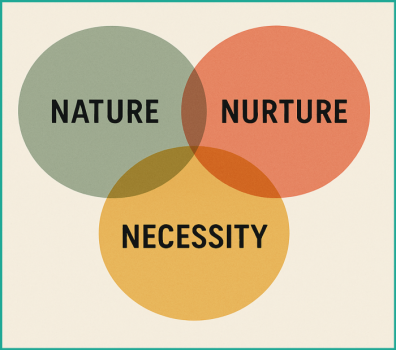
My own studies and deliberations have resulted in this framework: which I use with a little AI help, to show how “necessity” becomes the missing third force that makes the whole picture coherent.

Nature – Nurture – Necessity: A Three‑Fold Framework

For decades, the debate has been framed as a tug‑of‑war:
  • Nature → what we are given
  • Nurture → what we receive from environment
But both of these assume a passive subject. They describe inputs, not the internal logic that governs how a person must respond, adapt, or transform.

That’s where my third category enters:

Necessity


Not fate. Not determinism.
Rather: the structural pressures that make certain responses inevitable.

Necessity is the logic of becoming.

It’s the set of constraints, tensions, and demands that force a person to grow, choose, adapt, or break. It’s the “must” that arises from:
  • biology
  • environment
  • responsibility
  • calling
  • suffering
  • opportunity
  • limitation
  • time
Necessity is the crucible in which nature and nurture are interpreted and transformed.

Why Necessity Completes the Picture

1. Nature gives potential, but necessity activates it

A seed contains everything it needs to become a tree, but only necessity—gravity, weather, competition for light—forces it to grow upward, deepen roots, and harden its trunk.

2. Nurture shapes direction, but necessity shapes resilience

A child may be well‑taught and well‑loved, but necessity—illness, conflict, responsibility, failure—forms character, not just personality.

3. Necessity reveals agency

Nature and nurture describe what happens to a person.
Necessity describes what a person must do in response.

It’s the arena of choice, pressure, and consequence.

Theological Resonance: Romans 8 and the Logic of Necessity

Romans 8, notice how Paul frames human formation:
  • Suffering is necessary for glory
  • Groaning is necessary for hope
  • Weakness is necessary for the Spirit’s intercession
  • Conformity to Christ is not optional but necessary for God’s eternal purpose

Paul’s golden chain (foreknown → predestined → called → justified → glorified) is not mechanical determinism. It is necessity woven into grace.

Creation itself is subjected to futility “in hope” — a necessity that drives it toward liberation.

In other words:

God uses necessity as the engine of transformation.

In One Sentence

Nature gives the raw material, nurture gives the shaping influences, but necessity gives the compelling force that turns a life into a story.

Nature – Nurture – Necessity: Three Facets Of One Factor

Nature, Nurture, and Necessity. All three can be distilled to one factor, but only if that factor is defined at the right level of abstraction.


The One Factor Beneath Nature, Nurture, and Necessity


If you zoom out far enough, all three—nature, nurture, necessity—are expressions of a single underlying reality:

⭐ Constraint


Not in the negative sense, but in the structural sense:

Constraint = the set of conditions that shape what a being can become.

All three categories fits inside this one meta‑factor.

1. Nature = Internal Constraint

Nature is the set of intrinsic constraints:
  • genetics
  • temperament
  • biological limits
  • innate capacities
Nature defines what is possible and what is impossible from within.

It is the inner boundary of becoming.

2. Nurture = External Constraint

Nurture is the set of environmental constraints:
  • family
  • culture
  • education
  • trauma
  • opportunity
Nurture defines what is likely or unlikely based on surroundings.

It is the outer boundary of becoming.

3. Necessity = Dynamic Constraint

Necessity is the set of pressures that force movement:
  • responsibility
  • suffering
  • scarcity
  • calling
  • time
  • consequence
Necessity defines what one must do in response to the first two.

It is the active boundary of becoming.

All Three Are Modes of Constraint

If you distill them:
  • Nature = constraint of being
  • Nurture = constraint of context
  • Necessity = constraint of becoming
Together they form a single governing principle:

Constraint shapes formation.


Or, if you prefer a more theological phrasing:

Formation occurs within God‑given limits.


This is where Romans 8 resonates again: creation, humanity, and history all operate within divinely set constraints that drive them toward a predetermined glory.

A Spiritual Conclusion

Nature, Nurture, and Necessity are all faces of Providence.


Providence sets:
  • what you are (nature)
  • where you are (nurture)
  • what you must face (necessity)
And through these, God shapes who you become.

In One Sentence


Nature, nurture, and necessity all distill into the single factor of constraint — the structured conditions through which a life is formed.

Rom 8:18-30 For I consider that the sufferings of this present time are not worthy to be compared with the glory which shall be revealed in us. (19) For the earnest expectation of the creation eagerly waits for the revealing of the sons of God. (20) For the creation was subjected to futility, not willingly, but because of Him who subjected it in hope; (21) because the creation itself also will be delivered from the bondage of corruption into the glorious liberty of the children of God. (22) For we know that the whole creation groans and labors with birth pangs together until now. (23) Not only that, but we also who have the firstfruits of the Spirit, even we ourselves groan within ourselves, eagerly waiting for the adoption, the redemption of our body. (24) For we were saved in this hope, but hope that is seen is not hope; for why does one still hope for what he sees? (25) But if we hope for what we do not see, we eagerly wait for it with perseverance. (26) Likewise the Spirit also helps in our weaknesses. For we do not know what we should pray for as we ought, but the Spirit Himself makes intercession for us with groanings which cannot be uttered. (27) Now He who searches the hearts knows what the mind of the Spirit is, because He makes intercession for the saints according to the will of God. (28) And we know that all things work together for good to those who love God, to those who are the called according to His purpose. (29) For whom He foreknew, He also predestined to be conformed to the image of His Son, that He might be the firstborn among many brethren. (30) Moreover whom He predestined, these He also called; whom He called, these He also justified; and whom He justified, these He also glorified.
 

Stumpmaster

Well-Known Member
Apr 5, 2009
2,745
1,782
113
71
Hamilton, New Zealand
Faith
Christian
Country
New Zealand
Gender
Male
The question has been asked: "Does the phrase "Necessity is the mother of invention", have any Biblical parallels?"

The Bible never uses the phrase “Necessity is the mother of invention,” but several biblical narratives embody the same principle—human need provoking creative, Spirit‑guided solutions.

The proverb itself comes from classical literature, not Scripture.

Below is a clear mapping of the proverb to biblical patterns.

1. The Phrase Itself Is Not Biblical
The proverb “Necessity is the mother of invention” is traced to Aesop’s fable The Crow and the Pitcher (6th century BCE).
So it is ancient, but not from the Bible.

2. Biblical Stories That Parallel the Principle

Even though the phrase isn’t biblical, the pattern—need driving ingenuity—appears repeatedly.

A. Joseph’s famine strategy (Genesis 41)

  • Severe need (coming famine)
  • Leads to a new national system of grain storage
  • A Spirit‑inspired administrative “invention”

B. Moses and the bronze serpent (Numbers 21)

  • Crisis: people dying from serpents
  • God instructs Moses to craft a bronze serpent
  • A symbolic, unprecedented solution to a deadly need

C. David’s sling vs. Goliath (1 Samuel 17)

  • David lacks armor or conventional weapons
  • Necessity pushes him to use an unconventional tool
  • A creative, counter‑intuitive solution

D. Elijah and the widow’s oil (2 Kings 4)

  • Economic desperation
  • Leads to the “invention” of a miraculous oil‑multiplication process
  • A need-driven, God-enabled solution

E. The early church’s appointment of deacons (Acts 6)

  • Practical crisis: widows being overlooked
  • Leads to the creation of a new leadership structure
  • Organizational innovation born from necessity

F. Paul’s tentmaking (Acts 18)

  • Financial need
  • Leads Paul to use a trade to support ministry
  • A vocational adaptation to circumstance

3. Biblical Wisdom Literature Echoes the Theme

While not using the proverb, Scripture affirms the underlying logic:

Proverbs 8:12

“I, wisdom, dwell with prudence, and find out knowledge of witty inventions.”
(KJV wording highlights ingenuity)

Proverbs 30:24–28

Small creatures survive through clever adaptations—
  • ants store food
  • rock badgers build secure homes
  • locusts coordinate without a king
  • lizards find access into palaces
These are “necessity-driven innovations” in nature.

4. How the Bible Reframes the Proverb

The biblical pattern is slightly different:
  • Human need
  • Human ingenuity plus
  • Divine wisdom or intervention
So the biblical parallel is more like:

“Need invites wisdom, and wisdom births solutions.”

Rather than pure human inventiveness, Scripture frames innovation as a partnership between human resourcefulness and divine guidance.
 

XtraPercept

Active Member
Jul 21, 2025
478
212
43
NE USA
Faith
Christian
Country
United States
"This is where Romans 8 resonates again: creation, humanity, and history all operate within divinely set constraints that drive them toward a predetermined glory."

Predetermined is like knowing where you're going and knowing you'll get there because you have all you need to do so. God dynamically and actively sustains all things as they are contained within Him.

You make some implications in your wording that I would like to reiterate as I understand them for your reflection.

Joseph's strategy, David's sling, the appointment of deacons, and Paul's tentmaking were all human decisions using Kingdom perspectives.

The bronze serpent was a symbolic act under the immediate supervision of God and not to be repeated in any fashion as some kind of functional solution like logistics, offense, administration, or commerce as in the aforementioned human solutions.

The widow's oil was for so many more reasons than just financial and to limit the meaning so restrictively is a travesty against the intent of eternal words.

But reasons are what drive the necessity, because the necessity came after the Purpose.

I wrote this without AI as I quite dislike the very idea of it.
 

Wrangler

Well-Known Member
Feb 14, 2021
20,732
8,988
113
57
Shining City on a Hill
Faith
Christian
Country
United States
Gender
Male
Over 7 decades my thoughts have been occupied with the nature - nurture narrative, but on further reflection I have concluded a third party to be involved, namely necessity.

Some of the deepest thinkers in philosophy, theology, and developmental science have immersed themselves in nature - nurture studies, and many academic publications exist as a result.
This is because the proposition is binary. Necessity is but a subset of nurture.

I’ve thought a lot about the science of DNA and resurrecting all-time greats - Jesus (Da Vinci Code), Aristotle, Alexander The Great, Leonardo da Vinci, Galileo, Napoleon, Newton, Einstein, etc. The person who develops with the same DNA as these greats still need the nurture (including necessity) to blossom to their full potential.

Consider Lebron James or Muhammad Ali being born a millennium earlier in Africa, never having the opportunity to participate in the sports that made them great? Not benefitting from the inspirations, challenges, hardships and other environmental factors?

Ali famously said, “No Vietcong ever called me n******.” One can only imagine how such memories drove him, burned his passion in and out of the ring. Galileo was burdened with family expenses, having to save a dowry to marry off 3 sisters. Such hardships - or necessity, as you call it - may he distracted from greatness or honed their focus to be the cause of their greatness.

Regarding Biblical references to necessity, its everywhere, from God, himself, replacing the leaves with animal skin to cover the shame of their sin, to Jesus immediately upon being baptized to go to the desert to be tested to ultimately be perfected in suffering.
 

Wrangler

Well-Known Member
Feb 14, 2021
20,732
8,988
113
57
Shining City on a Hill
Faith
Christian
Country
United States
Gender
Male
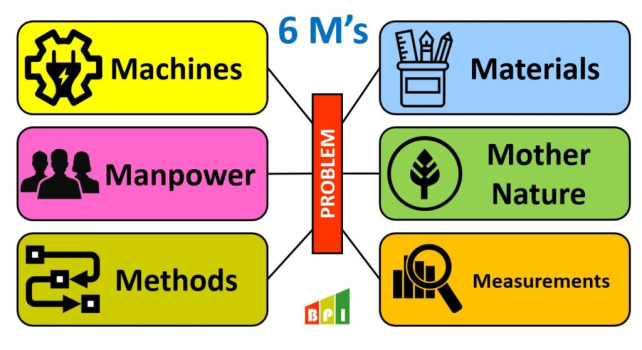
Can you show that graphically?
Sure! It all boils down to raw material and how you use that raw material. The graph is a variant of the 6 M's of Management. Where material is the nature of the DNA and everything else is nurture.

Imagine Napoleon being cloned. He has all the material but because of his environment, perhaps he focuses is manpower (his will) into areas other than the military? Maybe he's like Elon Musk in business. Maybe he's obsessed with finding the cure of what killed his father. Maybe he finds this time has no challenges worthy and he succumbs to hedonism.

1767871656063.png
 
  • Like
Reactions: Stumpmaster

Taken

Well-Known Member
Feb 6, 2018
29,996
15,757
113
United States
Faith
Christian
Country
United States
Nature… Gods Blessings for ManKind’s Discoveries.

Discoveries… Trials, Errors, broadly called Sciences.

Use for Good…Use for Evil…
ManKINDS FREEWILL Options.

Necessity… Gods super natural (Spiritual) involvement, relationships WITH manKIND or (Gods Offering) IN manKind.

ManKINDS FREEWILL Options, to Accept or Reject.

Philosophers… Focused Thinkers, Sharing Thoughts, (for Good or Evil)… Rather than Examples / Doers.

Glory to God,
Taken
 
  • Like
Reactions: Wrangler

Wrangler

Well-Known Member
Feb 14, 2021
20,732
8,988
113
57
Shining City on a Hill
Faith
Christian
Country
United States
Gender
Male
Nature… Gods Blessings for ManKind’s Discoveries.
Nature is also expressed as God given talent.

While its great to possess talent, it's what you do with it that counts. One could have the raw material to make an atomic bomb but use it as a paper weight. Is one even aware that it could be used for an atomic bomb? Or atomic power? Obviously, you need raw material AND mining the material (nurturing) in terms of optimum use. Is that in the form of atomic energy or atomic bombs? The necessity dictates.
 
  • Like
Reactions: Taken

Stumpmaster

Well-Known Member
Apr 5, 2009
2,745
1,782
113
71
Hamilton, New Zealand
Faith
Christian
Country
New Zealand
Gender
Male
Sure! It all boils down to raw material and how you use that raw material. The graph is a variant of the 6 M's of Management. Where material is the nature of the DNA and everything else is nurture.

Imagine Napoleon being cloned. He has all the material but because of his environment, perhaps he focuses is manpower (his will) into areas other than the military? Maybe he's like Elon Musk in business. Maybe he's obsessed with finding the cure of what killed his father. Maybe he finds this time has no challenges worthy and he succumbs to hedonism.

View attachment 77244
Clever. I enjoy that sort of presentation.

Some further observations:
1767904625048.png

⛓ The Convergence at the Cross: Nature, Nurture, Necessity​


In the beginning was Nature


God formed man from the dust of the ground (Genesis 2:7)—earthbound, organic, bearing the image of the Creator. Nature was not random; it was intentional, infused with divine breath. The trees, the rivers, the stars—they whispered of God's eternal power and divine nature (Romans 1:20). Yet even in Eden, nature alone could not sustain righteousness. The serpent spoke satanically, and the fall began.

Then came Nurture


God walked with Adam in the cool of the day (Genesis 3:8), nurturing relationship, instruction, and covenant. Through Abraham, Moses, and the prophets, He nurtured a people—guiding, correcting, feeding them with manna and law. The nurture of God was not pampering; it was discipline, love, and promise. “As a father disciplines the son he delights in” (Proverbs 3:12), so the Lord shaped Israel.

And Necessity entered


The law revealed sin, and sin demanded justice. Blood was required—not as cruelty, but as necessity. “Without the shedding of blood there is no forgiveness” (Hebrews 9:22). The sacrificial system pointed forward, groaning under the weight of necessity. Creation, covenant, and conscience all cried out for resolution.

✝️ The Cross: Where All Three Meet​


At Calvary, the intersection was complete.

  • Nature: Christ, fully human, born of a woman, flesh and blood—He bore our nature. “The Word became flesh and dwelt among us” (John 1:14).
  • Nurture: He grew in wisdom and stature, nurtured by Mary, Joseph, and the Father’s voice. “This is my beloved Son, in whom I am well pleased” (Matthew 3:17).
  • Necessity: He had to die. “It was necessary that the Christ should suffer and rise from the dead” (Luke 24:46). Not optional. Not tragic. Necessary.

The Cross is not merely a symbol of suffering—it is the almond-shaped center of divine convergence. Nature is redeemed, nurture fulfilled, necessity satisfied.

The Shared Qualities at the Cross​


QualityNatureNurtureNecessity
OriginCreated by GodShaped by GodRequired by God
PurposeTo reflect His imageTo form His peopleTo fulfill His justice
FulfillmentIn Christ’s incarnationIn Christ’s obedienceIn Christ’s sacrifice
OutcomeResurrection lifeDiscipled heartsEternal redemption

️ Final Word​


The Cross is not the end of the story—it is the hinge. From it flows resurrection, Pentecost, and the New Creation. Nature is reborn, nurture becomes indwelling Spirit, and necessity transforms into eternal grace.
 

Wrangler

Well-Known Member
Feb 14, 2021
20,732
8,988
113
57
Shining City on a Hill
Faith
Christian
Country
United States
Gender
Male
In the beginning was Nature

And Necessity entered
This is contrived. The greatest necessity everyone overlooks is why God made Creation. Necessity came first.

Perhaps deists reinforce the idea that God does not need anything. If this were true, he would not be the First Cause. Creation must have satisfied a need because there is otherwise, no reason to do it. Creators need to create or they are not much of a creator, are they?
 

Stumpmaster

Well-Known Member
Apr 5, 2009
2,745
1,782
113
71
Hamilton, New Zealand
Faith
Christian
Country
New Zealand
Gender
Male
Creation must have satisfied a need because there is otherwise, no reason to do it.
Your statement sounds philosophical, but the moment you test it against the biblical storyline, it collapses pretty quickly. And that’s actually interesting, because it reveals two very different ways of imagining God.

Does the Bible teach that God created because He “needed” something?​


✨ Short answer​


No. In fact, the Bible consistently teaches the opposite: God did not create out of need, lack, deficiency, loneliness, or compulsion.


Your view, @Wrangler, applies logic that is Aristotelian (cause → effect → purpose), not biblical.

What Scripture actually says​

1. God is self‑sufficient and lacks nothing

  • “If I were hungry, I would not tell you, for the world is mine and all that is in it.” — Psalm 50:12
  • “Nor is he served by human hands, as though he needed anything.” — Acts 17:25
These passages explicitly reject the idea that God creates or acts because He has unmet needs.

2. Creation is portrayed as an overflow of God’s nature, not a remedy for His lack

  • “In the beginning, God created…” — Genesis 1:1
    No motive is stated. The text simply presents God as sovereignly expressing His will.
  • “Let us make mankind in our image…” — Genesis 1:26
    This is framed as deliberate generosity, not necessity.
  • “You created all things, and by your will they existed and were created.” — Revelation 4:11
    The motive given is will, not need.

3. Theologically, God’s aseity (self-existence) is central

Classical Christian theology—across Protestant, Catholic, and Orthodox traditions—holds that:
  • God is complete in Himself
  • God’s inner life (Father, Son, Spirit) is eternally relational
  • Creation is an act of overflowing goodness, not filling a gap
This is why theologians often say:
“Creation is grace, not necessity.”


So Wrangler, what you are actually doing is applying this human logic angle of instrumental causation:​


“If someone does something, they must have needed to.”

That works for humans.
It does not work for a self-sufficient deity.

It’s a category error—like asking, “What need does a waterfall satisfy by falling?”

@Wrangler, your statement is not heretical or evil; it’s just philosophically narrow and biblically unsupported.

The non-biblical argument that God “desired” something—expression, relationship, glory, etc.—and that desire is a kind of “need” is stretching the word “need” beyond its normal meaning.​


Biblically, the text never frames creation as God solving a problem.

We are free to accept or reject this logic.
The Bible doesn’t force is into the "Creation was a necessity" conclusion, and it certainly doesn’t support it.​


Scripture reveals that Creation is an act of divine freedom, not divine necessity.
 

Wrangler

Well-Known Member
Feb 14, 2021
20,732
8,988
113
57
Shining City on a Hill
Faith
Christian
Country
United States
Gender
Male
Until they create something they are potential creators. God always knows everything, including the juxtaposition of His Creations in Eternity.
Sometimes I question this maxim. In the OT, God says he regrets making mankind. That implies he did not know what a disaster we were going to turn out to be.
 

Wrangler

Well-Known Member
Feb 14, 2021
20,732
8,988
113
57
Shining City on a Hill
Faith
Christian
Country
United States
Gender
Male
Your statement sounds philosophical,
It is, epistemology works. God did not give us a reasoning mind to forego its use.

Scripture reveals that Creation is an act of divine freedom, not divine necessity.
And this does not survive scrutiny. Freedom is a means not an end. All your doing is denying the divine necessity that motivated Creation. Ironic, given the premise of this entire thread.

“In the beginning, God created…” — Genesis 1:1
No motive is stated.

Just because no motive is stated does not mean there is none. I submit there are other passages that give insight to the necessity. When I get time I hope to post them. First, you must accept that necessity cannot be split from the reason to act - even for God.
 

Stumpmaster

Well-Known Member
Apr 5, 2009
2,745
1,782
113
71
Hamilton, New Zealand
Faith
Christian
Country
New Zealand
Gender
Male
God says he regrets making mankind. That implies he did not know what a disaster we were going to turn out to be.
Here the sceptic spirit smuggles in an assumption that regret must mean lack of foreknowledge. That is not a logically necessary connection, so the argument collapses before it even starts.

The fallacy is best described as a false inference from an anthropomorphic premise—more formally:

Category Error / Equivocation on “regret”

The sceptic treats God’s “regret” as if it functions exactly like human regret, which does imply ignorance or miscalculation. But in theology and ancient Near Eastern idiom, “regret” (Hebrew nāḥam) can express:
  • grief
  • sorrow
  • moral displeasure
  • a change in relationship, not a change in knowledge
The sceptic spirit equivocates between human regret (which presupposes lack of foresight) and divine regret (which expresses moral response, not surprise).

Also contains: Non sequitur

Even if God expresses regret, it does not logically follow that He lacked foreknowledge. The conclusion does not follow from the premise.

And a bit of: Strawman

It assumes a simplistic, human-shaped model of divine emotion and then attacks that model rather than the actual theological claim. preachy.

If He doesn't always know everything then He isn't God.
 

Wrangler

Well-Known Member
Feb 14, 2021
20,732
8,988
113
57
Shining City on a Hill
Faith
Christian
Country
United States
Gender
Male
Here the sceptic spirit smuggles in an assumption that regret must mean lack of foreknowledge
LOL.

As if there is any other kind.

That is not a logically necessary connection

It is a definition necessity. That why you have to pretend there is a difference between human regret from an6 other kind.
 
Last edited:

stevesonthebay

Active Member
Feb 4, 2026
175
126
43
66
Scarborough
Faith
Christian
Country
Australia
Gender
Male
My own studies and deliberations have resulted in this framework: which I use with a little AI help, to show how “necessity” becomes the missing third force that makes the whole picture coherent.

Nature – Nurture – Necessity: A Three‑Fold Framework

For decades, the debate has been framed as a tug‑of‑war:
  • Nature → what we are given
  • Nurture → what we receive from environment
But both of these assume a passive subject. They describe inputs, not the internal logic that governs how a person must respond, adapt, or transform.

That’s where my third category enters:

Necessity


Not fate. Not determinism.
Rather: the structural pressures that make certain responses inevitable.

Necessity is the logic of becoming.

It’s the set of constraints, tensions, and demands that force a person to grow, choose, adapt, or break. It’s the “must” that arises from:
  • biology
  • environment
  • responsibility
  • calling
  • suffering
  • opportunity
  • limitation
  • time
Necessity is the crucible in which nature and nurture are interpreted and transformed.
This is a good way to look at things. I have always taken a more holistic view where no aspect of humans or life is completely dominant. A more inter related and reciprical relationship.

I agree that what you tern 'Necessity' is related to human agency and choice and this has been completely under valued in the sciences. We are not passive lumps of flesh acted upon by outside forces. In fact in some ways we are the drivers of our own evolution and reality.

One cavet though. I think nature or nurture can be part of necessity or agency. Such as cultural values and beliefs that are healthy and conducive to life. As opposed to ones that conflict and divide.


Why Necessity Completes the Picture

1. Nature gives potential, but necessity activates it

A seed contains everything it needs to become a tree, but only necessity—gravity, weather, competition for light—forces it to grow upward, deepen roots, and harden its trunk.
There is a process called 'Developmental Plasticity'. This is especially present in plant life. The ability to plants to change their shape to adapt to conditions. For example ferns in well lit climates have thin leaves. Whereas ferns in thick tropical rain forests will have big wide leaves to capture more light.

This seems to be a non genetic adaptation. A natural ability in the cells and tissues to change with changing conditions. When the adaptation persists it is then cemented genetically and passed on.

But I agree primarily there is nature and then there is a living creature whose choices can have an input of how nature works. Or how they live with nature for better or worse. It seems especially for humans we see the necessity but don't act on it. Even doing the opposite.

2. Nurture shapes direction, but necessity shapes resilience

A child may be well‑taught and well‑loved, but necessity—illness, conflict, responsibility, failure—forms character, not just personality.
Do you think in some ways nature is designed to make people resilent if they take it for what it is and not try to skirt around it. I have always thought of Indigenous peoples or early cultures who were built on doing it hard. Sacrifice

3. Necessity reveals agency

Nature and nurture describe what happens to a person.
Necessity describes what a person must do in response.

It’s the arena of choice, pressure, and consequence.
I agree, this is so important and I don't think it is realised enough. It seems material science excluded the subject out of the equation. But in recent times with advancements in understanding the fundemental driving forces. We cannot help but bring the subject and observer back in.

The purely determinist and material explanation is inadequate and its not a case of more time and discoveries. There is a fundemental aspect that entangles the subject into the equation in one way or another.

Theological Resonance: Romans 8 and the Logic of Necessity

Romans 8, notice how Paul frames human formation:
  • Suffering is necessary for glory
  • Groaning is necessary for hope
  • Weakness is necessary for the Spirit’s intercession
  • Conformity to Christ is not optional but necessary for God’s eternal purpose

Paul’s golden chain (foreknown → predestined → called → justified → glorified) is not mechanical determinism. It is necessity woven into grace.
I also think that this golden chain is not independent of each other. In some ways all creation is suffering and aligning with Gods law and order and Christs truth is not only in harmony with God spiritually. But also in nature and in nurture.
Creation itself is subjected to futility “in hope” — a necessity that drives it toward liberation.

In other words:

God uses necessity as the engine of transformation.
And I think its not forced necessity. It is given or revealed in the nature of things and in reasoning and the drive towards life. Yet still and especially for humans theres varying degrees of choice. Or perhaps more a case of 'Will'.

In One Sentence

Nature gives the raw material, nurture gives the shaping influences, but necessity gives the compelling force that turns a life into a story.

Nature – Nurture – Necessity: Three Facets Of One Factor

Nature, Nurture, and Necessity. All three can be distilled to one factor, but only if that factor is defined at the right level of abstraction.


The One Factor Beneath Nature, Nurture, and Necessity


If you zoom out far enough, all three—nature, nurture, necessity—are expressions of a single underlying reality:

⭐ Constraint


Not in the negative sense, but in the structural sense:

Constraint = the set of conditions that shape what a being can become.

All three categories fits inside this one meta‑factor.

1. Nature = Internal Constraint

Nature is the set of intrinsic constraints:
  • genetics
  • temperament
  • biological limits
  • innate capacities
Nature defines what is possible and what is impossible from within.

It is the inner boundary of becoming.

2. Nurture = External Constraint

Nurture is the set of environmental constraints:
  • family
  • culture
  • education
  • trauma
  • opportunity
Nurture defines what is likely or unlikely based on surroundings.

It is the outer boundary of becoming.

3. Necessity = Dynamic Constraint

Necessity is the set of pressures that force movement:
  • responsibility
  • suffering
  • scarcity
  • calling
  • time
  • consequence
Necessity defines what one must do in response to the first two.

It is the active boundary of becoming.

All Three Are Modes of Constraint

If you distill them:
  • Nature = constraint of being
  • Nurture = constraint of context
  • Necessity = constraint of becoming
Together they form a single governing principle:

Constraint shapes formation.


Or, if you prefer a more theological phrasing:

Formation occurs within God‑given limits.


This is where Romans 8 resonates again: creation, humanity, and history all operate within divinely set constraints that drive them toward a predetermined glory.

A Spiritual Conclusion

Nature, Nurture, and Necessity are all faces of Providence.


Providence sets:
  • what you are (nature)
  • where you are (nurture)
  • what you must face (necessity)
And through these, God shapes who you become.

In One Sentence


Nature, nurture, and necessity all distill into the single factor of constraint — the structured conditions through which a life is formed.
I agree once again. Do you think the "constraint" in life is related to Christs sacrifice spiritually. At the very bottom as to what becomes necessary in life.

As opposed to say the naturalistic idea of survival. It seems that sacrifice in a contradiction for survival. This is always the sticking point that cannot be explained.

Yet it seems that the idea of sacrificimg ones self for the greater good or for others is foundational. This was the basis that hard work and putting off comfort for self for a greater good that built nations. Maybe material consumerism has changed all that.

But certainly I think we cannot dismiss agency and free will choice. Especially humans who really have a good deal of control over what happens. We have seen this played out in our own lived history.