


- Apr 5, 2009
- 2,861
- 1,880
- 113
- 72
- Faith
- Christian
- Country
- New Zealand
- Gender
- Male
Over 7 decades my thoughts have been occupied with the nature - nurture narrative, but on further reflection I have concluded a third party to be involved, namely necessity.
Some of the deepest thinkers in philosophy, theology, and developmental science have immersed themselves in nature - nurture studies, and many academic publications exist as a result.
My own studies and deliberations have resulted in this framework: which I use with a little AI help, to show how “necessity” becomes the missing third force that makes the whole picture coherent.
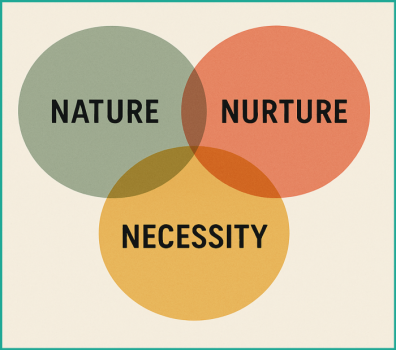
Nature – Nurture – Necessity: A Three‑Fold Framework
For decades, the debate has been framed as a tug‑of‑war:
That’s where my third category enters:
Not fate. Not determinism.
Rather: the structural pressures that make certain responses inevitable.
Necessity is the logic of becoming.
It’s the set of constraints, tensions, and demands that force a person to grow, choose, adapt, or break. It’s the “must” that arises from:
Why Necessity Completes the Picture
Necessity describes what a person must do in response.
It’s the arena of choice, pressure, and consequence.
Theological Resonance: Romans 8 and the Logic of Necessity
Romans 8, notice how Paul frames human formation:
Paul’s golden chain (foreknown → predestined → called → justified → glorified) is not mechanical determinism. It is necessity woven into grace.
Creation itself is subjected to futility “in hope” — a necessity that drives it toward liberation.
In other words:
God uses necessity as the engine of transformation.
In One Sentence
Nature gives the raw material, nurture gives the shaping influences, but necessity gives the compelling force that turns a life into a story.
Nature – Nurture – Necessity: Three Facets Of One Factor
Nature, Nurture, and Necessity. All three can be distilled to one factor, but only if that factor is defined at the right level of abstraction.
If you zoom out far enough, all three—nature, nurture, necessity—are expressions of a single underlying reality:
Not in the negative sense, but in the structural sense:
Constraint = the set of conditions that shape what a being can become.
All three categories fits inside this one meta‑factor.
1. Nature = Internal Constraint
Nature is the set of intrinsic constraints:
It is the inner boundary of becoming.
It is the outer boundary of becoming.
3. Necessity = Dynamic Constraint
Necessity is the set of pressures that force movement:
It is the active boundary of becoming.
All Three Are Modes of Constraint
If you distill them:
Or, if you prefer a more theological phrasing:
This is where Romans 8 resonates again: creation, humanity, and history all operate within divinely set constraints that drive them toward a predetermined glory.
A Spiritual Conclusion
Nature, Nurture, and Necessity are all faces of Providence.
Providence sets:
Nature, nurture, and necessity all distill into the single factor of constraint — the structured conditions through which a life is formed.
Rom 8:18-30 For I consider that the sufferings of this present time are not worthy to be compared with the glory which shall be revealed in us. (19) For the earnest expectation of the creation eagerly waits for the revealing of the sons of God. (20) For the creation was subjected to futility, not willingly, but because of Him who subjected it in hope; (21) because the creation itself also will be delivered from the bondage of corruption into the glorious liberty of the children of God. (22) For we know that the whole creation groans and labors with birth pangs together until now. (23) Not only that, but we also who have the firstfruits of the Spirit, even we ourselves groan within ourselves, eagerly waiting for the adoption, the redemption of our body. (24) For we were saved in this hope, but hope that is seen is not hope; for why does one still hope for what he sees? (25) But if we hope for what we do not see, we eagerly wait for it with perseverance. (26) Likewise the Spirit also helps in our weaknesses. For we do not know what we should pray for as we ought, but the Spirit Himself makes intercession for us with groanings which cannot be uttered. (27) Now He who searches the hearts knows what the mind of the Spirit is, because He makes intercession for the saints according to the will of God. (28) And we know that all things work together for good to those who love God, to those who are the called according to His purpose. (29) For whom He foreknew, He also predestined to be conformed to the image of His Son, that He might be the firstborn among many brethren. (30) Moreover whom He predestined, these He also called; whom He called, these He also justified; and whom He justified, these He also glorified.
Some of the deepest thinkers in philosophy, theology, and developmental science have immersed themselves in nature - nurture studies, and many academic publications exist as a result.
My own studies and deliberations have resulted in this framework: which I use with a little AI help, to show how “necessity” becomes the missing third force that makes the whole picture coherent.
Nature – Nurture – Necessity: A Three‑Fold Framework
For decades, the debate has been framed as a tug‑of‑war:
- Nature → what we are given
- Nurture → what we receive from environment
That’s where my third category enters:
Necessity
Not fate. Not determinism.
Rather: the structural pressures that make certain responses inevitable.
Necessity is the logic of becoming.
It’s the set of constraints, tensions, and demands that force a person to grow, choose, adapt, or break. It’s the “must” that arises from:
- biology
- environment
- responsibility
- calling
- suffering
- opportunity
- limitation
- time
Why Necessity Completes the Picture
1. Nature gives potential, but necessity activates it
A seed contains everything it needs to become a tree, but only necessity—gravity, weather, competition for light—forces it to grow upward, deepen roots, and harden its trunk.2. Nurture shapes direction, but necessity shapes resilience
A child may be well‑taught and well‑loved, but necessity—illness, conflict, responsibility, failure—forms character, not just personality.3. Necessity reveals agency
Nature and nurture describe what happens to a person.Necessity describes what a person must do in response.
It’s the arena of choice, pressure, and consequence.
Theological Resonance: Romans 8 and the Logic of Necessity
Romans 8, notice how Paul frames human formation:
- Suffering is necessary for glory
- Groaning is necessary for hope
- Weakness is necessary for the Spirit’s intercession
- Conformity to Christ is not optional but necessary for God’s eternal purpose
Paul’s golden chain (foreknown → predestined → called → justified → glorified) is not mechanical determinism. It is necessity woven into grace.
Creation itself is subjected to futility “in hope” — a necessity that drives it toward liberation.
In other words:
God uses necessity as the engine of transformation.
In One Sentence
Nature gives the raw material, nurture gives the shaping influences, but necessity gives the compelling force that turns a life into a story.
Nature – Nurture – Necessity: Three Facets Of One Factor
Nature, Nurture, and Necessity. All three can be distilled to one factor, but only if that factor is defined at the right level of abstraction.
The One Factor Beneath Nature, Nurture, and Necessity
If you zoom out far enough, all three—nature, nurture, necessity—are expressions of a single underlying reality:
 Constraint
Not in the negative sense, but in the structural sense:
Constraint = the set of conditions that shape what a being can become.
All three categories fits inside this one meta‑factor.
1. Nature = Internal Constraint
Nature is the set of intrinsic constraints:
- genetics
- temperament
- biological limits
- innate capacities
It is the inner boundary of becoming.
2. Nurture = External Constraint
Nurture is the set of environmental constraints:- family
- culture
- education
- trauma
- opportunity
It is the outer boundary of becoming.
3. Necessity = Dynamic Constraint
Necessity is the set of pressures that force movement:
- responsibility
- suffering
- scarcity
- calling
- time
- consequence
It is the active boundary of becoming.
All Three Are Modes of Constraint
If you distill them:
- Nature = constraint of being
- Nurture = constraint of context
- Necessity = constraint of becoming
Constraint shapes formation.
Or, if you prefer a more theological phrasing:
Formation occurs within God‑given limits.
This is where Romans 8 resonates again: creation, humanity, and history all operate within divinely set constraints that drive them toward a predetermined glory.
A Spiritual Conclusion
Nature, Nurture, and Necessity are all faces of Providence.
Providence sets:
- what you are (nature)
- where you are (nurture)
- what you must face (necessity)
In One Sentence
Nature, nurture, and necessity all distill into the single factor of constraint — the structured conditions through which a life is formed.
Rom 8:18-30 For I consider that the sufferings of this present time are not worthy to be compared with the glory which shall be revealed in us. (19) For the earnest expectation of the creation eagerly waits for the revealing of the sons of God. (20) For the creation was subjected to futility, not willingly, but because of Him who subjected it in hope; (21) because the creation itself also will be delivered from the bondage of corruption into the glorious liberty of the children of God. (22) For we know that the whole creation groans and labors with birth pangs together until now. (23) Not only that, but we also who have the firstfruits of the Spirit, even we ourselves groan within ourselves, eagerly waiting for the adoption, the redemption of our body. (24) For we were saved in this hope, but hope that is seen is not hope; for why does one still hope for what he sees? (25) But if we hope for what we do not see, we eagerly wait for it with perseverance. (26) Likewise the Spirit also helps in our weaknesses. For we do not know what we should pray for as we ought, but the Spirit Himself makes intercession for us with groanings which cannot be uttered. (27) Now He who searches the hearts knows what the mind of the Spirit is, because He makes intercession for the saints according to the will of God. (28) And we know that all things work together for good to those who love God, to those who are the called according to His purpose. (29) For whom He foreknew, He also predestined to be conformed to the image of His Son, that He might be the firstborn among many brethren. (30) Moreover whom He predestined, these He also called; whom He called, these He also justified; and whom He justified, these He also glorified.



 The Cross: Where All Three Meet
 Short answer


